




- Beauty & Personal Care
- Toothpaste Tube Squeezer Market
Toothpaste Tube Squeezer Market Size, Share, and Growth Forecast, 2026 - 2033
Toothpaste Tube Squeezer Market by Product (Manual, Semi-Automatic, Electric), Material & Design (Plastic, Metal, Biodegradable), Sales Channel (Online Retail, Offline Retail), and Regional Analysis for 2026 - 2033

Toothpaste Tube Squeezer Market Share and Trends Analysis
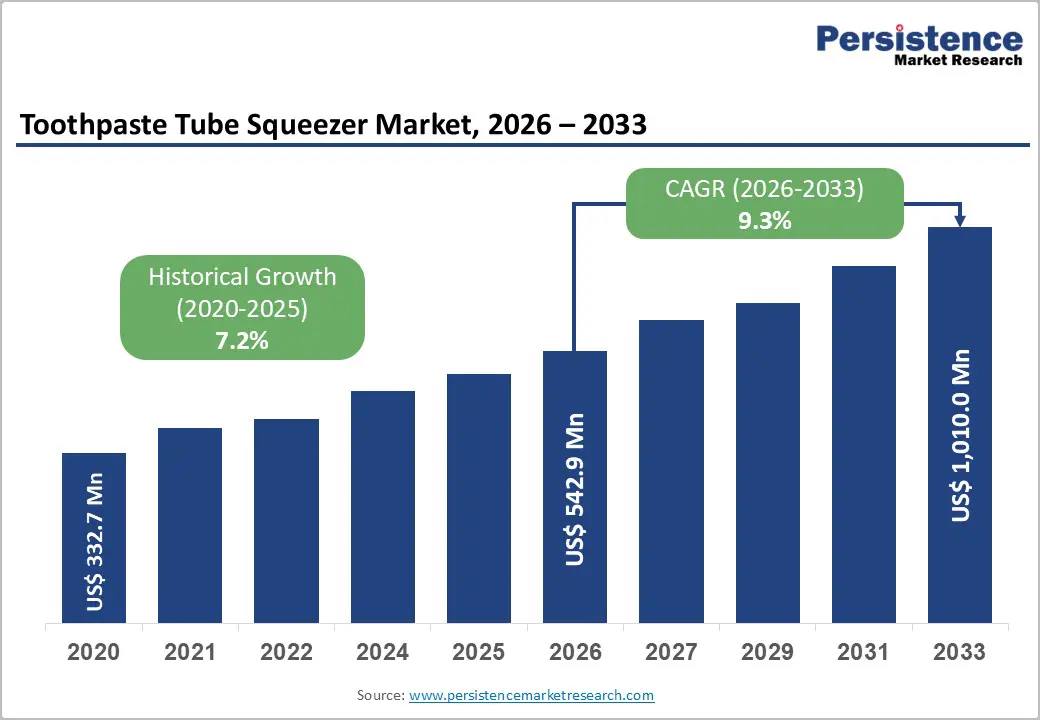
The global toothpaste tube squeezer market size is likely to be valued at US$ 542.9 million in 2026, and is projected to reach US$ 1,010.0 million by 2033, growing at a CAGR of 9.3% during the forecast period of 2026–2033. The expansion of the market is being fueled by multiple converging trends. Rising consumer demand for waste-minimization solutions has become a key driver, as households seek to extract maximum product from toothpaste tubes, reducing both cost and environmental impact. Increasing awareness of efficient product use encourages adoption, particularly among urban and environmentally conscious populations.
Sustainability preferences are influencing purchasing decisions, with consumers favoring recyclable or biodegradable materials. The growing penetration of online retail provides wider access and greater convenience. Innovations in design and materials, such as ergonomic, aesthetically appealing, and multi-functional squeezers, enhance usability and broaden appeal across demographics, while rising per capita toothpaste consumption supports sustained demand.
Key Industry Highlights
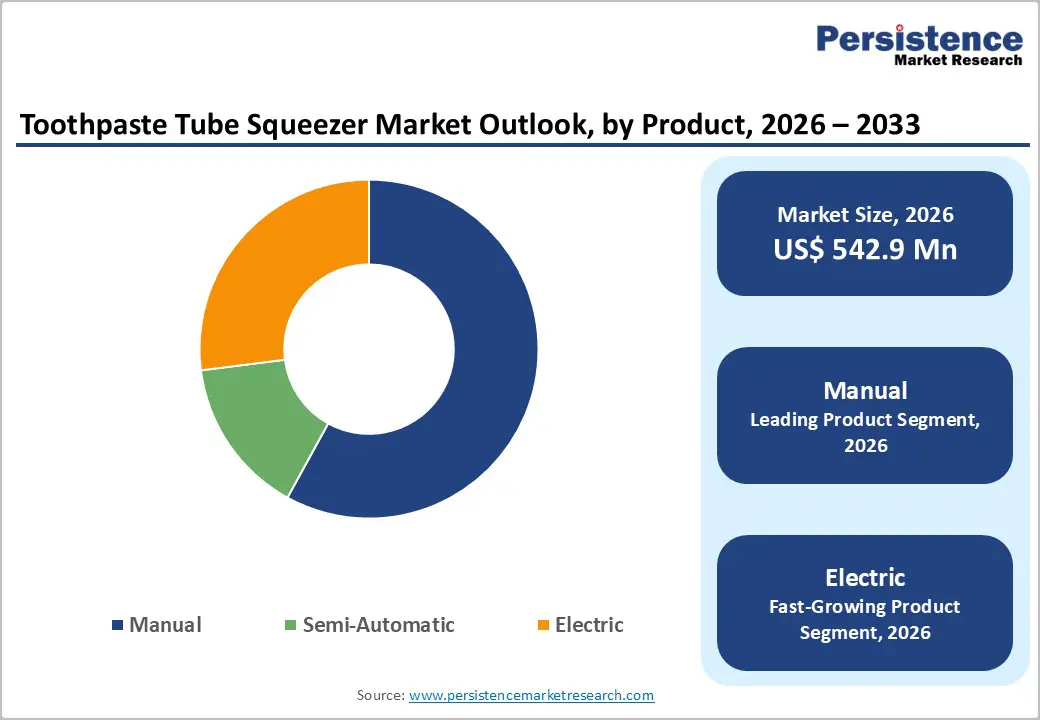
- Dominant Product: Manual squeezers are set to command roughly 58% volume share in 2026, while electric squeezers are likely to grow the fastest at a CAGR of 11.5% through 2033, driven by rising demand for automation and ergonomic designs.
- Leading Material: Plastic is expected to lead with 65% share in 2026, while biodegradable materials are projected to grow the fastest through 2033, supported by increasing consumer preference for eco-friendly and sustainable household products.
- Leading Sales Channel: Offline retail is anticipated to retain the largest revenue share at about 62% in 2026, fueled by growing e-commerce penetration and targeted digital marketing initiatives.
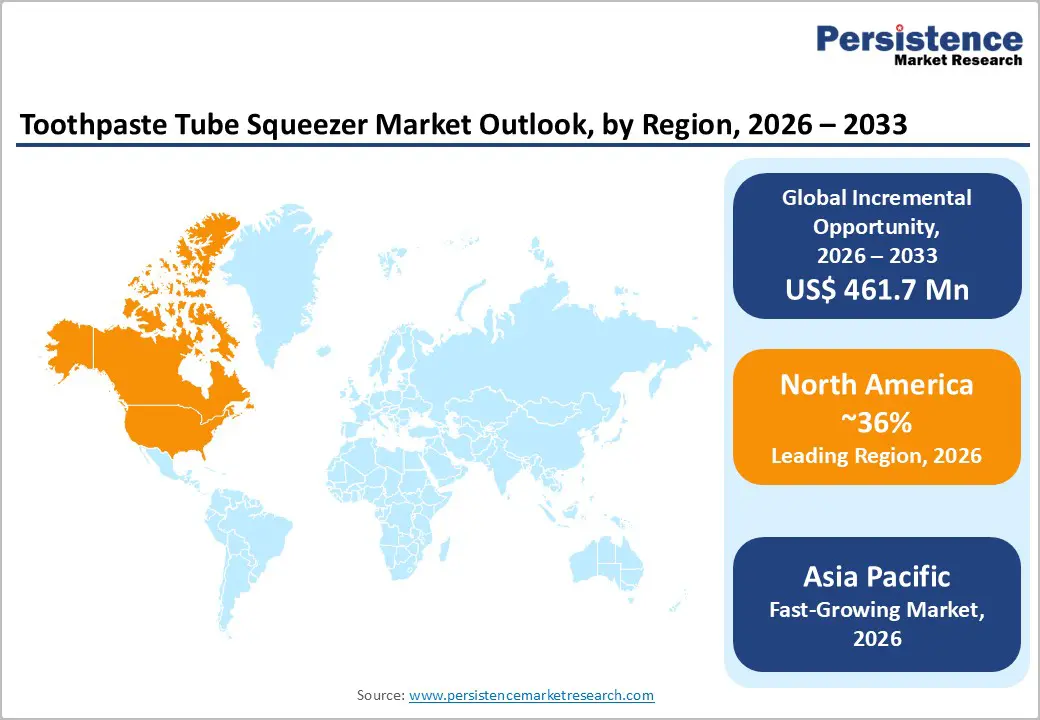
- Regional Leadership: North America is poised to hold an estimated 36% market share in 2026, while Asia Pacific is expected to register the fastest growth at a CAGR of 16% through 2033, driven by rapid urbanization and increasing awareness of personal care efficiency tools.
- Competitive Dynamics: Market players are emphasizing sustainability-driven innovation, premium and ergonomic design evolution, and expansion across digital retail channels, enhancing consumer convenience, brand differentiation, and market penetration.
| Key Insights | Details |
|---|---|
|
Toothpaste Tube Squeezer Market Size (2026E) |
US$ 542.9 Mn |
|
Market Value Forecast (2033F) |
US$ 1,010 Mn |
|
Projected Growth (CAGR 2026 to 2033) |
9.3% |
|
Historical Market Growth (CAGR 2020 to 2025) |
7.2% |
Market Factors - Growth, Barriers, and Opportunity Analysis
Rising Consumer Focus on Efficiency and Waste Reduction
Increasing consumer awareness about product waste drives demand for toothpaste tube squeezers that maximize toothpaste use and reduce leftovers. Many tubes leave 10–15% of product unused, prompting consumers to seek practical solutions that deliver better value per unit. Environmental concerns such as microplastic pollution and landfill waste have been highlighted by major news outlets as pressing sustainability priorities. In November 2025, the European Union (EU) finalized stricter packaging waste rules requiring member states to reduce packaging waste and expand reuse targets. These regulations reinforce the value of tools that help reduce household waste. As a result, regions with strong sustainability norms exhibit higher adoption rates of efficiency-improving squeezers.
Public sector initiatives also complement consumer preferences by promoting resource efficiency and responsible consumption. For example, during Recycle Week 2025, U.K. municipal programs highlighted recyclable everyday accessories, including tools that minimize product loss. Recycling campaigns by government bodies in North America and Western Europe emphasize extending product life and reducing environmental impact. Demographic groups such as millennials, Gen Z, and aging populations increasingly prioritize sustainability in purchasing decisions. Household educational campaigns on efficient use and waste reduction further elevate tool adoption. Together, these policy signals and consumer trends underpin a sustained preference for tools that reduce toothpaste waste.
Growth in E-Commerce Retail Penetration and Sustainable Product Preference
E-commerce continues to reshape how households discover and purchase personal care accessories such as toothpaste tube squeezers. In early 2026, leading retail analytics reported that U.S. online retail penetration reached its highest level in six years, reflecting expanding consumer comfort with digital shopping. Online marketplaces such as Amazon, Walmart.com, and large direct-to-consumer (D2C) platforms enhance product visibility through recommendations and targeted content. This accessibility enables both basic and premium squeezers to reach broader audiences beyond traditional retail footprints. Digital promotions and influencer content also boost discovery and comparative evaluation of new designs and materials. As a result, online retail channels are becoming a powerful growth engine for the market.
In parallel, rising global interest in sustainability strengthens demand for environmentally aligned accessories. Regulatory frameworks, such as the EU packaging reuse mandates enacted in late 2025, encourage products that support waste reduction and sustainable consumption practices. Consumers increasingly seek tools made from recycled or biodegradable materials, and online retail amplifies this preference through easy comparison and transparent product information. Sustainability themes regularly covered by major news outlets further reinforce these purchase drivers. Urban populations and tech-savvy shoppers, especially in North America, Europe, and the Asia Pacific, are leading this shift. Combined, expanding e-commerce reach and sustainability priorities significantly enhance market momentum for toothpaste tube squeezers.
Consumer Perception of Non-Essential Utility
Despite clear practical benefits, many consumers still view toothpaste tube squeezers as optional accessories rather than essential tools. As economic uncertainty persisted into 2026, surveys found that households were prioritizing spending on essentials and value-driven purchases, while discretionary items remained cautious choices for many buyers. Retailers in the U.S. reported that consumers were increasingly seeking deals and avoiding big-ticket or non-critical items, reflecting price sensitivity. This cautious consumer sentiment translates into slower adoption for supplementary household accessories perceived as non-crucial. With financial pressures still top of mind, discretionary categories see more deliberate spending behavior.
Broader consumer trends also show selective purchasing patterns, causing products seen as “nice to have” to lag. Data from a recent industry analysis on consumer behavior indicates that intent to spend on discretionary goods and services remains lower than in essential categories, underscoring cautious budgeting. Shoppers are taking longer to research purchases and are more likely to defer non-urgent items. Economic signals, such as reduced discretionary spending intentions, continue to temper the appetite for accessories that are not plainly necessary. This structural perception of squeezers as non-essentials limits mass market expansion, particularly in economically sensitive markets.
Competitive Substitution by Tube Design Improvements
Toothpaste manufacturers have accelerated packaging innovation that reduces product residue without the need for external tools, creating an indirect substitute for standalone squeezers. In 2025, a major U.K. recycling initiative announced that toothpaste tubes redesigned with high-density polyethylene (HDPE) are now recyclable across many local authorities, signaling widespread adoption of new packaging formats that naturally facilitate complete toothpaste removal. These recyclable tube formats can be squeezed or recycled more easily than older multi-material tubes, reducing the practical need for additional products such as squeezers.
National regulatory changes also support these design shifts. As of March 2026, new recycling regulations in England require all toothpaste tubes to be recyclable, helping consumers dispose of packaging more conveniently and reinforcing the value of improved tube design. This move encourages manufacturers to invest in better packaging technology that inherently addresses leftover waste without external tools. As packaging evolves toward integrated solutions, the demand for separate squeezers may stabilize or even decline in regions where new tube technologies are preferred, acting as a structural restraint on market growth.
Expansion into Emerging Markets with Rising Disposable Incomes
Emerging markets in the Asia Pacific and Latin America are ripe for expansion as household spending and disposable income continue to rise. Growth in these regions is supported by broader consumer adoption of convenience products and increasing interest in efficient daily-use accessories such as tube squeezers. In England, new recycling regulations requiring all toothpaste tubes to be recyclable from 2026 reflect a broader trend toward ecosystem improvements that elevate consumer awareness of tube-related accessories. Such regulatory momentum raises visibility for accessories that complement toothpaste products. Retailers and manufacturers can leverage growing environmental literacy to expand into under-penetrated economies. Rising urban populations and expanding retail access further widen the customer base. Localized marketing that ties efficient product use to sustainability goals can accelerate adoption where incomes are rising.
In addition, governments and civic bodies are increasingly promoting waste-reduction behaviors tied to everyday routines. Standardized recycling practices for toothpaste tubes simplify household waste management and signal a growing ecosystem focus on maximized product use, indirectly supporting demand for complementary tools. As regulatory actions improve recycling infrastructure and consumer education, awareness of efficient tube use benefits grows in tandem. Urban middle classes show stronger acceptance of small-value convenience purchases that improve everyday efficiency. With digital retail penetration increasing, targeted online campaigns can accelerate market entry. These trends position emerging markets as strategic priority zones for volume growth in the toothpaste tube squeezer industry.
Premiumization through Enhanced Design and Strategic Partnerships
Premiumization and design enhancements are becoming key levers for differentiation in the toothpaste tube accessory category. Consumer interest in environmentally aligned products and efficient daily-use tools is rising alongside broader sustainability discourse. This was reflected in 2025 news coverage, noting significant changes in toothpaste tube recyclability and household waste systems, elevating public discourse around efficient tube use and disposal. As consumers become more conscious of how products interact with waste streams, there is greater openness to accessories that help maximize tube usage and minimize residue. Can manufacturers respond with integrated and aesthetically refined squeezers to capture this premium-oriented demand.
Strategic partnerships with oral care brands and large retailers can further strengthen premiumization strategies. Although industry news on direct toothpaste tube squeezer remains sparse, the broader shift toward fully recyclable toothpaste tubes in England underscores the evolving product ecosystem that accessory makers can tap into. Oral care companies engaged in sustainability branding may be receptive to co-branding squeezers as part of their waste-reduction narratives. Retailers can benefit from value-aligned bundles that elevate average transaction values and deepen category penetration. These collaborations can create premium positioning for squeezers and expand visibility through established oral care distribution channels.
Category-wise Analysis
Product Insights
Manual squeezers are poised to command approximately 58% of the toothpaste tube squeezer market revenue share in 2026, supported by broad affordability and universal ease of use. These devices require no power, appeal across demographics, and are priced accessibly, making them the go-to choice in price-sensitive and traditional retail markets. Their physical simplicity allows them to be bundled with oral care kits in supermarkets and pharmacies. This accessibility reinforces their continued dominance, particularly where consumers are cautious about spending on niche accessories. Consumer behaviour tied to efficient usage and minimizing waste further boosts manual usage. Official recycling and packaging reforms also highlight the value of tools that help households extract more product prior to disposal.
Electric toothpaste tube squeezers are expected to register the highest 2026-2033 CAGR of about 11.5%, as consumers increasingly seek automation and convenience in daily routines. Enhanced functionalities such as automatic dispensing and ergonomic designs resonate with urban and tech-savvy buyers in developed markets. Integration with smart bathroom suites and digital retail showcases accelerate interest, especially for premium and novelty purchases. These products are aided by digital platforms that highlight innovative features and user benefits. Rising awareness of household efficiency and time-saving tools supports broader adoption. Urban households with dual incomes and greater discretionary spending are key adopters, driving electric’s growth trajectory alongside rising e-commerce reach.
Material & Design Insights
Plastic is likely to dominate with roughly 65% of the toothpaste tube squeezer market share in 2026, due to cost-effectiveness, lightweight nature, and ease of manufacturing. Plastic squeezers are widely stocked by both offline and online retailers, reinforcing their accessibility. Their durable performance satisfies core functional needs without premium pricing, making them popular with families, students, and price-conscious buyers alike. The shift towards recyclable plastic toothpaste tubes, now technically accepted for kerbside recycling across parts of the U.K., reinforces plastic’s utility and end-of-life relevance. As major brands and local authorities promote plastic tube recycling nationwide, awareness of the sustainability of plastic accessories also improves. This shift indirectly supports continued preference for plastic squeezers due to improved life-cycle perceptions.
Biodegradable squeezer materials are set to be the fastest-growing segment, projected at a CAGR of 13.8% through 2033, as eco-conscious consumers increasingly prioritize circularity. Advances in recyclable packaging, such as fully recyclable mono-material HDPE toothpaste tubes, have raised overall sustainability expectations in the oral care ecosystem. Consumers exposed to programs such as the Recycle Week 2025 initiative, where toothpaste tubes became recyclable nationwide, are more receptive to accessories that align with ecological goals. Biodegradable squeezers resonate particularly in Western Europe and North America, where environmental policy and consumer activism converge. As consumers increasingly seek reduced environmental impact, demand for premium, sustainable designs rises. Manufacturers emphasize certified compostable polymers and robust design aesthetics to appeal to this segment.
Regional Insights
North America Toothpaste Tube Squeezer Market Trends
North America holds the largest regional share at approximately 36% in 2026, with the U.S. leading in the consumption of toothpaste tube squeezers due to high interest in waste reduction and household convenience tools. Consumers increasingly seek accessories that complement sustainability trends in product use. In 2025, several U.S. recycling initiatives promoted recycle-ready oral care packaging, including HDPE recyclable toothpaste tubes, supporting tools that maximize tube evacuation. Strong e-commerce infrastructure accelerates visibility and acquisition of both manual and premium electric squeezers. Canada shows a strong preference for eco-oriented designs, while Mexico’s growing middle class supports moderate growth. Retail networks, including mass merchants and pharmacies, reinforce market penetration through physical and digital touchpoints.
Primary growth drivers include sustainability awareness, mature logistics, and established retail networks that help introduce innovations rapidly. Regulatory focus on recyclable materials indirectly supports premium squeezers. Materials recovery facilities are adapting to new recyclable packaging streams, encouraging household engagement. Online marketplaces enable promotions and product education for efficient tube use, boosting repeat purchases. Urban and suburban populations demonstrate higher adoption of convenience-focused accessories. Investment opportunities exist in ergonomic designs and bundled eco-friendly oral care kits that resonate with conscious consumers.
Europe Toothpaste Tube Squeezer Market Trends
Europe has a strong presence in the global market for toothpaste tube squeezers, headlined by Germany, the U.K., France, and Spain, where environmental consciousness and disposable incomes support demand for both standard and premium squeezers. In England, regulations now require all toothpaste tubes to be recyclable, strengthening demand for tools that help extract product before disposal. Harmonized EU efforts to adopt mono-material recycling streams bolster consumer and manufacturer attention on waste reduction. European consumers prefer eco-certified accessories aligned with circular economy principles. Strong offline distribution is complemented by advanced e-commerce networks. Retail campaigns and promotions reinforce the adoption of sustainable designs.
Environmental directives and extended producer responsibility laws intensify focus on sustainable material use across packaging and adjunct products. Awareness of recyclable packaging innovations encourages purchases of complementary efficiency tools. France and the U.K. show high demand for ergonomic, sustainable designs, while Spain’s urban regions respond to eco-focused retail campaigns. Buyers invest in premium offerings that align with ethical consumption. Manufacturers that integrate recycled materials and obtain certifications gain a competitive advantage. Partnerships with retailers and oral care brands strengthen product relevance across diversified consumers.
Asia Pacific Toothpaste Tube Squeezer Market Trends
Asia Pacific is anticipated to be the fastest-growing regional market for toothpaste tube squeezers with an estimated CAGR of 16% through 2033, driven by large populations, rising incomes, and growing acceptance of personal care accessories such as toothpaste tube squeezers. Urban centers in China and India lead adoption, supported by hygiene awareness and e-commerce infrastructure. In Hong Kong, Colgate and Watsons expanded a toothpaste tube recycling take-back programme, enabling consumers to return empty tubes for recycling and upcycling, highlighting regional sustainability focus. Japan’s consumers prefer premium, innovative designs. The ASEAN market contributes via expanding online retail reach and rising middle-income segments.
The growth drivers include rising personal care expenditure, awareness of product efficiency, and digital retail reach, supporting niche product discovery. Local governments and waste programmes emphasize recyclable oral care packaging, encouraging accessory adoption. Domestic manufacturing policies reduce costs and improve distribution. Competition involves global brands and local manufacturers vying on pricing, design, and reach. Partnerships with e-commerce platforms and bundled toothpaste kits boost scalable adoption. As sustainability awareness rises, consumers increasingly value tools that reduce waste and maximize product use.
Competitive Landscape
The global toothpaste tube squeezer market structure is moderately consolidated, with leading players such as OXO, Reachers, Colgate-Palmolive, Pigeon India, and Joseph Joseph controlling a substantial portion of market revenue. These established companies leverage strong brand recognition, extensive distribution networks, and product innovation capabilities to deliver both manual and premium electric squeezers. They continue to invest in ergonomic design improvements, sustainable and biodegradable materials, and digital retail channels to enhance usability, meet evolving consumer expectations, and maintain competitive advantage. Innovation in multi-tube and smart designs strengthens their product portfolios.
Regional and niche players, including Braun, Tommee Tippee, and local manufacturers in Asia, focus on specific consumer segments, price-sensitive markets, or high-end urban households. While competition from toothpaste tube design innovations and cost-sensitive substitutes limits some growth, the rising interest in sustainability, convenience, and premium aesthetics creates opportunities for differentiation. Partnerships with e-commerce platforms and co-branding with toothpaste and household care brands are increasingly employed to strengthen market presence. Market consolidation is expected to continue as leading players expand through acquisitions, strategic collaborations, and targeted product launches in 2025–2026.
Key Industry Developments
- In October 2025, West Sussex County Council expanded recycling options by allowing residents to recycle items such as toothpaste tubes at home and coffee pods at dedicated recycling centres. The initiative aims to reduce household waste, improve recycling rates, and support environmental sustainability through easier access and public awareness efforts.
Companies Covered in Toothpaste Tube Squeezer Market
- Naike Group
- XYKEEY
- GMS Rehabilitation
- Osun Life
- Big Squeeze
- EZ SQUEEZE
- Smart House
- Mosuch
- Jinjiang Naike EcoTechnology
- Fujian Singyee Group
Frequently Asked Questions
The global toothpaste tube squeezer market is projected to reach US$ 542.9 million in 2026.
Rising consumer demand for waste reduction and household convenience is driving the market.
The market is poised to witness a CAGR of 9.3% from 2026 to 2033.
Emerging markets, premium and smart designs, and partnerships with oral care brands are opening strong market opportunities.
Some of the key market players include OXO, Reachers, Colgate-Palmolive, Pigeon India, Joseph Joseph, Braun, and Tommee Tippee.


