Tinned Fish Market Size, Share, and Growth Forecast for 2025 - 2032

Tinned Fish Market by Type (Mackerel, Salmon, Sardines, Tuna), by Distribution Channel (Supermarkets/Hypermarkets, Convenience Stores, Online Retail Channels), and Regional Analysis

ID: PMRREP33382
Calendar

June 2025

250 Pages

Author : Amol Patil

Tinned Fish Market Size and Share Analysis

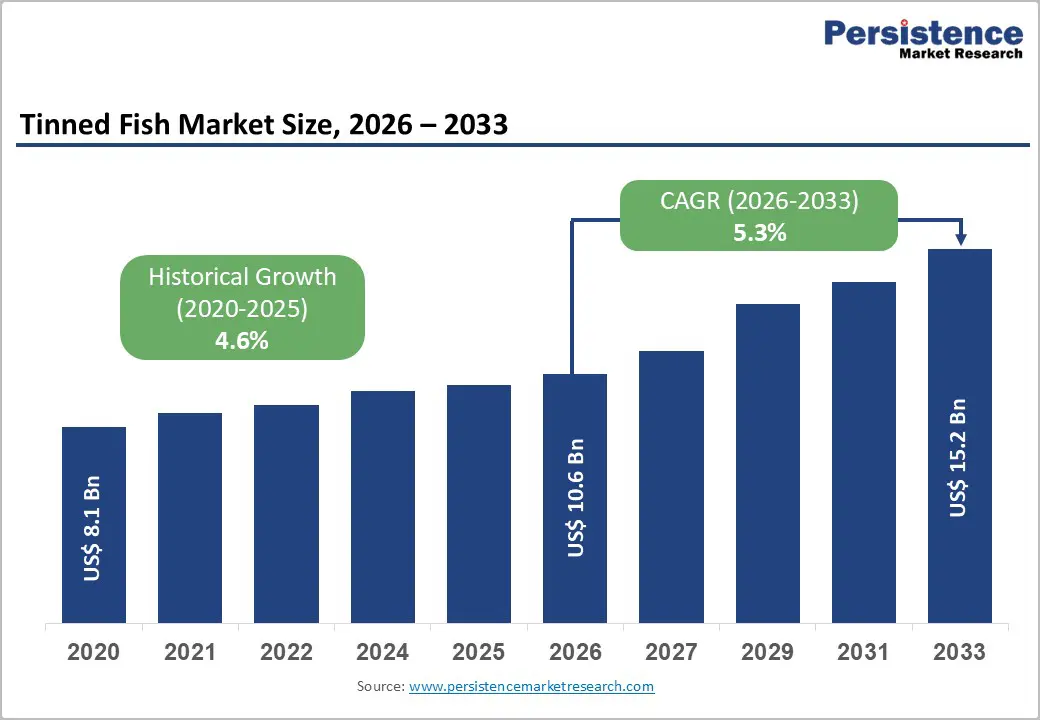
Newly-released Tinned Fish Market analysis report by Persistence Market Research reveals that global sales of the market in 2024 were held at US$ 9.7 Billion. With a projected CAGR of 5.7% from 2025 to 2032, the market is expected to reach a US$ 14.8 Billion valuation by the end of the forecast period.

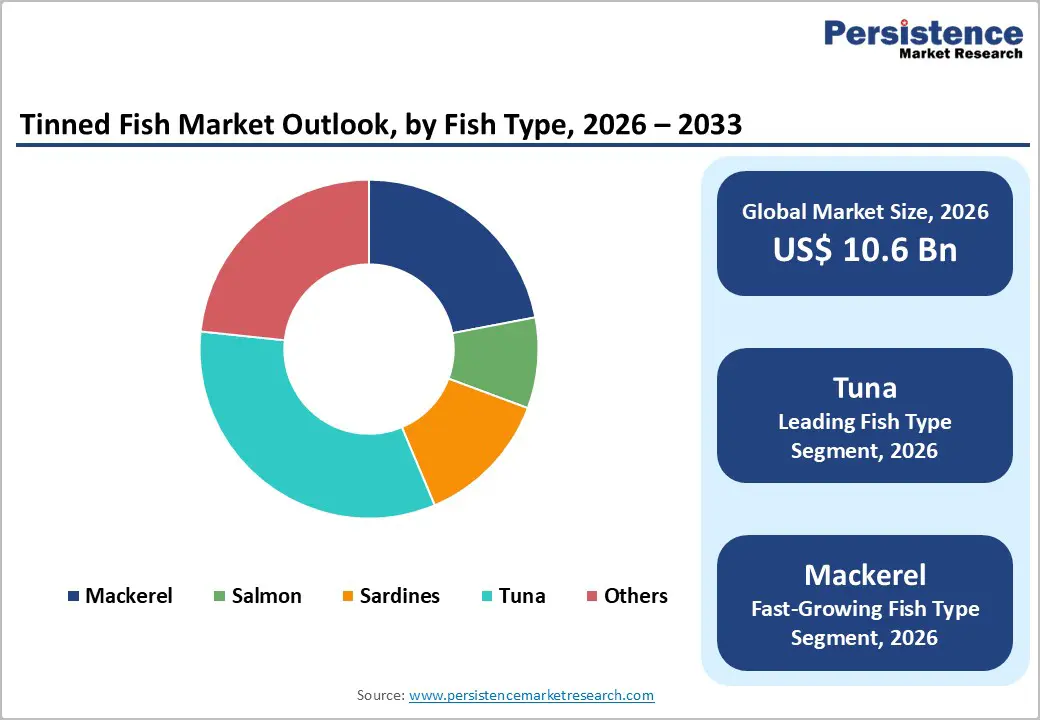
Tuna-tinned fish is expected to be the significant revenue-generating type in the market and is projected to grow at a CAGR of over 5.4% from 2025 to 2032. Supermarkets/Hypermarkets are expected to be the prominent revenue-generating distribution channel in the market, which is projected to grow at a CAGR of over 5% from 2025 to 2032.

Attributes Details
Market Size (2025) US$ 10.1 Billion
Market Size (2032) US$ 14.8 Billion
Global Tinned Fish Market CAGR (2025 to 2032) 5.7%
United States Tinned Fish Market CAGR (2025 to 2032) 4.6%
Key Companies Covered
  • Natural Sea
  • Crown Prince, Inc.
  • Roland Foods, LLC.
  • Bumble Bee Foods, LLC.
  • Chicken of the Sea
  • John West
  • Karavela
  • Wild Planet
  • King Oscar
  • Bar Harbor

Revenue of the Tinned Fish Market from 2019 to 2024 Compared to Demand Outlook from 2025 to 2032

As per the Market research by Persistence Market Research - a market research and competitive intelligence provider, historically, from 2019 to 2024, the market value increased at around 3.6% CAGR. With an absolute dollar opportunity of US$ 7.3 Billion, the market is projected to reach a US$ 17.2 Billion valuation by 2032.

What key factors are influencing the Tinned Fish Market's expansion?

The key factors that are influencing the market are the shifting preference of people from traditional food to ready-to-eat food, which has enabled the production of high-quality tinned fish products.

Tinned fish is often considered an easy and healthy food option as it provides omega-3 fatty acid which is good for heart and brain health, and prevents blood clots in the arteries. It is a rich source of selenium that helps to prevent the adverse effects caused by mercury. In 2018, it was recorded that household consumption of tinned fish reached around 727 thousand tons.

The reasons behind fish consumption growth are urbanization and the growing population. Global consumption is annually increasing at a rate of 3.1%, which is higher among other protein products obtained from animals like meat and milk. In 2022, the total fish consumption volume was about 185 billion kilograms, which grew by around 7 thousand tons from 2021.

Tinned food is processed food that is preserved for a long period of time by packing it in containers such as tin cans and steel. Food contamination is a key concern because of the corrosive property of tin cans, which leads to bisphenol-A (BPA) formation. To deal with this problem, can manufacturers Institute came up with a solution of producing tin with polyester and acrylic linings. Such advances in technology have made it possible to produce high-quality tinned fish products that retain their flavor, freshness, and nutritional value. These technological advancements in the canning industry are likely to fuel the market growth worldwide.

Which Region is projected to offer the Largest Tinned Fish Opportunity?

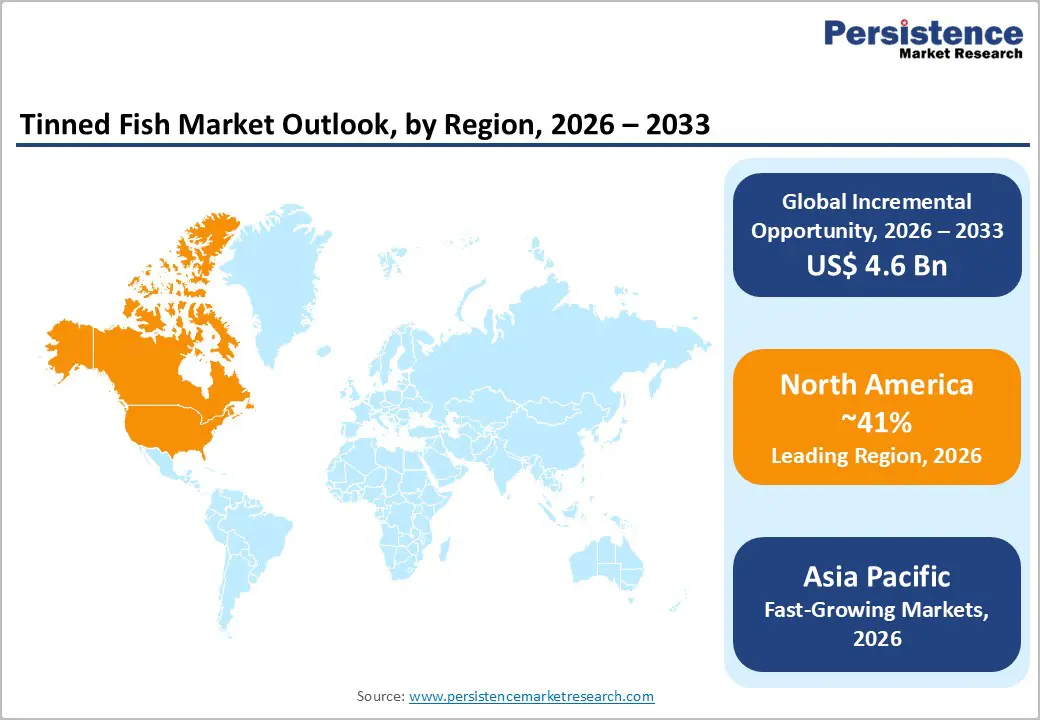
Europe accounted for a market size of US$ 3.8 Billion in 2023 and is estimated to reach a valuation of US$ 3.9 Billion in 2024. The regional market is expected to be worth US$ 6.9 Billion by 2032.

In recent years, Europe has seen a staggering increase in the consumption of tinned fish, particularly after COVID-19. In 2019, Europe imported about 775 thousand tons of tinned fish and exported around 104 thousand tons, of which Spain alone contributes to around 70% of canned tuna. With this figure, it is evident that Europe will play a prominent role in the demand.

Country-wise Analysis:

United States Tinned Fish Market Analysis:

The market in the United States is expected to grow to be worth US$ 3.4 Billion by 2032, with an absolute dollar growth of US$ 1.2 Billion from 2025 to 2032. The market in the country has grown at a CAGR of 2.2% from 2019 to 2024 and is expected to grow at a CAGR of 4.6% from 2025 to 2032.

Americans consider seafood products as a rich source of protein. In 2019, the United States became the second most prominent seafood consumer with a total consumption of 6.3 billion pounds. Around 81% of the total fish caught are consumed by Americans. In 2020, fish and fishery products were imported for worth over US$ 22 billion. Due to the high consumption rate of seafood, the United States can be a prospective market for tinned fish.

United Kingdom Tinned Fish Market Analysis:

In the United Kingdom, the market is expected to grow to be worth US$ 1.3 Billion by 2032, with an absolute dollar growth of US$ 483 Million. The market in the country has grown at a CAGR of 2.5% from 2019 to 2024 and is expected to grow at a CAGR of 4.9% from 2025 to 2032.

The United Kingdom is surrounded by oceans, which leads to an abundant supply of fish in the country. Due to the geographical advantages and the government’s ample amount of funding to the fishing sector, there are numerous market players. In 2022, around US$ 6 million of revenue was generated by 40 companies in the United Kingdom.

China Tinned Fish Market Analysis:

The market in China is expected to grow to be worth US$ 1.5 Billion by 2032, with an absolute dollar growth of US$ 699 Million. The market in the country has grown at a CAGR of 5% from 2019 to 2024 and is expected to grow at a CAGR of 6.7% from 2025 to 2032.

In China, consumption of seafood is significantly high which is over 2 billion kilograms for over 1 billion people. In 2020, the revenue of the country reached US$ 27 billion in terms of processed seafood and fish. Hence, growth in the consumption of fish will directly impact the market growth.

Japan Tinned Fish Market Analysis:

The market in Japan is expected to grow to be worth US$ 1.2 Billion by 2032, with an absolute dollar growth of US$ 489 Million. The market in the country has grown at a CAGR of 2.9% from 2019 to 2024 and is expected to grow at a CAGR of 5.1% from 2025 to 2032.

Salmon and Tuna are the preferable types of fish in Japan. In 2020, it was recorded that the consumption of seafood was around 23 kilograms per person in the country. The production of tinned tuna was more than 22 thousand tons in 2020. Fish is a prominent part of Japanese cuisine thus its consumption rate is also high. With the increasing labor culture, people are more likely to prefer ready-to-cook food items over traditional food. Thus, the demand for tinned fish is expected to see a steady increase in the coming years.

South Korea Tinned Fish Market Analysis:

The South Korean market is expected to grow to be worth US$ 694 Million by 2032, with an absolute dollar growth of US$ 309 Million. The market in the country has grown at a CAGR of 4.3% from 2019 to 2024 and is expected to grow at a CAGR of 6.1% from 2025 to 2032.

Rice has been a prominent part of Korean cuisine for a long period of time. However, in recent years, people are choosing seafood as an alternative to rice, as it is a rich source of proteins and vitamins. In 2021, the consumption of rice was 57 kilograms per person whereas the consumption of seafood was around 66 kilograms. Thus, Korea is going through a big transition phase, which will have a positive impact on the market.

Category-wise Insights

Why demand for Tuna Tinned Fish is projected to Witness Securely Growth?

Tinned-Tuna Fish is projected to witness secure growth as it has grown at a CAGR of 3.5% from 2019 to 2024 and is expected to grow at a CAGR of 5.4% from 2025 to 2032.

According to the United Nations report, Tuna is the most prominently consumed type of fish worldwide. Tuna is a resource of protein and vitamins which is leading to its increased consumption. More than 51% of tuna is used for the production of canned tuna. As per the survey conducted in 2020, the United States consumed over 266 million canned tuna, which accounts for around 31% of the world’s total canned tuna production. Also, around 454 million kilograms of canned tuna are consumed in the United States per year.

Competitive Analysis:

Key players in the Tinned Fish Market Are Natural Sea, Crown Prince, Inc., Roland Foods, LLC., Bumble Bee Foods, LLC., Chicken of the Sea, John West, Karavela, Wild Planet, King Oscar, and Bar Harbor.

A few of the recent developments in the Market are:

  • In February 2023, John West Foods collaborated with ParalympicsGB. The Duration of this collaboration will be of 4 years. For the healthy nutrition concern of athletes, ParalympicsGB partnered with John West Foods.
  • In May 2021, SEALECT Gold premium skinless and boneless mackerel fillets were launched by the Thai Union Group. The 90g cans of mackerel fillets cost only THB 38 and can be purchased in Thailand's top supermarkets, convenience shops, and internet retailers. In response to the demand for skinless, boneless mackerel fillets among Thai customers, SEALECT Gold premium mackerel fillets were introduced.

Segmentation of the Global Tinned Fish Market:

By Type:

  • Mackerel
  • Salmon
  • Sardines
  • Tuna

By Distribution Channel:

  • Supermarkets/Hypermarkets
  • Convenience Stores
  • Online Retail Channels

By Region:

  • North America
  • Latin America
  • Europe
  • Asia Pacific
  • Middle East
  • Africa

Companies Covered in Tinned Fish Market

  • Natural Sea
  • Crown Prince, Inc.
  • Roland Foods, LLC.
  • Bumble Bee Foods, LLC.
  • Chicken of the Sea
  • John West
  • Karavela
  • Wild Planet
  • King Oscar
  • Bar Harbor
Frequently Asked Questions

As of 2025, the global tinned fish market is valued at US$ 10.1 Billion.


The market is expected to reach US$ 14.8 Billion by 2032.


The market is projected to grow at a CAGR of 5.7% from 2025 to 2032.


Tuna-tinned fish is the leading revenue-generating type, with a CAGR of over 5.4%.


Supermarkets/Hypermarkets are the most prominent distribution channel, growing at over 5% CAGR.


Related Reports

1. Executive Summary

    1.1. Global Market Outlook

    1.2. Demand-side Trends

    1.3. Supply-side Trends

    1.4. Analysis and Recommendations

2. Market Overview

    2.1. Market Coverage / Taxonomy

    2.2. Market Definition / Scope / Limitations

3. Market Background

    3.1. Market Dynamics

        3.1.1. Drivers

        3.1.2. Restraints

        3.1.3. Opportunity

        3.1.4. Trends

    3.2. Scenario Forecast

        3.2.1. Demand in Optimistic Scenario

        3.2.2. Demand in Likely Scenario

        3.2.3. Demand in Conservative Scenario

    3.3. Opportunity Map Analysis

    3.4. Product Life Cycle Analysis

    3.5. Supply Chain Analysis

        3.5.1. Supply Side Participants and their Roles

            3.5.1.1. Producers

            3.5.1.2. Mid-Level Participants (Traders/ Agents/ Brokers)

            3.5.1.3. Wholesalers and Distributors

        3.5.2. Value Added and Value Created at Node in the Supply Chain

        3.5.3. List of Raw Material Suppliers

        3.5.4. List of Existing and Potential Buyer’s

    3.6. Investment Feasibility Matrix

    3.7. Value Chain Analysis

        3.7.1. Profit Margin Analysis

        3.7.2. Wholesalers and Distributors

        3.7.3. Retailers

    3.8. PESTLE and Porter’s Analysis

    3.9. Regulatory Landscape

        3.9.1. By Key Regions

        3.9.2. By Key Countries

    3.10. Regional Parent Market Outlook

    3.11. Production and Consumption Statistics

    3.12. Import and Export Statistics

4. Global Tinned Fish Market Analysis 2019-2024 and Forecast, 2025-2032

    4.1. Historical Market Size Value (US$ Million) & Volume (Tons) Analysis, 2019-2024

    4.2. Current and Future Market Size Value (US$ Million) & Volume (Tons) Projections, 2025-2032

        4.2.1. Y-o-Y Growth Trend Analysis

        4.2.2. Absolute $ Opportunity Analysis

5. Global Tinned Fish Market Analysis 2019-2024 and Forecast 2025-2032, By Type

    5.1. Introduction / Key Findings

    5.2. Historical Market Size Value (US$ Million) & Volume (Tons) Analysis By Type, 2019-2024

    5.3. Current and Future Market Size Value (US$ Million) & Volume (Tons) Analysis and Forecast By Type, 2025-2032

        5.3.1. Mackerel

        5.3.2. Salmon

        5.3.3. Sardines

        5.3.4. Tuna

        5.3.5. Others

    5.4. Y-o-Y Growth Trend Analysis By Type, 2019-2024

    5.5. Absolute $ Opportunity Analysis By Type, 2025-2032

6. Global Tinned Fish Market Analysis 2019-2024 and Forecast 2025-2032, By Distibution Channel

    6.1. Introduction / Key Findings

    6.2. Historical Market Size Value (US$ Million) & Volume (Tons) Analysis By Distibution Channel, 2019-2024

    6.3. Current and Future Market Size Value (US$ Million) & Volume (Tons) Analysis and Forecast By Distibution Channel, 2025-2032

        6.3.1. Supermarkets/Hypermarkets

        6.3.2. Convenience Stores

        6.3.3. Online Retail Channels

        6.3.4. Other Distribution Channels

    6.4. Y-o-Y Growth Trend Analysis By Distibution Channel, 2019-2024

    6.5. Absolute $ Opportunity Analysis By Distibution Channel, 2025-2032

7. Global Tinned Fish Market Analysis 2019-2024 and Forecast 2025-2032, By Region

    7.1. Introduction

    7.2. Historical Market Size Value (US$ Million) & Volume (Tons) Analysis By Region, 2019-2024

    7.3. Current Market Size Value (US$ Million) & Volume (Tons) Analysis and Forecast By Region, 2025-2032

        7.3.1. North America

        7.3.2. Latin America

        7.3.3. Europe

        7.3.4. Asia Pacific

        7.3.5. MEA

    7.4. Market Attractiveness Analysis By Region

8. North America Tinned Fish Market Analysis 2019-2024 and Forecast 2025-2032, By Country

    8.1. Historical Market Size Value (US$ Million) & Volume (Tons) Trend Analysis By Market Taxonomy, 2019-2024

    8.2. Market Size Value (US$ Million) & Volume (Tons) Forecast By Market Taxonomy, 2025-2032

        8.2.1. By Country

            8.2.1.1. U.S.

            8.2.1.2. Canada

        8.2.2. By Type

        8.2.3. By Distibution Channel

    8.3. Market Attractiveness Analysis

        8.3.1. By Country

        8.3.2. By Type

        8.3.3. By Distibution Channel

    8.4. Key Takeaways

9. Latin America Tinned Fish Market Analysis 2019-2024 and Forecast 2025-2032, By Country

    9.1. Historical Market Size Value (US$ Million) & Volume (Tons) Trend Analysis By Market Taxonomy, 2019-2024

    9.2. Market Size Value (US$ Million) & Volume (Tons) Forecast By Market Taxonomy, 2025-2032

        9.2.1. By Country

            9.2.1.1. Brazil

            9.2.1.2. Mexico

            9.2.1.3. Rest of Latin America

        9.2.2. By Type

        9.2.3. By Distibution Channel

    9.3. Market Attractiveness Analysis

        9.3.1. By Country

        9.3.2. By Type

        9.3.3. By Distibution Channel

    9.4. Key Takeaways

10. Europe Tinned Fish Market Analysis 2019-2024 and Forecast 2025-2032, By Country

    10.1. Historical Market Size Value (US$ Million) & Volume (Tons) Trend Analysis By Market Taxonomy, 2019-2024

    10.2. Market Size Value (US$ Million) & Volume (Tons) Forecast By Market Taxonomy, 2025-2032

        10.2.1. By Country

            10.2.1.1. Germany

            10.2.1.2. U.K.

            10.2.1.3. France

            10.2.1.4. Spain

            10.2.1.5. Italy

            10.2.1.6. Rest of Europe

        10.2.2. By Type

        10.2.3. By Distibution Channel

    10.3. Market Attractiveness Analysis

        10.3.1. By Country

        10.3.2. By Type

        10.3.3. By Distibution Channel

    10.4. Key Takeaways

11. Asia Pacific Tinned Fish Market Analysis 2019-2024 and Forecast 2025-2032, By Country

    11.1. Historical Market Size Value (US$ Million) & Volume (Tons) Trend Analysis By Market Taxonomy, 2019-2024

    11.2. Market Size Value (US$ Million) & Volume (Tons) Forecast By Market Taxonomy, 2025-2032

        11.2.1. By Country

            11.2.1.1. China

            11.2.1.2. Japan

            11.2.1.3. South Korea

            11.2.1.4. Singapore

            11.2.1.5. Thailand

            11.2.1.6. Indonesia

            11.2.1.7. Australia

            11.2.1.8. New Zealand

            11.2.1.9. Rest of Asia Pacific

        11.2.2. By Type

        11.2.3. By Distibution Channel

    11.3. Market Attractiveness Analysis

        11.3.1. By Country

        11.3.2. By Type

        11.3.3. By Distibution Channel

    11.4. Key Takeaways

12. MEA Tinned Fish Market Analysis 2019-2024 and Forecast 2025-2032, By Country

    12.1. Historical Market Size Value (US$ Million) & Volume (Tons) Trend Analysis By Market Taxonomy, 2019-2024

    12.2. Market Size Value (US$ Million) & Volume (Tons) Forecast By Market Taxonomy, 2025-2032

        12.2.1. By Country

            12.2.1.1. GCC Countries

            12.2.1.2. South Africa

            12.2.1.3. Israel

            12.2.1.4. Rest of MEA

        12.2.2. By Type

        12.2.3. By Distibution Channel

    12.3. Market Attractiveness Analysis

        12.3.1. By Country

        12.3.2. By Type

        12.3.3. By Distibution Channel

    12.4. Key Takeaways

13. Key Countries Tinned Fish Market Analysis

    13.1. U.S.

        13.1.1. Pricing Analysis

        13.1.2. Market Share Analysis, 2024

            13.1.2.1. By Type

            13.1.2.2. By Distibution Channel

    13.2. Canada

        13.2.1. Pricing Analysis

        13.2.2. Market Share Analysis, 2024

            13.2.2.1. By Type

            13.2.2.2. By Distibution Channel

    13.3. Brazil

        13.3.1. Pricing Analysis

        13.3.2. Market Share Analysis, 2024

            13.3.2.1. By Type

            13.3.2.2. By Distibution Channel

    13.4. Mexico

        13.4.1. Pricing Analysis

        13.4.2. Market Share Analysis, 2024

            13.4.2.1. By Type

            13.4.2.2. By Distibution Channel

    13.5. Germany

        13.5.1. Pricing Analysis

        13.5.2. Market Share Analysis, 2024

            13.5.2.1. By Type

            13.5.2.2. By Distibution Channel

    13.6. U.K.

        13.6.1. Pricing Analysis

        13.6.2. Market Share Analysis, 2024

            13.6.2.1. By Type

            13.6.2.2. By Distibution Channel

    13.7. France

        13.7.1. Pricing Analysis

        13.7.2. Market Share Analysis, 2024

            13.7.2.1. By Type

            13.7.2.2. By Distibution Channel

    13.8. Spain

        13.8.1. Pricing Analysis

        13.8.2. Market Share Analysis, 2024

            13.8.2.1. By Type

            13.8.2.2. By Distibution Channel

    13.9. Italy

        13.9.1. Pricing Analysis

        13.9.2. Market Share Analysis, 2024

            13.9.2.1. By Type

            13.9.2.2. By Distibution Channel

    13.10. China

        13.10.1. Pricing Analysis

        13.10.2. Market Share Analysis, 2024

            13.10.2.1. By Type

            13.10.2.2. By Distibution Channel

    13.11. Japan

        13.11.1. Pricing Analysis

        13.11.2. Market Share Analysis, 2024

            13.11.2.1. By Type

            13.11.2.2. By Distibution Channel

    13.12. South Korea

        13.12.1. Pricing Analysis

        13.12.2. Market Share Analysis, 2024

            13.12.2.1. By Type

            13.12.2.2. By Distibution Channel

    13.13. Singapore

        13.13.1. Pricing Analysis

        13.13.2. Market Share Analysis, 2024

            13.13.2.1. By Type

            13.13.2.2. By Distibution Channel

    13.14. Thailand

        13.14.1. Pricing Analysis

        13.14.2. Market Share Analysis, 2024

            13.14.2.1. By Type

            13.14.2.2. By Distibution Channel

    13.15. Indonesia

        13.15.1. Pricing Analysis

        13.15.2. Market Share Analysis, 2024

            13.15.2.1. By Type

            13.15.2.2. By Distibution Channel

    13.16. Australia

        13.16.1. Pricing Analysis

        13.16.2. Market Share Analysis, 2024

            13.16.2.1. By Type

            13.16.2.2. By Distibution Channel

    13.17. New Zealand

        13.17.1. Pricing Analysis

        13.17.2. Market Share Analysis, 2024

            13.17.2.1. By Type

            13.17.2.2. By Distibution Channel

    13.18. GCC Countries

        13.18.1. Pricing Analysis

        13.18.2. Market Share Analysis, 2024

            13.18.2.1. By Type

            13.18.2.2. By Distibution Channel

    13.19. South Africa

        13.19.1. Pricing Analysis

        13.19.2. Market Share Analysis, 2024

            13.19.2.1. By Type

            13.19.2.2. By Distibution Channel

    13.20. Israel

        13.20.1. Pricing Analysis

        13.20.2. Market Share Analysis, 2024

            13.20.2.1. By Type

            13.20.2.2. By Distibution Channel

14. Market Structure Analysis

    14.1. Competition Dashboard

    14.2. Competition Benchmarking

    14.3. Market Share Analysis of Top Players

        14.3.1. By Regional

        14.3.2. By Type

        14.3.3. By Distibution Channel

15. Competition Analysis

    15.1. Competition Deep Dive

        15.1.1. Natural Sea

            15.1.1.1. Overview

            15.1.1.2. Product Portfolio

            15.1.1.3. Profitability by Market Segments

            15.1.1.4. Sales Footprint

            15.1.1.5. Strategy Overview

                15.1.1.5.1. Marketing Strategy

                15.1.1.5.2. Product Strategy

                15.1.1.5.3. Channel Strategy

        15.1.2. Crown Prince, Inc.

            15.1.2.1. Overview

            15.1.2.2. Product Portfolio

            15.1.2.3. Profitability by Market Segments

            15.1.2.4. Sales Footprint

            15.1.2.5. Strategy Overview

                15.1.2.5.1. Marketing Strategy

                15.1.2.5.2. Product Strategy

                15.1.2.5.3. Channel Strategy

        15.1.3. Roland Foods, LLC.

            15.1.3.1. Overview

            15.1.3.2. Product Portfolio

            15.1.3.3. Profitability by Market Segments

            15.1.3.4. Sales Footprint

            15.1.3.5. Strategy Overview

                15.1.3.5.1. Marketing Strategy

                15.1.3.5.2. Product Strategy

                15.1.3.5.3. Channel Strategy

        15.1.4. Bumble Bee Foods, LLC.

            15.1.4.1. Overview

            15.1.4.2. Product Portfolio

            15.1.4.3. Profitability by Market Segments

            15.1.4.4. Sales Footprint

            15.1.4.5. Strategy Overview

                15.1.4.5.1. Marketing Strategy

                15.1.4.5.2. Product Strategy

                15.1.4.5.3. Channel Strategy

        15.1.5. Chicken of the Sea

            15.1.5.1. Overview

            15.1.5.2. Product Portfolio

            15.1.5.3. Profitability by Market Segments

            15.1.5.4. Sales Footprint

            15.1.5.5. Strategy Overview

                15.1.5.5.1. Marketing Strategy

                15.1.5.5.2. Product Strategy

                15.1.5.5.3. Channel Strategy

        15.1.6. John West

            15.1.6.1. Overview

            15.1.6.2. Product Portfolio

            15.1.6.3. Profitability by Market Segments

            15.1.6.4. Sales Footprint

            15.1.6.5. Strategy Overview

                15.1.6.5.1. Marketing Strategy

                15.1.6.5.2. Product Strategy

                15.1.6.5.3. Channel Strategy

        15.1.7. Karavela

            15.1.7.1. Overview

            15.1.7.2. Product Portfolio

            15.1.7.3. Profitability by Market Segments

            15.1.7.4. Sales Footprint

            15.1.7.5. Strategy Overview

                15.1.7.5.1. Marketing Strategy

                15.1.7.5.2. Product Strategy

                15.1.7.5.3. Channel Strategy

        15.1.8. Wild Planet

            15.1.8.1. Overview

            15.1.8.2. Product Portfolio

            15.1.8.3. Profitability by Market Segments

            15.1.8.4. Sales Footprint

            15.1.8.5. Strategy Overview

                15.1.8.5.1. Marketing Strategy

                15.1.8.5.2. Product Strategy

                15.1.8.5.3. Channel Strategy

        15.1.9. King Oscar

            15.1.9.1. Overview

            15.1.9.2. Product Portfolio

            15.1.9.3. Profitability by Market Segments

            15.1.9.4. Sales Footprint

            15.1.9.5. Strategy Overview

                15.1.9.5.1. Marketing Strategy

                15.1.9.5.2. Product Strategy

                15.1.9.5.3. Channel Strategy

        15.1.10. Bar Harbor

            15.1.10.1. Overview

            15.1.10.2. Product Portfolio

            15.1.10.3. Profitability by Market Segments

            15.1.10.4. Sales Footprint

            15.1.10.5. Strategy Overview

                15.1.10.5.1. Marketing Strategy

                15.1.10.5.2. Product Strategy

                15.1.10.5.3. Channel Strategy

16. Assumptions & Acronyms Used

17. Research Methodology

Research Methodology Framework for Market Research Excellence

At Persistence Market Research, we implement a comprehensive, validated, and multi-dimensional approachto market analysis that delivers actionable insights across complex market landscapes. Our methodology combines the analytical rigor of leading consulting firms with innovative research techniques, ensuring robust market assessments that guide strategic decision-making with confidence.

Core Research Philosophy

Our methodology is built on four foundational pillars:

Research Philosophy Image

At Persistence Market Research, our methodology is designed to transcend conventional market studies by combining analytical rigor, multi-source validation, and future-focused insights.

We integrate advanced research frameworks, robust data collection strategies, cutting-edge analytics, and innovative technologies to deliver a 360-degree view of complex markets.

We integrate advanced research frameworks, robust data collection strategies, cutting-edge analytics, and innovative technologies to deliver a 360-degree view of complex markets.

Each stage spanning from strategic scoping and hypothesis-building to competitive intelligence, quality validation, and actionable recommendations is engineered to provide clients with unmatched clarity, precision, and confidence in decision-making.

By embedding innovation and technology at the core, our approach ensures that insights are not only comprehensive but also predictive, empowering businesses to seize opportunities, mitigate risks, and achieve sustainable growth

Research Philosophy Image

Capturing Key Information and Events

During this phase, key research objectives focus on essential information and data points for assessing the market, including:

Research Philosophy Image

TAM-SAM-SOM Framework Implementation

We employ both top-down and bottom-up approaches to ensure accurate market sizing.

Top-Down Market SizingBottom-Up Market Sizing
Universe Definition: Total global/regional market identificationUnit Economics: Average transaction values, purchase frequencies, customer lifecycle
Segmentation Filters: Geographic, demographic, and behavioral constraintsCustomer Segmentation: Detailed buyer persona development and sizing
Market Share Analysis: Competitive landscape assessment and share allocationPenetration Analysis: Market penetration rates by segment and geography
Growth Rate Application: Historical trends and forward-looking growth assumptionsScaling Methodology: Extrapolation techniques with confidence intervals

Validation & Cross-Verification

  • Triangulation: Comparing top-down and bottom-up results for consistency
  • Sensitivity Analysis: Testing key assumptions and parameter variations
  • Peer Benchmarking: Comparison with analogous markets and industry benchmarks
  • Expert Review: External validation through industry specialist consultation

Research Philosophy Image

Forecasting & Projection Modeling

Our proprietary forecasting models incorporate multiple variables and scenarios.

Forecasting Components

  • Historical Trend Analysis: 10-year historical growth patterns and cyclical variations
  • Driver-Based Modeling: Economic indicators, demographic shifts, technology adoption
  • Scenario Planning: Base case, optimistic, and conservative projections
  • Monte Carlo Simulations: Probability-weighted outcomes and risk assessments

Model Validation

  • Back-Testing: Historical accuracy assessment over 3–5-year periods
  • Cross-Validation: Multiple modeling approaches for result comparison
  • External Benchmarking: Comparison with established market forecasts
  • Continuous Calibration: Quarterly model updates based on new data

Comprehensive Data Collection Strategy

Our secondary research phase establishes a robust knowledge base utilizing diverse, credible sources.

Secondary Data Sourcess

  • Industry Publications & Reports
  • Government & Regulatory Data
  • Financial Intelligence (filings & reports)
  • Academic Research & Digital Intelligence

Quality Assurance Protocol

  • Source credibility assessment and publication date validation
  • Data consistency checks across multiple sources
  • Bias identification and neutralization techniques
  • Information gap tracking for primary research prioritization

Research Philosophy Image

Primary Research Excellence

Our primary research methodology employs best-in-class techniques to capture unique market insights.

Quantitative Research Methods

  • Large-Scale Surveys: Statistically representative samples with 95% confidence intervals
  • Survey Methodology: Multi-channel deployment (online, telephone, in-person)
  • Question Architecture and Response Optimization

Qualitative Research Methods

  • Executive Interviews
  • Focus Groups
  • Expert Consultations

Quality Assurance & Validation Framework

Multi-Stage Validation Process

  • Source Verification and Consistency Testing
  • Outlier Detection and Bias Assessment
  • Peer Review Process and External Validation
  • Sensitivity Analysis and Confidence Intervals

Research Philosophy Image

Methodology Validation & Credibility

Our research methodology has been extensively validated through:

  • Academic Partnerships: Collaborations with top-tier business schools and research institutions
  • Client Success Stories: Documented case studies demonstrating research impact and ROI
  • Continuous Benchmarking: Performance comparison with leading global research firms

This comprehensive methodology framework positions Persistence Market Research at the forefront of market intelligence, combining the analytical sophistication of top-tier consulting firms with innovative research techniques. Our approach ensures that every market assessment delivers precise, actionable, and strategically valuable insights that drive business success in competitive market environments.

Ready to unlock your market potential? Contact our research experts to discuss how our validated methodology can transform your strategic decision-making with data-driven market intelligence.

Copyright © 2026 Persistence Market Research. All Rights Reserved

Connect With Us -