




- Nutraceuticals & Functional Foods
- Thyme Extract Market
Thyme Extract Market Size, Share, and Growth Forecast, 2026 - 2033
Thyme Extract Market by Form (Powder, Liquid), Nature (Conventional, Organic), Application (Cosmetics & Personal Care, Pharmaceutical, Food & Beverages, Others), and Regional Analysis for 2026 - 2033

Thyme Extract Market Share and Trends Analysis
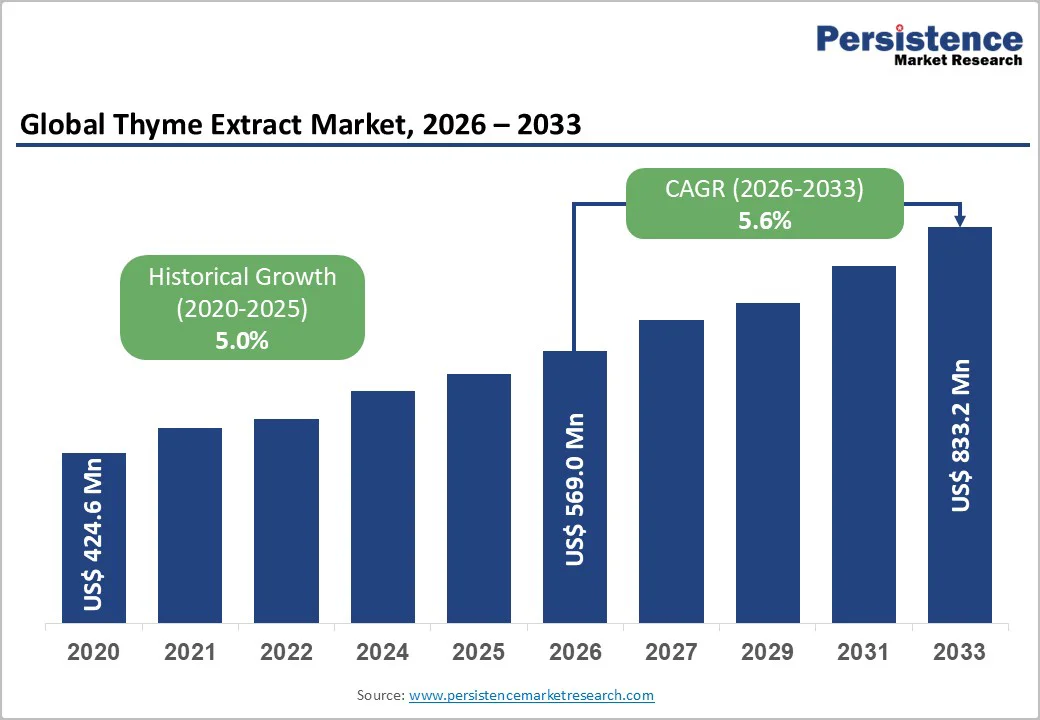
The global thyme extract market size is likely to be valued at US$569 million in 2026, and is projected to reach US$833.2 million by 2033, growing at a CAGR of 5.6% during the forecast period 2026-2033.
Supporting growth factors include rising consumer demand for natural and clean-label ingredients, growing use of thyme extract across food, cosmetics, and pharmaceutical applications, and increasing acceptance of botanical extracts as functional and preservative agents in processed foods and personal-care products. Supply-side improvements in extraction technologies and the expansion of herbal ingredient supply chains further support market expansion.
Key Industry Highlights
- Dominant Form: The liquid form is expected to lead with around 60% market share in 2026, owing to its blendability without additional processing.
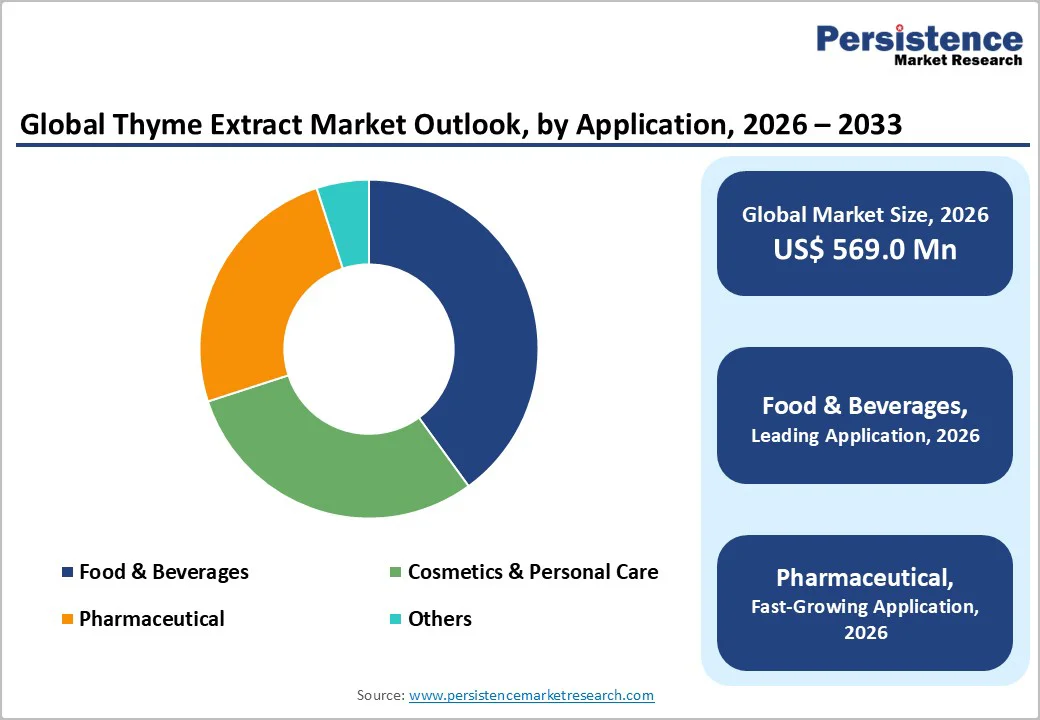
- Leading Application: The food & beverages segment is expected to dominate with an estimated 40% market share in 2026, on account of the widespread use of thyme extract as a natural flavoring agent.
- Fastest-Growing Application: The pharmaceutical segment is projected to grow the fastest, with an approximately 7% CAGR, driven by the deepening focus on preventive health and herbal remedies.
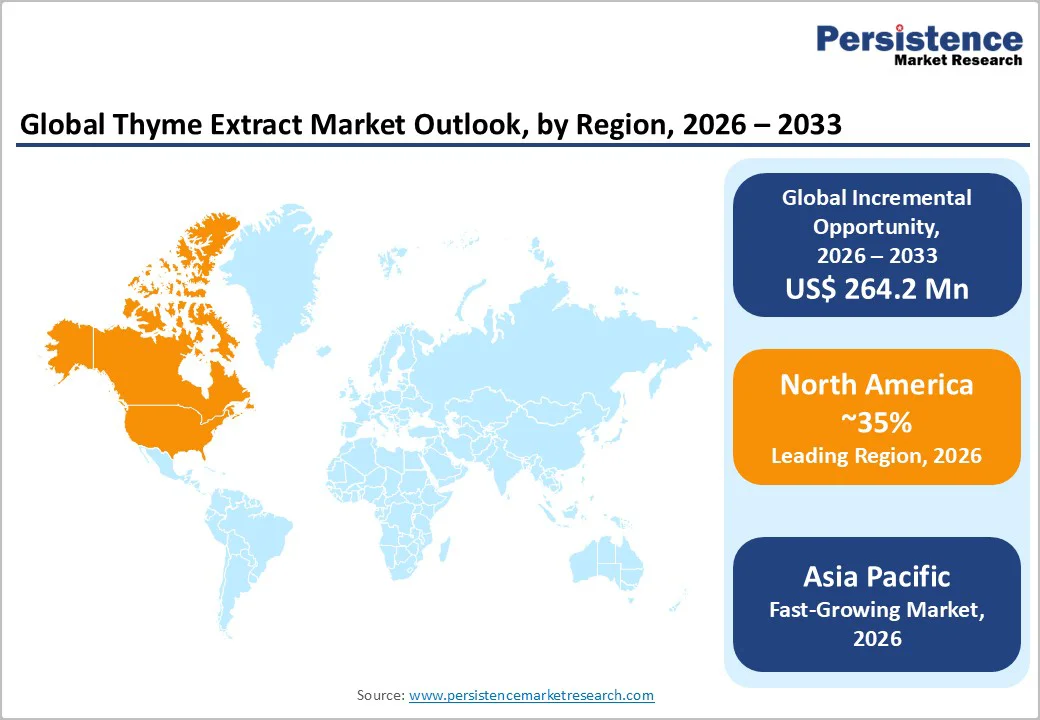
- Leading Region: North America is projected to lead with an approximate 35% market share in 2026, while Europe is likely to remain a major growth contributor through 2033.
- Fastest-Growing Market: Asia Pacific is expected to exhibit the highest growth potential across the 2026-2033 forecast period.
- Key Market Drivers: Rising demand for natural, clean-label ingredients and the strong antimicrobial and antioxidant properties of thyme extract are key growth drivers for the market.
- Notable Developments: The market is witnessing launches of organic-certified thyme extracts, expansion into functional beverages and nutraceutical applications, and rising investments in advanced extraction and standardization technologies.
| Key Insights | Details |
|---|---|
|
Thyme Extract Market Size (2026E) |
US$569 Mn |
|
Market Value Forecast (2033F) |
US$ 833.2 Mn |
|
Projected Growth (CAGR 2025 to 2032) |
5.6 % |
|
Historical Market Growth (CAGR 2020 to 2025) |
5.0 % |
Market Factors- Growth, Barriers, and Opportunity Analysis
Rising Demand for High-Quality Natural & Functional Botanical Ingredients
Growing consumer preference for natural, clean-label, and plant-based products is significantly increasing demand for thyme extract across the food, cosmetics, and nutraceutical sectors. Its role as a natural flavoring, preservative, and wellness ingredient aligns well with reformulation trends that prioritize transparency and minimally processed inputs. For instance, the thyme oil market is showing a clear growth trajectory on the back of a strengthening preference natural, clean-label, and wellness-focused products, with rising adoption in personal care, cosmetics, food & beverage, aromatherapy, and natural preservatives and flavors. As brands shift away from synthetic additives, thyme extract benefits from its strong safety perception and broad compatibility with modern product development needs, supporting steady long-term growth.
At the same time, the functional advantages of thyme extract, particularly its antimicrobial, antioxidant, and anti-inflammatory properties, strengthen its adoption across multiple industries. Improvements in extraction technologies and better standardization practices have enhanced purity and consistency, making the ingredient more reliable for high-spec applications. With higher quality assurance, producers can meet diverse regulatory and performance requirements, enabling wider commercial uptake.
Supply Instability and Competitive Pressure Limiting Consistent Growth
The thyme extract market growth faces structural challenges, driven by its heavy dependence on agricultural production, which exposes supply to fluctuations in weather, harvest cycles, and raw material availability. These variables can trigger cost instability, making it difficult for manufacturers to ensure consistent sourcing and predictable pricing. For industries that require stable input costs, such volatility may reduce confidence in long-term use. As a result, some producers may adopt a cautious procurement strategy or limit thyme extract usage in large-scale formulations where reliability is critical.
Competition from synthetic additives and alternative botanical extracts adds pressure to pricing and market penetration. Synthetic preservatives, flavorings, and antioxidants often offer greater cost efficiency and stable performance, making them attractive in price-sensitive applications. Additionally, a wide array of plant extracts with similar functional benefits increases the likelihood of substitution. This crowded landscape reduces differentiation and can constrain thyme extract suppliers' ability to secure premium positioning.
Widening Acceptance in High-Growth Markets
The accelerating shift toward natural and clean-label ingredients in emerging economies, particularly in the Asia-Pacific region, presents a major expansion opportunity for thyme extract formulations. Rising disposable incomes, growing awareness of botanical wellness products, and rapid growth in processed food and personal-care sectors are driving strong regional demand. Even a small gain in market share within these fast-growing economies can generate significant volume increases. This creates a compelling opportunity for manufacturers to strengthen regional distribution, introduce differentiated product grades, and align offerings with clean-label and natural-preservation trends.
Simultaneously, the broad functionality of thyme extract opens doors to nutraceuticals, therapeutic blends, and functional-food applications, where antioxidants and natural actives are increasingly prioritized. Its relevance in immune support, respiratory wellness, and natural preservation allows companies to tap into rapidly expanding preventive-health segments. As brands reformulate to replace synthetic additives, thyme extract can serve as a versatile ingredient across supplements, beverages, and fortified foods.
Category-wise Analysis
Product Form Insights
The liquid form is likely to lead the market with about 60% share in 2026, supported by its high bioavailability, smooth integration into formulations, and established use across food, beverages, cosmetics, and aromatherapy. Its ability to blend easily without additional processing makes it the preferred choice for manufacturers seeking consistency and sensory performance. The versatility of liquid thyme extract in preservation, flavoring, and topical applications strengthens its dominance across multiple industries. The segment also benefits from its long-standing acceptance in essential oil-based products. Its widespread adoption among both small and large producers ensures steady demand and stable commercial traction.
The powdered form is projected to be the fastest-growing, with an 8% CAGR through 2033. This demand is driven by its longer shelf life, reduced storage challenges, and enhanced stability for nutraceutical and dietary supplement applications. Powder formats enable controlled dosing, making them ideal for functional foods and tablets. Their transport efficiency and higher formulation precision appeal to global manufacturers aiming for cost-effective operations. As clean-label demand rises, powdered variants offer convenient integration into health-oriented product lines. This places the segment firmly on a high-growth trajectory across emerging and premium applications.
Product Nature Insights
Conventional thyme extract is expected to represent the largest share of the market in 2026, due to the scale of traditional herb cultivation, established farming networks, and cost-efficient production. Its broad availability supports stable supply for high-volume users in food, flavoring, and personal-care applications. The segment’s affordability enables manufacturers to maintain competitive pricing, particularly in mass-market products. Conventional sourcing ensures predictable output, making it suitable for processors that depend on consistent ingredient flow. This foundation maintains its dominance as the preferred option for bulk procurement.
The organic segment is projected to be the fastest-growing through 2033, supported by rising interest in clean-label, sustainably sourced, and chemical-free ingredients. Organic thyme extract appeals strongly to premium brands targeting natural wellness, plant-based diets, and eco-conscious consumers. Growing regulatory emphasis on transparency amplifies demand for certified organic inputs. Manufacturers launching organic-certified variants gain access to higher-margin segments, especially in nutraceuticals and skincare. Although production volumes remain lower than conventional, expanding organic farming capacity and consumer willingness to pay a premium drive rapid adoption.
Application Insights
The food & beverage segment is likely to lead the thyme extract market, accounting for roughly 40% of revenue share in 2026, reflecting its widespread use as a natural flavoring and clean-label preservative. Rising demand for botanical ingredients in sauces, drinks, snacks, and functional foods reinforces their dominance. Clean-label reformulation trends continue to push brands toward plant-based preservation solutions, favoring thyme extract for its antimicrobial properties. The segment also benefits from consumer preference for natural taste enhancers, expanding adoption across global processed-food sectors. Strong regulatory acceptance shapes steady integration in mainstream applications.
The pharmaceutical segment is expected to be the fastest-growing, expanding at a CAGR of close to 7% through 2033. Growth stems from rising focus on preventive health, herbal remedies, and immune-support supplements. The antioxidant and therapeutic benefits of thyme extract make it valuable in syrups, capsules, and respiratory wellness formulations. As consumers shift toward natural alternatives for everyday health needs, botanical actives gain stronger traction. Intensifying research on bioactive compounds further supports broader clinical and commercial interest in herbal formulations. The cosmetics & personal care category also shows strong momentum, driven by soaring demand for natural skincare products.
Regional Insights
North America Thyme Extract Market Trends
North America is expected to hold an estimated 35% of the thyme extract market share due to a strong demand for natural, clean-label, and plant-based ingredients across food, beverages, cosmetics, and wellness formulations across the U.S. and Canada. The U.S. dictates the regional landscape, supported by a mature nutraceutical sector, high consumer spending on natural products, and robust R&D activity in botanical ingredients. Regulatory frameworks that encourage the use of safer, plant-derived additives further reinforce market adoption. The region’s advanced extraction technologies and established supplier networks maintain its leadership.
The competitive environment is shaped by specialized botanical-extract manufacturers that emphasize quality, standardization, and traceability. Investment patterns indicate ongoing expansion in clean-label preservation systems and natural cosmetic actives, creating opportunities for innovative formulation development. Supply chain enhancements and premium-grade ingredient offerings are expected to drive sustained demand. The strong emphasis of the market stakeholders in North America on functional ingredients and natural wellness solutions will help preserve its leading position throughout the forecast period.
Europe Thyme Extract Market Trends
Europe represents a high-value and mature market, likely to account for an estimated 30% share in 2026, backed by long-standing traditions in herbal extracts and strong consumer preference for natural, organic, and sustainably sourced ingredients. Germany, France, the UK, and Spain drive regional consumption, supported by stringent regulatory standards that favor botanical actives in food, cosmetics, and personal care. Unified regulations across the European Union (EU) strengthen confidence in product safety, purity, and quality. This regulatory alignment makes the region particularly attractive for premium thyme extract suppliers.
European brands place a strong emphasis on clean-label formulations, natural preservatives, and high-quality botanical extracts, ensuring consistent demand. The market also benefits from rising interest in therapeutic and nutraceutical applications, especially those emphasizing antioxidant and antimicrobial benefits. As a market, the region is known for its high value generation, wide adoption of premium organic products, and standardization of organic ingredients across industries. These strengths position Europe as a stable contributor to growth, with notable opportunities in high-end and high-value applications.
Asia Pacific Thyme Extract Market Trends
Asia Pacific is projected to be the fastest-growing regional market, capturing about 20% of the global share and outpacing the other markets in expansion. The reasons of the rapid growth of the Asia Pacific thyme extract include rising disposable incomes, greater preference for herbal products, and unprecedented industrial growth in food processing, cosmetics, and nutraceuticals. China, India, and Japan are the prime contributors, aided by their large consumer bases and evolving attitude toward natural-ingredient products. Local cultivation of herbs and expanding extraction capacities create a strong supply foundation. Lower production costs and improved technical capabilities further enhance regional competitiveness.
The region’s regulatory landscape is gradually aligning to support natural preservatives, botanical extracts, and export-oriented production, encouraging manufacturers to scale operations. Local suppliers are gaining visibility and increasingly competing with multinational ingredient companies. Investment trends show substantial focus on extraction infrastructure, quality certifications, and international market integration. With escalating demand for clean-label and functional ingredients, the Asia Pacific is positioned to deliver the highest growth and emerge as a major global supply and demand hub.
Competitive Landscape
The global thyme extract market features a moderately fragmented competitive landscape, shaped by a mix of established botanical-extract manufacturers, essential-oil producers, and specialized natural-ingredient suppliers. Leading companies such as Symrise, Givaudan, Döhler, and Martin Bauer Group maintain their position through strong sourcing networks, advanced extraction technologies, and diversified product portfolios that include liquid extracts, powdered extracts, essential oils, and standardized actives. Their capabilities in quality control, traceability, and regulatory compliance enable them to serve high-value segments such as cosmetics, nutraceuticals, and premium food and beverage applications. Continuous investment in clean-label, organic-certified, and high-purity extracts reinforces their competitive edge, particularly as natural preservatives and functional ingredients gain wider adoption.
Regional producers across Europe, North America, and the Asia Pacific are leveraging proximity to herb cultivation zones and cost-efficient processing. Many emerging players focus on integrating organic farming, sustainable sourcing, and customized formulations tailored to regional consumer trends. Differentiation in this market increasingly depends on standardized active levels, solvent-free or green extraction methods, and the ability to deliver consistent quality across batches. Companies that combine technical expertise with strong supply-chain resilience and certification capabilities are best positioned to capture market share as demand for natural and botanical ingredients continues to expand.
Key Industry Developments
- In October 2025, Symrise invested in Cellibre to advance its biotechnology roadmap and accelerate the development of high-value natural ingredients through fermentation, strengthening its botanical and functional ingredient portfolio.
- In August 2025, researchers at Koya University in Iran found that thyme extract significantly reduced pro-inflammatory cytokines and markers while elevating the anti-inflammatory cytokine IL-10 (Interleukin-10) in rats with induced rheumatoid arthritis (RA).
- In June 2025, AgroSpheres launched FUN-THYME™, a broad-spectrum biofungicide based on thyme oil and delivered via its proprietary AgriCell (Agricultural Cell) encapsulation platform, under an exclusive U.S. distribution partnership with Wilbur-Ellis.
Companies Covered in Thyme Extract Market
- Symrise
- Givaudan
- Kalsec
- Firmenich
- Martin Bauer
- Doehler
- Synthite Industries Ltd.
- Penta Herbs
- Botanic Innovations
- Olam Spices
Frequently Asked Questions
The global thyme extract market is projected to reach US$ 569 million in 2026.
Rising adoption of herbal formulations in food, cosmetics, and nutraceuticals, and the antimicrobial and antioxidant properties of thyme extract are driving the market.
The market is poised to witness a CAGR of 5.6% from 2026 to 2033.
Lucrative opportunities exist in developing organic-certified extracts, powdered forms for nutraceuticals, and clean-label food preservation.
Symrise, Givaudan, Döhler, Martin Bauer, and Kalsec are some of the key market players.


