




- Technology
- Semantic Knowledge Graphing Market
Semantic Knowledge Graphing Market Size, Share, and Growth Forecast, 2026 - 2033
Semantic Knowledge Graphing Market by Graph Type (Context-rich Knowledge Graphs, Others), Application (Semantic Search, QnA Machines, Information Retrieval, Electronic Reading), and Regional Analysis for 2026 - 2033

Semantic Knowledge Graphing Market Size and Trends Analysis
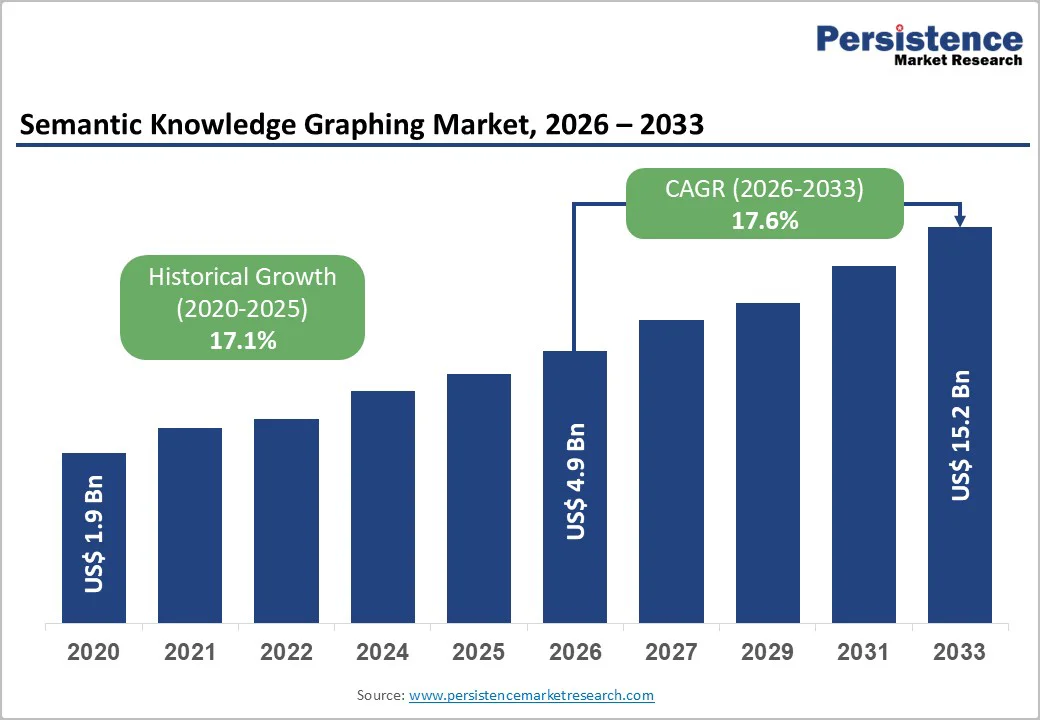
The global semantic knowledge graphing market size is likely to be valued at US$4.9 billion in 2026 and is expected to reach US$15.2 billion by 2033, growing at a CAGR of 17.6% during the forecast period from 2026 to 2033, driven by the increasing adoption of AI and machine learning technologies that rely on structured semantic data for enhanced contextual understanding.
The rise of unstructured digital data drives demand for advanced integration tools, while investments in data governance and enterprise knowledge management support efficient decision-making, with semantic search, AI-powered Q&A, and recommendation systems fueling growth across BFSI, healthcare, telecom, and IT.
Key Industry Highlights:
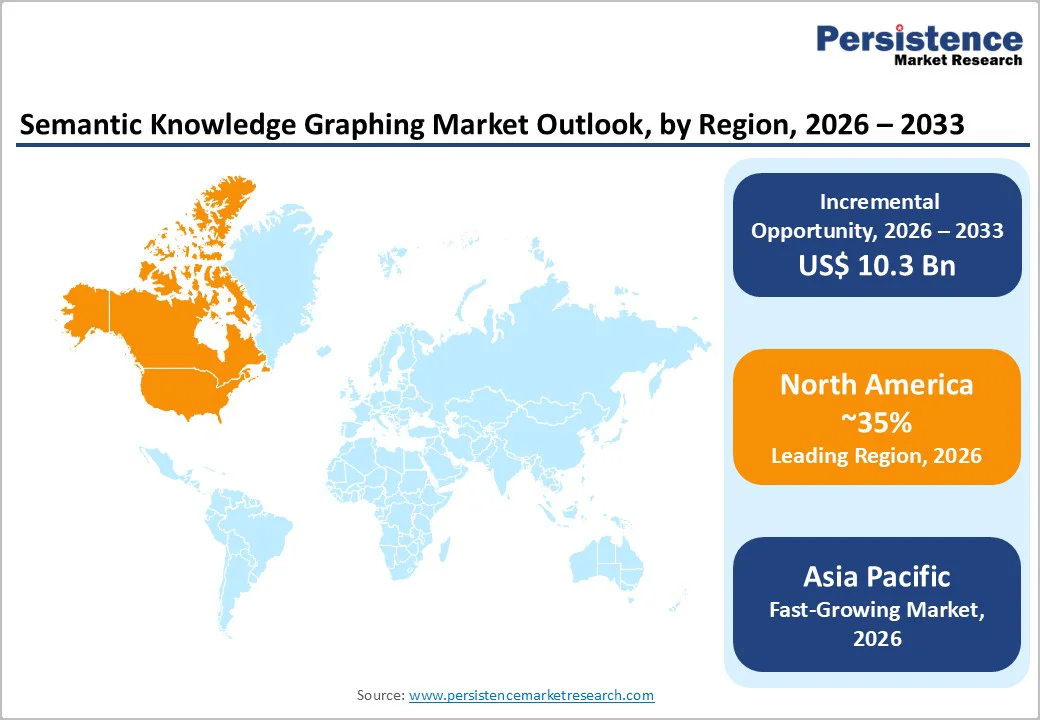
- Leading Region: North America is expected to be the leading region, accounting for 35% in 2026, driven by strong AI adoption, advanced data governance standards, and major tech players driving cloud-based semantic graph solutions.
- Fastest-growing Region: Asia Pacific is likely to be the fastest-growing region, driven by IoT, manufacturing analytics, and supportive policies such as China’s Digital Silk Road, with a competitive landscape led by Baidu.
- Leading Graph Type: Context-rich knowledge graphs are projected to represent the leading graph type in 2026, accounting for 60% of the revenue share, driven by comprehensive enterprise views and enabling quick knowledge discovery.
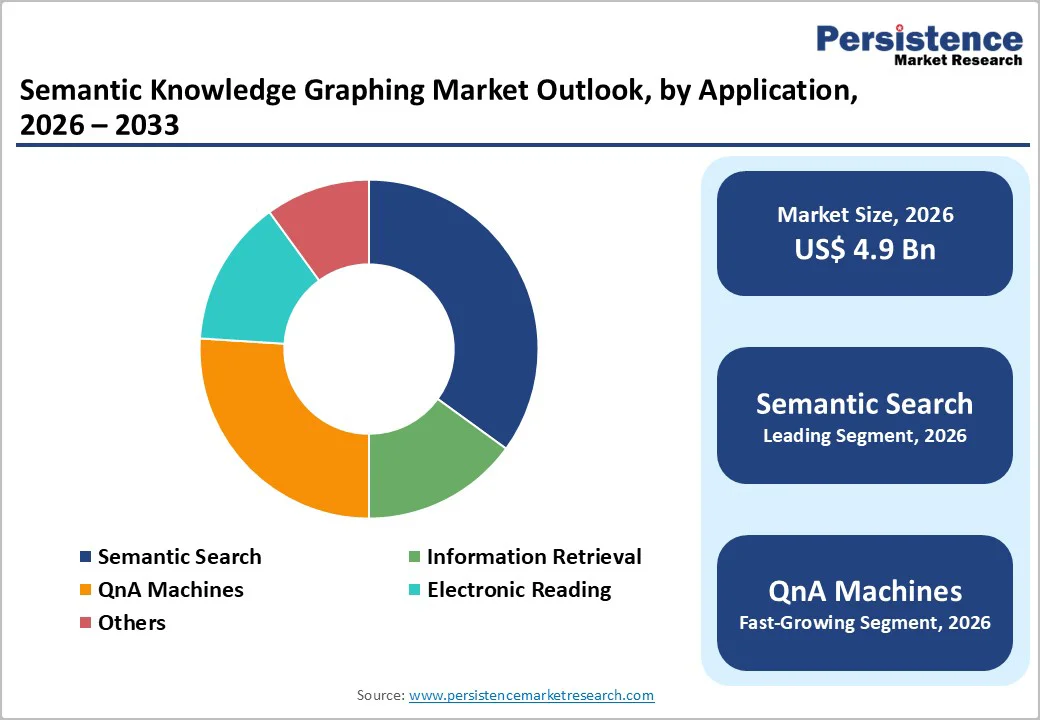
- Leading Application: Semantic search is expected to be the leading application type, accounting for over 40% of revenue share in 2026, supported by improvements in search accuracy through entity relationships and contextual results.
| Key Insights | Details |
|---|---|
|
Semantic Knowledge Graphing Market Size (2026E) |
US$4.9 Bn |
|
Market Value Forecast (2033F) |
US$15.2 Bn |
|
Projected Growth (CAGR 2026 to 2033) |
17.6% |
|
Historical Market Growth (CAGR 2020 to 2025) |
17.1% |
Market Factors - Growth, Barriers, and Opportunity Analysis
Explosion of Data Volumes and Need for Effective Data Management
Organizations are generating enormous amounts of both structured and unstructured data from a wide range of sources, including IoT devices, social media platforms, enterprise applications, and digital content systems. Traditional data management tools often struggle to efficiently process, integrate, and analyze this rapidly growing information. Semantic knowledge graphs address these challenges by connecting disparate data points through contextual relationships, enabling organizations to derive meaningful insights. By offering a unified and structured view of complex datasets, these graphs allow enterprises to identify patterns, uncover hidden trends, and make more accurate, data-driven decisions.
The increasing emphasis on effective data governance and knowledge management is further driving adoption. Organizations are prioritizing interoperability, data lineage, and regulatory compliance, creating demand for solutions that seamlessly integrate diverse data sources. Semantic knowledge graphs support real-time analytics, intelligent search, and AI-powered applications such as chatbots and recommendation engines, making them a cornerstone of modern data architectures. This convergence of data proliferation and the need for structured, actionable intelligence positions semantic knowledge graphing as a strategic investment for organizations aiming to enhance operational efficiency and maintain a competitive edge.
Data Quality and Scalability Challenges
Knowledge graphs depend on accurate, consistent, and up-to-date data to generate meaningful insights. However, organizations often face challenges with incomplete, inconsistent, or distributed data across multiple silos. Poor data quality can result in incorrect relationships, misinterpretations, and flawed analytics, diminishing the overall value of semantic graph implementations. Integrating diverse data sources, including unstructured text, IoT streams, and legacy databases, further complicates maintaining data integrity, necessitating robust data cleansing, validation, and governance processes.
Scalability is another critical challenge limiting market growth. As organizations accumulate larger volumes of data, conventional graph storage and processing architectures may encounter performance bottlenecks. Managing large-scale, real-time data in enterprise environments requires high-performance computing, optimized algorithms, and scalable cloud infrastructure. These technical demands can increase deployment costs and extend implementation timelines, particularly for small and medium-sized enterprises (SMEs). Effectively addressing both data quality and scalability is essential for broader adoption of semantic knowledge graphs, as organizations seek reliable, efficient solutions for managing interconnected, high-volume datasets.
Emerging Applications in Healthcare and Life Sciences
Knowledge graphs enable the integration of large and complex datasets, including electronic health records (EHRs), genomic information, clinical trial data, and biomedical literature. By linking these diverse sources, semantic graphs support advanced analytics, pattern recognition, and predictive modeling, facilitating precision medicine and personalized treatment strategies. For instance, healthcare providers can use these graphs to identify patient-specific risk factors, recommend optimized treatment plans, and monitor real-time patient outcomes. Similarly, pharmaceutical companies can accelerate drug discovery, better understand disease pathways, and streamline clinical trials by leveraging interconnected biomedical datasets.
Semantic knowledge graphs also underpin the development of intelligent healthcare applications, including AI-driven diagnostic systems, virtual health assistants, and drug repurposing platforms. These solutions improve operational efficiency, minimize errors, and enhance decision-making across healthcare workflows. With growing investments in digital health, genomics, and biomedical research, the adoption of semantic knowledge graphs in the healthcare and life sciences sectors is expected to expand rapidly, presenting a significant opportunity for vendors offering high-value, specialized solutions with measurable impact.
Category-wise Analysis
Graph Type Insights
The context-rich knowledge graphs segment is expected to lead the semantic knowledge graphing market, accounting for approximately 60% of the total revenue share in 2026. These graphs consolidate and contextualize internal enterprise data, linking disparate datasets to provide a comprehensive view of business operations. They excel at enabling knowledge discovery, trend analysis, and faster decision-making by integrating internal processes, customer information, and operational data. For instance, Microsoft’s Graph platform connects organizational data across emails, documents, and collaboration tools, enhancing productivity and enabling context-aware search, highlighting the practical value of context-rich graphs. Their market dominance is driven by the growing need for enterprises to overcome data fragmentation and enable holistic analytics.
The NLP knowledge graphs segment is likely to be the fastest-growing category, fueled by advancements in natural language processing technologies. These graphs extract entities and relationships from unstructured text, enabling intelligent interactions in AI-driven applications such as chatbots, virtual assistants, and semantic search engines. For example, Google’s Knowledge Graph, combined with NLP algorithms, enhances search capabilities by understanding user intent, delivering context-aware results, and supporting question-answering features. The growth of NLP knowledge graphs is propelled by increasing demand for human-like AI interactions, automated content management, and intelligent customer support solutions.
Application Insights
Semantic search is expected to lead the market, accounting for approximately 40% of total revenue in 2026, due to its critical role in delivering contextually relevant results across enterprise and e-commerce platforms. Unlike traditional keyword-based search, semantic search leverages entity relationships and knowledge graphs to understand user intent, enhancing accuracy and overall satisfaction. For instance, Amazon employs semantic search in its product discovery engine, enabling users to find items via natural queries while accounting for related attributes and personalized recommendations.
The QnA machines segment is projected to be the fastest-growing application in 2026, driven by the rapid adoption of AI-powered virtual assistants and automated customer support systems. These applications utilize semantic knowledge graphs to deliver context-aware, precise responses to user queries in real time, improving both service efficiency and customer experience. For example, IBM Watson Assistant leverages knowledge graphs to interpret complex questions and provide accurate answers across sectors such as healthcare, banking, and enterprise support. Growth in this segment is fueled by increasing digital adoption, rising customer expectations for instant query resolution, and the deployment of AI chatbots in high-volume query environments.
Regional Insights
North America Semantic Knowledge Graphing Market Trends
North America is anticipated to be the leading region, accounting for a market share of 35% in 2026, driven by its advanced digital infrastructure, early AI adoption, and strong investment in data analytics. Enterprises across the United States and Canada are integrating semantic knowledge graphs to tackle complex data challenges and improve decision-making. For example, major tech firms such as Microsoft and Google are embedding semantic layers into their cloud and AI platforms to enhance contextual analytics and semantic search capabilities for enterprise customers, reinforcing the region’s dominance.
North America is witnessing strategic shifts that shape market growth, including the rise of cloud-based knowledge graph services and AI-infused data fabrics that accelerate deployment and scalability. For example, knowledge graph-as-a-service (KGaaS) offerings on cloud platforms are lowering barriers for enterprises to adopt semantic solutions without incurring heavy upfront infrastructure costs. Regulatory emphasis on data privacy and transparency also motivates organizations to invest in semantic graphing to ensure compliance while unlocking analytics value.
Europe Semantic Knowledge Graphing Market Trends
Europe is expected to be a significant market for semantic knowledge graphing in 2026, driven by robust data governance practices and ongoing digital transformation initiatives. Regulatory frameworks such as GDPR are encouraging organizations to adopt advanced data management and compliance solutions, increasing demand for semantic graph technologies that provide transparent data lineage, interoperability, and governance across diverse datasets. For instance, France’s national AI strategy includes dedicated funding for knowledge graph development in sectors such as healthcare and aerospace, fostering innovation and adoption.
The region also benefits from a diverse enterprise ecosystem and a collaborative research environment, which are enabling new use cases for semantic knowledge graphs across industries. In the financial services sector, banks and insurers are leveraging graph solutions to unify customer, transaction, and risk data, enhancing fraud detection and enabling personalized services. In healthcare and life sciences, knowledge graphs integrate clinical records, research outputs, and genomic data, accelerating insights and improving decision-making.
Asia Pacific Semantic Knowledge Graphing Market Trends
The Asia Pacific region is expected to be the fastest-growing market for semantic knowledge graphing in 2026, driven by robust digital transformation initiatives and strong government support for AI and data analytics. In China, state-backed funding for semantic computing through national R&D programs is accelerating the adoption of graph technologies in sectors such as e-commerce and public services. Companies such as Alibaba leverage semantic graphs to enhance intelligent search and recommendation engines. In Singapore, the National Library Board implemented a Linked Data-based semantic knowledge graph to integrate library and archival resources, improving data interoperability and search across collections.
Emerging use cases in the region also demonstrate the integration of knowledge graphs with IoT and manufacturing analytics, particularly in Japan and Australia. Japanese manufacturers are connecting IoT sensor data to production and logistics systems via knowledge graphs to optimize supply chains and enable predictive maintenance, thereby enhancing operational efficiency. In Australia, initiatives such as HydroKG consolidate hydrologic data from multiple sources to support environmental monitoring and informed decision-making.
Competitive Landscape
The global semantic knowledge graphing market is moderately fragmented, shaped by a combination of large technology conglomerates and specialized graph platform providers competing across cloud, AI, and enterprise analytics solutions. Market participants range from hyperscale cloud vendors offering integrated graph and knowledge services to niche players focused on semantic reasoning and ontology management. Market growth is driven by increasing enterprise adoption of AI and machine learning, the rapid expansion of structured and unstructured data, and the rising demand for advanced data management and analytics capabilities.
Key market leaders include Amazon.com Inc., Google LLC, Microsoft Corporation, IBM Corporation, Neo4j Inc., Ontotext AD, Baidu Inc., Yandex, and Franz Inc. These companies compete through strategic partnerships, product innovation, cloud service integration, and expanded enterprise feature sets that cater to evolving market needs, such as explainable AI and real-time analytics. Their offerings emphasize advanced semantic graph functionalities, including contextual search, knowledge inference, and real-time decision support, reinforcing their competitive positioning in the market.
Key Industry Developments:
- In May 2025, Kobai launched Kobai Saturn, the first knowledge graph combining lakehouse scalability with a codeless semantic layer. Saturn allows organizations to query and link enterprise data in place, supporting W3C and Lakehouse standards. Key features include high-performance on-demand compute, direct integration with existing data layers, and seamless collaboration through SQL views for BI and data science workflows.
- In October 2024, Semantic Web Company and Ontotext merged to form Graphwise, a leading Graph AI solutions provider. Semantic Web Company brings expertise in knowledge engineering, semantic AI, and intelligent document processing, while Ontotext contributes its GraphDB engine and advanced AI models for large-scale data linking. Together, Graphwise offers a complete knowledge graph infrastructure to help enterprises maximize their AI investments.
Companies Covered in Semantic Knowledge Graphing Market
- Amazon.com Inc.
- Baidu, Inc.
- Facebook Inc
- Google LLC
- Microsoft Corporation
- Mitsubishi Electric Corporation
- NELL
- Semantic Web Company
- YAGO
- Yandex
Frequently Asked Questions
The global semantic knowledge graphing market is projected to reach US$4.9 billion in 2026.
The growing need to integrate, manage, and analyze large volumes of structured and unstructured data for AI, semantic search, and advanced analytics.
The semantic knowledge graphing market is expected to grow at a CAGR of 17.6% from 2026 to 2033.
Key market opportunities include growth in healthcare and life sciences, advanced analytics through AI and machine learning, and adoption in enterprise knowledge management and digital transformation.
Amazon.com Inc., Baidu, Inc., Facebook Inc., Google LLC, Microsoft Corporation, and Mitsubishi Electric Corporation are the leading players.


