




- Industrial Goods & Service
- Screw Jacks Market
Screw Jacks Market Size, Share, and Growth Forecast, 2026 - 2033
Screw Jacks Market by Application (Automotive, Manufacturing, Construction, Aerospace), Load Capacity (Up to 5 Tons, 5-20 Tons, Above 20 Tons), Lubrication Type (Grease, Oil), and Regional Analysis for 2026-2033

Screw Jacks Market Share and Trends Analysis
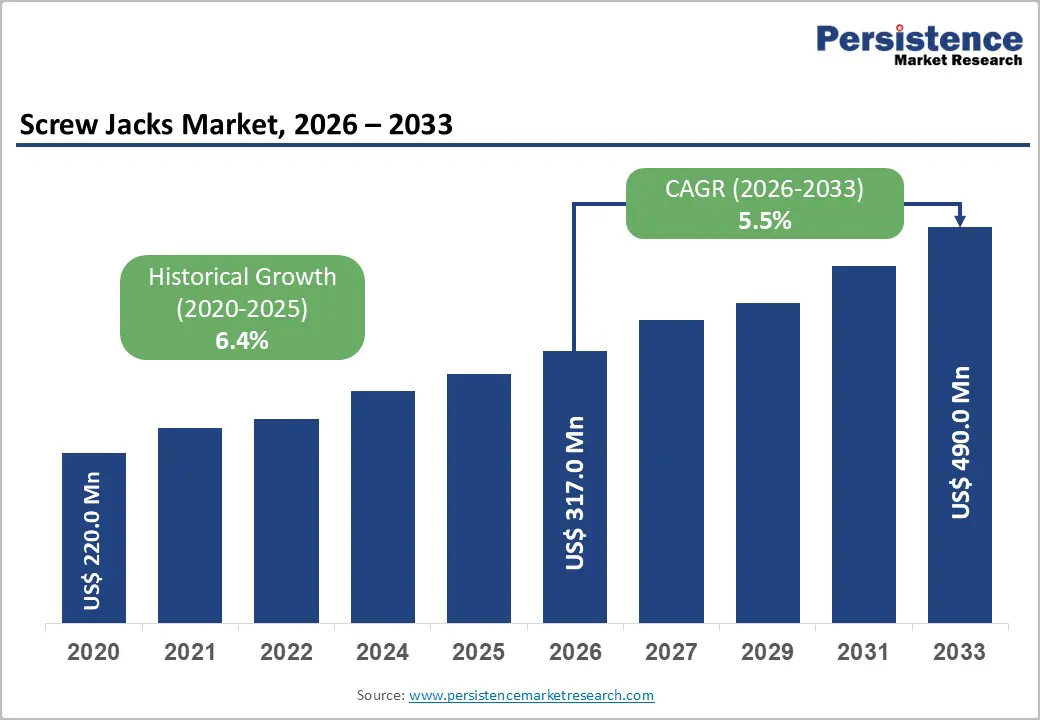
The global screw jacks market size is likely to be valued at US$ 317.0 million in 2026, and is projected to reach US$ 490.0 million by 2033, growing at a CAGR of 5.5% during the forecast period 2026−2033.
Market expansion is gaining momentum as manufacturing industries are accelerating automation and upgrading legacy machinery with precise mechanical positioning systems. Infrastructure development across emerging economies is increasing demand for controlled lifting and load handling equipment. Industrial operators are adopting screw jacks to achieve accurate linear motion, synchronized lifting, and stable load distribution in production lines and heavy engineering environments. Machinery modernization programs and stricter workplace safety regulations are reinforcing the need for dependable mechanical actuation solutions.
Manufacturers are engineering energy efficient designs that deliver higher load capacity with optimized torque transmission and reduced power consumption. This innovation focus is gaining traction in automotive assembly plants and aerospace manufacturing facilities, where precision alignment and operational reliability are essential. Companies are integrating advanced materials, corrosion resistant coatings, and modular configurations to enhance durability and lifecycle performance.
Key Industry Highlights
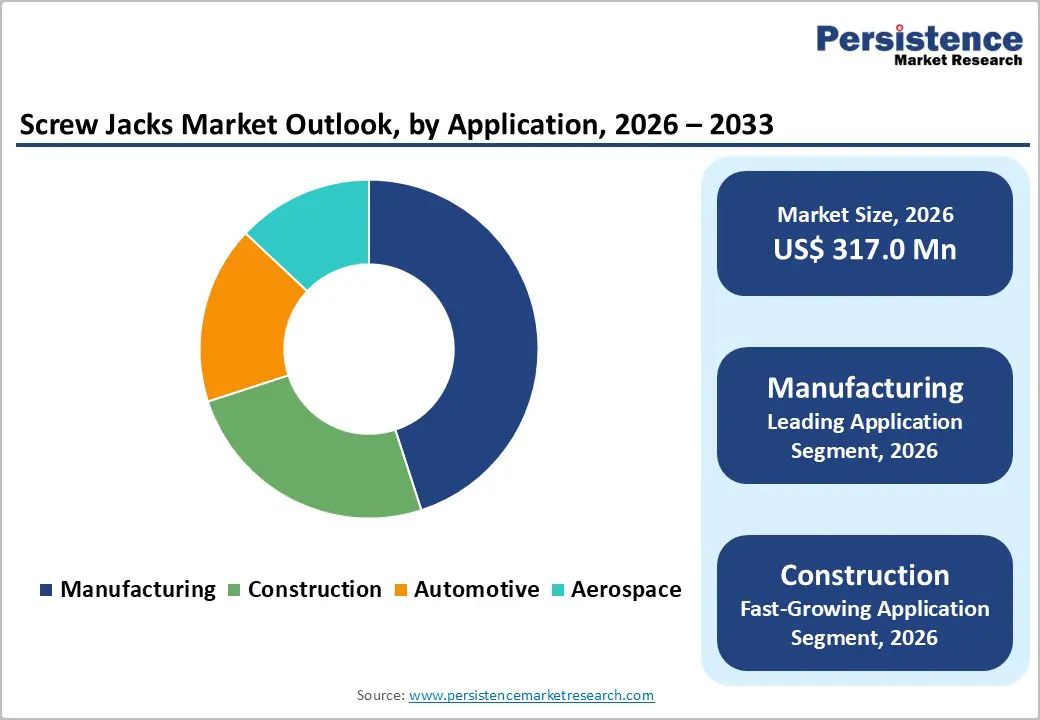
- Application Leadership: Manufacturing is expected to hold around 42% of the revenue share in 2026, while construction is likely to be the fastest-growing segment during the 2026-2033 forecast period.
- Load Capacity Dominance: 5-20 tons is poised to secure about 61% of the revenue share in 2026, whereas above 20 tons is set to grow the fastest from 2026 to 2033.
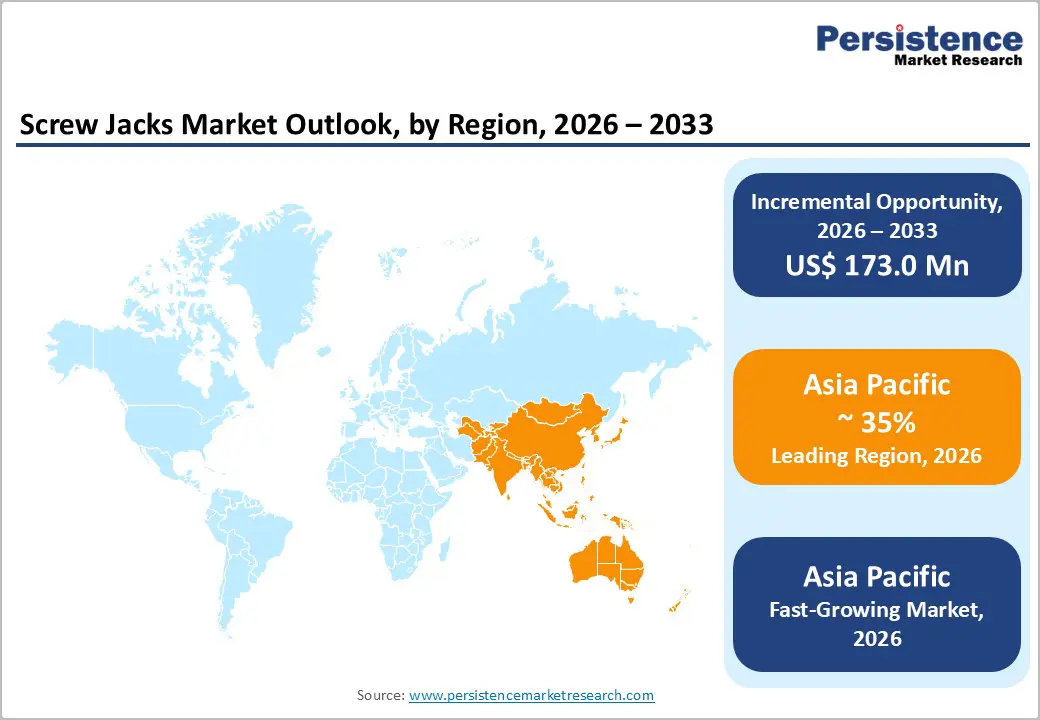
- Regional Dynamics: Asia Pacific is slated to be the leading and the fastest-growing regional market in 2026, accounting for approximately 35% share, fueled by infrastructure development and manufacturing capacity expansion.
- Key Opportunity: Merging mechanical actuators with Internet of Things (IoT) platforms to deliver real-time monitoring and proactive upkeep for smoother operations is a highly lucrative growth avenue.
| Key Insights | Details |
|---|---|
| Screw Jacks Market Size (2026E) | US$ 317.0 Mn |
| Market Value Forecast (2033F) | US$ 490.0 Mn |
| Projected Growth (CAGR 2026 to 2033) | 5.5% |
| Historical Market Growth (CAGR 2020 to 2025) | 6.4% |
Market Factors – Growth, Barriers, and Opportunity Analysis
Industrial Automation and Manufacturing Modernization
Industrial automation is accelerating growth in the screw jacks market as companies are modernizing production systems and increasing robotic deployment. Manufacturers are upgrading assembly lines to improve throughput and process consistency. They are relying on screw jacks to deliver precise linear motion control for material positioning, fixture adjustment, and equipment alignment. These systems are maintaining tight tolerance levels, which are supporting stable and repeatable automated workflows. Automotive manufacturers are representing a significant share of demand due to large scale line retrofits across North America and Europe.
Industry 4.0 is transforming factories into digitally connected environments, and this shift is increasing demand for intelligent screw jack solutions. Producers are integrating electronic control units and IoT-enabled monitoring systems to generate real time performance data and predictive maintenance insights. This capability is reducing unplanned downtime and improving asset utilization across industrial sectors. Engineering consultants are advising clients to evaluate hybrid models that combine mechanical strength with digital connectivity. Companies that are adopting scalable, IoT ready configurations are strengthening long term competitiveness in precision manufacturing.
Infrastructure Development in Emerging Markets
Large-scale infrastructure programs across Asia Pacific and the Middle East are stoking the demand for heavy duty lifting equipment. Governments are investing in transportation corridors, power generation facilities, ports, and urban expansion projects to support long term economic growth. Construction contractors are deploying high capacity screw jacks within bridge launching systems, structural alignment frameworks, and industrial installation platforms. These mechanical actuators are delivering precise positioning under extreme load conditions while maintaining structural stability. Suppliers that are aligning sales strategies with national development pipelines can secure stronger order visibility and higher volume contracts.
Renewable energy expansion is creating specialized demand for advanced screw jack solutions. Wind energy installations are requiring controlled adjustment mechanisms for turbine blade pitch optimization to maximize energy output. Solar power facilities are integrating tracking systems that reposition photovoltaic panels to maintain optimal sun exposure throughout the day. High load designs are withstanding environmental stress while preserving alignment accuracy. Industry advisors are recommending corrosion resistant and weather sealed models for deployment in green energy projects. Companies that are forming early partnerships with renewable developers are strengthening their competitive positioning.
Competition from Alternative Actuation Technologies
Hydraulic and pneumatic actuation systems are competing directly with screw jacks in several industrial use cases. Hydraulic cylinders are delivering high force output with favorable force to weight ratios, which makes them suitable for heavy construction equipment and aerospace ground systems. Operators are valuing their rapid response and load handling capacity in dynamic applications. Pneumatic actuators are supporting quick motion cycles in light duty automation tasks where speed is critical. These alternatives are influencing purchasing decisions in time sensitive environments, and engineering teams are evaluating performance parameters carefully before selecting actuation technology. Manufacturers are responding by emphasizing durability, load stability, and mechanical simplicity in applications that require sustained positioning rather than rapid movement.
Electric linear actuators that incorporate ball screw assemblies are offering superior positioning accuracy and integrated electronic controls. Built in sensors and programmable interfaces are enabling seamless automation and connectivity within precision manufacturing systems. Well established hydraulic supply chains are maintaining cost competitiveness, which is limiting screw jack penetration in overlapping segments. Industry consultants are advising manufacturers to differentiate through hybrid configurations or specialized high endurance designs. Screw jacks are retaining advantages in applications that demand prolonged static load support without continuous energy input.
High Initial Investment and Maintenance Costs
Industrial grade screw jacks require substantial upfront capital investment, which is limiting adoption among cost sensitive buyers. Small and medium sized enterprises (SMEs) are facing tighter capital expenditure constraints, particularly when selecting high precision, heavy load configurations. Advanced models are involving higher acquisition costs along with installation, commissioning, and system integration expenses. During periods of economic uncertainty or margin compression, manufacturers are postponing equipment upgrades to preserve liquidity while conducting detailed return on investment assessments to balance immediate financial pressure with long-term productivity benefits.
Maintenance requirements are increasing total cost of ownership beyond the initial purchase price. Operations teams are performing scheduled lubrication, alignment inspections, and component replacements to sustain performance and safety compliance. These recurring activities are adding measurable annual operating expenses. Financial planners are evaluating full lifecycle cost models to support capital justification processes. Industry advisors are recommending leasing structures, phased deployment, or modular configurations to reduce entry barriers for smaller firms. A flexible sourcing strategy will help organizations adapt to funding variability while maintaining operational continuity.
Integration with Smart Manufacturing and IoT Technologies
Mechanical actuators are converging with digital technologies to accelerate product innovation across automated industries. IoT platforms are enabling real time monitoring and predictive maintenance, which are improving operational continuity. Smart manufacturing facilities are requiring components with embedded sensors that generate immediate performance data. Screw jack manufacturers are integrating position encoders, load cells, and wireless communication modules to support connected workflows. These capabilities are expanding relevance across assembly automation, material handling systems, and precision alignment tasks. Forward-looking suppliers are delivering fully integrated, sensor ready solutions that simplify commissioning and data capture.
Advanced analytics is transforming maintenance from reactive servicing to condition based management. Continuous vibration analysis and operational logging are identifying anomalies before they escalate into equipment failure. End users are reducing unplanned downtime and extending service life through data informed interventions. Equipment manufacturers are strengthening value propositions by demonstrating measurable reliability gains and lifecycle optimization. Strategic collaboration with industrial software providers is accelerating integration into digitally mature production environments. Pilot deployments of hybrid mechanical digital configurations are validating performance improvements and enabling faster adoption within high technology facilities.
Acceleration of Urbanization and Infrastructure Development
The demand for reliable lifting systems is increasing across construction, heavy engineering, and industrial manufacturing, with screw jacks serving as critical load positioning components. Construction machinery is utilizing these mechanisms to raise, stabilize, and align heavy structural elements with controlled precision. Project teams are valuing their mechanical robustness in complex environments such as high rise developments and bridge erection sites. Rapid urban expansion in Asia and Africa is accelerating infrastructure deployment, which is raising requirements for scalable and accurate actuation systems. Equipment manufacturers are identifying strong entry potential in these regions through localized assembly, regional distribution partnerships, and tailored product configurations that address site specific load demands.
Sustainability priorities are further expanding growth avenues. Builders are adopting energy efficient screw jack systems that lower power consumption while maintaining load capacity and mechanical strength. Advanced designs are incorporating low friction materials, optimized thread geometry, and high efficiency gear assemblies to comply with tightening environmental standards. Industry advisors are recommending product certifications that validate reduced emissions impact and recyclability performance. Suppliers that are integrating these actuators into modular, adaptable platforms are enhancing versatility across applications. End users are benefiting from lower operating expenses and simplified regulatory adherence.
Category-wise Analysis
Application Insights
Manufacturing is anticipated to dominate by commanding approximately 42% of the screw jacks market revenue share in 2026. Screw jacks are delivering precise lifting and positioning control within advanced manufacturing environments. As industries are accelerating automation and smart production practices, demand for dependable mechanical actuation systems is increasing. These components are supporting accurate alignment, load stabilization, and synchronized motion in assembly lines and robotic cells. Industry 4.0 frameworks are promoting deeper integration with Internet of Things (IoT) enabled monitoring and intelligent control systems, which are expanding functional capabilities. Robotics deployment and automated production architectures are intensifying requirements for connected, high precision screw jack models. Established industrial infrastructure and continuous plant modernization initiatives are maintaining stable demand fundamentals across core manufacturing sectors.
Construction is expected to be the fastest-growing application segment from 2026 to 2033 due to the vital role played by screw jacks for heavy load handling and fine positional adjustment operations. Rapid urbanization and large scale infrastructure development are driving adoption across commercial, residential, and transportation projects. Construction equipment is utilizing screw jacks to lift structural components, align prefabricated modules, and ensure dimensional accuracy in complex assemblies. Sustainable construction practices and the use of advanced materials are reinforcing demand for durable and energy efficient mechanical solutions. Eco-compliant screw jack variants are supporting regulatory adherence while maintaining performance standards. Manufacturers that are targeting environmentally optimized designs and integrating them into modular construction systems will have strengthened their presence in expanding infrastructure markets.
Load Capacity Insights
The 5 to 20 tons capacity segment is forecasted to accounting for an estimated 61% of the screw jacks market share in 2026. These instrumentals are pivotal in supporting demanding industrial operations that require a balance between load strength, positional accuracy, and cost efficiency. Their versatility is driving adoption across manufacturing, construction, and automotive production environments. Factories are utilizing them for assembly alignment and material elevation tasks, while construction teams are applying them in formwork positioning and equipment leveling. Automotive production lines are depending on this range for jig calibration and lift table stabilization. Ongoing industrial expansion is sustaining demand, and manufacturers are strengthening their portfolios with durable mid capacity models that deliver reliable performance under sustained mechanical stress.
The above 20 tons segment is projected to be the fastest-growing during the 2026 to 2033 forecast period. High capacity screw jacks are serving heavy duty applications in aerospace, energy generation, and mining operations. Engineers are designing these systems to withstand extreme loads, temperature fluctuations, and vibration intensive environments. Energy companies are deploying them in turbine alignment systems and offshore platform structures, while aerospace manufacturers are using them for precise positioning of large assembly fixtures. Mining operations are integrating them into conveyor stabilization and crusher foundation frameworks. Advances in high strength alloys and corrosion resistant surface treatments are enhancing durability and service life. Growth in global infrastructure megaprojects is accelerating adoption of these high load solutions, positioning this segment as a key contributor to future market expansion.
Regional Insights
Asia Pacific Screw Jacks Market Trends
Asia Pacific is expected to be both the leading and fastest growing regional market for screw jacks in 2026, securing about 35% of global revenues. Rapid industrialization, large scale infrastructure expansion, and sustained manufacturing capacity growth are driving regional demand. China is maintaining the largest share through extensive public works programs and continuous factory modernization. India is expanding adoption through domestic manufacturing initiatives and national highway development projects. Japan is focusing on advanced assembly systems and robotic integration, while Southeast Asian economies such as Vietnam, Thailand, and Indonesia are attracting foreign direct investment for new production facilities. Competitive labor structures, established component supply networks, and proximity to end use industries are strengthening regional advantages. Safety regulations are encouraging certified mechanical systems, and buyers are differentiating between cost competitive local offerings and premium global brands for quality critical installations.
Strategic public investment programs are creating additional growth pathways. China is extending overseas construction engagement through cross border infrastructure initiatives, while India is channeling capital into ports, logistics corridors, and transport modernization. ASEAN production hubs are drawing multinational manufacturers seeking export oriented capacity. Renewable energy expansion, including large scale solar installations across India and Southeast Asia, is increasing demand for durable and precise lifting mechanisms. Electronics manufacturing growth, spanning semiconductor fabrication and consumer device assembly, is raising requirements for high accuracy positioning systems. Urban development projects are further supporting equipment procurement for modern construction frameworks.
Europe Screw Jacks Market Trends
Europe is expected to hold a sizable share of the screw jacks market in 2026 due to its advanced industrial infrastructure and strong engineering capabilities. Germany is driving demand through automotive manufacturing, precision machine building, and industrial equipment fabrication. The United Kingdom is contributing through aerospace component production and specialized engineering services, while France and Spain are expanding usage across public infrastructure and renewable energy installations. European Union (EU) environmental directives are accelerating factory modernization and grid transformation initiatives, which are increasing demand for compliant mechanical actuation systems. Harmonized machinery regulations are standardizing safety requirements across member states and facilitating cross border trade. Established regional manufacturers are leveraging strong distribution networks and brand credibility, and procurement teams are prioritizing proven suppliers to ensure reliability in high value industrial projects.
Sustainability driven investment is reshaping procurement priorities across the region. Offshore wind developments are creating urgent demand for durable positioning and load stabilization mechanisms. Electric vehicle (EV) battery manufacturing facilities are expanding across central Europe, which is increasing the need for precise alignment systems within automated production lines. Industry consultants are recommending modular screw jack designs that align with emission reduction targets and energy efficiency standards. Companies that are partnering with technology innovators to integrate digital monitoring and energy saving features are strengthening long term competitiveness.
North America Screw Jacks Market Trends
North America is slated to occupy a strong position in the market for screw jacks through 2033 on the back of its extensive manufacturing base and accelerating automation investments. The U.S. is leading regional demand through mature industrial infrastructure and ongoing plant modernization. Companies are reshoring production to reinforce supply chain resilience following prior disruptions. Automotive manufacturers are retooling facilities for electric vehicle production, while aerospace companies are increasing aircraft assembly rates to meet backlog requirements. Occupational Safety and Health Administration (OSHA) standards are enforcing strict workplace lifting and positioning regulations, which are driving adoption of certified mechanical actuation systems. Domestic suppliers are leveraging established distribution networks, while select European imports are serving high precision applications. Buyers are optimizing procurement strategies by combining local availability with premium performance options.
Federal semiconductor incentive programs are funding new chip fabrication plants, which are increasing demand for highly accurate positioning equipment. Clean energy expansion, including large scale solar tracking installations in desert regions, is requiring durable and weather resistant actuators. Infrastructure investment programs are supporting road, bridge, and public facility upgrades, further strengthening equipment utilization. Investors are prioritizing IoT-enabled enhancements to transform conventional factories into connected production environments. Competitive strategies need to emphasize compliant, digitally connected designs to align with regulatory frameworks and secure growth opportunities across electric vehicle batteries, semiconductor fabrication, and renewable energy projects.
Competitive Landscape
The global screw jacks market structure is moderately concentrated. Leading participants such as Columbus McKinnon Corporation, ZIMM Group, Joyce Dayton Corp., Power Jacks Ltd., and Nook Industries collectively account for approximately 45% to 50% of the market share. These companies are shaping competitive dynamics through sustained investment in research and development, targeted acquisitions, and strategic partnerships. Manufacturers are introducing advanced models that deliver improved load efficiency, reduced energy consumption, and extended operational lifespan. Integration of embedded sensors and monitoring modules is aligning product portfolios with customer expectations for connectivity, performance tracking, and sustainability compliance. This concentration is reinforcing brand loyalty and raising entry barriers for smaller competitors.
Strategic collaborations are expanding geographic reach and technical capabilities beyond core competencies. Leading manufacturers are partnering with automation technology providers and sector specific engineering firms to enhance system integration and access new application segments. These alliances are enabling entry into emerging industrial markets while strengthening value propositions in established regions. Joint development initiatives are accelerating innovation cycles and improving responsiveness to evolving end user requirements. Forward looking companies are combining internal engineering expertise with external digital and application focused networks to secure positioning in high growth verticals. This blended strategy is supporting differentiation, faster commercialization, and sustained leadership across expanding industrial automation and infrastructure driven segments.
Key Industry Developments
- In January 2026, Power Jacks formed a strategic partnership with Belgium-based Vydraulics Group, aiming to supply its electric actuation technology to support Vydraulics' expansion across Europe, targeting defense, offshore, marine, and industrial sectors.
- In October 2025, Joyce/Dayton Corp. completed a US$ 8.7 million expansion of its Indiana manufacturing facility, increasing the plant size from 82,000 to 108,000 square feet. The project will enhance the production capacity for screw jacks, linear motion systems, and electric actuators to meet rising demand for American-made products.
- In October 2025, Power Jacks launched its versatile 10kN E-Series screw jack, designed for precision linear motion in demanding industrial applications. The compact unit features a precision worm gear set, multiple mounting options including trunnion and double clevis, and customizable options such as anti-backlash and stainless steel construction.
Companies Covered in Screw Jacks Market
- Columbus McKinnon Corporation
- ZIMM Group
- Joyce Dayton Corp.
- Power Jacks Ltd.
- Nook Industries
- Haacon Hebetechnik GmbH
- Pfaff-silberblau GmbH
- Thomson Industries, Inc.
- Servomech
- ANDANTEX USA Inc.
- Maschinenfabrik Albert GmbH
- Unimec S.p.A.
- Duff-Norton
- WMH Herion Antriebstechnik GmbH
- Redsun Precision Machinery Co., Ltd.
Frequently Asked Questions
The global screw jacks market is projected to reach US$ 317.0 million in 2026.
Industrial automation, infrastructure projects, and manufacturing upgrades are stimulating market growth.
The market is poised to witness a CAGR of 5.5% from 2026 to 2033.
Key growth opportunities are emerging in the realms of IoT integration, renewable energy applications, and Asia Pacific expansion.
Columbus McKinnon Corporation, ZIMM Group, Joyce Dayton Corp., Power Jacks Ltd., and Nook Industries are some of the key players in the market.


