




- Technology
- RFID Printers Market
RFID Printers Market Size, Share, and Growth Forecast 2026 - 2033
RFID Printers Market by Product Type (Industrial Printers, Desktop Printers, Mobile Printers), by Resolution (<300 DPI, 300-600 DPI, >600 DPI), by Application (Retail & E-commerce, Healthcare & Pharmaceuticals, Logistics & Transportation, Manufacturing, Government & Public Sector, Education, Hospitality, Others), by Regional Analysis, 2026-2033

RFID Printers Market Size and Trend Analysis
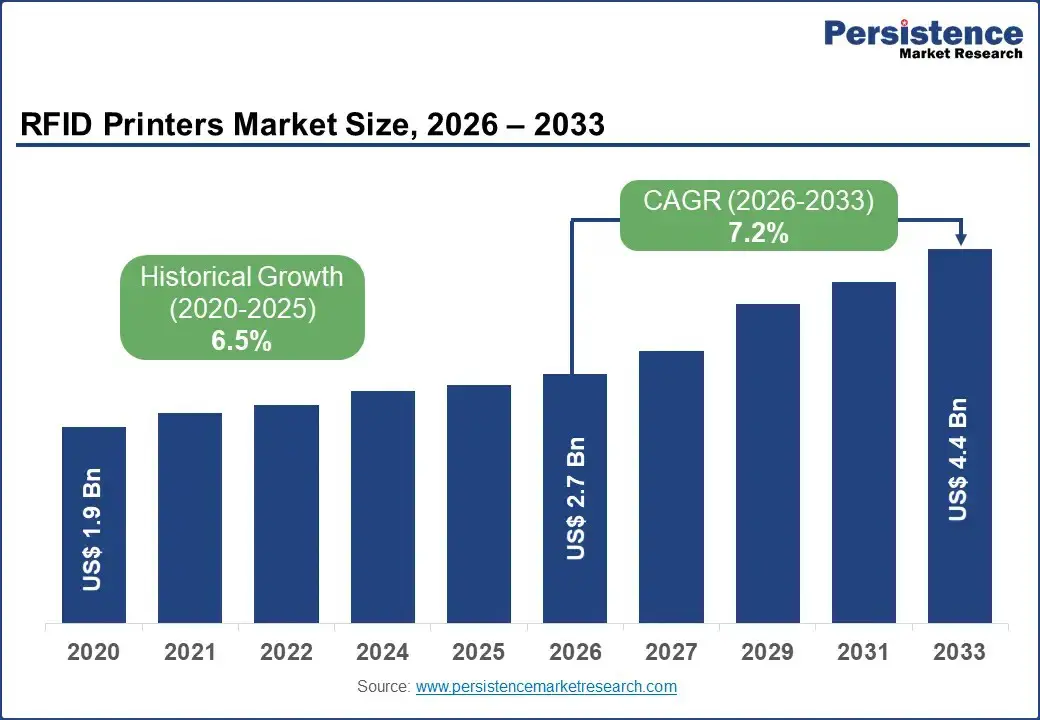
The global RFID printers market size is expected to be valued at US$ 2.7 billion in 2026 and projected to reach US$ 4.4 billion by 2033, growing at a CAGR of 7.2% between 2026 and 2033.
The market expansion is primarily driven by the accelerating adoption of automated identification systems across retail, healthcare, and logistics sectors seeking real-time inventory visibility and enhanced supply chain efficiency. Growing regulatory mandates for product traceability, coupled with declining RFID tag costs and increasing integration of IoT-enabled tracking solutions, are compelling organizations to invest in advanced RFID printing infrastructure that supports serialization requirements and improves operational accuracy.
Key Market Highlights
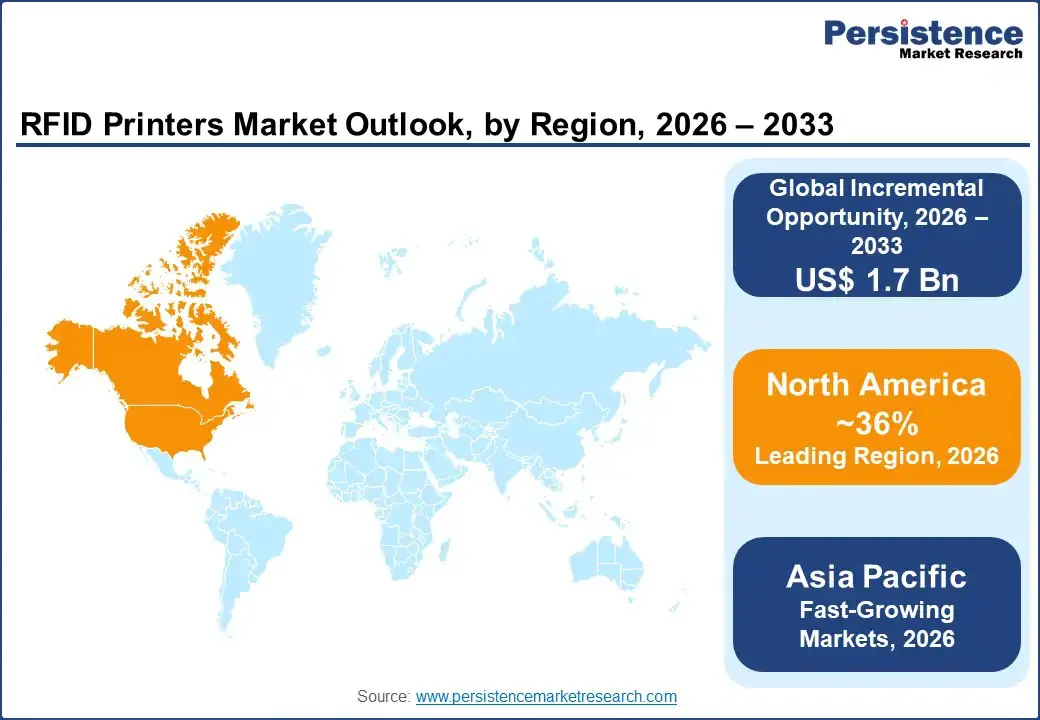
- Leading Region: North America holds the largest share of the global RFID printers market at ~36% in 2025, fueled by DoD logistics mandates, FDA pharmaceutical serialization, and extensive retail automation.
- Fastest Growing Region: Asia Pacific is the fastest-growing region with a CAGR above 8.5% through 2033, driven by manufacturing growth in China and India, booming e-commerce in ASEAN, and government smart logistics initiatives.
- Dominant Segment: Industrial Printers dominate the market with ~58% share in 2025, preferred for high-volume distribution centers due to robust build, fast encoding speeds, and WMS compatibility.
- Fastest Growing Segment: Mobile Printers are the fastest-growing product segment with a CAGR near 9% through 2033, enabled by field service, retail replenishment, and healthcare bedside printing requiring portability and wireless connectivity.
- Key Opportunity: Healthcare digital transformation offers strong growth as hospitals invest over $300 billion annually, with RFID wristbands cutting medication errors by 87% and supporting regulatory compliance.
| Key Insights | Details |
|---|---|
| RFID Printers Market Size (2026E) | US$ 2.7 billion |
| Market Value Forecast (2033F) | US$ 4.4 billion |
| Projected Growth CAGR (2026-2033) | 7.2% |
| Historical Market Growth (2020-2025) | 6.5% |
Market Dynamics
Market Growth Drivers
Exponential Growth in E-commerce and Retail Automation Demands
The explosive expansion of global e-commerce infrastructure is fundamentally reshaping inventory management paradigms and driving substantial demand for RFID printing solutions. According to the U.S. Census Bureau, e-commerce sales in the United States exceeded $1.1 trillion in 2024, representing approximately 16% of total retail sales. Major retailers including Walmart, Amazon, and Target have mandated RFID tagging across numerous product categories to achieve near-perfect inventory accuracy levels exceeding 95%, compared to traditional barcode systems that typically deliver 65-75% accuracy.
The National Retail Federation reports that inventory distortion costs retailers approximately $1.77 trillion annually worldwide, creating compelling economic justification for RFID adoption. RFID printers enable retailers to produce encoded tags on-demand at distribution centers and stores, facilitating item-level tracking that reduces stockouts, prevents shrinkage, and optimizes replenishment cycles in omnichannel fulfillment environments.
Stringent Regulatory Frameworks for Drug Authentication and Traceability
Pharmaceutical supply chain security regulations are mandating serialization and track-and-trace capabilities that directly stimulate RFID printer deployment across healthcare ecosystems. The U.S. Food and Drug Administration's Drug Supply Chain Security Act (DSCSA) requires pharmaceutical manufacturers and distributors to implement serialization systems by November 2023, with enhanced traceability requirements phased through 2027. The European Medicines Agency enforces similar mandates through the Falsified Medicines Directive, requiring unique identifiers on prescription medicines across 27 member states.
According to the World Health Organization, counterfeit medicines account for approximately 10% of medicines in low and middle-income countries, representing a $200 billion annual problem globally. RFID-enabled smart labels printed with embedded authentication data provide tamper-evident packaging and enable automated verification at each distribution node, ensuring compliance while protecting patient safety and brand integrity throughout complex multi-tier pharmaceutical networks.
Market Restraints
High Initial Capital Investment and Total Cost of Ownership
The substantial upfront expenditure required for industrial-grade RFID printing infrastructure presents a significant adoption barrier, particularly for small and medium-sized enterprises operating with constrained capital budgets. Industrial RFID printers capable of high-volume production with encoding capabilities typically range from $3,000 to $15,000 per unit, while comprehensive system implementations including middleware integration, antenna arrays, and reader infrastructure can exceed $100,000 for warehouse-scale deployments.
Beyond equipment acquisition, organizations face recurring costs for proprietary RFID inlays, specialized ribbons, and maintenance contracts that collectively increase total cost of ownership compared to conventional thermal printing solutions. The International Data Corporation indicates that RFID system integration projects frequently encounter budget overruns of 20-30% due to unforeseen technical complexities and customization requirements, creating financial hesitation among potential adopters evaluating return on investment timelines.
Technical Limitations and Environmental Interference Challenges
RFID printing systems face persistent technical constraints related to read range variability, metallic interference, and liquid absorption that compromise performance reliability in diverse operational environments. Radio frequency signals experience attenuation when tags are affixed to products containing metals or liquids, reducing read accuracy rates in beverage, pharmaceutical, and industrial applications. Studies published in the IEEE Journal of RFID demonstrate that metallic surfaces can reduce effective read ranges by 40-60% compared to optimal conditions, necessitating specialized tag designs and printer configurations that increase implementation complexity.
Environmental factors including electromagnetic interference from industrial machinery, temperature extremes in cold chain logistics, and humidity variations in warehouse settings further impact tag performance consistency. Additionally, the lack of universal standardization across UHF, HF, and NFC frequency bands creates interoperability challenges that complicate global supply chain implementations and limit seamless data exchange between disparate RFID ecosystems operated by trading partners.
Market Opportunities
Expanding Integration with Internet of Things and Industry 4.0 Ecosystems
The convergence of RFID technology with Industrial Internet of Things architectures presents transformative opportunities for printer manufacturers to develop intelligent solutions that enable real-time visibility across interconnected manufacturing and logistics networks. Industry 4.0 initiatives could unlock $3.7 trillion in value by 2025 through digitalization, increasingly depend on automated identification systems that seamlessly integrate with enterprise resource planning, warehouse management, and manufacturing execution systems.
Smart RFID printers equipped with edge computing capabilities, cloud connectivity, and predictive maintenance algorithms can deliver analytics-driven insights while reducing operational downtime. The International Federation of Robotics projects that global industrial robot installations will reach 5.6 million units by 2025, creating substantial demand for RFID printing solutions that support automated material handling, robotic picking systems, and lights-out manufacturing environments where human intervention is minimized and autonomous asset tracking becomes essential for production optimization.
Healthcare Digital Transformation and Patient Safety Initiatives
The accelerating digitalization of healthcare delivery systems worldwide creates exceptional growth potential for RFID printers that support patient identification, pharmaceutical tracking, and medical asset management applications. The American Hospital Association reports that hospitals using RFID-based patient wristband systems have reduced medication administration errors by approximately 87% compared to traditional barcode methods, while emergency departments using RFID tracking have decreased patient wait times by 30-40%.
With the global healthcare industry investing over $300 billion annually in digital health technologies, opportunities exist for RFID printer vendors to develop specialized solutions for printing antimicrobial-coated wristbands, biocompatible surgical instrument tags, and blood bank labels that withstand sterilization processes. The Centers for Medicare & Medicaid Services initiatives promoting value-based care models incentivize healthcare providers to adopt technologies that improve operational efficiency and patient outcomes, positioning RFID printing infrastructure as a strategic investment for health systems pursuing Joint Commission accreditation and Leapfrog Group safety ratings.
Category-wise Insights
Product Type Analysis
Industrial printers dominate the RFID printers market with approximately 58% share in 2025, driven by their ability to support high-volume manufacturing and logistics operations. These printers combine fast encoding speeds of 12–14 inches per second with compatibility for multiple tag standards, including ISO 15693, ISO 14443, and EPC Gen 2, making them essential for distribution centers handling thousands of shipments daily. Rugged metal chassis, extended print head lifespans exceeding 50 miles, and integration with enterprise warehouse management systems enable continuous operations with minimal maintenance. Companies deploying industrial printers achieve superior inventory accuracy and operational efficiency, justifying their premium pricing through total cost of ownership advantages over desktop alternatives.
Application Analysis
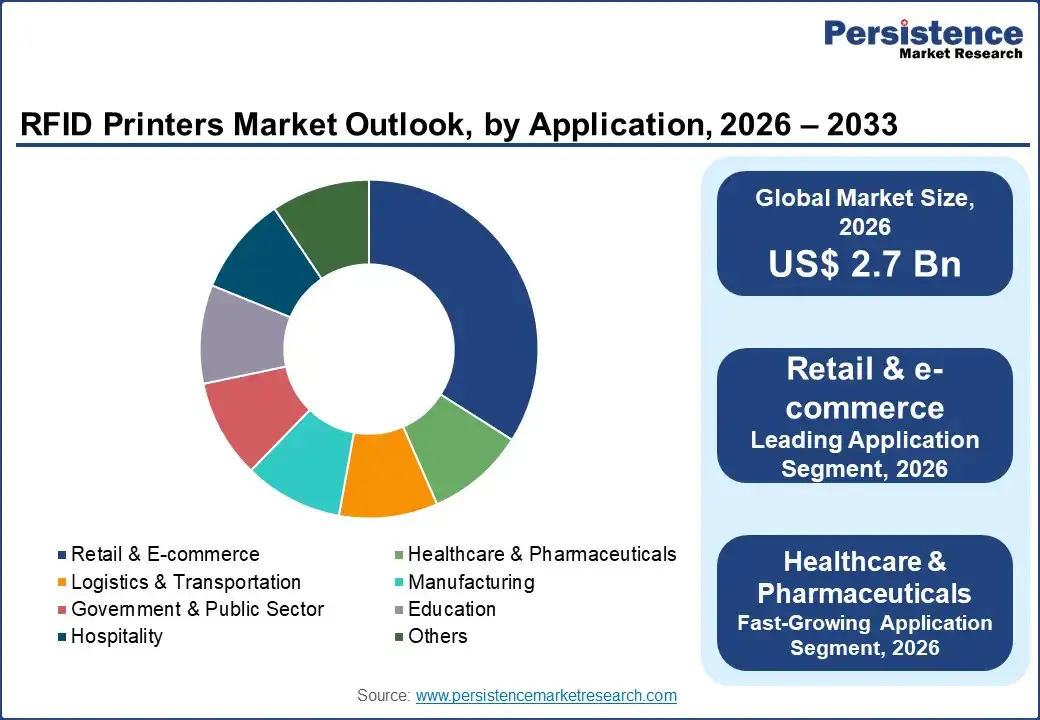
Retail & e-commerce applications lead the market, accounting for roughly 34% share in 2025, as omnichannel retailers adopt RFID infrastructure to enhance inventory visibility across stores, fulfillment centers, and warehouses. Major global retailers implement item-level tagging, enabling real-time tracking of billions of products and improving stock availability, replenishment accuracy, and sales performance. Fashion retailers particularly benefit from RFID’s ability to trace individual garments through complex supply chains, facilitating rapid style rotations and responsive inventory allocation. Studies show RFID adoption reduces stockouts by 20–25% and lowers inventory carrying costs by 15–20%, while addressing global apparel waste worth approximately $500 billion annually through more precise demand sensing.
Resolution Analysis
The 300–600 DPI resolution segment dominates with approximately 52% market share in 2025, offering a practical balance between print quality and RFID encoding performance. This range delivers clear barcodes, text, and graphics suitable for regulatory compliance while maintaining high printing throughput for operational efficiency. Widely adopted in healthcare and industrial applications, 300–600 DPI ensures legible patient wristbands, specimen labels, and durable product labels that withstand abrasion, temperature extremes, and chemical exposure. Standards bodies such as GS1 recommend 300 DPI for GS1-128 and DataMatrix barcodes, making this resolution ideal for environments where longevity, readability, and RFID functionality must coexist over extended product lifecycles.
Regional Insights
North America RFID Printers Market Trends and Insights
North America maintains regional dominance with approximately 36% market share in 2025, anchored by the United States' leadership in retail automation, pharmaceutical serialization compliance, and Department of Defense logistics modernization initiatives. The U.S. Department of Defense mandate requiring RFID tagging on all shipments exceeding $5,000 value has established standardized implementation frameworks that cascaded throughout commercial supply chains. Major technology adopters including Walmart, Boeing, and Johnson & Johnson operate expansive RFID deployments spanning thousands of facilities, creating demonstration effects that accelerate adoption among suppliers and competitors.
The regulatory environment significantly influences market dynamics, with the FDA's DSCSA requirements driving pharmaceutical RFID printer deployments across manufacturer facilities, wholesale distributors, and hospital pharmacies throughout compliance timelines extending through 2027. Canada's Health Products and Food Branch has implemented parallel requirements, creating harmonized North American pharmaceutical supply chain security standards.
Innovation ecosystems centered in Silicon Valley, Research Triangle Park, and Boston foster collaboration between RFID printer manufacturers, semiconductor companies producing specialized chips, and software vendors developing middleware solutions that collectively advance technological capabilities. According to Freight Waves, North American logistics operations process over 15 billion RFID-tagged pallets and cases annually, demonstrating the technology's entrenchment in regional supply chain infrastructure.
Europe RFID Printers Market Trends and Insights
European market development is characterized by stringent data privacy frameworks, sustainability mandates, and regulatory harmonization across 27 European Union member states that collectively shape RFID deployment strategies. Germany leads regional adoption through advanced manufacturing ecosystems where automotive, industrial equipment, and chemical sectors utilize RFID for work-in-progress tracking and quality traceability. Volkswagen Group, BMW, and Mercedes-Benz employ RFID printing solutions throughout production facilities to track components through complex assembly processes, ensuring quality documentation and facilitating recall management. The General Data Protection Regulation (GDPR) influences system architectures by mandating encrypted data storage and consumer consent mechanisms when RFID tags contain personal information.
United Kingdom retailers including Marks & Spencer and John Lewis have implemented comprehensive RFID programs across apparel categories, while the National Health Service explores RFID applications for medical device tracking and patient identification. France and Spain demonstrate growing adoption in luxury goods authentication and wine industry provenance tracking, where RFID-enabled labels combat counterfeiting threats that cost European luxury brands an estimated €60 billion annually according to the European Union Intellectual Property Office. The European Commission's Circular Economy Action Plan promotes product lifecycle tracking systems where RFID enables recycling and remanufacturing through automated identification of materials and components, creating new application opportunities for printer manufacturers developing solutions compatible with environmental sustainability objectives and extended producer responsibility regulations.
Asia Pacific RFID Printers Market Trends and Insights
Asia Pacific represents the fastest-growing region with projected CAGR exceeding 8.5% through 2033, propelled by manufacturing expansion, e-commerce proliferation, and smart city initiatives across China, India, Japan, and ASEAN nations. China dominates regional production, manufacturing approximately 70% of global RFID tags and housing major printer production facilities that supply domestic and international markets. The Ministry of Commerce of China promotes RFID adoption through national supply chain modernization programs supporting the country's transition toward high-value manufacturing and logistics services. Alibaba Group and JD.com operate automated fulfillment centers processing millions of RFID-tagged items daily, establishing operational benchmarks for regional e-commerce competitors.
Japan demonstrates technological leadership in developing miniaturized RFID solutions and high-resolution printing systems, with companies like Toshiba TEC and Sato Holdings pioneering innovations in printer-encoder integration and specialized applications for automotive and electronics manufacturing. India's rapidly expanding pharmaceutical manufacturing sector, positioned as the global leader in generic drug production supplying approximately 40% of U.S. generic demand according to PharmExcil, drives RFID printer adoption to meet export market serialization requirements.
The Association of Southeast Asian Nations economic integration facilitates cross-border trade requiring standardized identification systems, while government initiatives in Singapore, Thailand, and Vietnam promote smart manufacturing and logistics digitalization. Manufacturing cost advantages, expanding middle-class consumer markets, and infrastructure investments in ports, airports, and logistics parks collectively position Asia Pacific as the primary growth engine for global RFID printer market expansion.
Competitive Landscape
Market Structure Analysis
The RFID printers market is moderately consolidated, with leading industrial printer providers holding substantial market positions through strong patent portfolios, extensive installed bases, and robust service networks, while niche vendors focus on mobile and healthcare applications. Market players pursue vertically integrated strategies, combining inlay procurement, hardware engineering, and software solutions to deliver end-to-end printing and encoding systems compatible with enterprise infrastructure.
Competitive approaches center on expanding partnerships with system integrators and value-added resellers possessing domain expertise in retail, logistics, and healthcare. Differentiation is achieved through high reliability, multi-tag compatibility, ease of integration, and optimization of total cost of ownership via consumables efficiency and maintenance support. Innovation drives the adoption of cloud-enabled printers with predictive maintenance, mobile form factors for on-demand applications, and environmentally sustainable designs that reduce ribbon consumption and employ recyclable materials. Overall, the market favors providers capable of delivering comprehensive, reliable, and scalable solutions across diverse end-use industries.
Key Market Developments
- April?2025: Avery?Dennison opens its first RFID inlays and labels production facility in Pune, India, marking a strategic expansion that localizes manufacturing under the “Make in India” initiative to better serve South Asia’s growing RFID market.
- October?2025: Xerafy unveils the world’s thinnest Gen2X?enabled on?metal RAIN RFID labels, marking a breakthrough in ultra?thin, compact tagging solutions for space?constrained industrial and asset?dense applications.
- October?2025: Walmart and Avery?Dennison announce a first?to?market RFID?enabled labelling solution for fresh food categories including meat, bakery and deli to improve inventory management, boost freshness tracking and reduce food waste.
Companies Covered in RFID Printers Market
- Zebra Technologies Corporation
- Sato Holdings Corporation
- Honeywell International Inc.
- Toshiba Corp.
- Avery Dennison Corporation
- Seiko Epson Corporation
- Dascom
- Printronix Auto ID
- ID Technology LLC
- BIXOLON
- GoDEX International
- Star Micronics
- Wasp Barcode Technologies
- Primera Technology
- Brother International Corporation
- TSC Auto ID Technology
- Postek Electronics
- Cab Produkttechnik
- Xerafy
- Cognitive TPG
Frequently Asked Questions
The global RFID printers market is projected to reach approximately US$ 2.7 billion in 2026.
Key drivers include e-commerce expansion, regulatory requirements in pharmaceuticals, and Industry 4.0–driven automation.
North America leads the market, supported by strong regulatory compliance and large-scale retail RFID deployments.
Major opportunities arise from healthcare digitalization, Industry 4.0 integration, and sustainability-driven traceability initiatives.
Leading players include Zebra Technologies, Sato Holdings, Honeywell, Toshiba, Avery Dennison, Seiko Epson, and Printronix Auto ID.


