




- Rail
- Rail Fasteners Market
Rail Fasteners Market Size, Share, and Growth Forecast, 2026 – 2033
Rail Fasteners Market by Product Type (Rail Clip, Tie Plate, Dog Spike, Screw Spike, Rail Pad), Speed Type (Conventional Rail Fastening System, High-Speed Rail Fastening System), and Regional Analysis for 2026 – 2033

Rail Fasteners Market Size and Trends Analysis
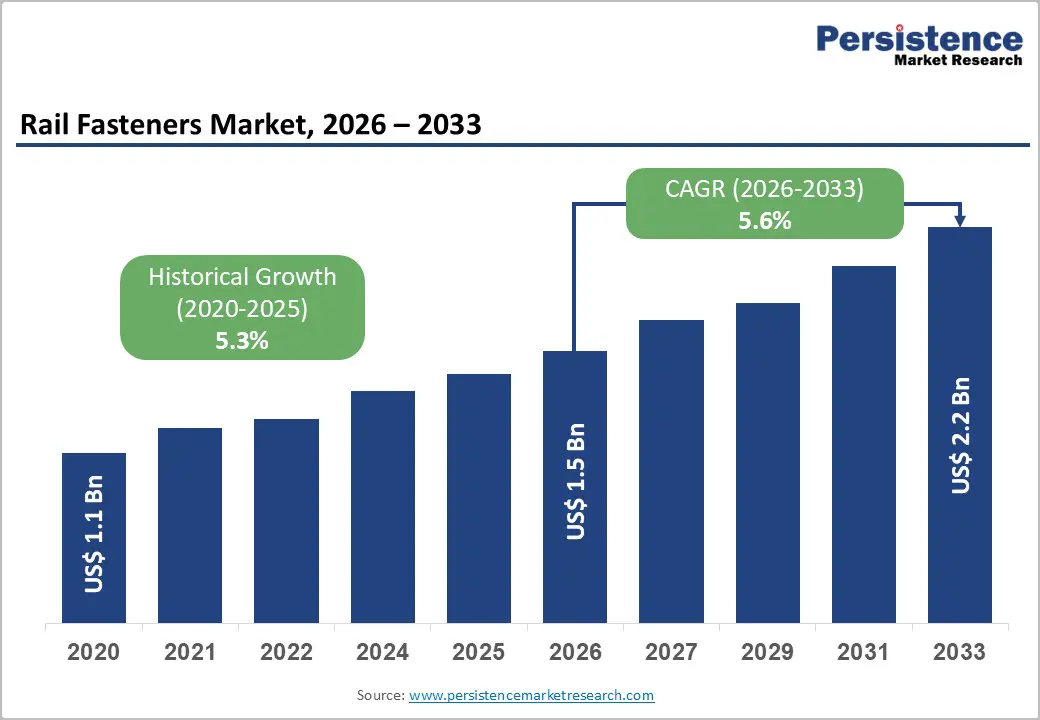
The global rail fasteners market size is likely to be valued at US$1.5 billion in 2026 and is expected to reach US$2.2 billion by 2033, growing at a CAGR of 5.6% during the forecast period from 2026 to 2033, driven by sustained investments in rail infrastructure worldwide, supported by rapid urbanization, rising passenger mobility, and increasing freight transportation demand.
Technological advancements in rail fastening systems, including elastic and high-performance fasteners, have significantly improved track stability, vibration control, and service life, thereby reducing maintenance requirements and operating costs. Stringent safety and sustainability regulations, such as standardized track component requirements enforced by the European Union Agency for Railways, are accelerating the adoption of advanced, compliant fastening solutions. Railway network expansion and modernization programs, particularly across Asia Pacific, Europe, and North America, continue to generate consistent demand for rail fastening systems.
Key Industry Highlights:
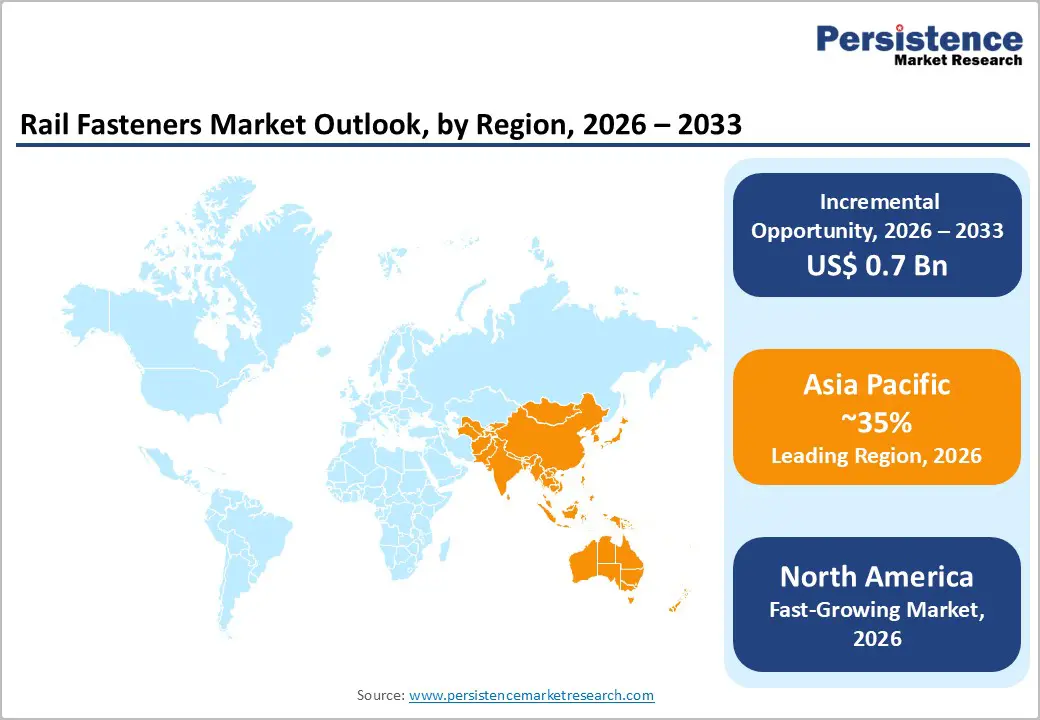
- Leading Region: Asia Pacific is expected to be the leading region, accounting for 35% market share in 2026, driven by extensive rail infrastructure expansion, rapid urbanization, high-speed rail projects, and strong government investment across China, India, Japan, and Southeast Asia.
- Fastest-growing Region: North America is likely to be the fastest-growing region, supported by large-scale rail infrastructure modernization, strong freight rail activity, supportive government investment programs, and strict safety regulations.
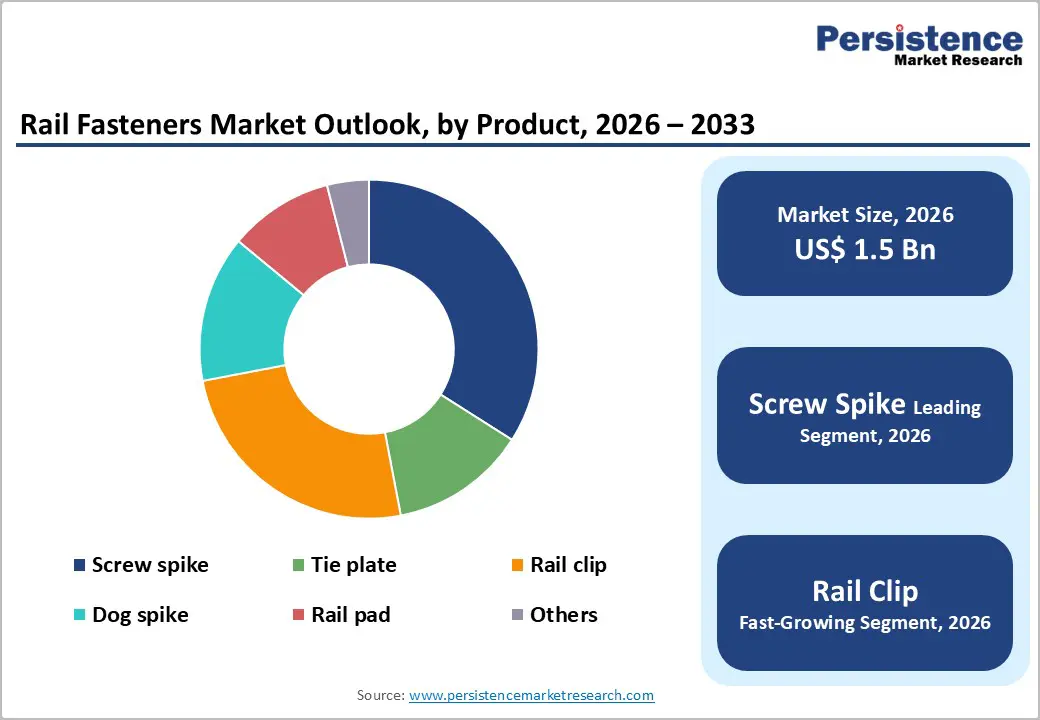
- Leading Product Type: Screw spike is projected to be the leading product type in 2026, accounting for 28% of revenue, driven by its strong holding capacity and widespread use across conventional and heavy-haul rail networks.
- Leading Speed Type: Conventional rail fastening systems are expected to be the leading speed type, accounting for over 75% of revenue share in 2026, supported by extensive deployment across existing freight and passenger rail networks, cost efficiency, and proven reliability in long-term track maintenance.
| Key Insights | Details |
|---|---|
| Rail Fasteners Market Size (2026E) | US$1.5 Bn |
| Market Value Forecast (2033F) | US$2.2 Bn |
| Projected Growth (CAGR 2026 to 2033) | 5.6% |
| Historical Market Growth (CAGR 2020 to 2025) | 5.3% |
Market Factors – Growth, Barriers, and Opportunity Analysis
Technological Advancements in High-Speed Rail Systems
Modern high-speed rail operations typically exceeding 250–300 km/h require advanced elastic rail fastening systems that deliver superior track stability, precise gauge control, and effective vibration and noise attenuation. Innovations such as high-performance spring clips, resilient rail pads, and corrosion-resistant coatings have significantly improved fastening durability while reducing track displacement and wear. These systems enhance rail-sleeper interaction, allowing tracks to maintain alignment under repeated stress cycles, which is essential to passenger safety and ride comfort. The integration of advanced materials, including engineered polymers and high-strength alloys, has increased fatigue resistance and extended service life, lowering lifecycle maintenance costs.
Digitalization and smart rail technologies are reinforcing the role of innovation in high-speed rail fastening systems, directly supporting market growth. Sensor-enabled and condition-monitoring fasteners are gaining traction, enabling real-time detection of stress, vibration, and loosening, which supports predictive maintenance strategies. This reduces unplanned downtime and enhances operational reliability, particularly on high-speed lines where maintenance windows are limited. Automated manufacturing processes and precision engineering have also improved dimensional accuracy and consistency, which are critical for high-speed applications with extremely tight tolerances. Regulatory bodies and rail operators increasingly favor fastening systems that meet enhanced safety, noise-reduction, and sustainability benchmarks.
High Maintenance Complexity in Extreme Operating Conditions
Rail fasteners installed in environments characterized by extreme temperatures, high humidity, corrosion, sand ingress, or freeze-thaw cycles are subject to accelerated wear, fatigue, and loosening. In heavy-haul freight corridors and high-speed rail lines, fasteners endure continuous dynamic stresses that increase the frequency of inspection, tightening, and replacement. These conditions elevate maintenance costs and require specialized equipment and skilled labor, placing financial pressure on rail operators. In developing regions, limited access to advanced maintenance technologies compounds the challenge, leading to delayed servicing and reduced fastener performance. Differing climatic conditions across regions necessitate customized fastening designs, increasing complexity for manufacturers and operators alike.
Maintenance complexity under extreme operating conditions affects network reliability and investment decisions, influencing procurement strategies across the market. In high-speed rail systems, even minor fastener degradation can compromise track geometry and safety, requiring frequent monitoring and preventive maintenance. This creates operational disruptions, especially where rail corridors operate at high capacity with limited maintenance windows. Coastal and industrial regions face corrosion-related challenges from saline exposure and chemical pollutants, reducing fastener service life and increasing replacement cycles. In freight-dominated networks, heavy axle loads accelerate material fatigue, requiring robust fastening systems that are more costly to install and maintain.
Sustainability-Driven Innovations and High-Speed Rail Adoption
Rail fastener manufacturers are focusing on eco-friendly materials, including recycled steel, bio-based polymers, and composite rail pads, to reduce carbon footprints while maintaining high mechanical strength. These innovations align with sustainability frameworks and stricter environmental regulations, particularly in Europe and the Asia-Pacific, where green procurement policies are influencing infrastructure spending. Sustainable fastening systems also offer extended service life and improved resistance to corrosion and fatigue, lowering long-term maintenance requirements and lifecycle costs. This encourages adoption across both new rail projects and track renewal programs. Lightweight and modular fastener designs reduce material consumption and transportation emissions, supporting sustainability objectives.
High-speed rail adoption creates new market opportunities, as next-generation rail networks require advanced fastening solutions that deliver superior performance under extreme dynamic conditions. High-speed rail systems demand fasteners with enhanced vibration damping, precise track alignment, and long-term structural integrity to ensure safety and passenger comfort. Sustainability and performance converge in these applications, as operators seek fastening systems that reduce noise pollution, minimize maintenance interventions, and support energy-efficient operations. Investments in high-speed rail corridors across Asia Pacific, Europe, and parts of North America are accelerating the adoption of technologically advanced and sustainable fastening systems.
Category-wise Analysis
Product Type Insights
Screw spikes are projected to dominate the rail fasteners market, accounting for approximately 28% of revenue in 2026. This is due to their exceptional mechanical grip, reliability, and versatility across a range of rail applications. Commonly used in conventional rail systems and freight corridors, screw spikes are crucial for ensuring track stability and long-term durability. Their threaded design offers superior resistance to loosening under dynamic loads, making them ideal for mixed-traffic routes that undergo frequent stress. Screw spikes are preferred for maintenance and replacement projects because they are easier to remove and reinstall than traditional spikes. For instance, they are widely utilized in North American freight rail networks, where operators prioritize fastening solutions that provide consistent gauge control and minimize track movement.
Rail clips are expected to be the fastest-growing segment, driven by their increasing use in modern rail infrastructure and high-performance track systems. These fasteners are designed to provide elastic restraint, offering effective vibration damping, noise reduction, and enhanced ride comfort—features that are increasingly important in passenger and high-speed rail projects. Rail clips help maintain precise rail positioning while allowing for thermal expansion and contraction, which contributes to greater track durability and safety. For instance, their widespread adoption in newly constructed metro and high-speed rail lines across the Asia-Pacific region, where elastic fastening systems are standard, underscores their growing importance. Rail clips are gaining popularity due to regulatory requirements focused on safety, reduced maintenance needs, and improved track resilience.
Speed Type Insights
Conventional rail fastening systems are expected to dominate the market, accounting for approximately 75% of the revenue share by 2026, due to their widespread use in existing rail networks. These systems are commonly found in freight rail, regional passenger services, and urban transit networks, where moderate operational speeds and cost efficiency are top priorities. Conventional fasteners are favored for their proven reliability, ease of maintenance, and compatibility with existing infrastructure, making them the go-to solution for track renewal and rehabilitation projects. For instance, they remain widely used on European regional rail lines, where operators prioritize reliability and standardized components to manage high rail traffic volumes.
High-speed rail fastening systems are expected to be the fastest-growing segment by 2026, driven by increasing investments in modern rail corridors and next-generation transportation infrastructure. These systems are designed to meet stringent performance standards, providing superior stability, vibration control, and precise track alignment under high dynamic loads. High-speed rail fasteners are increasingly specified in new rail projects where safety, passenger comfort, and long-term performance are paramount. For example, their adoption in newly launched high-speed rail corridors across East Asia highlights the importance of advanced fastening technologies in system design. The growing shift toward high-speed rail as a sustainable alternative to air and road transport is further fueling the demand for specialized fastening solutions.
Regional Insights
North America Rail Fasteners Market Trends
North America is expected to be the fastest-growing region in the rail fasteners market by 2026, driven by ongoing investments in rail infrastructure modernization and the growing demand for reliable track components that improve safety and operational efficiency. This growth is fueled by substantial federal funding programs and urban transit upgrades in the U.S. and Canada, which are encouraging the replacement of aging fastening systems with advanced, vibration-dampening solutions. There is a growing focus on durable components that can withstand heavy freight traffic, extreme axle loads, and diverse climatic conditions, driving increased demand for high-performance elastic and modular fasteners along key rail corridors. This trend is further supported by advanced regulatory frameworks that promote maintenance cost reduction and long-term reliability, extending service intervals and enhancing rail network performance.
As North American rail operators balance the increasing needs of commuter and freight services, they are increasingly adopting fastening systems that ensure strong gauge retention and minimize downtime. A notable example is L.B. Foster Company, which has strategically expanded its rail components portfolio to support track renewal and upgrade projects across North America. The company's development of automated torque calibration devices and its collaborations with infrastructure contractors reflect a broader focus on precision installation and operational efficiency in both freight and passenger rail applications. This strategic approach strengthens its competitive edge, helping rail authorities meet stringent performance and safety standards while reducing lifecycle costs.
Europe Rail Fasteners Market Trends
Europe is expected to be a key market for rail fasteners in 2026, driven by strong sustainability mandates that prioritize reliability, safety, and reduced lifecycle costs. The region accounts for a significant share of global demand for rail fastening systems, thanks to its well-established rail infrastructure and proactive public policies that promote environmentally friendly and efficient passenger and freight transport solutions. Countries such as Germany, France, and the U.K. play a major role in regional consumption, supported by ongoing upgrades to conventional rail lines and the expansion of cross-border high-speed rail connections.
The European Union’s Trans-European Transport Network (TEN-T) and other regional initiatives are allocating substantial funding for infrastructure projects, often including advanced elastic and composite fastening systems to enhance vibration control, noise reduction, and track durability. A notable example is Vossloh AG, a leading German rail technology company that supplies advanced rail fastening systems and components throughout the region. Vossloh’s product lineup includes maintenance-free elastic clips, modular fastening systems, and customized solutions designed to meet the demanding performance standards of high-speed and heavy-haul rail networks.
Asia Pacific Rail Fasteners Market Trends
Asia-Pacific is expected to be the leading region, accounting for 35% in 2026, driven by extensive rail infrastructure investments, high-speed rail deployment, and rapid urbanization across major economies. Countries such as China, India, Japan, and Southeast Asian nations are investing heavily in both passenger and freight rail projects, creating sustained demand for high-performance fastening solutions. For example, CRRC Corporation Limited has leveraged its extensive manufacturing base to supply rail fasteners and track components for large-scale high-speed rail and metro projects across the Asia Pacific, aligning with rising infrastructure activity and performance expectations.
Rail operators in the region increasingly specify fastening systems designed for reduced lifecycle costs, lower environmental impact, and enhanced operational reliability. This includes fasteners with improved corrosion resistance, low-noise profiles, and greater tolerance for dynamic forces encountered in high-speed and heavy-haul applications. The shift toward electrified and high-speed corridors has emphasized the need for fastening technologies that deliver higher precision and durability under increased thermal and mechanical stress. For example, AGICO Group, a prominent Asia-Pacific rail components manufacturer, introduced advanced fastening solutions tailored to high-speed and urban rail projects, integrating design enhancements that meet performance and sustainability benchmarks.
Competitive Landscape
The global rail fasteners market is moderately fragmented, with well-established multinational manufacturers and a broad base of regional and niche suppliers competing for contracts across conventional, high-speed, and urban transit rail segments. Industry participants are increasingly focused on technological innovation, product quality, and geographic expansion to meet diverse infrastructure requirements worldwide. Established firms leverage their extensive product portfolios, R&D capabilities, and distribution networks to secure major rail infrastructure contracts, while regional players emphasize cost-competitive offerings and localized solutions to capture emerging market demand.
With key leaders including Pandrol, Vossloh AG, and L.B. Foster Company, the rail fasteners market's competitive landscape reflects both concentrated influence and dynamic rivalry. These companies maintain strong market positions through diversified product lines that address applications from heavy-haul freight to high-speed and metro networks. These players compete by continuously investing in research and development, building strategic partnerships, and enhancing after-sales support, all aimed at delivering integrated solutions tailored to evolving customer needs. Firms pursue mergers, acquisitions, and localized manufacturing to expand capabilities, strengthen supply chain resilience, and enhance responsiveness to market trends and regulatory shifts.
Key Industry Developments:
- In May 2025, voestalpine Fastening Systems Sp. z o.o. launched the SBW4 rail fastening system in Poland, an upgraded version of the long-standing SBW3 system. The new SBW4 addresses key challenges in assembly ergonomics, electrical resistance, and material efficiency, while being fully compatible with automated installation processes. Designed for fastening rails to prestressed concrete sleepers, the system delivers improved performance while delivering economic and environmental benefits, reinforcing Voestalpine’s commitment to modernizing railway infrastructure.
- In April 2025, voestalpine Railway Systems launched the G9 Rail Clip, a next-generation rail fastening solution. The G9 clip features an innovative asymmetrical geometry that optimizes stress distribution, enhances elasticity, and allows reliable fixation across diverse installation scenarios. Combining the strengths of SKL tension and tilt protection with the ease of boltless clips, the modular G9 design simplifies both installation and maintenance while delivering superior performance and durability.
Companies Covered in Rail Fasteners Market
- Vossloh
- Pandrol
- LB Foster Rail Products
- Cooper & Turner Limited
- Taicang Zhongbo Railway Fastening Co., Ltd
- MNP
- Pankaj Steel Industries
- Eastern Trading Corporation
- VJ Sourcing and Services
- Hamidi Exports
- Capital Bolts and Hardwares
- Fasteners India
- Brainard Rivet Co.
- Js Group
- General Industries
- Midas Industrial Product
Frequently Asked Questions
The global rail fasteners market is projected to reach US$1.5 billion in 2026.
The rail fasteners market is driven by expanding rail infrastructure, high-speed rail adoption, and the need for durable, low-maintenance track fastening solutions.
The rail fasteners market is expected to grow at a CAGR of 5.6% from 2026 to 2033.
High-speed rail expansion, sustainable and advanced fastening technologies, and rail infrastructure modernization in emerging and developed regions.
Vossloh, Pandrol, LB Foster Rail Products, Cooper & Turner Limited, and Taicang Zhongbo Railway Fastening Co. are the leading players.


