Hydrogen Tube Trailer Market Size, Share, Trends, Growth, Regional Forecasts 2026 - 2033

Hydrogen Tube Trailer Market by Trailer Type (Modular Tube Trailer, Intermediate Trailer, Jumbo Tube Trailer), Pressure Rating (Below 250 Bar, 250 to 500 Bar, Above 500 Bar), Application (Industrial Use, Hydrogen Fuel Stations), and Regional Analysis for 2026 - 2033

ID: PMRREP35124
Calendar

March 2026

188 Pages

Author : Rajat Zope

Key Industry Highlights:

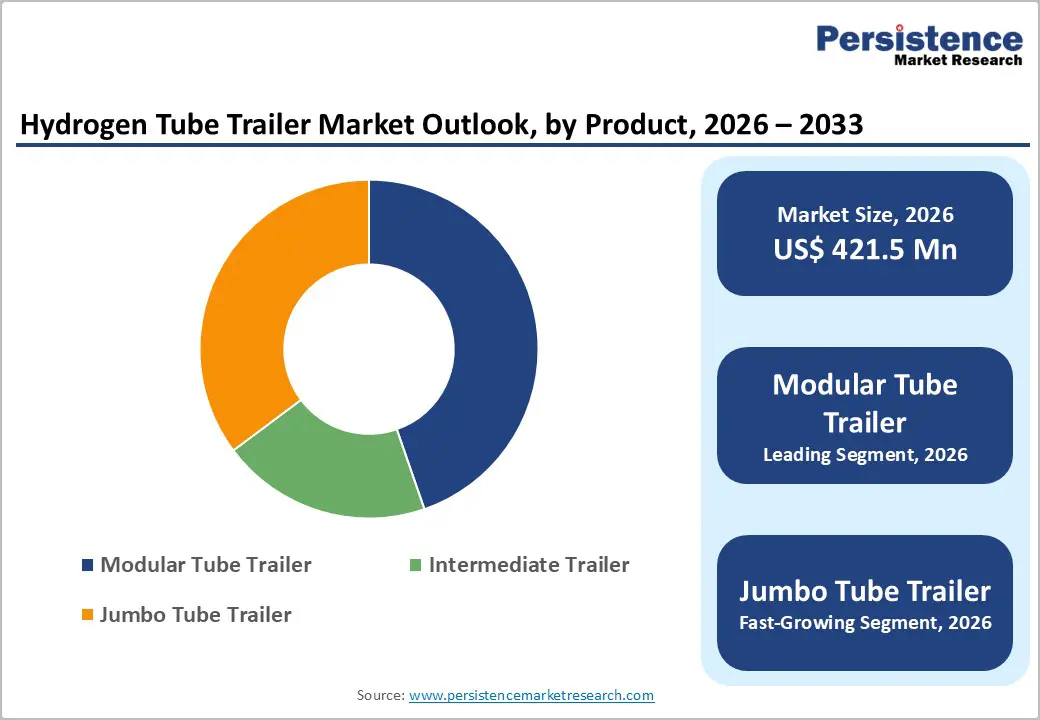
  • Modular tube trailers dominate the market with nearly 45% share, while jumbo trailers are witnessing the fastest growth at 8.3% CAGR due to rising demand for higher hydrogen payload transportation.
  • 250-500 bar pressure trailers account for around 40% of market demand, whereas above-500 bar systems are expanding at 8.2% CAGR, supported by advancements in composite cylinder technologies.
  • Industrial applications contribute about 54% of total demand, but hydrogen fuel stations are emerging as the fastest-growing application, projected to expand at 8.8% CAGR with accelerating station deployments.
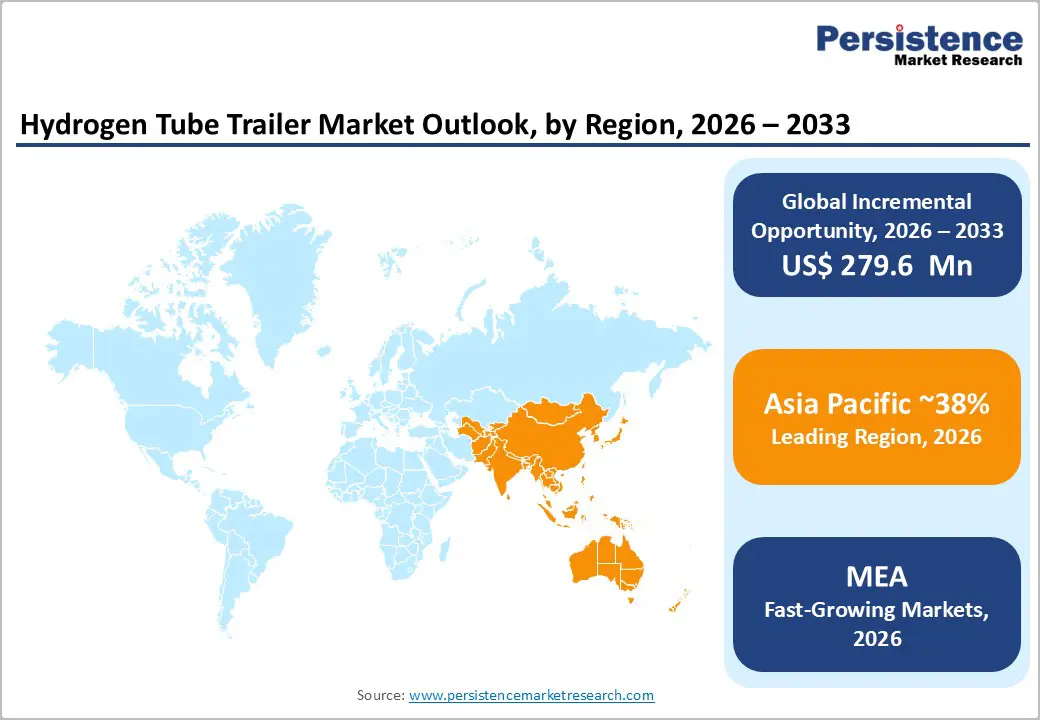
  • Asia Pacific leads the global market with roughly 38% share, while Europe is projected to grow steadily at 7.3% CAGR, driven by strong hydrogen policies and infrastructure investments.
Key Insights Details
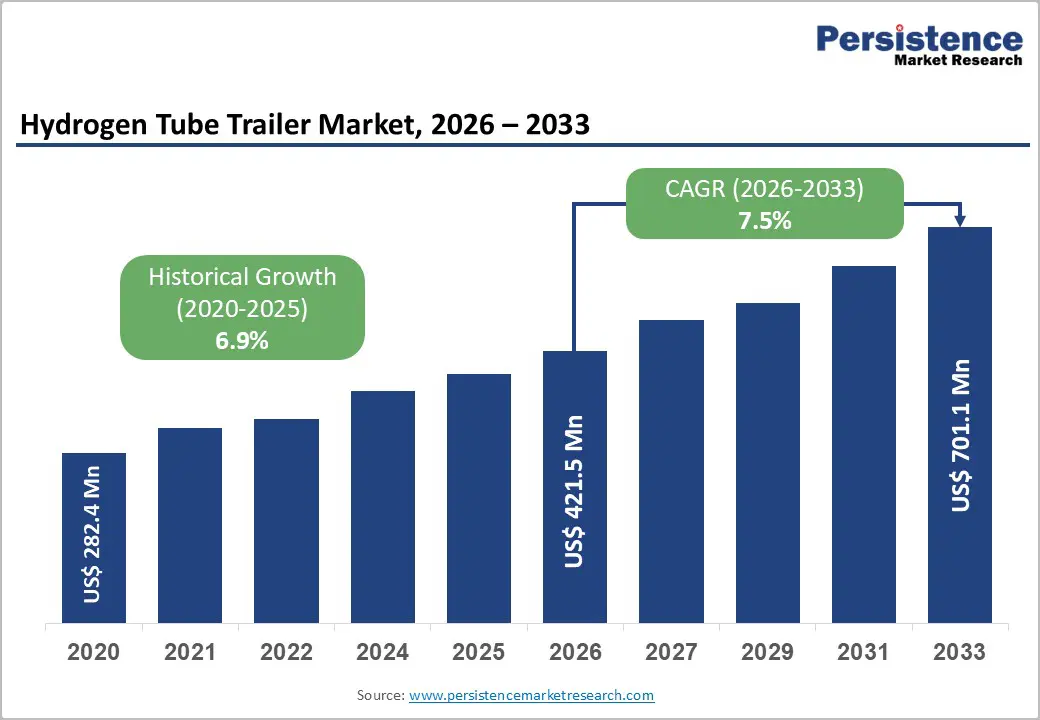
Hydrogen Tube Trailer Market Size (2026E) US$ 421.5 million
Market Value Forecast (2033F) US$ 701.1 million
Projected Growth CAGR (2026 - 2033) 7.5%
Historical Market Growth (2020 - 2025) 6.9%

hydrogen-tube-trailer-market-2026-2033

Market Dynamics Analysis

Drivers - Accelerating Hydrogen Infrastructure Development

Government-backed hydrogen roadmaps across major economies are catalyzing significant investments in hydrogen transport and distribution infrastructure. The European Union's Hydrogen Strategy targets 40 GW of electrolyzer capacity by 2030, necessitating extensive tube trailer fleets for last-mile hydrogen delivery. The U.S. Department of Energy's Hydrogen Shot initiative aims to reduce clean hydrogen costs to US$ 1/kg within a decade, prompting expanded logistics networks. Japan's hydrogen supply chain development program has allocated over US$ 3.4 Bn through 2030. These public investments are directly stimulating tube trailer procurement across industrial gas distributors, energy companies, and logistics providers globally, with demand expected to intensify as electrolyzer output scales considerably.

Decarbonization Mandates and Emission Regulations

Stringent carbon reduction targets are compelling industries to transition from fossil-based fuels toward clean hydrogen, amplifying tube trailer demand. The EU's Fit for 55 package mandates a 55% reduction in greenhouse gas emissions by 2030, with hydrogen positioned as a cornerstone decarbonization vector for hard-to-abate sectors including steelmaking, ammonia production, and heavy transport. China's 14th Five-Year Plan explicitly targets 1 million hydrogen fuel cell vehicles by 2030, creating substantial demand for high-pressure tube trailers. South Korea's Hydrogen Economy Roadmap commits to deploying 15,000 hydrogen buses and 200 hydrogen refueling stations, further amplifying logistical infrastructure requirements and underpinning robust medium-to-long-term procurement cycles for tube trailer manufacturers.

Restraints - High Capital Investment and Certification Costs

The production of high-pressure tube trailers involves substantial capital expenditures in specialized materials, including CFRP composites and precision-engineered valves, alongside rigorous certification processes mandated by bodies such as the UN ECE R134, ISO 11515, and DOT regulations. Certification compliance can add 15 to 25% to per-unit manufacturing costs, creating significant barriers for new market entrants and constraining capacity expansion among smaller regional players. These cost pressures limit market accessibility, particularly in price-sensitive emerging economies where infrastructure budgets remain constrained.

Pipeline Hydrogen Infrastructure as Competing Alternative

The expanding development of dedicated hydrogen pipeline networks in Europe and Asia poses a medium-term displacement risk for tube trailer logistics. Germany's planned 9,700 km hydrogen pipeline network, targeted for completion by 2032, alongside similar pipeline initiatives in the Netherlands and Belgium, may reduce dependence on mobile tube trailer distribution in densely industrial regions. For large-volume, fixed-route hydrogen delivery, pipeline economics become favorable beyond a threshold volume, potentially limiting tube trailer market expansion in high-pipeline-density geographies over the forecast horizon.

Opportunities - Green Hydrogen Export Corridors and Cross-Border Logistics

Emerging green hydrogen export corridors between hydrogen-surplus nations and industrial import hubs present a significant untapped opportunity. Australia-Japan, Chile-Germany, and MENA-EU green hydrogen trade lanes are actively developing distribution logistics frameworks where tube trailers serve as critical short-to-medium haul connectors. The International Energy Agency (IEA) projects global hydrogen trade flows to reach 150 Mt/year by 2050. Tube trailers operating in port logistics, connecting hydrogen import terminals to downstream consumers, represent a growing incremental market estimated to contribute meaningfully to overall trailer demand across the 2026-2033 forecast period.

Industrial Decarbonization in Emerging Economies

Rapidly industrializing economies across Southeast Asia, India, and Latin America are formulating national hydrogen strategies that will necessitate cost-effective distribution solutions. India's National Green Hydrogen Mission targets 5 MMT of green hydrogen annual production by 2030, creating significant distribution infrastructure requirements. In these markets, tube trailers offer a practical alternative to capital-intensive pipeline networks during early infrastructure development stages. The combination of growing industrial hydrogen consumption in refining, fertilizers, and chemicals, alongside nascent FCEV ecosystems, positions emerging economies as the next high-growth frontier for hydrogen tube trailer manufacturers and distributors through 2033.

Category-wise Analysis

Trailer Type Insights

Modular tube trailers lead with approximately ~45% market share, favored for their flexibility in configuration, ease of maintenance and compatibility with standard chassis across diverse applications. Typically featuring 4-6 tubes at 250-500 bar, they dominate short- to medium-haul routes serving industrial sites and fuel stations where payload optimization balances with regulatory weight limits. Their standardized design facilitates rapid deployment and scalability for fleet operators transitioning from legacy gas transport.

Jumbo tube trailers emerge as the fastest-growing type at ~8.3% CAGR to 2033, driven by demand for higher capacities exceeding 1 ton H2 per load in extended-range fuel station and industrial supply chains. Advances in 45-foot carbon fiber composites at >500 bar enable 20-30% payload gains over modular units, aligning with infrastructure scaling and cost-per-kg reductions essential for commercial viability.

Pressure Rating Insights

The 250 to 500 bar segment commands ~40% market share, striking a balance between payload efficiency and manufacturing costs for prevalent industrial and station applications. Operating pressures around 300-450 bar support payloads of 400-800 kg H2, suiting most current refilling infrastructure and tube materials while complying with major transport codes like ADR. This rating prevails in modular and intermediate trailers where volumetric density meets typical route economics without excessive complexity.

Above 500 bar ratings will grow fastest at ~8.2% CAGR, propelled by composite tube innovations enabling >1 ton capacities and longer ranges critical for hub-to-hub logistics. As stations upgrade compressors and steel decarbonizes via blue/green hydrogen, high-pressure trailers reduce delivery frequency by 25%, optimizing fleet productivity amid tightening emissions rules.

Application Insights

Industrial use dominates with ~54% market share, reflecting hydrogen's entrenched role in refining, chemicals, glass and electronics where tube trailers bridge production to consumption sites absent pipelines. Reliable delivery of compressed H2 at scale underpins processes like ammonia synthesis and methanol production, with fleets ensuring >95% uptime critical for continuous operations.

Hydrogen fuel stations grow fastest at ~8.8% CAGR, fueled by FCEV deployments targeting >40,000 vehicles by 2030 and station networks expanding in Europe, California and Asia. High-frequency, just-in-time deliveries demand agile modular/jumbo trailers, creating opportunities for specialized fleets integrated with station digital management.
hydrogen-tube-trailer-market-outlook-by-product-2026-2033

Regional Market Insights

North America Hydrogen Tube Trailer Market Share and Trends

North America holds approximately 27% of the global hydrogen tube trailer market in 2026, underpinned by the United States' dominant position as the region's primary hydrogen consumer and distribution infrastructure developer. The U.S. market benefits from substantial federal support through the Inflation Reduction Act's US$ 3/kg hydrogen production tax credit (45V provision), directly incentivizing green hydrogen production scale-up and associated distribution logistics demand. Industrial hydrogen consumption in Gulf Coast refining, ammonia production, and emerging hydrogen mobility corridors in California and the Northeast drives consistent tube trailer procurement. Canada's growing clean hydrogen export ambitions, particularly from Alberta and British Columbia, further expand regional market scope through 2033.

The regulatory framework governed by DOT, PHMSA, and CGA standards provides a structured certification environment supporting market confidence. Strong industrial gas sector players and active venture investment in hydrogen mobility infrastructure present clear expansion opportunities for tube trailer manufacturers in the region through 2033.

Europe Hydrogen Tube Trailer Market Share and Trends

Europe is a strategically important hydrogen tube trailer market, growing at a prominent CAGR of 7.3% through 2033, driven by the EU's comprehensive hydrogen policy ecosystem. Germany leads regional demand, with its National Hydrogen Strategy allocating EUR9 Bn in public investment and a strong industrial hydrogen base in chemical and steel sectors. France's hydrogen plan committing EUR7.2 Bn and the U.K.'s Hydrogen Strategy targeting 10 GW of production capacity by 2030 are expanding distribution requirements. Spain's emerging role as a green hydrogen export hub targeting North African-sourced hydrogen inflows further amplifies trailer logistics demand across Iberian distribution networks.

Regulatory harmonization under EU pressure vessel directives and ADR transport regulations streamlines cross-border tube trailer operations. Competitive dynamics are shaped by established industrial gas multinationals and a growing cohort of specialized European tube trailer manufacturers leveraging advanced composites manufacturing capabilities.

Asia Pacific Hydrogen Tube Trailer Market Share and Trends

Asia Pacific is the leading region globally, commanding approximately 38% of global market share in 2026, propelled by China, Japan, South Korea, and India's ambitious hydrogen economy programs. China's hydrogen strategy targeting 1 million FCEVs and 1,000 refueling stations by 2025 has accelerated tube trailer fleet expansion across eastern industrial corridors. Japan's hydrogen society roadmap and well-established FCEV deployment, with over 160 operational HRS, sustains consistent demand. South Korea's Hydrogen Economy Roadmap commits to 15,000 hydrogen buses by 2030. India's National Green Hydrogen Mission is emerging as a significant growth catalyst, with distribution infrastructure at early-stage development but accelerating rapidly.

Asia Pacific's manufacturing cost advantages, high-density industrial hydrogen consumption clusters, and proactive government co-investment in hydrogen logistics infrastructure solidify the region's market leadership position. Competitive intensity is high, with domestic Chinese manufacturers gaining share through cost-competitive offerings.
hydrogen-tube-trailer-market-outlook-by-region-2026-2033

Competitive Landscape

Market leaders are pursuing innovation-led differentiation through advanced composite cylinder integration, IoT-enabled fleet management, and strategic geographic expansion into high-growth Asia Pacific and European corridors. Cost leadership through manufacturing scale and supply chain localization complements premium positioning in safety-critical, high-pressure segments. Emerging business models increasingly emphasize trailer-as-a-service and long-term hydrogen logistics contracts aligned with offtake agreements.

Strategic Developments

  • In May 2024, Calvera Hydrogen developed a 45-foot tube trailer with >1 ton H2 capacity at 517 bar for Shell Hydrogen, enabling global station servicing with highest-pressure certification.
  • In October 2023, Calvera reported surging orders for 30 MPa trailers amid European bus/truck adoption, scaling production for urban hydrogen logistics demands.
  • In August 2023, FIBA Technologies invested in next-gen valves, targeting 20% maintenance reductions for high-utilization industrial trailer operations worldwide.

Companies Covered in Hydrogen Tube Trailer Market

  • Chart Industries
  • Hexagon Purus
  • Linde Group
  • CIMC Enric Holdings
  • Weldship Group
  • BayoTech
  • Nishal Group
  • Nanliang Pressure Vessel (Shanghai)
  • Shanghai Pujiang Special Gas
  • Sinoma Science & Technology
  • Luxfer Gas Cylinders
  • Calvera Hydrogen
  • FIBA Technologies
  • Xinxiang Chengde Energy
  • Qingdao Eleph Industry & Trade
Frequently Asked Questions

The global Hydrogen Tube Trailer Market stands at US$ 421.5 million in 2026, expanding to US$ 701.1 million by 2033 amid infrastructure scaling.

Key drivers include surging hydrogen demand to 179.9 MT by 2030, policy investments like U.S. $9.5B hubs and composite tech enabling >1-ton payloads.

The market anticipates 7.5% CAGR from 2026-2033, building on 6.9% historical growth fueled by fuel stations and industrial corridors.

Opportunities center on fuel station networks (>1,000 by 2025), industrial corridors and jumbo trailers at 8.3% CAGR for Asia Pacific dominance.

Leading players encompass Chart Industries, Hexagon Purus, Linde Group, CIMC Enric, Weldship, BayoTech and Chinese manufacturers like Nanliang and Sinoma.

Global Hydrogen Tube Trailer Market Report Scope
Report Attribute Details
Historical Data/Actuals 2020 - 2025
Forecast Period 2026 - 2033
Market Analysis Units Value: US$ Bn/Mn, Volume: As applicable
Geographical Coverage
  • North America
  • Europe
  • East Asia
  • South Asia and Oceania
  • Latin America
  • Middle East and Africa
Segmental Coverage
  • Type Coverage
  • Capacity
  • Application
  • Region
Competitive Analysis
  • Chart Industries
  • Hexagon Purus
  • Linde Group
  • CIMC Enric Holdings
  • Weldship Group
  • BayoTech
  • Nishal Group
  • Nanliang Pressure Vessel (Shanghai)
  • Shanghai Pujiang Special Gas
  • Sinoma Science & Technology
  • Luxfer Gas Cylinders
  • Calvera Hydrogen
  • FIBA Technologies
  • Xinxiang Chengde Energy
  • Qingdao Eleph Industry & Trade
Report Highlights
  • Market Forecast and Trends
  • Competitive Intelligence & Share Analysis
  • Growth Factors and Challenges
  • Strategic Growth Initiatives
  • Pricing Analysis & Technology Roadmap
  • Future Opportunities and Revenue Pockets
  • Market Analysis Tools
Market Segmentation

By Type Coverage

  • Modular Tube Trailer
  • Intermediate Trailer
  • Jumbo Tube Trailer

By Capacity

  • Below 250 Bar
  • 250 to 500 Bar
  • Above 500 Bar

By Application

  • Industrial Use
  • Hydrogen Fuel Stations

By Region

  • North America
  • Europe
  • East Asia
  • South Asia and Oceania
  • Latin America
  • Middle East and Africa

Related Reports

  1. Executive Summary
    1. Global Hydrogen Tube Trailer Market Snapshot 2026 and 2033
    2. Market Opportunity Assessment, 2026-2033, US$ Bn
    3. Key Market Trends
    4. Industry Developments and Key Market Events
    5. Demand Side and Supply Side Analysis
    6. PMR Analysis and Recommendations
  2. Market Overview
    1. Market Scope and Definitions
    2. Value Chain Analysis
    3. Macro-Economic Factors
      1. Global GDP Outlook
      2. Global Energy Transition & Hydrogen Economy Overview
      3. Global Automotive & Hydrogen Mobility Industry Overview
      4. Global Industrial Gas Industry Overview
      5. Global Logistics & Gas Distribution Infrastructure Overview
    4. Forecast Factors - Relevance and Impact
    5. COVID-19 Impact Assessment
    6. PESTLE Analysis
    7. Porter's Five Forces Analysis
    8. Geopolitical Tensions: Market Impact
    9. Regulatory and Technology Landscape
  3. Market Dynamics
    1. Drivers
    2. Restraints
    3. Opportunities
    4. Trends
  4. Price Trend Analysis, 2020 - 2033
    1. Region-wise Price Analysis
    2. Price by Segments
    3. Price Impact Factors
  5. Global Hydrogen Tube Trailer Market Outlook: Historical (2020 - 2025) and Forecast (2026 - 2033)
    1. Key Highlights
    2. Global Hydrogen Tube Trailer Market Outlook: Trailer Type
      1. Introduction/Key Findings
      2. Historical Market Size (US$ Bn) and Volume (Tons) Analysis by Trailer Type, 2020-2025
      3. Current Market Size (US$ Bn) and Volume (Tons) Forecast, by Trailer Type, 2026-2033
        1. Modular Tube Trailer
        2. Intermediate Trailer
        3. Jumbo Tube Trailer
      4. Market Attractiveness Analysis: Trailer Type
    3. Global Hydrogen Tube Trailer Market Outlook: Pressure Rating
      1. Introduction/Key Findings
      2. Historical Market Size (US$ Bn) and Volume (Tons) Analysis by Pressure Rating, 2020-2025
      3. Current Market Size (US$ Bn) and Volume (Tons) Forecast, by Pressure Rating, 2026-2033
        1. Below 250 Bar
        2. 250 to 500 Bar
        3. Above 500 Bar
      4. Market Attractiveness Analysis: Pressure Rating
    4. Global Hydrogen Tube Trailer Market Outlook: Application
      1. Introduction/Key Findings
      2. Historical Market Size (US$ Bn) and Volume (Tons) Analysis by Application, 2020-2025
      3. Current Market Size (US$ Bn) and Volume (Tons) Forecast, by Application, 2026-2033
        1. Industrial Use
        2. Hydrogen Fuel Stations
      4. Market Attractiveness Analysis: Application
  6. Global Hydrogen Tube Trailer Market Outlook: Region
    1. Key Highlights
    2. Historical Market Size (US$ Bn) and Volume (Tons) Analysis by Region, 2020-2025
    3. Current Market Size (US$ Bn) and Volume (Tons) Forecast, by Region, 2026-2033
      1. North America
      2. Europe
      3. East Asia
      4. South Asia & Oceania
      5. Latin America
      6. Middle East & Africa
    4. Market Attractiveness Analysis: Region
  7. North America Hydrogen Tube Trailer Market Outlook: Historical (2020 - 2025) and Forecast (2026 - 2033)
    1. Key Highlights
    2. Pricing Analysis
    3. North America Market Size (US$ Bn) and Volume (Tons) Forecast, by Country, 2026-2033
      1. U.S.
      2. Canada
    4. North America Market Size (US$ Bn) and Volume (Tons) Forecast, by Trailer Type, 2026-2033
      1. Modular Tube Trailer
      2. Intermediate Trailer
      3. Jumbo Tube Trailer
    5. North America Market Size (US$ Bn) and Volume (Tons) Forecast, by Pressure Rating, 2026-2033
      1. Below 250 Bar
      2. 250 to 500 Bar
      3. Above 500 Bar
    6. North America Market Size (US$ Bn) and Volume (Tons) Forecast, by Application, 2026-2033
      1. Industrial Use
      2. Hydrogen Fuel Stations
  8. Europe Hydrogen Tube Trailer Market Outlook: Historical (2020 - 2025) and Forecast (2026 - 2033)
    1. Key Highlights
    2. Pricing Analysis
    3. Europe Market Size (US$ Bn) and Volume (Tons) Forecast, by Country, 2026-2033
      1. Germany
      2. Italy
      3. France
      4. U.K.
      5. Spain
      6. Russia
      7. Rest of Europe
    4. Europe Market Size (US$ Bn) and Volume (Tons) Forecast, by Trailer Type, 2026-2033
      1. Modular Tube Trailer
      2. Intermediate Trailer
      3. Jumbo Tube Trailer
    5. Europe Market Size (US$ Bn) and Volume (Tons) Forecast, by Pressure Rating, 2026-2033
      1. Below 250 Bar
      2. 250 to 500 Bar
      3. Above 500 Bar
    6. Europe Market Size (US$ Bn) and Volume (Tons) Forecast, by Application, 2026-2033
      1. Industrial Use
      2. Hydrogen Fuel Stations
  9. East Asia Hydrogen Tube Trailer Market Outlook: Historical (2020 - 2025) and Forecast (2026 - 2033)
    1. Key Highlights
    2. Pricing Analysis
    3. East Asia Market Size (US$ Bn) and Volume (Tons) Forecast, by Country, 2026-2033
      1. China
      2. Japan
      3. South Korea
    4. East Asia Market Size (US$ Bn) and Volume (Tons) Forecast, by Trailer Type, 2026-2033
      1. Modular Tube Trailer
      2. Intermediate Trailer
      3. Jumbo Tube Trailer
    5. East Asia Market Size (US$ Bn) and Volume (Tons) Forecast, by Pressure Rating, 2026-2033
      1. Below 250 Bar
      2. 250 to 500 Bar
      3. Above 500 Bar
    6. East Asia Market Size (US$ Bn) and Volume (Tons) Forecast, by Application, 2026-2033
      1. Industrial Use
      2. Hydrogen Fuel Stations
  10. South Asia & Oceania Hydrogen Tube Trailer Market Outlook: Historical (2020 - 2025) and Forecast (2026 - 2033)
    1. Key Highlights
    2. Pricing Analysis
    3. South Asia & Oceania Market Size (US$ Bn) and Volume (Tons) Forecast, by Country, 2026-2033
      1. India
      2. Southeast Asia
      3. ANZ
      4. Rest of SAO
    4. South Asia & Oceania Market Size (US$ Bn) and Volume (Tons) Forecast, by Trailer Type, 2026-2033
      1. Modular Tube Trailer
      2. Intermediate Trailer
      3. Jumbo Tube Trailer
    5. South Asia & Oceania Market Size (US$ Bn) and Volume (Tons) Forecast, by Pressure Rating, 2026-2033
      1. Below 250 Bar
      2. 250 to 500 Bar
      3. Above 500 Bar
    6. South Asia & Oceania Market Size (US$ Bn) and Volume (Tons) Forecast, by Application, 2026-2033
      1. Industrial Use
      2. Hydrogen Fuel Stations
  11. Latin America Hydrogen Tube Trailer Market Outlook: Historical (2020 - 2025) and Forecast (2026 - 2033)
    1. Key Highlights
    2. Pricing Analysis
    3. Latin America Market Size (US$ Bn) and Volume (Tons) Forecast, by Country, 2026-2033
      1. Brazil
      2. Mexico
      3. Rest of LATAM
    4. Latin America Market Size (US$ Bn) and Volume (Tons) Forecast, by Trailer Type, 2026-2033
      1. Modular Tube Trailer
      2. Intermediate Trailer
      3. Jumbo Tube Trailer
    5. Latin America Market Size (US$ Bn) and Volume (Tons) Forecast, by Pressure Rating, 2026-2033
      1. Below 250 Bar
      2. 250 to 500 Bar
      3. Above 500 Bar
    6. Latin America Market Size (US$ Bn) and Volume (Tons) Forecast, by Application, 2026-2033
      1. Industrial Use
      2. Hydrogen Fuel Stations
  12. Middle East & Africa Hydrogen Tube Trailer Market Outlook: Historical (2020 - 2025) and Forecast (2026 - 2033)
    1. Key Highlights
    2. Pricing Analysis
    3. Middle East & Africa Market Size (US$ Bn) and Volume (Tons) Forecast, by Country, 2026-2033
      1. GCC Countries
      2. South Africa
      3. Northern Africa
      4. Rest of MEA
    4. Middle East & Africa Market Size (US$ Bn) and Volume (Tons) Forecast, by Trailer Type, 2026-2033
      1. Modular Tube Trailer
      2. Intermediate Trailer
      3. Jumbo Tube Trailer
    5. Middle East & Africa Market Size (US$ Bn) and Volume (Tons) Forecast, by Pressure Rating, 2026-2033
      1. Below 250 Bar
      2. 250 to 500 Bar
      3. Above 500 Bar
    6. Middle East & Africa Market Size (US$ Bn) and Volume (Tons) Forecast, by Application, 2026-2033
      1. Industrial Use
      2. Hydrogen Fuel Stations
  13. Competition Landscape
    1. Market Share Analysis, 2025
    2. Market Structure
      1. Competition Intensity Mapping
      2. Competition Dashboard
    3. Company Profiles
      1. Chart Industries
        1. Company Overview
        2. Product Portfolio/Offerings
        3. Key Financials
        4. SWOT Analysis
        5. Company Strategy and Key Developments
      2. Hexagon Purus
      3. Linde Group
      4. CIMC Enric Holdings
      5. Weldship Group
      6. BayoTech
      7. Nishal Group
      8. Nanliang Pressure Vessel (Shanghai)
      9. Shanghai Pujiang Special Gas
      10. Sinoma Science & Technology
      11. Luxfer Gas Cylinders
      12. Calvera Hydrogen
      13. FIBA Technologies
      14. Xinxiang Chengde Energy
      15. Qingdao Eleph Industry & Trade
  14. Appendix
    1. Research Methodology
    2. Research Assumptions
    3. Acronyms and Abbreviations

Research Methodology Framework for Market Research Excellence

At Persistence Market Research, we implement a comprehensive, validated, and multi-dimensional approachto market analysis that delivers actionable insights across complex market landscapes. Our methodology combines the analytical rigor of leading consulting firms with innovative research techniques, ensuring robust market assessments that guide strategic decision-making with confidence.

Core Research Philosophy

Our methodology is built on four foundational pillars:

Research Philosophy Image

At Persistence Market Research, our methodology is designed to transcend conventional market studies by combining analytical rigor, multi-source validation, and future-focused insights.

We integrate advanced research frameworks, robust data collection strategies, cutting-edge analytics, and innovative technologies to deliver a 360-degree view of complex markets.

We integrate advanced research frameworks, robust data collection strategies, cutting-edge analytics, and innovative technologies to deliver a 360-degree view of complex markets.

Each stage spanning from strategic scoping and hypothesis-building to competitive intelligence, quality validation, and actionable recommendations is engineered to provide clients with unmatched clarity, precision, and confidence in decision-making.

By embedding innovation and technology at the core, our approach ensures that insights are not only comprehensive but also predictive, empowering businesses to seize opportunities, mitigate risks, and achieve sustainable growth

Research Philosophy Image

Capturing Key Information and Events

During this phase, key research objectives focus on essential information and data points for assessing the market, including:

Research Philosophy Image

TAM-SAM-SOM Framework Implementation

We employ both top-down and bottom-up approaches to ensure accurate market sizing.

Top-Down Market SizingBottom-Up Market Sizing
Universe Definition: Total global/regional market identificationUnit Economics: Average transaction values, purchase frequencies, customer lifecycle
Segmentation Filters: Geographic, demographic, and behavioral constraintsCustomer Segmentation: Detailed buyer persona development and sizing
Market Share Analysis: Competitive landscape assessment and share allocationPenetration Analysis: Market penetration rates by segment and geography
Growth Rate Application: Historical trends and forward-looking growth assumptionsScaling Methodology: Extrapolation techniques with confidence intervals

Validation & Cross-Verification

  • Triangulation: Comparing top-down and bottom-up results for consistency
  • Sensitivity Analysis: Testing key assumptions and parameter variations
  • Peer Benchmarking: Comparison with analogous markets and industry benchmarks
  • Expert Review: External validation through industry specialist consultation

Research Philosophy Image

Forecasting & Projection Modeling

Our proprietary forecasting models incorporate multiple variables and scenarios.

Forecasting Components

  • Historical Trend Analysis: 10-year historical growth patterns and cyclical variations
  • Driver-Based Modeling: Economic indicators, demographic shifts, technology adoption
  • Scenario Planning: Base case, optimistic, and conservative projections
  • Monte Carlo Simulations: Probability-weighted outcomes and risk assessments

Model Validation

  • Back-Testing: Historical accuracy assessment over 3–5-year periods
  • Cross-Validation: Multiple modeling approaches for result comparison
  • External Benchmarking: Comparison with established market forecasts
  • Continuous Calibration: Quarterly model updates based on new data

Comprehensive Data Collection Strategy

Our secondary research phase establishes a robust knowledge base utilizing diverse, credible sources.

Secondary Data Sourcess

  • Industry Publications & Reports
  • Government & Regulatory Data
  • Financial Intelligence (filings & reports)
  • Academic Research & Digital Intelligence

Quality Assurance Protocol

  • Source credibility assessment and publication date validation
  • Data consistency checks across multiple sources
  • Bias identification and neutralization techniques
  • Information gap tracking for primary research prioritization

Research Philosophy Image

Primary Research Excellence

Our primary research methodology employs best-in-class techniques to capture unique market insights.

Quantitative Research Methods

  • Large-Scale Surveys: Statistically representative samples with 95% confidence intervals
  • Survey Methodology: Multi-channel deployment (online, telephone, in-person)
  • Question Architecture and Response Optimization

Qualitative Research Methods

  • Executive Interviews
  • Focus Groups
  • Expert Consultations

Quality Assurance & Validation Framework

Multi-Stage Validation Process

  • Source Verification and Consistency Testing
  • Outlier Detection and Bias Assessment
  • Peer Review Process and External Validation
  • Sensitivity Analysis and Confidence Intervals

Research Philosophy Image

Methodology Validation & Credibility

Our research methodology has been extensively validated through:

  • Academic Partnerships: Collaborations with top-tier business schools and research institutions
  • Client Success Stories: Documented case studies demonstrating research impact and ROI
  • Continuous Benchmarking: Performance comparison with leading global research firms

This comprehensive methodology framework positions Persistence Market Research at the forefront of market intelligence, combining the analytical sophistication of top-tier consulting firms with innovative research techniques. Our approach ensures that every market assessment delivers precise, actionable, and strategically valuable insights that drive business success in competitive market environments.

Ready to unlock your market potential? Contact our research experts to discuss how our validated methodology can transform your strategic decision-making with data-driven market intelligence.

Copyright © 2026 Persistence Market Research. All Rights Reserved

Connect With Us -