




- Home Care & Utilities
- Household Composters Market
Household Composters Market Size, Share, and Growth Forecast, 2026 - 2033
Household Composters Market by Product Type (Stationary, Tumbler, Others), Application (Indoor, Outdoor), Distribution Channel (Online, Offline), and Regional Analysis for 2026 - 2033

Household Composters Market Size and Trends Analysis
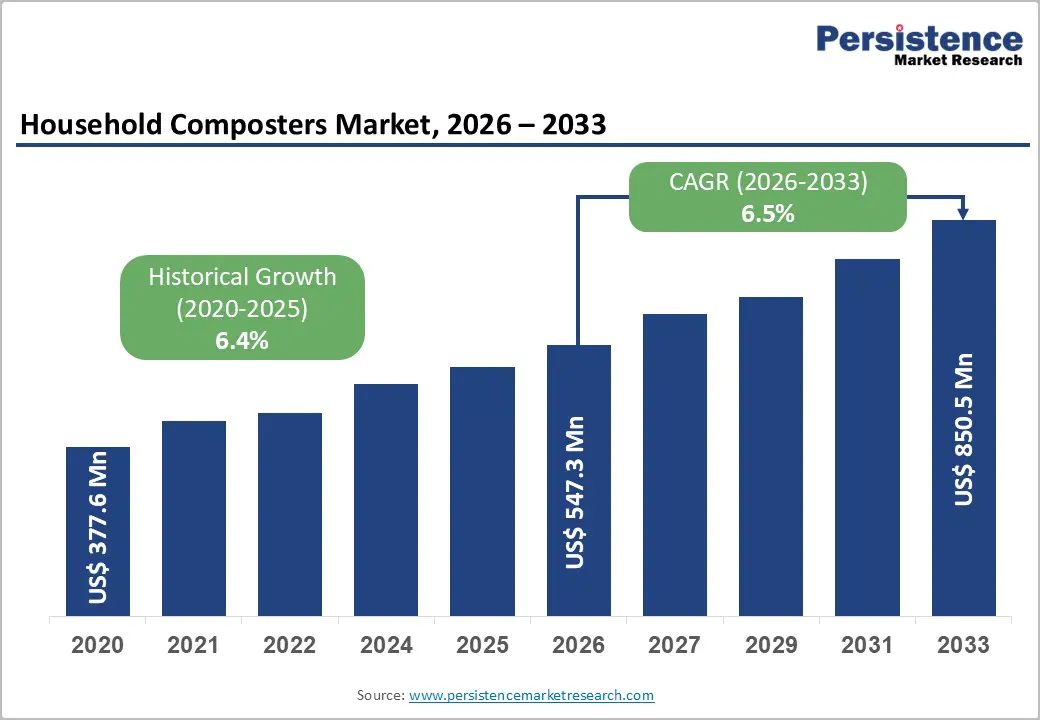
The global household composters market size is likely to be valued at US$547.3 million in 2026, and is expected to reach US$850.5 million by 2033, growing at a CAGR of 6.5% during the forecast period from 2026 to 2033, driven by the increasing prevalence of sustainable living practices, rising demand for zero-waste kitchen solutions, and advancements in compact, odor-free household composters.
Growing demand for convenient, eco-friendly household composters, especially stationery and tumbler models, is accelerating adoption across urban households. Advances in electric and bokashi-style systems are further boosting uptake by offering faster composting and better odor control. Increasing recognition of household composters as critical for reducing food waste and supporting circular economy goals in emerging green markets remains a major driver of market growth.
Key Industry Highlights:
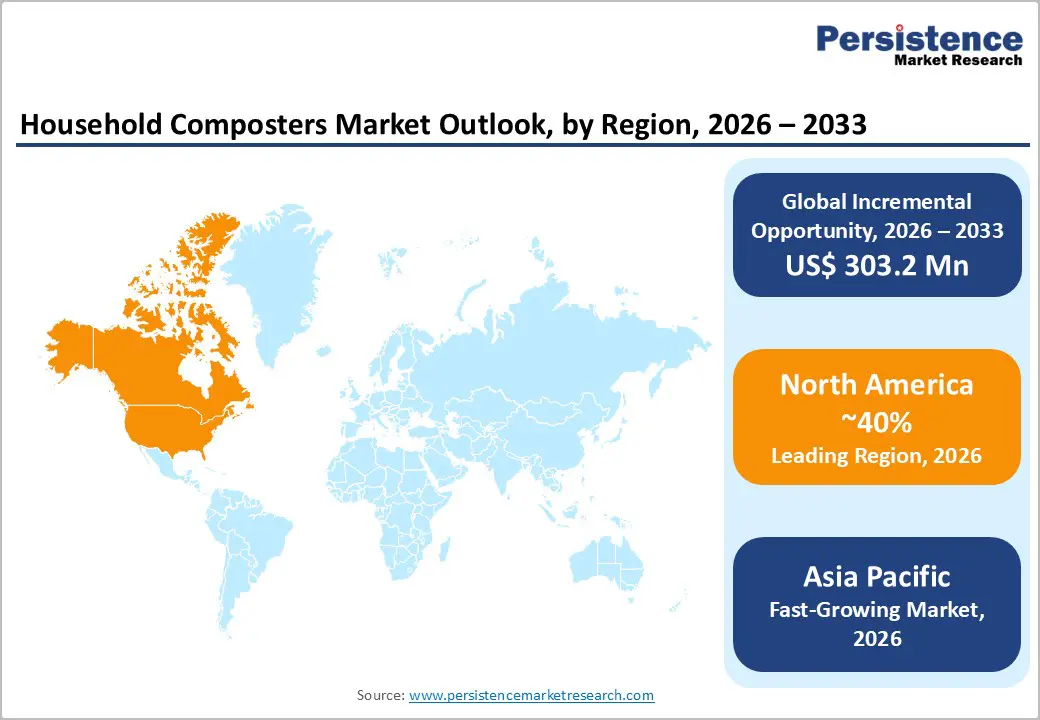
- Leading Region: North America, to account for a 40% market share in 2026, driven by high environmental awareness, strong e-commerce penetration, and premium demand in the U.S.
- Fastest-growing Region: Europe, fueled by strict organic waste regulations, rising zero-waste trends, and growing investments in home composting in Germany and the U.K.
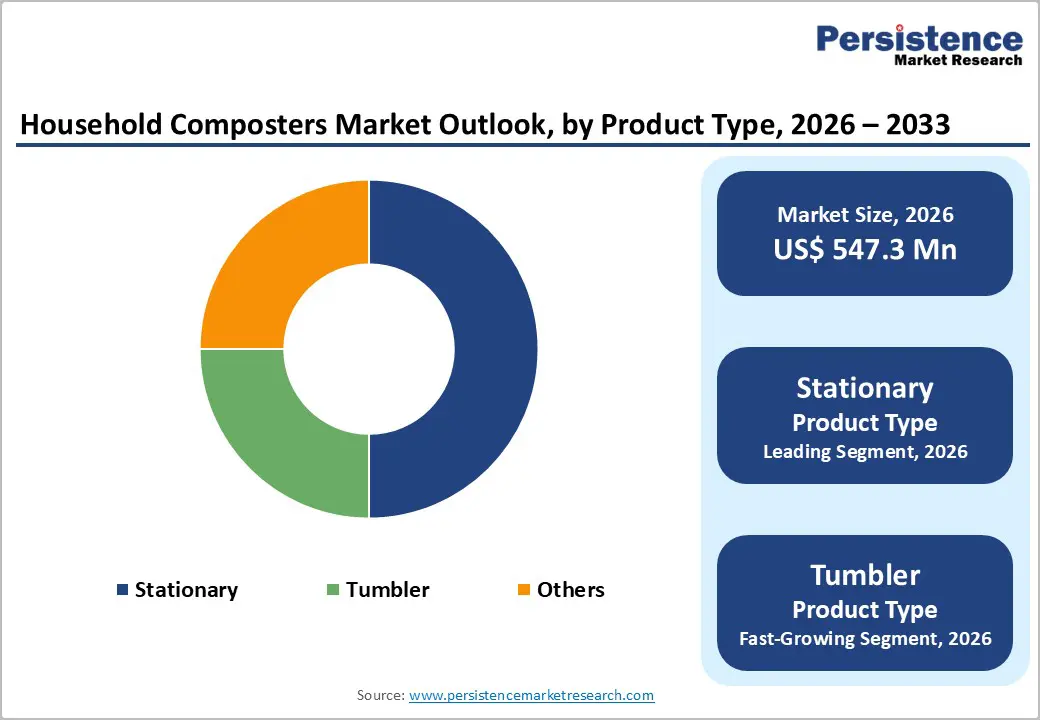
- Dominant Product Type: Stationary, to hold approximately 50% of the market share, as it suits indoor use and apartment living.
- Leading Application: Indoor accounts for over 60% of the market revenue, due to year-round usability in urban homes.
- Leading Distribution Channel: Online, to contribute nearly 45% of the market revenue in 2026, due to convenience and wide product variety.
| Key Insights | Details |
|---|---|
| Household Composters Market Size (2026E) | US$547.3 Mn |
| Market Value Forecast (2033F) | US$850.5 Mn |
| Projected Growth (CAGR 2026 to 2033) | 6.5% |
| Historical Market Growth (CAGR 2020 to 2025) | 6.4% |
Market Factors - Growth, Barriers, and Opportunity Analysis
Rising Prevalence of Sustainable Living Practices
The rising prevalence of sustainable living practices reflects a growing global awareness of environmental responsibility and long-term resource conservation. Individuals and communities are increasingly recognizing the impact of everyday choices on climate change, biodiversity, and public health. As a result, sustainable behaviors are becoming more integrated into daily life rather than being viewed as niche or optional actions.
Consumers are adopting habits such as reducing energy and water consumption, minimizing waste, and prioritizing reusable or biodegradable products. Energy-efficient appliances, solar power installations, and smart home technologies are gaining traction as people seek to lower both utility costs and carbon footprints. Similarly, dietary shifts toward plant-based foods and locally sourced produce are being embraced to reduce environmental strain associated with large-scale industrial agriculture. Urban populations are also supporting sustainability through shared mobility, public transportation, and eco-friendly housing developments. Digital platforms have played a key role by enabling access to information, community initiatives, and transparent product sourcing, empowering consumers to make informed decisions. Governments and institutions further reinforce these behaviors through supportive policies, incentives, and awareness campaigns.
Lack of Consumer Awareness and Knowledge
Lack of consumer awareness and knowledge remains a key restraint in the household composters market, limiting widespread adoption despite growing interest in sustainable living. Many households are unfamiliar with the concept of composting at home and often lack a clear understanding of how composters function, what types of waste can be processed, and the benefits they offer. This knowledge gap creates uncertainty and hesitation, particularly among first-time users who may perceive composting as complicated or time-consuming.
Misconceptions also play a significant role. Consumers frequently associate composting with unpleasant odors, pest problems, or unhygienic conditions, even though modern household composters are designed to address these issues effectively. Without proper guidance, users may struggle with correct usage, leading to poor composting results and reinforcing negative perceptions. This can discourage repeat usage and reduce word-of-mouth promotion. Limited access to practical demonstrations, instructional resources, and community-level education programs further restricts understanding. In many regions, composting is not actively promoted through schools, local governments, or waste management initiatives, resulting in low visibility of household composting solutions. Consumers may continue relying on traditional waste disposal methods, slowing market penetration.
Developments in Odor-Free and Electric Delivery Platforms
Developments in odor-free and electric household composters delivery platforms are transforming the global home waste landscape by addressing two major challenges, smell barriers and slow decomposition. Odor-free platforms are engineered to achieve sealed aerobic composting, reducing reliance on outdoor bins and enabling indoor usability. Innovations, such as carbon filtration, microbial accelerators, temperature control, and automatic mixing, significantly improve user experience and reduce complaints, lowering adoption barriers for urban campaigns.
Progress in electric platforms, including heated stationary units, tumbler rotation, low-energy drying, and smart sensors, supports more efficient composting by minimizing odor, the system’s first line of defense against rejection. These formats eliminate manual turning, enhance speed, and allow versatile use without outdoor space, making them highly suitable for mass apartment programs. New technologies such as bio-adhesive microbial starters and app-guided operation further enhance convenience and response.
Category-wise Analysis
Product Type Insights
The stationary segment is expected to dominate the market, accounting for approximately 50% of the market share in 2026. Its dominance is driven by compact design, indoor suitability, and ease of use, making it preferred for urban households. Stationary provides consistent composting, ensures odor control, and contributes to convenience, making it suitable for large-scale apartment campaigns. The FoodCycler Eco 5 Home Food Waste Recycler is a compact, stationary composter designed for indoor household use. Its sleek, countertop-friendly form factor (about 5 L capacity) makes it well-suited to urban apartments and small kitchens, helping residents convert food scraps into nearly 90% reduced waste compost without the outdoor space traditionally needed for composting.
The tumbler segment is likely to be the fastest-growing segment, due to its faster decomposition and expanding use in outdoor settings. Its rotating profile makes it ideal for targeted volume, reducing cycle time. Continuous innovations in aeration are further strengthening its appeal, driving rapid adoption across North America and Europe, where demand for quick composting is accelerating. The Joraform Compost Tumbler JK125 is a premium rotating composter manufactured by Joraform, a well-known Swedish company specializing in high-efficiency garden composting solutions. Its double-chamber, rotating profile enhances oxygen flow and internal mixing, allowing organic waste to break down much faster than in traditional static bins. Dual chambers mean users can load fresh waste into one side while the other continues decomposing, providing a continuous composting cycle that significantly reduces the time required to produce usable compost.
Application Insights
The indoor segment leads the market, holding approximately 60% of the share in 2026, driven by year-round usability, large apartment programs, and strong global demand for kitchen-integrated solutions. Their dominance continues as urban living expands. The rising adoption of outdoor garden composting and expanded other campaigns highlight the growing focus on multi-setting benefits. The TrustBasket Trustbin and Mota Lota Home Compost Bin illustrate how indoor composting solutions are tailored for urban households and integrated kitchen use. These compact indoor compost bins are designed specifically for kitchen countertops or under-sink spaces, enabling year-round organic waste management without outdoor space.
The outdoor segment is the fastest-growing segment, driven by strong momentum in backyard composting and expanding inclusion in suburban homes. The growing shift toward garden platforms, along with better capacity, accelerates the adoption. Advancements in tumbler durability and continued progress of weather-resistant entering consumer trials drive market growth. The BLACK+DECKER 40-Gallon Dual Chamber Compost Tumbler demonstrates how outdoor composting solutions are driving growth in suburban and garden settings. This large-capacity, dual-chamber tumbler is specifically designed for outdoor use, allowing users to handle significant volumes of kitchen and yard waste efficiently. Its rotating design enhances aeration and speeds up decomposition compared with static bins, typically producing nutrient-rich compost in weeks rather than months.
Distribution Channel Insights
The online segment is expected to dominate the market, contributing nearly 45% of revenue in 2026, due to remaining the primary hub for product discovery, large e-commerce programs, and management of diverse models requiring detailed reviews. Their strong reach, trained platforms, and ability to handle high-volume or specialty blends drive higher consumption. Online channels are leading direct sales rollouts as well as administering emerging offline trials. Cooler Kitchen and Housewares Solutions are among the top sellers for in-home composting bins on Amazon’s U.S. marketplace, often leading category rankings with thousands of positive user reviews. Platforms such as Amazon enable consumers to compare composters from multiple brands (such as Cooler Kitchen and others) side-by-side, read detailed customer feedback, check ratings, and make informed choices without visiting a store.
The offline (Hypermarkets/Supermarkets & Specialty Stores) segment is the fastest-growing, driven by their strong in-store presence and expanding role in experiential sales. They offer convenient, quick, and accessible demonstrations, attracting buyers who prefer hands-on, low-risk settings. Increased outreach programs, retail focus, and wider availability of routine and premium composters further accelerate uptake, boosting rapid adoption across both urban and semi-urban areas. Home Depot (Garden & Outdoor Center) carries a wide range of composters from dual-chamber tumblers to stationary compost bins directly on store shelves, allowing customers to see, touch, and compare models before purchase. Popular products such as the RSI 65-Gallon Two-Stage Compost Tumbler and FreeGarden EARTH82 gal. Compost bins are stocked in-store and available with expert staff guidance. This hands-on retail experience supports consumer confidence and helps buyers understand product features such as capacity, material quality, and ease of use before buying.
Regional Insights
North America Household Composters Market Trends
North America is projected to dominate the global household composters market in 2026, accounting for nearly 40% of the total share, driven by strong environmental awareness, advanced e-commerce networks, and widespread interest in zero-waste lifestyles. Well-established distribution channels in the U.S. and Canada ensure household composters are easily accessible for indoor, outdoor, and apartment users. The growing demand for convenient, stationary, and user-friendly models is further accelerating adoption, as these designs simplify composting and lower barriers compared to traditional bins.
Technological innovations in household composters, such as odor-free operation, enhanced electric functionality, and optimized kitchen integration, are attracting substantial investment from both public and private sectors. Government programs and sustainability initiatives continue to encourage food waste recycling, alleviating landfill pressures and addressing emerging environmental challenges, thereby supporting sustained market growth. The increasing focus on specialized composter types, including tumblers and apartment-friendly models, is expanding the range of target applications across the region.
Europe Household Composters Market Trends
Europe's growth is propelled by increasing awareness of zero-waste benefits, strong regulatory systems, and government-led green programs. Countries such as Germany, France, and the U.K. have well-established frameworks that support routine composting and encourage the adoption of innovative composter delivery methods, including household composters. These eco-friendly formulations are particularly appealing for indoor populations, regulation-conscious households, and outdoor users, improving compliance and coverage rates.
Technological advancements in household composters development, such as enhanced odor control, application-targeted delivery, and improved electric grades, are further boosting market potential. European authorities are increasingly supporting research and trials for composters against both routine and specialized needs, strengthening market confidence. The growing emphasis on convenient, compact options is aligned with the region’s focus on preventive waste reduction and reducing landfill use. Public awareness campaigns and promotion drives are expanding reach in both urban and rural areas, while suppliers are investing in design and novel variants to increase efficacy.
Asia Pacific Household Composters Market Trends
Asia Pacific is the fastest-growing market for household composters in 2026, driven by rising sustainability awareness, increasing government initiatives, and expanding application programs across the region. Countries such as India, China, Japan, and Southeast Asian nations are actively promoting composting campaigns to address food waste growth and emerging green living needs. Household composters are particularly attractive in these regions due to their scalable administration, ease of use, and suitability for large-scale urban drives in both high-rise and suburban populations.
Technological advancements are supporting the development of stable, effective, and easy-to-deploy household composters, which can withstand challenging climatic conditions and minimize odor dependence. These innovations are critical for reaching remote households and improving overall waste coverage. Growing demand for indoor, outdoor, and kitchen applications is contributing to market expansion. Public-private partnerships, increased eco expenditure, and rising investments in composter research and manufacturing capacity are further accelerating growth. The convenience of composter delivery, combined with improved efficiency and reduced risk of smell, positions household composters as a preferred choice.
Competitive Landscape
The global household composters market features competition between established sustainable brands and emerging eco-innovators. In North America and Europe, FoodCycler and reencle. lead through strong R&D, distribution networks, and retail ties, bolstered by innovative electric and odor-free programs. In Asia Pacific, Smartenviro Systems advances with localized solutions, enhancing accessibility. Electric delivery boosts speed, cuts odor risks, and enables mass urban integrations across regions. Strategic partnerships, collaborations, and acquisitions merge expertise, expand product lines, and speed commercialization. Odor-free formulations solve acceptance issues, aiding penetration in apartment areas.
Key Industry Developments
- In December 2025, GEME, the leader in the global bio-composting market, launches the revolutionary kitchen composter model GEME Terra 2. Its lighter, smarter design makes composting at home much easier and more efficient, fitting almost all kinds of households, reducing food waste, and bringing an eco-friendlier lifestyle in the future.
- In September 2025, A Bengaluru-based technology startup has developed an AI-powered robot named “Chewie” that can transform wet kitchen waste, such as vegetable peels and food scraps, into nutrient-rich soil in just a few hours, a breakthrough in household waste management.
Companies Covered in Household Composters Market
- Oklin International Ltd.
- FoodCycler
- Reencle
- Ridan Composting Limited
- Nature Mill
- Bokashicycle, LLC
- Vita-Mix Corporation
- Smartenviro Systems
- SMS Hydrotech Pvt. Ltd.
Frequently Asked Questions
The global household composters market is projected to reach US$547.3 million in 2026.
The household composters market is primarily driven by the growing adoption of sustainable lifestyles and the increasing demand for zero-waste solutions in the kitchen.
The household composters market is poised to witness a CAGR of 6.5% from 2026 to 2033.
The main market opportunities lie in the development of odor-free technologies and electric delivery platforms.
FoodCycler, reencle. Oklin International Ltd., Nature Mill, and Vita-Mix Corporation are the key players.


