




- Transportation & Logistics
- Forklift Attachments Market
Forklift Attachments Market Size, Share, Growth, and Regional Forecast, 2026 to 2033
Forklift Attachments Market Attachment Type (Side Shifters, Fork Positioners, Rotators, Paper Roll Clamps, Push/Pull (Slip Sheet Handlers), Carton Clamps, Single–Double Pallet Handlers), End Use Segment (Rental Service Providers, Individual Operators), Forklift Truck Type (Counterbalance, Walkie Trucks, Reach Stackers, Order Pickers, Sideloaders, Off-road Forklifts, Telescopic Handlers, Truck-mounted Forklifts, Articulated Forklifts), and Regional Analysis from 2026 to 2033

Market Overview
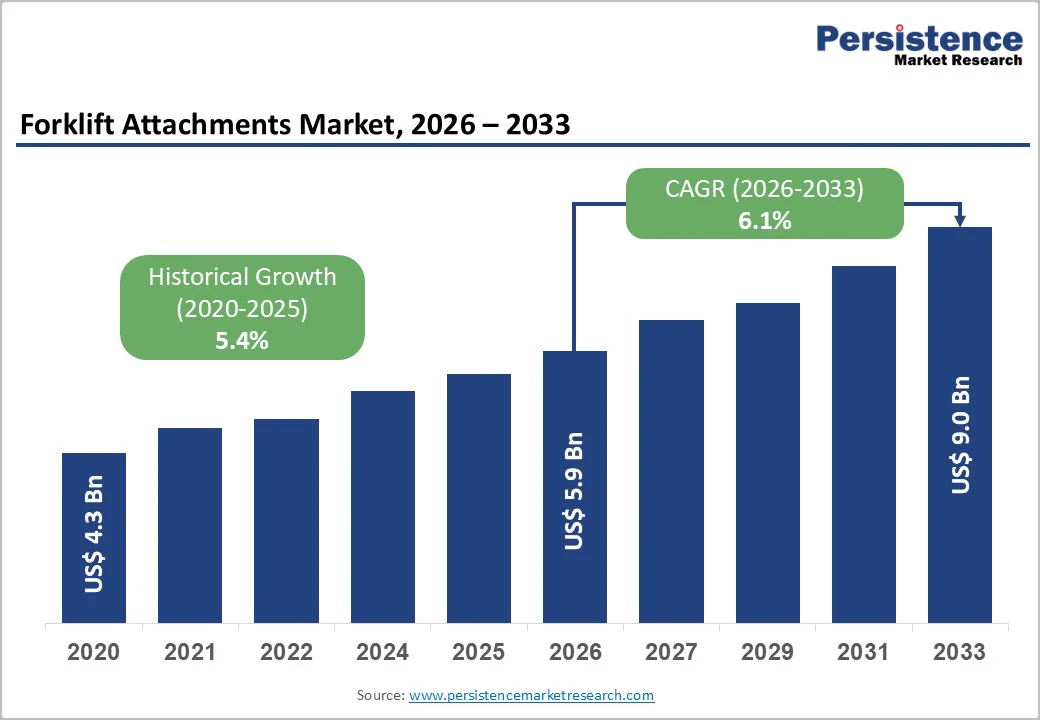
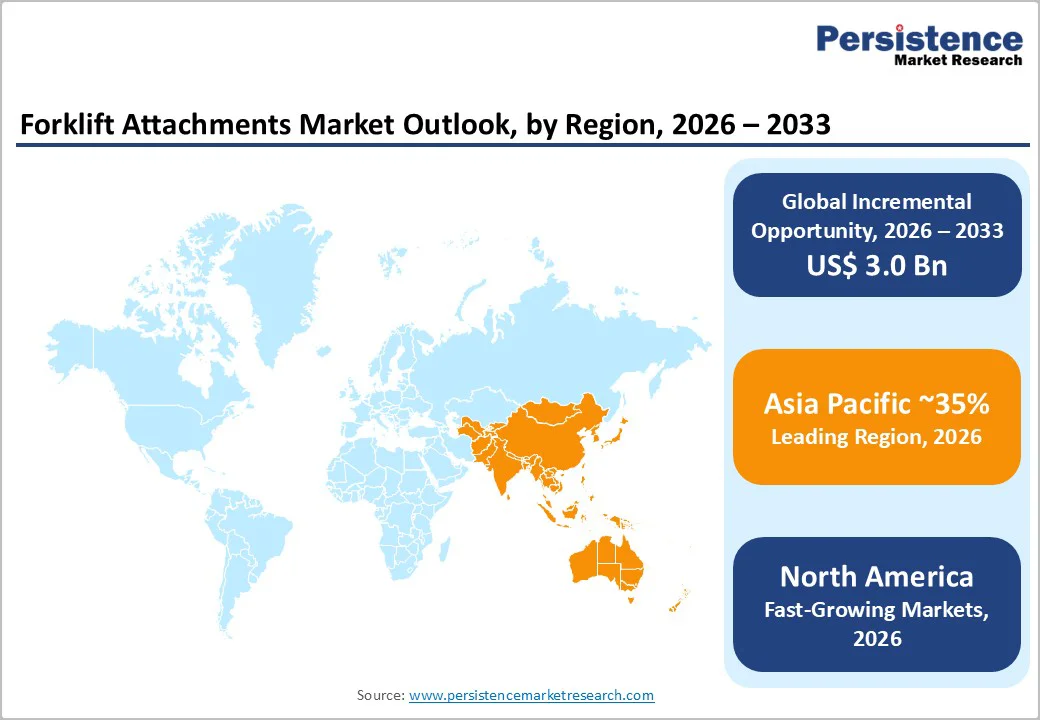
The global Forklift Attachments Market size is anticipated at US$ 5.9 Billion in 2026 and is projected to reach US$ 9.0 Billion by 2033, growing at a CAGR of 6.10% between 2026 and 2033. Market expansion is driven by industrial automation requiring specialized gripping and positioning attachments, e-commerce-led warehouse modernization using quick-change modular systems, and smart sensor-enabled electric attachments enabling real-time data and predictive maintenance. North America grows at 5.7% CAGR, Europe holds 24% share through regulation-led automation, and Asia Pacific leads with 35% share driven by manufacturing scale and e-commerce expansion globally sustained.
Key Highlights Summary
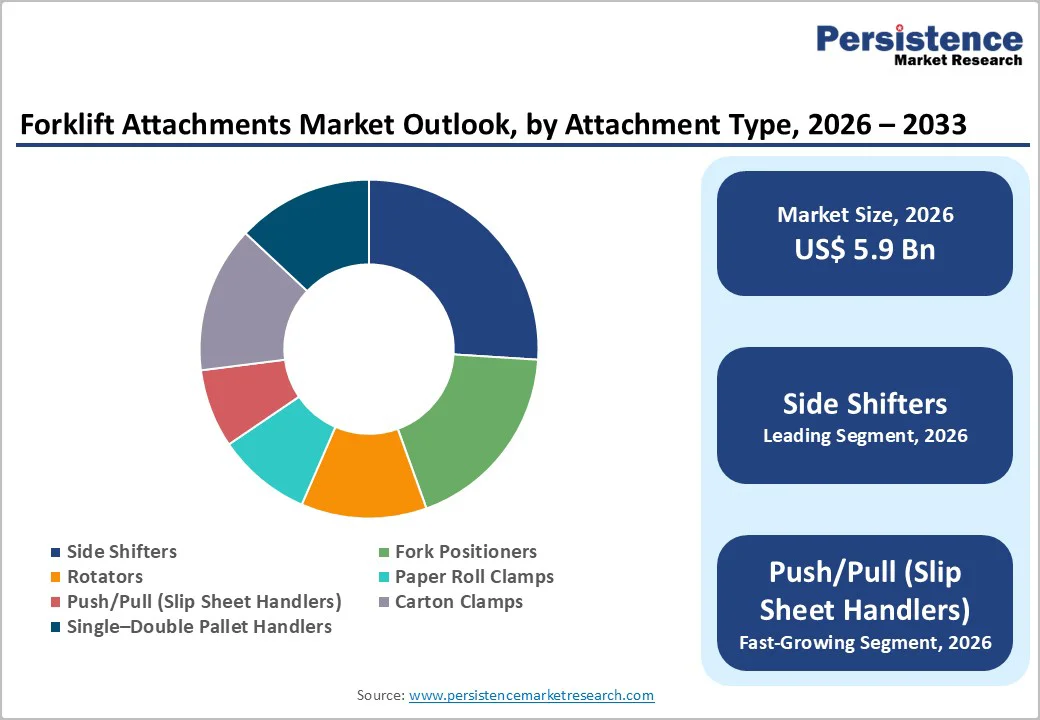
- Side shifters command 26% market share enabling 20-30% speed improvements and precise alignment, while Push/Pull slip sheet handlers expand at 6.9% CAGR offering cost-effective and sustainable alternatives to traditional pallets.
- Rental service providers lead at 58% end-use share with diverse attachment requirements, while Individual operators expand at 5.5% CAGR supporting emerging small business and contractor markets.
- Counterbalance forklifts dominate at 34% market share with versatile attachment compatibility, while Telescopic handlers expand at 7.2% CAGR supporting specialized construction and material handling applications.
- Europe maintains 24% market share with regulatory and sustainability focus, Asia Pacific commands 35% with manufacturing dominance and e-commerce growth, and North America expands 5.7% CAGR with automation leadership momentum.
- TVH launches PK TS fork positioner with hydraulic adjustment, quick-change systems achieve 90-second attachment swaps maintaining full pressure, and Jungheinrich integrates Magazino acquisition for enhanced automation capabilities, demonstrating technology advancement and market consolidation momentum.
| Key Insights | Details |
|---|---|
|
Forklift Attachments Market Size (2026E) |
US$ 5.9 billion |
|
Market Value Forecast (2033F) |
US$ 9.0 billion |
|
Projected Growth CAGR (2026-2033) |
6.1% |
|
Historical Market Growth (2020-2025) |
5.4% |
Market Dynamics Analysis
Market Drivers
Industrial Automation and Autonomous Vehicle Integration Driving Attachment Innovation
Industrial automation and autonomous material handling are systematically driving forklift attachment demand, with automated guided vehicles and robotic forklifts requiring specialized attachments for gripping, positioning, and rotating capabilities. Nearly 94% of material handling businesses lack real-time forklift fleet tracking, creating significant adoption opportunity, while AGV/AMR integration necessitates sensor-compatible, precision-engineered attachments supporting automation-ready operations. Demand is further reinforced by specialized gripping capability development, high-accuracy positioning for automated workflows, sensor-enabled attachment design, autonomous task execution, standardized interface architectures ensuring cross-platform compatibility, and broader automation ecosystem growth across warehouses, manufacturing, logistics, ports, and distribution centers globally, accelerating investment, fleet modernization, scalability, and productivity.
E-commerce Expansion and Warehouse Modernization Supporting Attachment Market Growth
E-commerce expansion and warehouse modernization are systematically driving forklift attachment adoption, with quick-change systems enabling hydraulic attachment swaps in approximately 90 seconds while maintaining pressure under load. A modular attachment toolkit reduces equipment acquisition and labor costs, allowing a single forklift with multiple attachments to replace several specialized machines and streamline operations. These systems deliver measurable operational efficiency gains through reduced downtime, faster task transitions, and higher throughput. Maintained hydraulic connections during changeovers ensure safety and performance continuity, while improved equipment utilization maximizes asset productivity. Collectively, quick-change capability, modular design, and downtime reduction enable scalable, cost-efficient warehousing aligned with fulfillment.
Market Restraints
High Attachment Costs and Capital Investment Requirements Limiting Adoption
Forklift attachment market expansion is constrained by significant capital costs associated with specialized attachment systems with electric and smart sensor-enabled attachments commanding premium pricing creating adoption barriers particularly for small operators and emerging markets limiting price-sensitive segment penetration. Specialized attachment system costs. Electric attachment premium pricing. Smart sensor technology cost. Capital investment requirements. Budget constraints for SMEs. Return on investment calculation complexity. Financing availability limitations.
Interoperability Challenges and Cross-Brand Attachment Compatibility Issues
Forklift attachment market expansion is constrained by limited standardized interfaces across forklift manufacturers creating compatibility challenges and operational complexity with operators requiring different attachment sets for different equipment increasing total cost of ownership and operational inefficiency. Standardization limitations. Cross-brand compatibility challenges. Multiple attachment set requirements. Equipment lock-in risk. Vendor dependency. Integration complexity issues. Operational inflexibility concerns.
Market Opportunities
Electrification and Energy-Efficient Attachment Technology Supporting Sustainability
Electrification and energy-efficient attachment technology represent an emerging opportunity, with electric attachments delivering up to 90% higher energy efficiency than hydraulic systems while eliminating hydraulic leakage risks. Electric motor adoption supports electric forklift and AGV compatibility, extending battery life and enabling longer operating cycles. Leakage-free operation improves suitability for hygiene-sensitive applications such as food, pharmaceuticals, and clean logistics. Reduced energy consumption lowers operating costs and supports environmental compliance requirements. Sustainability-focused attachment solutions strengthen ESG positioning for fleet operators, rental providers, and OEMs, while accelerating transition toward low-emission material handling ecosystems aligned with decarbonization goals and regulatory pressure globally, worldwide adoption.
Industry-Specific Customization and Niche Application Solutions
Industry-specific customization and niche application solutions represent a strong emerging opportunity, with specialized forklift attachments targeting automotive, food processing, chemical handling, and pharmaceutical sectors enabling premium positioning and focused market penetration. Automotive component handling demands precision, load stability, and damage prevention, while food processing requires hygiene-compliant, corrosion-resistant designs. Chemical applications emphasize containment, safety, and spill mitigation, and pharmaceutical operations require strict cleanliness and traceability standards. These needs drive specialized design expertise and custom engineering capabilities, allowing suppliers to deliver tailored solutions, build long-term customer loyalty, achieve vertical market leadership, and capture higher-margin revenues through differentiation and application-specific performance advantages.
Segmentation Analysis
Attachment Type Analysis
Side shifters command 26% of forklift attachment market share, representing dominant attachment type with lateral fork movement enabling precise pallet alignment without forklift repositioning supporting enhanced warehouse efficiency and reduced maneuvering time across diverse industries including logistics, manufacturing, and distribution. Lateral movement capability. Precise alignment achievement. Maneuvering reduction benefit. Time savings (20-30%). Standard equipment adoption. Indoor and outdoor versatility. Industry-wide penetration.
Push/pull slip sheet handlers expand as fastest-growing attachment category at 6.9% CAGR, driven by cost-effective alternative to traditional pallets and reduced packaging material requirements supporting emerging demand for sustainable and economical material handling solutions particularly in high-volume operations. Slip sheet handler functionality. Cost-effectiveness advantage. Packaging reduction benefit. Pallet elimination capability. Sustainable approach positioning. High-volume operation focus. Emerging market growth opportunity.
End Use Segment Analysis
Rental service providers command 58% of forklift attachment end-use market share, representing dominant segment with rental company fleets requiring diverse attachment portfolios supporting sustained demand for versatile and durable attachment solutions across broad customer base and industry applications. Rental fleet requirements. Diverse attachment variety. Customer base breadth. Utilization optimization. Maintenance and service integration. Economic viability importance. Market revenue generation.
Individual operators expand as growing segment at 5.5% CAGR, driven by small business and independent contractor growth supporting emerging market development for cost-effective attachment solutions enabling affordable equipment access for price-sensitive operators. Small business growth. Cost-effective solutions. Entry-level offerings. Accessory market development. Aftermarket channel growth. Competitive pricing positioning. Market democratization opportunity.
Forklift Truck Type Analysis
Counterbalance forklifts command 34% of forklift attachment market share, representing dominant truck type with simple design, high lifting capacity, and versatile attachment compatibility supporting widespread adoption across diverse industries for beverage handling, automotive parts, and container operations. Versatile compatibility with attachments. High lifting capacity. Simple design advantage. Broad applicability across industries. Standard platform positioning. Widespread adoption base. Market dominance persistence.
Telescopic handlers expand as fastest-growing truck type at 7.2% CAGR, driven by extended reach and unique positioning capability enabling diverse material handling and construction applications supporting emerging demand for multi-functional equipment in specialized segments. Extended reach capability. Unique positioning flexibility. Construction application focus. Specialized material handling. Emerging markets adoption. Niche application growth. Operational versatility advantage.
Regional Market Insights
North America
North America expands at 5.7% CAGR, driven by warehouse automation leadership, e-commerce logistics expansion, labor shortage pressures, and advanced technology adoption supporting market development and premium positioning. Warehouse automation adoption leadership. E-commerce logistics expansion. Labor shortage response. Advanced technology investment. Regulatory compliance standards. Premium market development. Technology innovation ecosystem.
North American market characterized by automation-focused strategy and efficiency optimization with significant warehouse modernization investments. Strong emphasis on reducing labor costs through mechanical and automated solutions. Established supply chains and technical support networks enabling rapid technology deployment. Innovation ecosystem supporting advanced sensor and AI integration enabling competitive differentiation.
Europe
Europe maintains 24% market share, driven by regulatory standards, sustainability emphasis, automotive industry concentration, and advanced manufacturing practices supporting technology advancement and compliance focus. Regulatory compliance standards. Sustainability emphasis prioritization. Automotive manufacturing concentration. Advanced practices adoption. Technical standards leadership. Safety regulations compliance. Industry 4.0 integration momentum.
European market characterized by regulatory compliance and sustainability consciousness with manufacturers focusing on energy-efficient and emission-reducing solutions. Strong emphasis on safety and ergonomic design meeting stringent European standards. Established technical expertise supporting reliability and advanced feature integration. Partnership ecosystems supporting innovation and market development across diverse industrial segments.
Asia Pacific
Asia Pacific commands 35% market share, driven by manufacturing scale, rapid industrialization, e-commerce explosion, and warehouse modernization investment supporting market expansion exceeding global averages. Manufacturing sector dominance. Rapid urbanization and industrialization. E-commerce explosion and fulfillment. Warehouse mechanization expansion. Industrial diversity supporting demand. Regional production scale. Government infrastructure investment.
Asia Pacific market characterized by rapid growth with China and India leading through heavy manufacturing concentration and emerging e-commerce logistics. Japan and South Korea driving precision industry requirements and advanced technology adoption. Southeast Asia experiencing explosive e-commerce growth and cold chain logistics expansion. Cost-competitive manufacturing attracting supply chain development. Government focus on industrial modernization and logistics optimization creating sustained market expansion opportunities.
Competitive Landscape
Market Structure
The forklift attachment market shows consolidation led by multinational players such as Toyota Industries, KION Group, and Jungheinrich through integrated portfolios and OEM partnerships. Specialized manufacturers including Cascade, Bolzoni Auramo, and TVH strengthen positioning via focused product expertise, while regional specialists and emerging players capture niche demand through cost-competitive offerings and localized customization, sustaining competitive and dynamic market conditions globally.
Strategic Developments
- In January 2023, Crown Equipment Corporation and JBT Corporation formed strategic collaboration supporting customers seeking maximize material handling automation benefits, combining expertise enabling development of integrated automation solutions and delivery of advanced warehouse automation capabilities.
- In June 2025, Toyota Motor Corporation confirmed plan to privatize Toyota Industries Corporation, consolidating autonomous forklift technology development and material handling innovations under unified mobility strategy, strengthening competitive position in rapidly evolving autonomous and attachment technology segments.
Business Strategies
Market leaders drive growth through technology differentiation using quick-change and modular attachments, strong OEM partnerships enabling integrated solutions, and industry-specific customization. Geographic expansion targets emerging markets, while sustainability positioning emphasizes electric, efficient designs. Multinational players leverage global distribution, regional specialists focus customization, technology partners enable IoT automation, and aftermarket suppliers deliver cost-effective upgrades across logistics, manufacturing, warehousing ecosystems worldwide globally.
Companies Covered in Forklift Attachments Market
- Toyota Industries Corporation
- KION Group AG
- Crown Equipment Corporation
- Jungheinrich AG
- Linde Material Handling
- Cascade Corporation
- Bolzoni Auramo
- TVH Inc.
- Vestil Manufacturing
- Kalmar
- Clark Equipment
- Hyster-Yale Technologies
Frequently Asked Questions
The global Forklift Attachments Market is anticipated at US$ 5.9 Billion in 2026 and is projected to reach US$ 9.0 Billion by 2033.
Market growth is driven by industrial automation and AGV adoption, e-commerce–led warehouse modernization with rapid attachment changeovers, and smart sensor-enabled attachments enabling real-time monitoring and predictive maintenance.
The market is projected to expand at a 6.1% CAGR between 2026 and 2033.
Key opportunities lie in Asia Pacific industrial expansion, electrified and energy-efficient attachment technologies, and industry-specific customized attachments for automotive, food, chemical, and pharmaceutical applications.
The market is led by Toyota Industries, KION Group, and Jungheinrich, supported by Crown Equipment, Cascade Corporation, and Bolzoni Auramo, with ongoing innovation in automation-ready, quick-change, and sensor-enabled attachment systems.


