




- Processed Food
- Duckweed Protein Market
Duckweed Protein Market Size, Share, Growth, and Regional Forecast, 2026 to 2033
Duckweed Protein Market by Source (Lemna Minor, Spirodela Globose, and Wolffia Globose), Form (Dry, Liquid, and Paste), Application (Food Processing, Animal Husbandary, Pharmaceutical, and Aquaculture) End-user (Food & Beverage Manufacturers, Animal Nutrition & Aquafeed Producers, Dietary Supplement Companies, Cosmetics & Personal Care Industry, and Bioenergy & Industrial Biotechnology), and Regional Analysis from 2026 to 2033

Duckweed Protein Market Share and Trend Analysis
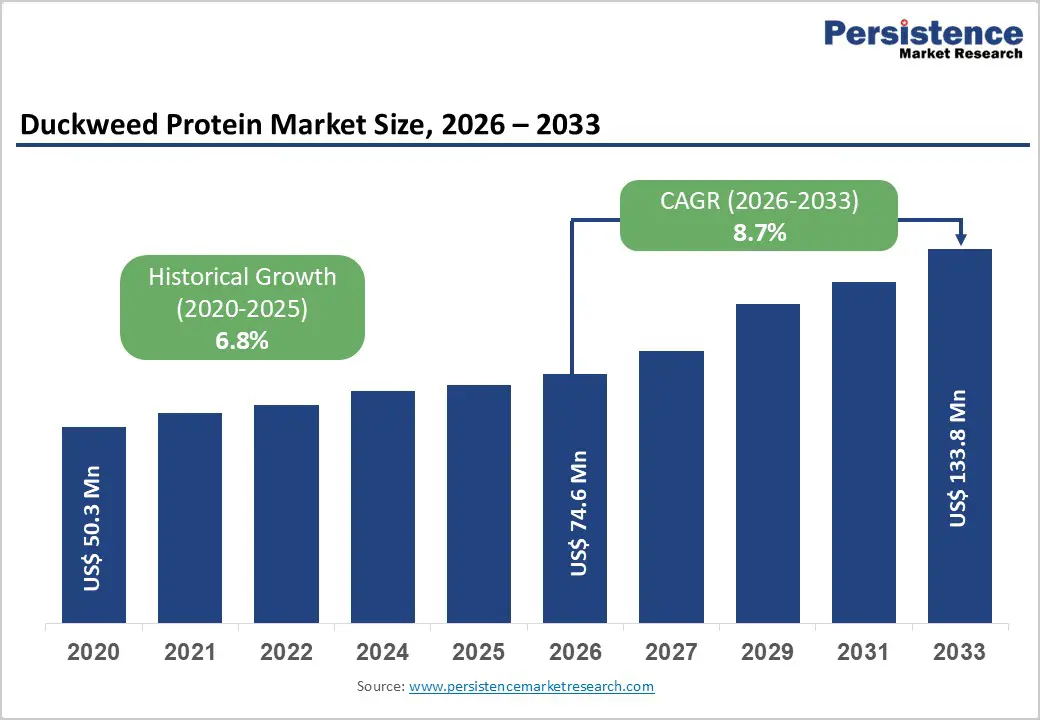
The global duckweed protein market size is estimated to grow from US$ 74.6 million in 2026 to US$ 133.8 million by 2033, growing at a CAGR of 8.7% during the forecast period from 2026 to 2033. Global demand for duckweed protein is expanding consistently as food producers, feed manufacturers, and ingredient developers increasingly seek sustainable and resource-efficient protein alternatives. Rising pressure on conventional agriculture, combined with growing adoption of plant-forward diets, has encouraged the transition toward high-yield aquatic crops that deliver strong nutritional performance with minimal environmental impact.
Duckweed protein is gaining traction due to its rapid growth cycle, balanced amino acid profile, and suitability across food processing, aquaculture, and nutraceutical applications. Manufacturers are integrating the ingredient into protein-enriched foods and alternative feed formulations to improve sustainability metrics while maintaining functional performance. Broader commercialization is supported by advancements in controlled cultivation systems, improved extraction technologies, and expanding partnerships between agri-technology firms and food companies. Increasing investment in climate-resilient agriculture, rising awareness of alternative proteins, and growing demand for efficient feed inputs are further strengthening market momentum. Expansion of B2B ingredient distribution networks and ongoing innovation in protein purification, taste neutrality, and formulation compatibility continue to enhance adoption across developed as well as emerging economies.
Key Industry Highlights:
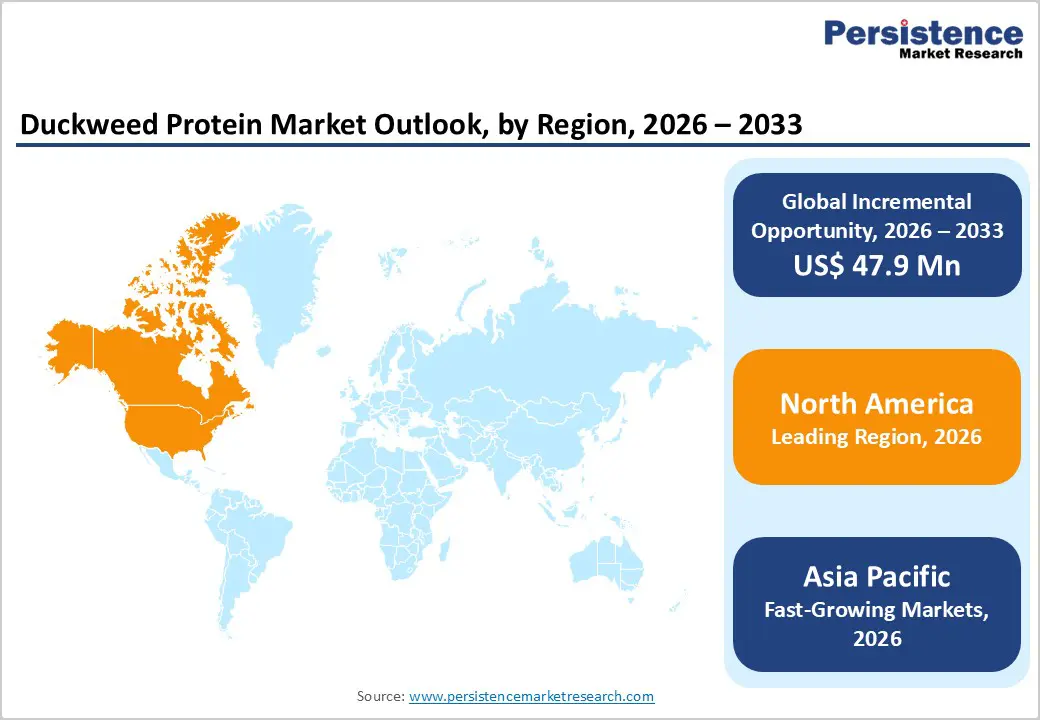
- Leading Region: North America holds the largest share at 46.7%, supported by early commercialization of alternative proteins, strong R&D capabilities, advanced cultivation technologies, and the presence of pioneering ingredient innovators.
- Fastest-Growing Region: Asia Pacific is expanding fastest due to rapid urbanization, increasing protein consumption, supportive government initiatives for sustainable agriculture, and growing investment in aquaculture and food innovation.
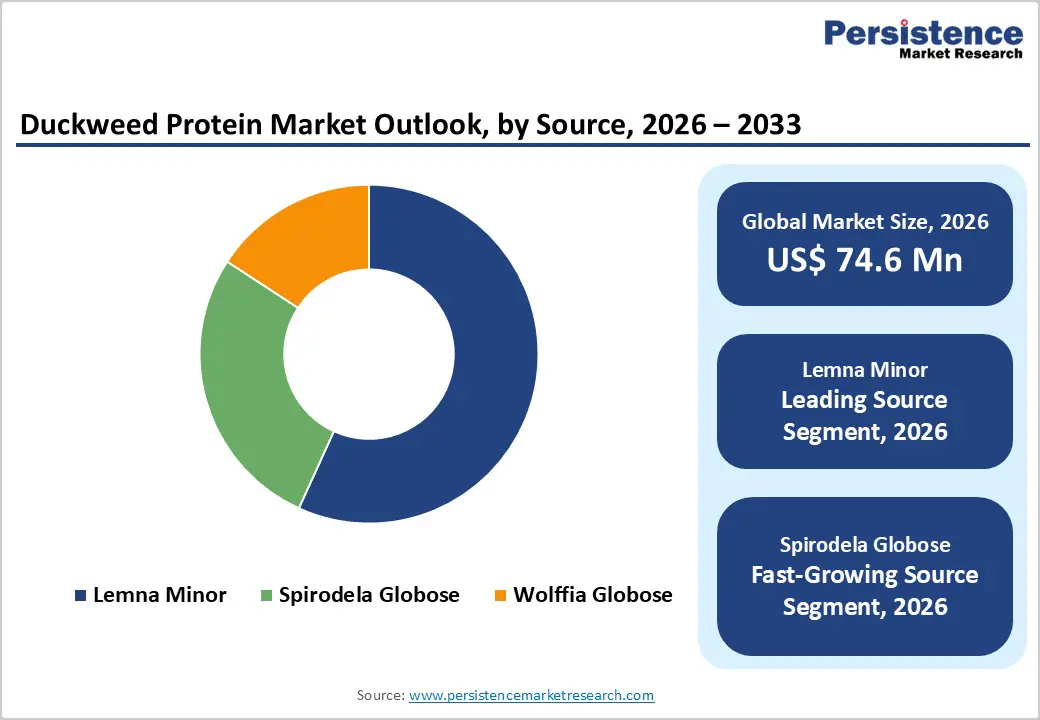
- Leading Source Segment: Lemna minor dominates with a 56.8% share owing to scalable cultivation, consistent protein yield, and established industrial processing compatibility.
- Fastest-Growing Source Segment: Wolffia globose is witnessing accelerated growth as research advances improve cultivation efficiency and expand its use in premium nutrition applications.
- Leading Application Segment: Food processing leads with a 38.7% share, driven by increasing incorporation of sustainable proteins into functional foods, bakery products, and plant-based formulations.
- Fastest-Growing Application Segment: Animal husbandry is expanding rapidly as livestock producers increasingly adopt duckweed protein as a sustainable, high-nutrient feed ingredient that supports improved feed efficiency, reduced dependence on conventional soy and fishmeal, and more environmentally responsible animal nutrition practices.
| Key Insights | Details |
|---|---|
| Duckweed Protein Market Size (2026E) | US$ 74.6 Mn |
| Market Value Forecast (2033F) | US$ 133.8 Mn |
| Projected Growth (CAGR 2026 to 2033) | 8.7 % |
| Historical Market Growth (CAGR 2020 to 2025) | 6.8 % |
Market Dynamics
Driver - Rising Demand for Sustainable, High-Efficiency Alternative Proteins
Global food systems are undergoing structural transformation as governments, manufacturers, and consumers increasingly prioritize environmentally responsible protein sources. Duckweed protein is gaining strong momentum because it delivers exceptionally high protein output while requiring minimal land, freshwater, and agricultural inputs compared to traditional crops such as soy or wheat. Growing pressure on arable land, climate variability, and resource scarcity are encouraging investment in aquatic crop cultivation that can support scalable food production without intensifying environmental degradation. Food producers are actively seeking ingredients that help reduce carbon footprints while maintaining nutritional value, positioning duckweed as an attractive solution. Its rapid growth cycle and ability to absorb nutrients efficiently enable year-round cultivation, improving supply reliability.
Additionally, rising adoption of plant-forward diets and increasing awareness of protein diversification are expanding commercial acceptance across food processing and feed industries. Aquaculture operators are also exploring duckweed protein as a substitute for fishmeal and soymeal, driven by cost volatility and sustainability concerns. Continuous research highlighting amino acid completeness and digestibility further strengthens confidence among manufacturers. As sustainability transitions move from voluntary commitments to operational priorities, adoption of resource-efficient proteins continues to accelerate across global supply chains.
Restraints - Limited Large-Scale Processing Infrastructure and Regulatory Uncertainty
Despite promising growth prospects, commercialization still faces several operational and market barriers. One of the most significant challenges involves scaling production infrastructure capable of delivering consistent, food-grade protein volumes. Cultivation systems require controlled water quality, nutrient optimization, and harvesting technologies that are still evolving in many regions. Processing duckweed into stable, standardized protein ingredients demands specialized extraction and drying capabilities, increasing initial capital investment. In addition, regulatory pathways for novel plant proteins differ widely across countries, often requiring extensive safety evaluations before approval for human consumption. This creates longer commercialization timelines and uncertainty for manufacturers entering new markets. Sensory acceptance also remains a concern, as slight variations in cultivation conditions can influence flavor, color, and texture characteristics, requiring additional formulation refinement.
Market awareness among consumers is still developing, which slows adoption compared with established plant proteins such as soy or pea. Pricing pressure represents another constraint, as early-stage production costs remain relatively high until economies of scale are achieved. Furthermore, supply chain integration between cultivators, processors, and ingredient buyers is still fragmented, limiting widespread availability. Addressing these challenges will require continued technological advancement, regulatory harmonization, and long-term investment across the value chain.
Opportunity - Expansion across Food Innovation, Aquaculture Nutrition, and Circular Bio-economy Models
Emerging applications across multiple industries present substantial opportunities for future expansion. Food manufacturers are increasingly exploring duckweed protein as a multifunctional ingredient capable of enhancing nutritional density while supporting clean-label product development. Its compatibility with plant-based meat alternatives, fortified snacks, and protein beverages allows brands to diversify beyond conventional plant proteins. In parallel, aquaculture represents a major growth avenue, as producers search for sustainable feed inputs that reduce reliance on marine resources. Duckweed’s ability to grow using nutrient-rich water streams creates opportunities within circular agriculture systems, where waste nutrients are converted into valuable biomass.
Biotechnology advancements are further improving strain selection, protein concentration, and cultivation efficiency, enabling more consistent commercial output. Emerging economies facing protein supply gaps are also investing in localized production to strengthen food security and reduce import dependency. Partnerships between food companies, agricultural technology firms, and research institutions are accelerating commercialization and innovation pipelines. Additionally, increasing investor interest in climate-resilient agriculture is supporting funding for large-scale cultivation facilities. As sustainability, nutrition, and resource optimization converge, duckweed protein is positioned to evolve from a niche innovation into a widely adopted ingredient across global food and feed ecosystems.
Category-wise Analysis
By Source, Lemna Minor Dominates Owing to Commercial Scalability and Higher Protein Yield
The lemna minor segment is projected to lead the global duckweed protein market in 2026, accounting for a 56.8% revenue share. Its dominance is largely attributed to well-established cultivation practices, faster biomass doubling rates, and consistent protein composition suitable for industrial processing. Lemna minor adapts efficiently to controlled aquatic farming systems, enabling predictable output and lower operational costs compared to other duckweed species. The ingredient also offers balanced amino acid content and relatively neutral sensory characteristics, making it easier to incorporate into food, feed, and nutraceutical formulations. Producers prefer this species due to reliable harvesting cycles and compatibility with large-scale vertical farming and wastewater nutrient recovery systems. Increasing investments in sustainable protein production and growing interest in land-efficient agriculture further support adoption. Continuous improvements in strain optimization and cultivation technologies strengthen supply stability, allowing manufacturers to meet rising demand across alternative protein and aquafeed applications globally.
By Application, Food Processing Leads Supported by Expanding Plant-Protein Integration Across Food Systems
The food processing segment is expected to hold the largest share of the duckweed protein market in 2026, capturing 38.7% of total revenue. Growth is driven by rising incorporation of sustainable protein ingredients into bakery, snacks, beverages, meat alternatives, and fortified foods. Duckweed protein provides functional advantages such as emulsification, improved nutritional density, and compatibility with clean-label product development. Food manufacturers increasingly utilize it to enhance protein content without significantly altering texture or flavor profiles. Demand is also supported by consumer preference for environmentally responsible ingredients with minimal land and water usage. The ingredient’s adaptability across multiple formulations allows companies to diversify product portfolios while addressing plant-based nutrition trends. Advances in extraction technologies have improved solubility and sensory performance, enabling broader commercial adoption. As food companies seek alternative protein sources beyond soy and pea, duckweed protein continues gaining traction within large-scale food processing operations.
By End-user, Food & Beverage Manufacturers Lead Due to Strong Industrial Adoption and Product Development Capacity
Food & beverage manufacturers are projected to dominate the market in 2026 with a 36.5% revenue share. Their leadership stems from extensive product innovation pipelines and the ability to integrate novel proteins into mainstream consumer products. Large manufacturers actively explore sustainable ingredients to align with ESG commitments and evolving dietary preferences. Duckweed protein is increasingly incorporated into functional foods, plant-based formulations, and protein-enriched beverages due to its nutritional profile and production efficiency. Established manufacturing infrastructure enables rapid scaling once ingredient validation is achieved. Additionally, strong distribution networks allow faster commercialization compared to smaller specialty players. Collaboration with ingredient suppliers and research institutions further accelerates formulation development and regulatory approvals. As companies continue reformulating products toward high-protein and environmentally responsible positioning, food and beverage producers remain the primary demand generators within the global duckweed protein ecosystem.
Regional Insights
North America Duckweed Protein Market Trends
North America is anticipated to dominate the global duckweed protein market in 2026, representing a 46.7% value share, with the United States acting as the primary growth engine. The region benefits from advanced alternative-protein research, strong venture funding, and early commercialization of aquatic plant proteins. Increasing consumer awareness regarding sustainable food systems and carbon-efficient agriculture is encouraging adoption of novel protein ingredients across food and feed industries. Food manufacturers actively invest in next-generation plant proteins to diversify beyond conventional soy and pea sources, supporting steady demand expansion.
The presence of pioneering producers and technology developers accelerates innovation in cultivation systems, protein extraction, and ingredient functionality. Well-developed regulatory pathways for novel food ingredients also help companies bring products to market more efficiently. Additionally, strong collaboration between startups, academic institutions, and food corporations promotes rapid product testing and commercialization. High purchasing power and premiumization trends further allow adoption of environmentally sustainable proteins, reinforcing North America’s continued leadership in the duckweed protein market.
Europe Duckweed Protein Market Trends
Europe’s duckweed protein market is expected to witness stable expansion in 2026, supported by strong sustainability policies and increasing demand for alternative protein sources aligned with climate goals. Consumers across Germany, the U.K., France, the Netherlands, and Nordic countries demonstrate growing acceptance of environmentally responsible food ingredients. Regional emphasis on reducing agricultural emissions and promoting circular bioeconomy models supports investment in water-based crop cultivation such as duckweed. Strict regulatory standards encourage transparency, safety validation, and high-quality ingredient development, which strengthens consumer confidence.
Food manufacturers increasingly explore duckweed protein to meet plant-based product innovation targets while maintaining nutritional quality. Research programs funded by European institutions further accelerate advancements in cultivation efficiency and processing technologies. Retailers and private labels are also expanding sustainable product portfolios, creating downstream demand for innovative protein inputs. Combined with strong environmental awareness and policy support, these factors position Europe as a consistently growing market with long-term adoption potential.
Asia Pacific Duckweed Protein Market Trends
The Asia Pacific duckweed protein market is projected to register the fastest growth, expanding at a CAGR of around 7.9% between 2026 and 2033. Rapid urbanization, population growth, and increasing pressure on agricultural land are encouraging exploration of high-yield aquatic crops as alternative nutrition sources. Countries such as China, India, Japan, and South Korea are investing in sustainable food technologies to strengthen domestic protein security. Traditional familiarity with aquatic plants and plant-forward diets provides a favorable cultural foundation for adoption. Expanding middle-class populations and rising disposable incomes are also driving demand for protein-enriched foods and functional nutrition products.
Governments and research institutes across the region actively support innovation in controlled environment farming and biotechnology-enabled cultivation systems. Growth of aquaculture industries further boosts demand, as duckweed protein offers a viable substitute for fishmeal and soy inputs. Increasing participation from regional food manufacturers and partnerships with global ingredient companies are accelerating commercialization, positioning the Asia Pacific as the most dynamic growth hub worldwide.
Competitive Landscape
The global duckweed protein market is highly competitive, with strong participation from Plantible Foods, Inc., Hinoman Ltd., Parabel USA Inc., Rubisco Foods, and GreenOnyx. These players leverage scalable cultivation technologies, vertically integrated production, and expanding B2B ingredient distribution networks to strengthen market positioning while advancing protein extraction efficiency, nutritional consistency, taste neutrality, and formulation versatility.
Rising demand for sustainable alternative proteins, increasing focus on resource-efficient agriculture, and growing adoption across food, feed, and nutraceutical applications are accelerating innovation. Manufacturers emphasize clean-label positioning, high amino acid profiles, regulatory approvals, and strategic partnerships while expanding production capacity and investing in R&D investment.
Key Industry Developments:
- In February 2025, the European Commission approved Lemna minor and Lemna gibba (duckweed) for human consumption following a comprehensive safety assessment, supporting diversification of sustainable protein sources in Europe. The authorization, issued under Commission Implementing Regulation (EU) 2025/153, officially added these species to the EU’s novel food list, permitting their commercial use as food ingredients.
- In August 2025, Plantible Foods inaugurated a large-scale manufacturing facility in Texas dedicated to duckweed protein production and is actively seeking further investment to triple its operational capacity. The expansion aims to strengthen commercial supply while accelerating adoption of sustainable alternative protein ingredients across food and nutrition applications.
- In November 2024, Plantible Foods secured $30 million in Series B funding to expand production capacity of its duckweed-derived protein through the development of a 100-acre cultivation facility in Texas. The investment is intended to accelerate large-scale commercialization and strengthen supply capabilities to meet growing demand for sustainable plant-based protein ingredients.
Companies Covered in Duckweed Protein Market
- Plantible Foods, Inc.
- Hinoman Ltd.
- Parabel USA Inc.
- Rubisco Foods
- GreenOnyx
- Lempro Inc.
- Floatmeal
- Barentz International BV
- Bioway Organic Group Ltd
- Aquatic Technologies
- Seta Organics
- DryGrow (UK)
- microTerra
- Aspyre Foods
- Others
Frequently Asked Questions
The global duckweed protein market is projected to be valued at US$ 74.6 Mn in 2026.
Rising demand for sustainable plant-based proteins, food security concerns, and duckweed’s high protein yield with low land- and water-use requirements are primarily driving global market growth.
The global duckweed protein market is poised to witness a CAGR of 8.7% between 2026 and 2033.
Expansion in alternative foods, animal feed, biofuels, and biotech-enabled cultivation systems creates major commercialization opportunities for duckweed protein globally.
Plantible Foods, Inc., Hinoman Ltd., Parabel USA Inc., Rubisco Foods, and GreenOnyx are some of the key players in the duckweed protein market.


