




- Chipsets & Processors
- Development Board Market
Development Board Market Size, Share, and Growth Forecast, 2026 – 2033
Development Board Market by Product Type (Single-board Computers, Modular Development Boards, Others), Application Type (Consumer Electronics, Automotive, Industrial Automation, Others), and Regional Analysis for 2026 – 2033

Development Board Market Size and Trends Analysis
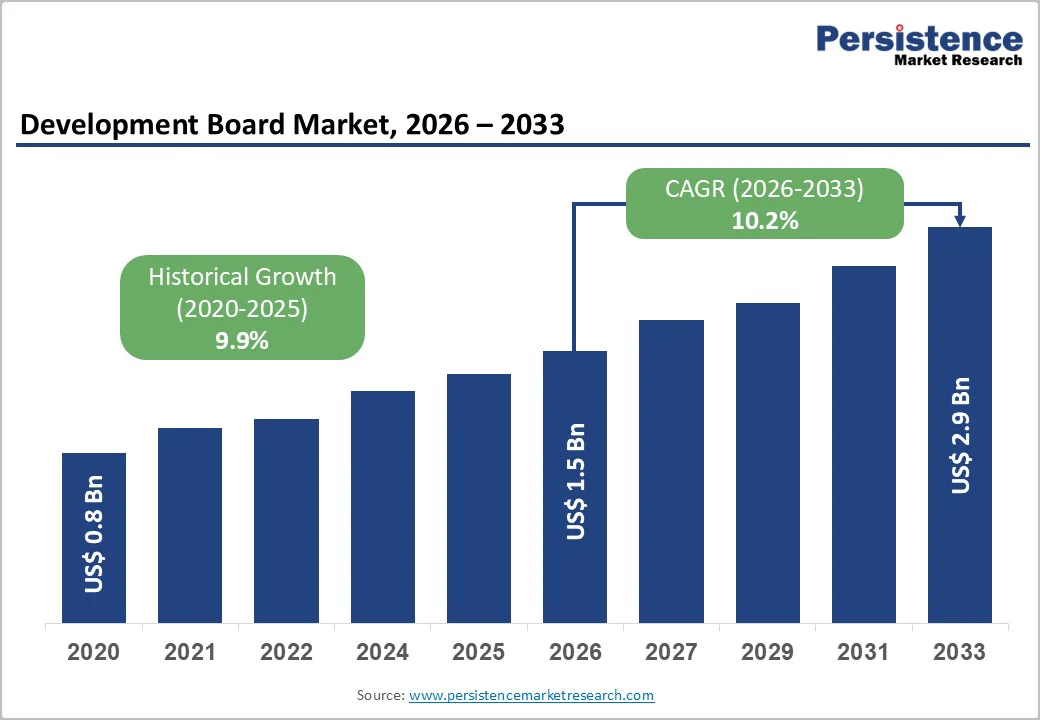
The global development board market size is likely to be valued at US$1.5 billion in 2026 and is expected to reach US$2.9 billion by 2033, growing at a CAGR of 10.2% during the forecast period from 2026 to 2033, driven by the rapid adoption of Internet of Things (IoT) across consumer, industrial, automotive, and healthcare sectors, supported by the proliferation of connected devices and smart systems. Continuous advancements in embedded systems, edge computing, and low-power electronics are increasing demand for compact, high-performance development platforms that enable faster prototyping. The rising integration of artificial intelligence (AI) and machine learning (ML) capabilities into development boards is accelerating their use in automation, robotics, smart devices, and predictive maintenance applications.
Key Industry Highlights:
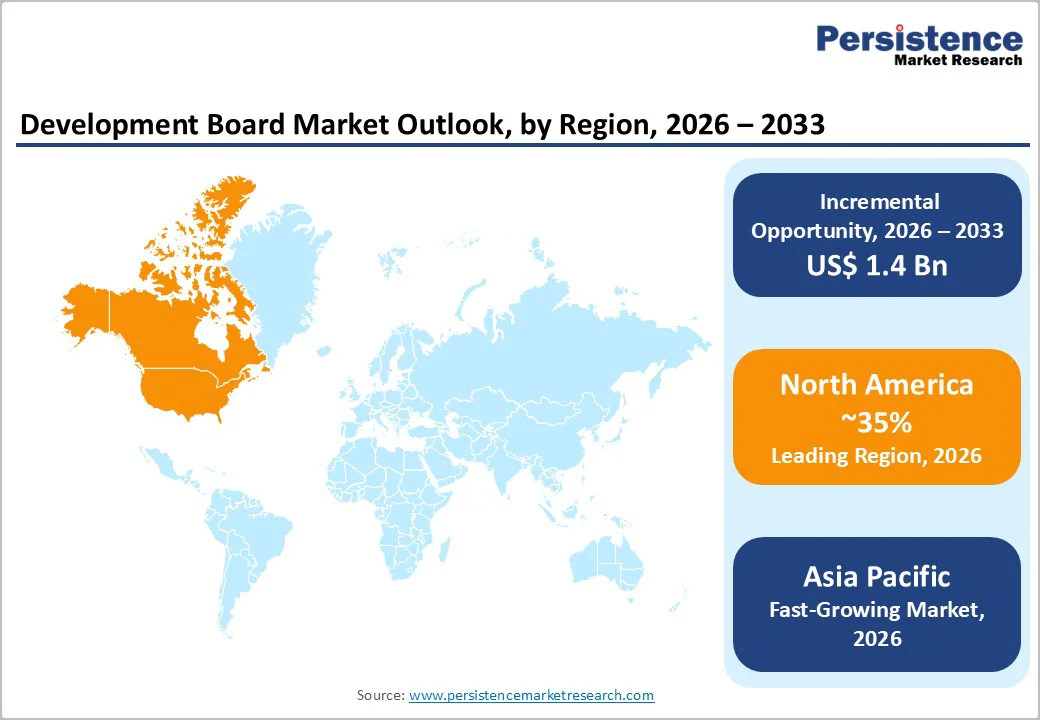
- Leading Region: North America is anticipated to be the leading region, accounting for a market share of 35% in 2026, driven by strong R&D ecosystems, high adoption in education and industrial automation, and growing demand for AI- and edge-enabled development boards.
- Fastest-growing Region: Asia Pacific is likely to be the fastest-growing region in 2026, driven by cost-effective manufacturing, government digital initiatives, rapid industrialization, IoT expansion, and supportive electronics policies.
- Leading Product Type: Single-board computers are projected to represent the leading product type in 2026, accounting for 50% of the revenue share, due to their versatility in IoT and embedded applications.
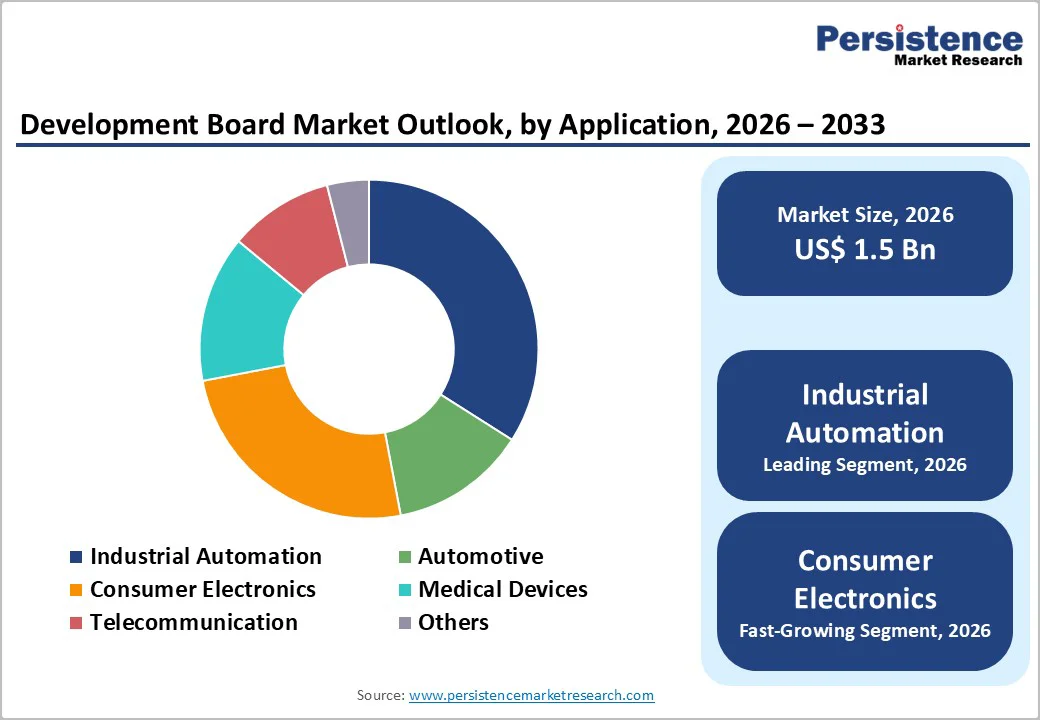
- Leading Application: Industrial automation is anticipated to be the leading application type, accounting for over 35% of the revenue share in 2026, supported by adoption in factory automation and robotics.
| Key Insights | Details |
|---|---|
|
Development Board Market Size (2026E) |
US$1.5 Bn |
|
Market Value Forecast (2033F) |
US$2.9 Bn |
|
Projected Growth (CAGR 2026 to 2033) |
10.2% |
|
Historical Market Growth (CAGR 2020 to 2025) |
9.9% |
Market Factors – Growth, Barriers, and Opportunity Analysis
Advancements in AI and Machine Learning Integration
Modern development boards increasingly feature on-board AI processors, neural processing units (NPUs), and support for ML frameworks, allowing developers to implement real-time analytics, computer vision, predictive maintenance, and automation solutions directly at the edge. This reduces dependency on cloud computing, lowers latency, and enhances data privacy, making boards ideal for applications in industrial automation, automotive systems, healthcare devices, and smart consumer electronics. As industries adopt AI-driven solutions, demand for development boards capable of supporting these advanced applications continues to rise.
AI and ML integration support the expanding IoT ecosystem, where connected devices require intelligent decision-making capabilities. Development boards now enable machine learning model training, testing, and deployment in compact, low-power platforms, making them suitable for edge devices in smart homes, robotics, wearable technology, and telecommunication systems. This trend not only boosts adoption in professional R&D environments but also attracts hobbyists and educational institutions, strengthening market growth and fostering innovation across multiple sectors.
Security Vulnerabilities and Compatibility Issues
Many development boards are connected to networks or integrated with IoT devices, making them vulnerable to cyberattacks, data breaches, and unauthorized access. Such security risks are especially critical in industrial automation, healthcare, automotive, and telecommunication applications, where system compromises can result in operational failures, financial losses, safety hazards, or leakage of sensitive data. Addressing these vulnerabilities requires manufacturers and developers to implement robust firmware security, encryption protocols, and continuous software updates, which can increase development time, costs, and complexity, thereby slowing adoption in sensitive sectors.
Compatibility issues also limit market growth, as not all development boards seamlessly integrate with diverse sensors, peripherals, or software ecosystems. Differences in hardware architectures, operating systems, and interface standards can lead to additional customization requirements, creating barriers for developers and reducing ease of use. These challenges particularly impact startups, educational institutions, and small-scale innovators who may lack resources for extensive integration testing, thereby restraining widespread adoption despite the market’s overall growth potential.
Integration with 5G and Advanced Connectivity
5G and advanced connectivity technologies enabling the design and deployment of high-performance, connected devices across multiple sectors. Development boards with 5G, Wi-Fi 6, Bluetooth, LoRa, and other wireless protocols allow developers to prototype IoT-enabled applications, industrial automation systems, smart consumer electronics, telecommunication solutions, and automotive devices with real-time data processing capabilities. The low latency, high bandwidth, and reliable network performance offered by 5G empower edge computing, AI-enabled analytics, and autonomous operations, reducing dependency on centralized cloud infrastructures and improving system responsiveness.
In North America, Asia Pacific, and Europe, demand is rising for development boards that support advanced connectivity standards. This enables innovation in smart cities, industrial IoT, remote healthcare monitoring, connected vehicles, and robotics, where rapid and reliable data transfer is critical. Startups, educational institutions, and R&D labs can leverage 5G-enabled boards to develop scalable prototypes, enhance product functionality, and accelerate time-to-market. As industries increasingly adopt connected and intelligent systems, development boards with integrated AI and machine learning capabilities are becoming essential for edge computing applications, allowing real-time data processing and decision-making. Wireless development kits are seeing higher adoption, supporting versatile IoT deployments across urban and industrial environments.
Category-wise Analysis
Product Type Insights
Single-board computer (SBCs) segment is expected to lead the development board market, accounting for approximately 50% of the total revenue in 2026, driven by their versatility, compact design, and suitability for diverse IoT and embedded applications. SBCs, particularly Raspberry Pi models, provide a cost-effective and scalable platform for developers, enabling integration into smart home systems, industrial control units, robotics, and educational tools. Their popularity is strengthened by support for ARM-based architectures, which deliver low-power consumption, broad ecosystem compatibility, and strong community support. These boards allow rapid prototyping and deployment of connected devices, offering prebuilt interfaces for sensors, actuators, and wireless modules.
Wireless development kits are likely to represent the fastest-growing segment in 2026, driven by rising demand for connected prototyping in IoT and 5G applications. For example, the Arduino MKR Wi-Fi 1010 enables developers to rapidly create smart devices with integrated Bluetooth, Wi-Fi, and LoRa connectivity. These kits are crucial for prototyping smart city applications, wearable devices, and industrial IoT solutions, where real-time wireless communication is essential. As IoT adoption accelerates, demand for boards that allow seamless integration of sensors and wireless modules grows, particularly in sectors such as home automation, healthcare, and telecommunication. Wireless development kits reduce development time and support edge computing by enabling local data processing, improving performance, and efficiency.
Application Insights
Industrial automation is projected to lead the market, capturing around 35% of the total revenue share in 2026, driven by the growing use of development boards in factory automation, robotics, and process control systems. Single-board computers (SBCs) and FPGA development kits are widely deployed in smart manufacturing environments to control equipment, monitor production lines, and enable predictive maintenance through real-time sensor data collection. For example, Raspberry Pi and BeagleBone boards are commonly used in industrial prototyping and pilot automation projects for machine monitoring, data acquisition, and edge analytics before full-scale deployment. These platforms support multiple industrial interfaces and operating systems, allowing customization for diverse manufacturing needs.
The consumer electronics segment is likely to be the fastest-growing application in 2026, driven by integration in smart home devices, educational tools, and maker projects. Growth is fueled by the increasing popularity of DIY projects, affordable prototyping platforms, and the maker movement, which encourages innovation and experimentation with smart devices. Boards enable rapid testing and iteration, allowing developers and hobbyists to integrate IoT, AI, and wireless connectivity into consumer products. Educational institutions leverage these boards to teach programming, electronics, and IoT concepts, further boosting adoption.
Regional Insights
North America Development Board Market Trends
North America is anticipated to be the leading region, accounting for a market share of 35% in 2026, driven by a mature R&D ecosystem and early adoption of emerging technologies. Increasing focus on IoT, edge computing, and AI-enabled embedded systems is driving demand for advanced development boards that offer higher processing power, low latency, and robust security features. Educational institutions and research organizations continue to be major end-users, using development boards to support STEM education, robotics programs, and applied research. The region benefits from widespread availability of open-source platforms, strong developer communities, and favorable funding for technology innovation, which together accelerate prototyping and commercialization of embedded solutions.
The growing use of development boards in industrial and commercial prototyping, particularly for smart manufacturing and automation. For example, Texas Instruments (TI) offers a wide range of microcontroller and processor development kits that are extensively used by U.S.-based developers for industrial control, motor drives, and edge AI applications. These boards support rapid testing and validation before large-scale deployment, helping companies reduce development time and costs. The integration of advanced connectivity standards, such as Ethernet, Wi-Fi, and industrial protocols, is enhancing real-time data exchange in automation systems.
Europe Development Board Market Trends
Europe is likely to be a significant market for development boards in 2026, driven by strong adoption in industrial automation, automotive electronics, smart infrastructure, and research applications. The region’s focus on industry, digital manufacturing, and sustainable technologies is increasing demand for development boards that support embedded systems, IoT, and edge computing. European manufacturers and system integrators rely on development boards for rapid prototyping, testing, and validation of automation solutions, robotics, and connected devices. Universities and research institutions across Europe actively use development boards for STEM education, applied engineering programs, and innovation projects, contributing to consistent market demand.
The rising use of development boards in automotive and mobility applications, particularly for electric vehicles, advanced driver assistance systems, and in-vehicle connectivity. For example, STMicroelectronics offers a wide range of microcontroller- and sensor-based development boards that are widely used across Europe for automotive electronics, industrial control, and IoT prototyping. These platforms support motor control, sensor fusion, and edge AI, enabling faster development cycles. Growing investments in smart factories, electric mobility, and digital infrastructure continue to support the long-term growth of the Europe development board market.
Asia Pacific Development Board Market Trends
The Asia Pacific region is likely to be the fastest-growing region in the development board market in 2026, driven by expanding electronics manufacturing, industrial automation, and large-scale adoption of IoT technologies across countries. The region benefits from cost-effective manufacturing capabilities, a strong semiconductor supply chain, and rising demand for embedded systems in consumer electronics, smart appliances, and industrial equipment. Government initiatives promoting digital transformation, smart cities, and local electronics production further accelerate the adoption of development boards for prototyping and deployment.
Asia Pacific has a strong demand for development boards in consumer electronics and industrial IoT applications. For example, Renesas Electronics, a major player in the region, provides microcontroller and processor development kits that are widely used by manufacturers in Japan and China for industrial control, automotive electronics, and smart device prototyping. These boards enable rapid design validation, customization, and scalability for mass production. Rising adoption of AI-enabled and wireless development kits, combined with supportive government policies and expanding manufacturing infrastructure.
Competitive Landscape
The global development board market exhibits a moderately fragmented structure, driven by rapid technological innovation, diverse end-use applications, and the presence of both established semiconductor companies and agile specialist firms. Market participants range from large technology and chip manufacturers to open-source hardware communities, competing across product portfolios that include microcontroller boards, single-board computers, wireless kits, and AI-enabled platforms. This competitive dynamic is underpinned by continuous advancements in IoT, edge computing, and connectivity standards, which are reshaping development board capabilities and expanding their adoption across industrial automation, healthcare, and educational segments.
With key leaders including STMicroelectronics, Texas Instruments, Raspberry Pi Foundation, Intel Corporation, NXP Semiconductors, and Microchip Technology, the market reflects a blend of traditional semiconductor expertise and community-driven hardware ecosystems. These players compete through product diversification, strategic partnerships, acquisitions, and enhanced software ecosystems, often integrating toolchains, development environments, and open-source support to improve usability and accelerate adoption. Competitive strategies also emphasize geographic expansion, targeted applications such as AI/edge computing, and collaborations with academic and industry partners.
Key Industry Developments:
- In January 2025, Union Minister Shri Ashwini Vaishnaw launched C-DAC–designed ARIES ECO and ARIES NOVA development boards along with THEJAS64, India’s first fully indigenous 64-bit VEGA-based System-on-Chip (SoC), at the C-DAC campus in Pune. Developed under the Government of India’s Digital India RISC-V (DIR-V) program, these products mark a major milestone in India’s push toward self-reliance in semiconductor and embedded system design. ARIES ECO is targeted at students for hands-on experimentation in applications such as sensor fusion, smart meters, and wearable devices, while ARIES NOVA supports education, research, and advanced embedded system development.
Companies Covered in Development Board Market
- STMicroelectronics
- Analog Devices
- Silicon Labs
- Texas Instruments
- Cypress Semiconductor
- ARM
- Adafruit
- Renesas
- Nordic Semi
- Intel
Frequently Asked Questions
The global development board market is projected to reach US$1.5 billion in 2026.
The rapid adoption of IoT, AI, and embedded systems across industries, increasing demand for rapid prototyping, edge computing, and connected device development, are the key drivers.
The development board market is expected to grow at a CAGR of 10.2% from 2026 to 2033.
The key opportunities include the integration of AI and edge computing, expansion of 5G and advanced connectivity, growing adoption in industrial automation and smart cities, and rising demand from education, startups, and indigenous semiconductor initiatives.
STMicroelectronics, Analog Devices, Silicon Labs, and Texas Instruments are the leading players.


