




- Hardware & Software IT Services
- Integrated Development Environment (IDE) Software Market
Integrated Development Environment (IDE) Software Market Size, Share, and Growth Forecast, 2026 - 2033
Integrated Development Environment (IDE) Software Market by Application (Web Application Development, Others), End-user (Individual Developers, Others), and Regional Analysis for 2026 - 2033

Integrated Development Environment (IDE) Software Market Size and Trends Analysis
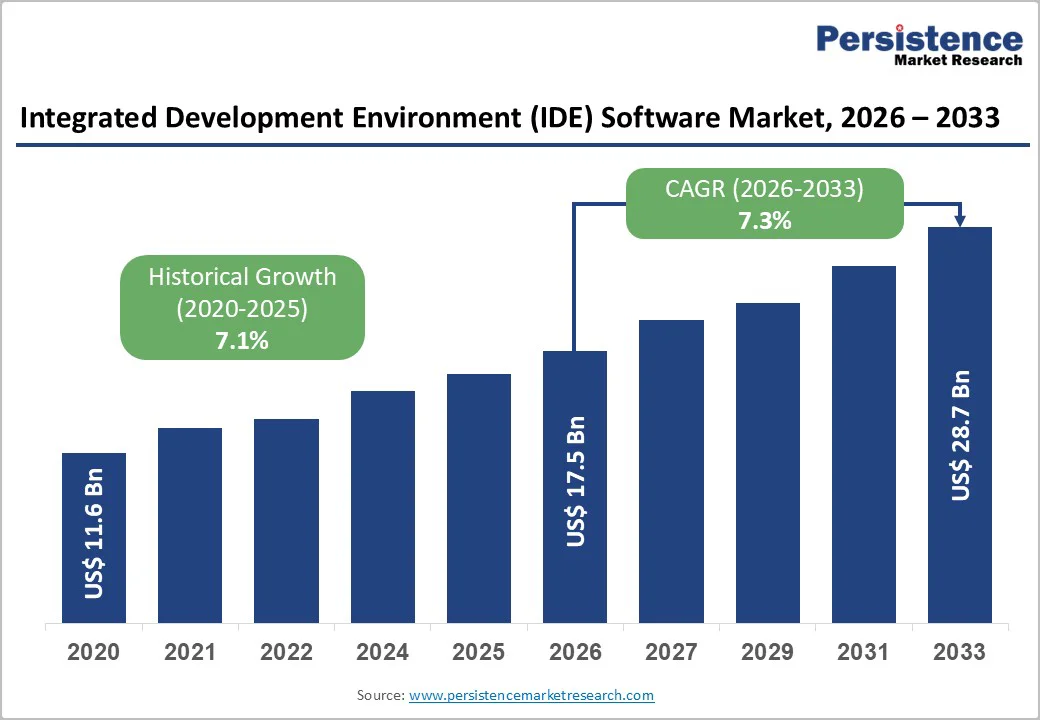
The global integrated development environment (IDE) software market size is likely to be valued at US$17.5 billion in 2026. It is expected to reach US$28.7 billion by 2033, growing at a CAGR of 7.3% from 2026 to 2033, driven by rising demand for efficient software development tools amid accelerating digital transformation initiatives across industries.
The adoption of cloud-based IDE solutions enhances accessibility and collaboration for distributed teams. Integration of AI-assisted coding and intelligent debugging features supports productivity gains and reduces development errors. The expanding developer workforce and growing emphasis on application development across industries also support long-term market expansion.
Key Industry Highlights:
- Leading Region: North America is anticipated to be the leading region, accounting for a market share of 42% in 2026, driven by strong U.S. demand, a robust tech ecosystem, high per-capita IDE spending, and adoption of AI- and cloud-integrated enterprise solutions.
- Fastest-growing Region: Asia Pacific is likely to be the fastest-growing region in the integrated development environment (IDE) software, driven by tech startups, manufacturing advantages, supportive policies, and emerging mobile/IoT-focused players.
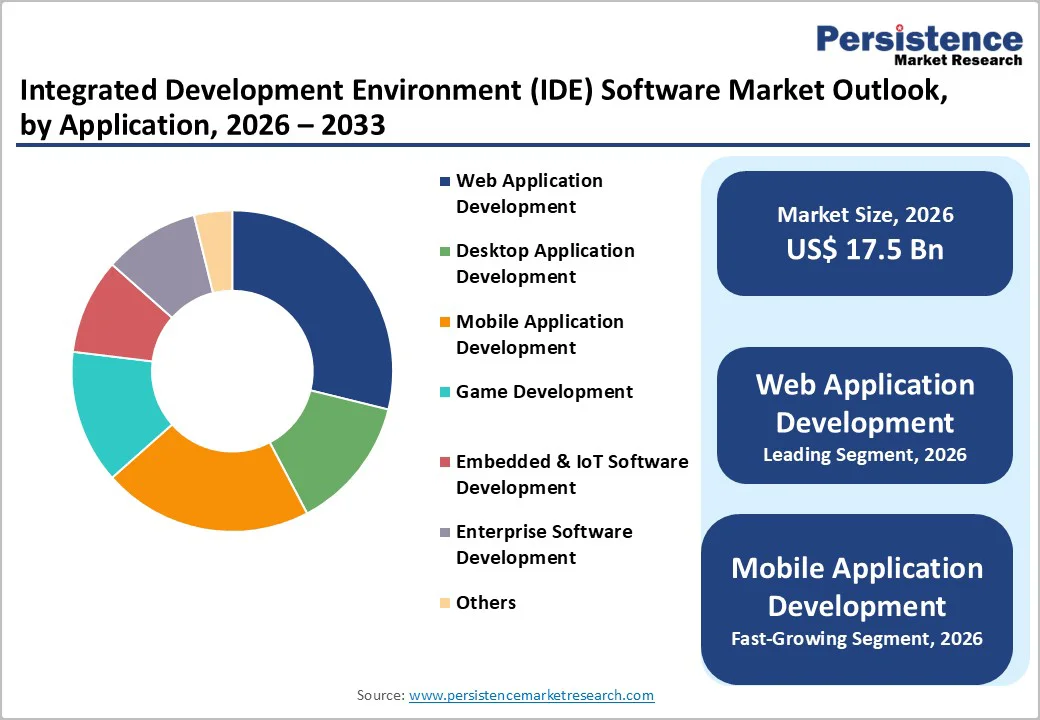
- Leading Application: Web application development is projected to lead in 2026, accounting for 40% of revenue, driven by the dominance of web-based services, e-commerce platforms, and widespread browser access.
- Leading End-user: Large enterprises are expected to be the largest end-user segment, accounting for over 50% of revenue in 2026, driven by complex project requirements, substantial budgets, and investments in enterprise-grade features such as collaboration and security.
| Key Insights | Details |
|---|---|
|
IDE Software Market Size (2026E) |
US$17.5 Bn |
|
Market Value Forecast (2033F) |
US$28.7 Bn |
|
Projected Growth (CAGR 2026 to 2033) |
7.3% |
|
Historical Market Growth (CAGR 2020 to 2025) |
7.1% |
Market Factors - Growth, Barriers, and Opportunity Analysis
Increasing Adoption of Cloud-Based Development Platforms
Cloud IDEs provide developers with browser-accessible, fully-integrated environments that support coding, debugging, and deployment without the need for complex local installations. This accessibility enables seamless collaboration among distributed teams, allowing multiple developers to work on the same project in real time. Businesses are increasingly embracing cloud IDEs as part of their digital transformation strategies, leveraging the scalability and flexibility these platforms offer. Cloud-based solutions reduce upfront infrastructure costs, making them attractive to small and medium-sized enterprises (SMEs) and startups, while maintaining enterprise-level security and compliance.
The trend toward remote and hybrid work models has accelerated cloud IDE adoption, as developers require reliable, anywhere-access environments. Integration with DevOps pipelines, version control systems, and AI-assisted coding tools further enhances productivity and reduces development cycle times. Cloud IDEs also support rapid prototyping and deployment of web, mobile, and enterprise applications, making them essential for modern software development workflows. Robust security features and compliance with industry standards ensure that sensitive code and intellectual property are protected.
Security and Integration Concerns
Cloud-based IDE platforms, while offering convenience and remote accessibility, require developers to store source code and project data on external servers. This raises concerns about data breaches, unauthorized access, and compliance with regulatory frameworks such as GDPR and industry-specific guidelines. Organizations managing sensitive or proprietary software are often cautious about fully adopting cloud IDEs, as any compromise could result in the loss of intellectual property, financial damage, or reputational risk. Enterprises in sectors such as finance, healthcare, and defense are particularly sensitive to these issues, slowing widespread adoption despite the operational benefits.
Integration complexities also hinder market expansion. IDEs must connect seamlessly with existing DevOps pipelines, legacy systems, version control tools, and third-party plugins to ensure smooth workflows. Compatibility challenges or inefficient integration can increase development errors, reduce productivity, and elevate operational costs. Enterprises with hybrid environments face additional hurdles in synchronizing cloud IDEs with on-premises infrastructure. These security and integration concerns collectively restrain faster adoption of IDE solutions, particularly among large enterprises and regulated industries.
Integration of Emerging Technologies such as AI and DevOps
Modern IDEs increasingly incorporate AI-powered features such as code autocompletion, intelligent debugging, error prediction, and automated testing. These capabilities enhance developer productivity, reduce coding errors, and accelerate development cycles. AI integration also enables smarter code suggestions, learning from developer patterns, which is particularly valuable for complex projects involving multiple programming languages and frameworks. As a result, organizations can deliver high-quality software more efficiently and at lower cost.
DevOps integration within IDEs streamlines the software development lifecycle by linking coding, testing, and deployment in a continuous workflow. IDEs that integrate seamlessly with version control systems, CI/CD pipelines, and cloud environments support rapid prototyping, deployment, and iterative updates. This synergy between AI and DevOps empowers enterprises to adopt agile practices, improve collaboration among distributed teams, and respond faster to market demands. Consequently, the adoption of AI- and DevOps-enabled IDEs is becoming a key growth driver in the software development industry.
Category-wise Analysis
Application Insights
The web application development segment is projected to dominate, contributing around 40% of revenue in 2026, fueled by the widespread adoption of web-based services, e-commerce platforms, and broad browser accessibility. Web applications are increasingly essential for enterprises, startups, and governments seeking scalable and accessible solutions across multiple devices. IDEs such as Microsoft Visual Studio Code and JetBrains WebStorm offer comprehensive frameworks for web development, supporting languages such as JavaScript, HTML5, and CSS, and seamlessly integrating with version control and cloud services. As web-based platforms remain central to global business operations, their adoption continues to grow.
Mobile application development is likely to be the fastest-growing segment, driven by smartphone adoption, the expansion of the app economy, and rising demand for mobile-first experiences. IDEs such as Android Studio and Xcode facilitate the swift development and deployment of mobile applications for Android and iOS. Organizations use these mobile IDEs to implement enterprise mobility solutions, enhancing productivity and customer engagement. The rising adoption of cross-platform frameworks such as Flutter and React Native further boosts growth by allowing developers to build applications for multiple devices from a single codebase.
By End-user Insights
Large enterprises are projected to lead the market, capturing around 50% of the total revenue share in 2026, driven by complex project requirements, substantial budgets, and investments in enterprise-grade features such as collaboration, security, and CI/CD integration. Companies such as Amazon and Microsoft deploy enterprise-grade IDEs to streamline large-scale software development across global teams. These IDEs support advanced features, including cloud integration, automated testing, and multi-language support, enabling large organizations to manage high volumes of code and ensure consistent quality.
Small and Medium Enterprises (SMEs) are likely to be the fastest-growing, driven by rising digital adoption, affordable cloud-based IDE subscriptions, and scalable development tools. SMEs are progressively utilizing platforms such as Visual Studio Code and cloud IDEs, including AWS Cloud9, to create competitive software solutions while minimizing infrastructure costs. Cloud subscriptions and flexible licensing enable small businesses to access enterprise-level features while controlling costs. The growth of startups and digital-first companies worldwide accelerates SME adoption of IDEs for web, mobile, and enterprise software development.
Regional Insights
North America Integrated Development Environment (IDE) Software Market Trends
North America is anticipated to be the leading region, accounting for a market share of 42% in 2026, driven by its mature technology ecosystem, advanced IT infrastructure, and high adoption of cloud-based and AI-enhanced development tools. There is strong demand in the U.S. and Canada for scalable, collaborative development environments that integrate seamlessly with modern workflows. Developers and enterprises in North America are leading the adoption of AI-assisted coding, real-time debugging, and cloud-based IDE platforms such as AWS Cloud9 and Gitpod, enabling efficient collaboration for distributed and remote engineering teams.
Organizations seek to reduce time-to-market and enhance developer productivity. Cloud-based IDE adoption remains strong, with the region holding a dominant share of the Cloud IDE market thanks to major technology vendors and early uptake of remote collaboration tools. Advances in AI, including natural language code creation and automated bug detection, are redefining software development workflows. Innovations, such as Google’s Project IDX and AI-enabled enterprise offerings from JetBrains, highlight the shift toward cloud-first, intelligence-driven modern IDEs.
Europe Integrated Development Environment (IDE) Software Market Trends
Europe is likely to be a significant market for integrated development environment (IDE) software in 2026, driven by robust demand in key markets such as Germany, the U.K., and France, where enterprises and startups alike leverage IDE tools for software development across sectors such as automotive, finance, and healthcare. The increasing focus on cloud-based solutions and collaborative development is evident as organizations adopt platforms, such as Visual Studio Code and JetBrains IntelliJ IDEA, to support distributed teams and complex development workflows.
Organizations increasingly integrate DevOps practices and automated workflows into IDE environments to improve efficiency and reduce time-to-market. Cloud IDE adoption is rising across sectors such as education, BFSI, and healthcare, as these tools support remote collaboration and scalable development. For example, the region’s growing interest in generative AI for software development workflows has been driven by platforms that offer EU-compliant AI integrations, enhancing code generation and predictive assistance. European companies are balancing innovation with regulatory compliance, with sectors such as smart manufacturing and embedded systems increasingly adopting secure development workflows.
Asia Pacific Integrated Development Environment (IDE) Software Market Trends
The Asia Pacific region is likely to be the fastest-growing region in the integrated development environment (IDE) software market, driven by rapid digital transformation, expanding startup ecosystems, rising software development outsourcing, increasing adoption of cloud-based IDEs, strong demand for mobile and web applications, and government-led digital initiatives. SME adoption of cloud-based and open-source IDE tools is particularly high, as these provide scalable, cost-effective development environments for web and application projects. Increased use of IDEs in education and training programs also bolsters the regional talent pipeline.
Countries such as India and Japan are witnessing accelerated adoption of AI-assisted coding tools and automated workflows that streamline development lifecycles. Regional policies supporting digital growth, such as India’s Digital India initiative, stimulate demand for advanced IDE capabilities and cloud-based development environments. The growth of DevOps practices and cloud-native deployments in the region enhances the integration of IDE tools with CI/CD pipelines, supporting faster and more efficient software delivery across industries.
-software-market-outlook-by-region-2026-2033.webp)
Competitive Landscape
The global integrated development environment (IDE) software market exhibits a moderately fragmented structure, driven by diverse open-source projects, large commercial vendors, and a vibrant startup scene seeking to capture niche toolsets.) Market leadership is distributed across platform giants and specialist vendors, with a strong presence of cloud and AI entrants reshaping competitive dynamics. With key leaders including Microsoft, JetBrains, Oracle, IBM, and Amazon Web Services (AWS), the market balances dominant free/code-centric tools (e.g., Visual Studio Code) with paid, feature-rich offerings.
These players compete through differentiated feature sets and ecosystem integrations. Cloud IDE and collaboration features, AI-assisted coding, DevOps/CI-CD integration, enterprise security/compliance, pricing, and extensibility via plugins. Vendors also pursue partnerships, developer community engagement, and M&A to extend capabilities (for example, GitHub/Microsoft ecosystem integrations and AWS cloud offerings). The result is intense competition across usability, performance, and enterprise readiness, with cloud-native and AI-enabled capabilities driving recent investment and product roadmaps.
Key Industry Developments:
- In November 2025, Microsoft released Visual Studio 2026, positioning it as an “AI-native intelligent development environment.” The latest version of Microsoft’s flagship IDE introduces AI-powered debugging, performance profiling, and application modernization features, alongside faster startup times and an improved user experience. According to Microsoft, embedded AI capabilities reduce development friction by surfacing actionable insights, enabling developers to code, debug, and optimize applications more efficiently without interrupting workflow.
- In October 2025, Syncfusion® announced the launch of Code Studio, a new AI-powered Integrated Development Environment (IDE) designed to empower enterprise developers with responsible, governed AI-driven coding. The platform combines AI-assisted code generation, intelligent editing, visualization, and collaboration within a secure, enterprise-ready workspace, enabling faster and more controlled software development.
Companies Covered in Integrated Development Environment (IDE) Software Market
- Adobe Systems
- Amazon Web Services (AWS)
- Appcelerator
- IBM Corp.
- Intel Corp.
- JetBrains
- Microsoft
- Nitrous
- OpenClovis
- Oracle
- Red Hat Inc.
- Renesas Electronics Corporation.
- SAP SE
- ServiceNow
- Unqork
Frequently Asked Questions
The global integrated development environment (IDE) software market is likely to be valued at US$17.5 billion in 2026.
Growing demand for efficient and productivity-enhancing software development tools, fueled by rapid digital transformation, is increasing the adoption of cloud-based and AI-enabled IDEs.
The integrated development environment (IDE) software market is expected to grow at a CAGR of 7.3% from 2026 to 2033.
Expanding adoption of cloud-based and AI-driven IDEs, growing demand from SMEs and startups, and increasing mobile, IoT, and embedded software development.
Adobe Systems, Amazon Web Services (AWS), Appcelerator, IBM Corp., Intel Corp., JetBrains, Microsoft, Nitrous, and Others are the leading players.


