




- Medical Devices
- Dermatology Excimer Lasers Market
Dermatology Excimer Lasers Market Size, Share, Growth, and Regional Forecast, 2026 to 2033
Dermatology Excimer Lasers Market by Product (Table Top Excimer Lasers, Handheld Excimer Lasers, and Trolley Mounted Excimer Lasers), by Application (Psoriasis, Vitiligo, Eczema/ Atopic Dermatitis, Allergic Rhinitis, Alopecia Areata, and Others) by End User (Hospitals, Dermatology & Cosmetic Clinics, Plastic Surgery Centers, and Others), and Regional Analysis from 2026 to 2033

Dermatology Excimer Lasers Market Share and Trend Analysis
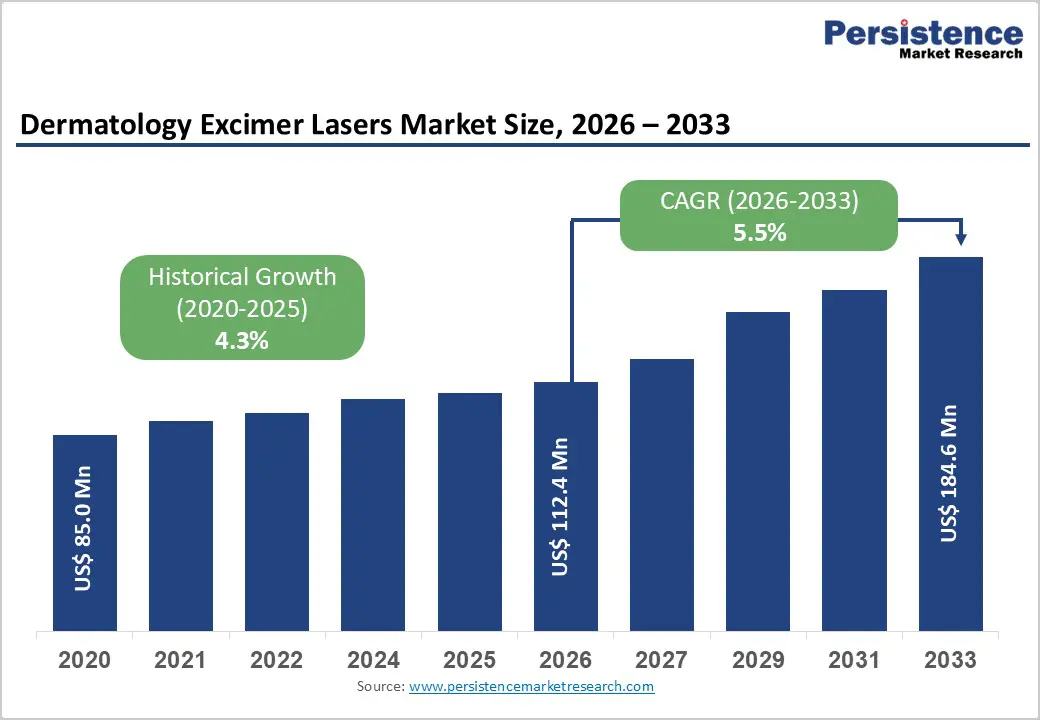
The global dermatology excimer lasers market size is estimated to grow from US$ 112.4 million in 2026 to US$ 184.6 million by 2033. The market is projected to grow at a CAGR of 5.5% from 2026 to 2033.
Growing global demand for targeted dermatological therapies is driving wider adoption of advanced phototherapy technologies in clinical practice. Excimer laser systems are increasingly utilized by dermatologists for the treatment of chronic inflammatory and pigmentary skin disorders, including psoriasis and vitiligo, where localized ultraviolet B (UVB) radiation can precisely target affected tissue while preserving surrounding healthy skin. Compared with conventional phototherapy, excimer lasers offer higher treatment accuracy and shorter therapy cycles, improving patient compliance and clinical outcomes.
Rising prevalence of chronic skin diseases, combined with greater awareness of non-invasive dermatologic treatments, continues to expand the patient pool requiring specialized care. Technological advancements in laser beam control, safety monitoring, and device ergonomics are further improving treatment reliability across hospitals and dermatology clinics. Additionally, the expansion of private dermatology centers and aesthetic clinics worldwide is increasing access to specialized laser-based therapies. Growing physician training programs, supportive clinical research, and improved treatment protocols are strengthening clinical confidence, positioning excimer laser technology as an increasingly important tool within modern dermatology treatment pathways.
Key Industry Highlights:
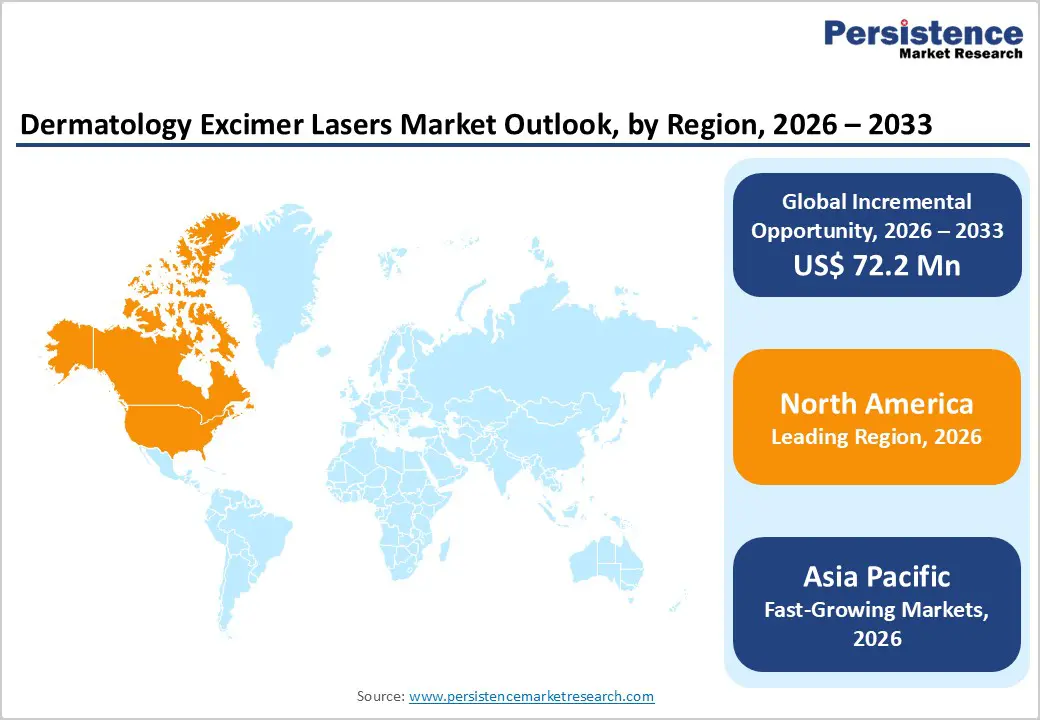
- Leading Region: North America holds 46.7% of the global market, supported by strong dermatology infrastructure, early adoption of advanced laser technologies, high physician awareness of targeted phototherapy, and widespread availability of specialized skin treatment centers.
- Fastest-Growing Region: Asia Pacific is witnessing the fastest expansion, driven by improving healthcare infrastructure, growing dermatology clinic networks, rising disposable incomes, and increasing acceptance of advanced laser-based skin treatments.
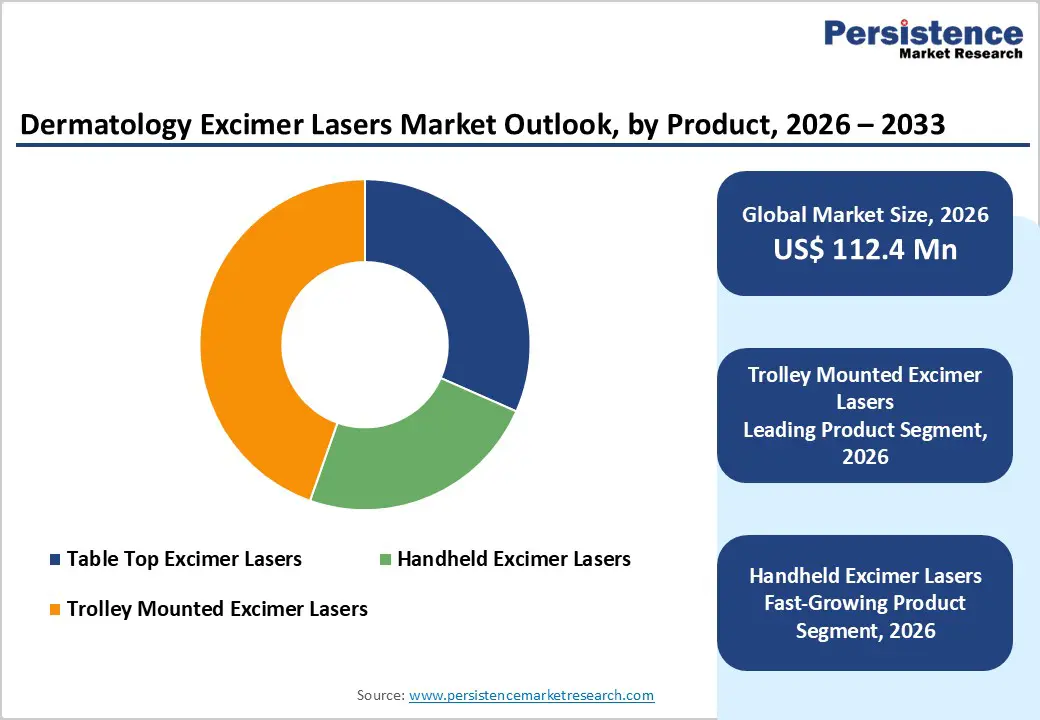
- Leading Product Segment: Trolley mounted excimer lasers represent the leading product segment due to their higher treatment stability, precise UVB delivery, and widespread installation in hospitals and high-volume dermatology clinics.
- Fastest-Growing Product Segment: Handheld excimer lasers are experiencing rapid growth as dermatologists increasingly adopt compact and portable laser platforms that enable targeted treatment of localized skin lesions in outpatient environments.
- Leading Application Segment: Psoriasis continues to represent the largest application segment, supported by the high global prevalence of the condition and the strong clinical effectiveness of excimer laser therapy in clearing localized plaques.
- Fastest-Growing Application Segment: Vitiligo is emerging as the fastest-growing treatment area, driven by increasing demand for repigmentation therapies and growing awareness of advanced dermatological treatment options among patients worldwide.
| Global Market Attributes | Key Insights |
|---|---|
| Dermatology Excimer Lasers Market Size (2026E) | US$ 112.4 Mn |
| Market Value Forecast (2033F) | US$ 184.6 Mn |
| Projected Growth (CAGR 2026 to 2033) | 5.5% |
| Historical Market Growth (CAGR 2020 to 2025) | 4.3% |
Market Dynamics
Driver - Rising Prevalence of Chronic Skin Disorders and Increasing Demand for Targeted Phototherapy
Growing incidence of chronic inflammatory skin diseases is significantly contributing to the expansion of advanced dermatological treatment technologies worldwide. Conditions such as psoriasis, vitiligo, eczema, and alopecia areata affect millions of patients globally and often require long-term therapeutic management. Conventional treatment options, including topical corticosteroids and systemic immunosuppressive therapies, can produce variable outcomes or undesirable side effects with prolonged use. As a result, dermatologists are increasingly adopting targeted phototherapy solutions that provide localized treatment while minimizing systemic exposure. Excimer laser systems, particularly those operating at the 308-nm wavelength, allow physicians to deliver focused ultraviolet B (UVB) radiation directly to affected skin lesions. This precise energy delivery improves therapeutic response rates while limiting damage to surrounding healthy tissue. The technology is particularly valuable for patients with localized or treatment-resistant psoriasis plaques and pigmentary disorders such as vitiligo.
Increasing clinical evidence demonstrating faster lesion clearance, improved repigmentation outcomes, and shorter treatment cycles has strengthened physician confidence in excimer laser therapy. Additionally, advancements in laser beam calibration, safety controls, and real-time dose monitoring are improving treatment accuracy and patient safety. Growing patient awareness regarding non-invasive dermatological procedures is also encouraging adoption across outpatient clinics and specialized skin treatment centers. As healthcare providers increasingly focus on precision dermatology and individualized treatment protocols, excimer laser systems are becoming a preferred option for managing chronic skin diseases. The expanding dermatology clinic network, combined with increasing availability of advanced medical laser technologies, continues to reinforce the long-term growth trajectory of targeted phototherapy solutions.
Restraints - High Equipment Costs and Limited Accessibility in Developing Healthcare Systems
The high capital investment required for advanced excimer laser systems is one of the major restraint effecting market growth. Many devices involve significant upfront costs related to laser technology components, integrated safety features, and specialized calibration mechanisms. These financial requirements can limit adoption among smaller dermatology clinics, particularly in emerging economies where healthcare budgets and reimbursement support remain constrained.
Maintenance expenses, including periodic servicing, laser component replacement, and regulatory compliance checks, further increase operational costs for healthcare providers. Another challenge involves the requirement for specialized physician training and technical expertise to safely operate excimer laser platforms. Dermatologists must carefully determine treatment dosage, exposure duration, and lesion targeting to achieve optimal clinical outcomes while minimizing potential side effects such as erythema or blistering. Limited training opportunities and the absence of standardized treatment protocols across regions may slow clinical integration. Furthermore, reimbursement coverage for laser-based dermatological procedures varies widely between countries and insurance providers, often categorizing these treatments as elective or cosmetic rather than medically necessary. This reimbursement uncertainty may discourage healthcare facilities from investing in advanced phototherapy systems. In many developing regions, limited awareness regarding targeted phototherapy options and insufficient access to dermatology specialists also restrict patient utilization. Collectively, these financial, technical, and systemic constraints continue to influence market penetration despite growing demand for advanced dermatological treatment technologies.
Opportunity - Technological Advancements and Expanding Applications in Aesthetic and Pigmentary Dermatology
Emerging technological developments and expanding treatment applications are creating promising growth opportunities within modern dermatology practices. Innovations in laser engineering are enabling manufacturers to develop more compact, portable, and energy-efficient excimer laser systems designed for outpatient clinics and specialty dermatology centers. Handheld and hybrid device platforms are improving treatment flexibility, allowing physicians to perform highly targeted therapy for small and difficult-to-reach skin lesions. These advancements are particularly beneficial for treating pigmentary disorders such as vitiligo, where precise UVB delivery can stimulate melanocyte activity and promote repigmentation.
Growing interest in aesthetic dermatology is also contributing to increased adoption of advanced laser technologies. Dermatology clinics are increasingly incorporating phototherapy devices into comprehensive treatment portfolios that address skin pigmentation irregularities, chronic inflammatory conditions, and localized dermatologic lesions. Integration of digital treatment planning software and automated dose control systems is improving workflow efficiency and ensuring consistent treatment outcomes across multiple sessions. In addition, the expansion of dermatology services in emerging healthcare markets is opening new commercial opportunities for device manufacturers. Rising disposable income levels, greater patient awareness of skin health, and increased access to private dermatology clinics are accelerating demand for specialized skin treatments. Ongoing clinical research evaluating excimer laser therapy for additional dermatologic indications, including alopecia areata and resistant eczema, may further broaden therapeutic applications. As technology continues to evolve and treatment accessibility improves, targeted phototherapy systems are expected to become increasingly integral to modern dermatology care worldwide.
Category-wise Insights
By Product
Trolley mounted excimer lasers are expected to remain the dominant product category in 2026, holding a 44.6% revenue share of the global dermatology excimer lasers market. Their leadership is largely attributed to superior power stability, precise targeted phototherapy delivery, and compatibility with high patient throughput environments. These systems are widely adopted in dermatology departments and specialized skin clinics because they allow physicians to treat localized lesions with controlled ultraviolet B (UVB) radiation while minimizing exposure to surrounding healthy tissue. Compared with smaller systems, trolley-mounted devices offer enhanced beam control, larger treatment spot sizes, and advanced calibration features that improve therapeutic accuracy. In addition, the presence of integrated safety mechanisms and programmable treatment settings supports standardized protocols across multi-physician facilities.
Growing demand for hospital-grade dermatological equipment, combined with increasing cases of chronic inflammatory skin diseases, continues to support the installation of trolley-based platforms. Continuous product innovation, including improved mobility, touchscreen interfaces, and integrated patient data tracking, further strengthens adoption across high-volume dermatology practices and tertiary care hospitals worldwide.
By Application
The psoriasis segment is projected to remain the largest application area in 2026, accounting for 41.7% of the global dermatology excimer lasers market. Excimer laser therapy has become an established targeted phototherapy approach for treating localized psoriasis plaques, offering higher efficacy compared with conventional topical therapies in certain cases. Dermatologists frequently utilize 308-nm excimer laser systems because they deliver concentrated UVB energy directly to affected skin areas, reducing overall treatment duration while limiting exposure to unaffected tissue. The rising global burden of psoriasis, coupled with increasing patient preference for non-systemic treatment options, continues to strengthen procedural demand. Clinical evidence supporting faster lesion clearance and longer remission periods has also improved physician confidence in excimer laser therapy. In addition, advancements in beam targeting technologies and adjustable dose calibration have improved treatment safety and patient outcomes. As healthcare providers increasingly integrate precision dermatology approaches within outpatient settings, excimer laser therapy for psoriasis remains a primary clinical application, generating stable and recurring treatment volumes worldwide.
By End-user
Dermatology and cosmetic clinics are anticipated to dominate the end-user segment in 2026, capturing approximately 47.9% of the global market share. Their leadership is primarily driven by the growing number of specialized dermatology centers offering advanced phototherapy treatments for chronic skin conditions. These clinics typically manage large volumes of patients with psoriasis, vitiligo, eczema, and other inflammatory dermatologic disorders that require targeted UVB therapy. Compared with large hospital environments, specialty clinics often provide faster appointment cycles, personalized treatment protocols, and dedicated laser therapy units, making them the preferred setting for excimer laser procedures. Increasing consumer awareness regarding aesthetic dermatology treatments has also expanded clinic-based procedures for pigment disorders and skin rejuvenation therapies. Furthermore, the availability of compact laser platforms and improved treatment ergonomics has enabled dermatologists to integrate excimer systems into outpatient practice settings efficiently. Continuous physician training programs and technological upgrades in dermatology clinics are expected to further reinforce their leading position in the dermatology excimer lasers market.
Regional wise Insights
North America Dermatology Excimer Lasers Market Trends
North America is projected to maintain its dominant position in the global dermatology excimer lasers market in 2026, accounting for a 46.7% market share. The region benefits from a well-established dermatology treatment ecosystem, widespread availability of advanced laser technologies, and strong clinical awareness among healthcare professionals. The United States remains the primary contributor due to the high prevalence of chronic skin disorders such as psoriasis and vitiligo, alongside strong demand for specialized dermatological treatments. Many dermatology clinics and hospital-based skin treatment centers in the region have already integrated excimer laser systems into their therapeutic offerings for targeted phototherapy procedures.
Additionally, favorable regulatory pathways for dermatology devices and the presence of several leading manufacturers support the rapid commercialization of new laser platforms. Physician training programs and clinical education initiatives further encourage the adoption of precision phototherapy treatments. North America also benefits from strong research activity focused on improving treatment protocols and patient outcomes in inflammatory skin diseases. With increasing patient preference for non-invasive dermatologic procedures and growing adoption of advanced medical lasers in outpatient clinics, the region continues to maintain technological leadership and strong commercial growth in the dermatology excimer lasers market.
Europe Dermatology Excimer Lasers Market Trends
Europe represents a significant share of the global dermatology excimer lasers market and is expected to demonstrate consistent expansion through 2026. Countries including Germany, France, Italy, and the United Kingdom play a key role in regional demand due to their well-developed healthcare infrastructure and strong dermatology research communities. Dermatology specialists across Europe increasingly incorporate targeted phototherapy into treatment plans for chronic inflammatory skin diseases, particularly psoriasis and vitiligo. The region emphasizes evidence-based clinical practice, which has supported the adoption of excimer laser systems supported by validated treatment protocols and controlled dosing strategies. Public healthcare systems across several European countries also contribute to procedural adoption by supporting dermatological care for chronic skin disorders.
Furthermore, the presence of numerous academic medical centers and dermatology research institutes promotes clinical trials evaluating new phototherapy applications and treatment optimization methods. Growing interest in aesthetic dermatology and pigment disorder management is further expanding utilization in private dermatology clinics. Technological advancements such as precision beam delivery, compact device designs, and improved patient safety features continue to strengthen the adoption of excimer laser therapy across both hospital dermatology departments and specialized skin treatment centers throughout Europe.
Asia Pacific Dermatology Excimer Lasers Market Trends
The Asia Pacific region is expected to emerge as the fastest-growing regional market, projected to expand at a CAGR of approximately 7.4% between 2026 and 2033. Rapid development of healthcare infrastructure in major economies such as China, India, Japan, and South Korea is significantly improving access to advanced dermatology treatments, including excimer laser therapy. Rising awareness about chronic skin disorders and growing demand for specialized dermatological care are encouraging hospitals and private skin clinics to adopt modern laser technologies. Increasing disposable incomes and expanding middle-class populations are also contributing to higher spending on both medical and aesthetic dermatology services. In addition, several countries in the region are witnessing strong growth in cosmetic dermatology clinics that offer advanced treatments for pigmentation disorders, vitiligo, and skin rejuvenation.
Governments are investing in expanding dermatology care facilities and training programs to address the increasing burden of skin diseases. Furthermore, regional manufacturers are introducing cost-competitive laser devices, making advanced phototherapy technologies more accessible to smaller clinics. The growing medical tourism sector in countries such as South Korea, Thailand, and India is also boosting demand for specialized dermatological procedures, positioning the Asia Pacific as the most dynamic growth hub for dermatology excimer laser technologies in the coming years.
Competitive Landscape
The global dermatology excimer lasers market is highly competitive, with strong participation from STRATA Skin Sciences, Inc., Alma Lasers Ltd., Phothera (formerly The Daavlin Company), Shenzhen GSD Tech Co., Ltd., Kernel Medical Equipment Co., Ltd., and KRUPA MEDI SCAN. These players leverage strong clinical collaborations, physician training programs, and continuous innovation in targeted phototherapy technologies, advanced laser delivery systems, and compact device platforms to support various dermatological treatments.
Rising demand for non-invasive skin therapies and increasing prevalence of psoriasis and vitiligo are accelerating innovation, with manufacturers focusing on portable laser systems, improved treatment precision, digital treatment tracking, and expansion into emerging healthcare markets to enhance accessibility and clinical outcomes.
Key Industry Developments:
- In February 2026, STRATA Skin Sciences, Inc., a medical technology company focused on developing and commercializing advanced dermatologic treatments, announced that Johns Hopkins Dermatology has incorporated the XTRAC® 308 nm excimer laser into its clinical treatment portfolio to expand targeted phototherapy options for patients.
Companies Covered in Dermatology Excimer Lasers Market
- STRATA Skin Sciences, Inc.
- Alma Lasers Ltd.
- Phothera (formerly The Daavlin Company)
- Shenzhen GSD Tech Co., Ltd.
- Kernel Medical Equipment Co., Ltd.
- KRUPA MEDI SCAN
- Shanghai SIGMA High-tech Co., Ltd.
- Beijing Sincoheren S&T Development Co., Ltd.
- Wuhan Peninsula Medical Technology Co., Ltd.
- WONTECH Co., Ltd.
- Lumenis Be Ltd.
- Candela Corporation
- Cynosure Lutronic
- GME German Medical Engineering GmbH
- Fotona d.o.o.
- Others
Frequently Asked Questions
The global dermatology excimer lasers market is projected to be valued at US$ 112.4 Mn in 2026.
Rising prevalence of chronic skin disorders such as psoriasis, vitiligo, and eczema, along with increasing demand for precise and minimally invasive dermatological treatments, is driving the global dermatology excimer lasers market.
The global dermatology excimer lasers market is poised to witness a CAGR of 5.5% between 2026 and 2033.
Key opportunities include the expansion of portable/handheld excimer laser systems, integration of AI-based lesion mapping technologies, and growing adoption in emerging markets and aesthetic dermatology clinics.
STRATA Skin Sciences, Inc., Alma Lasers Ltd., Phothera (formerly The Daavlin Company), Shenzhen GSD Tech Co., Ltd., Kernel Medical Equipment Co., Ltd., and KRUPA MEDI SCAN are some of the key players in the dermatology excimer lasers market.


