




- Food Ingredients & Additives
- Dehydrated Onions Market
Dehydrated Onions Market Size, Share, and Growth Forecast 2026 - 2033
Dehydrated Onions Market by Form (Powder, Flakes, Granules, Slices, Others), Onion Type (White Onion, Red Onion, Pink Onion), Nature (Conventional, Organic), End-user (Food Processing Companies, Food Service, Retail / Household), and Regional Analysis, 2026 - 2033

Dehydrated Onions Market Share and Trends Analysis
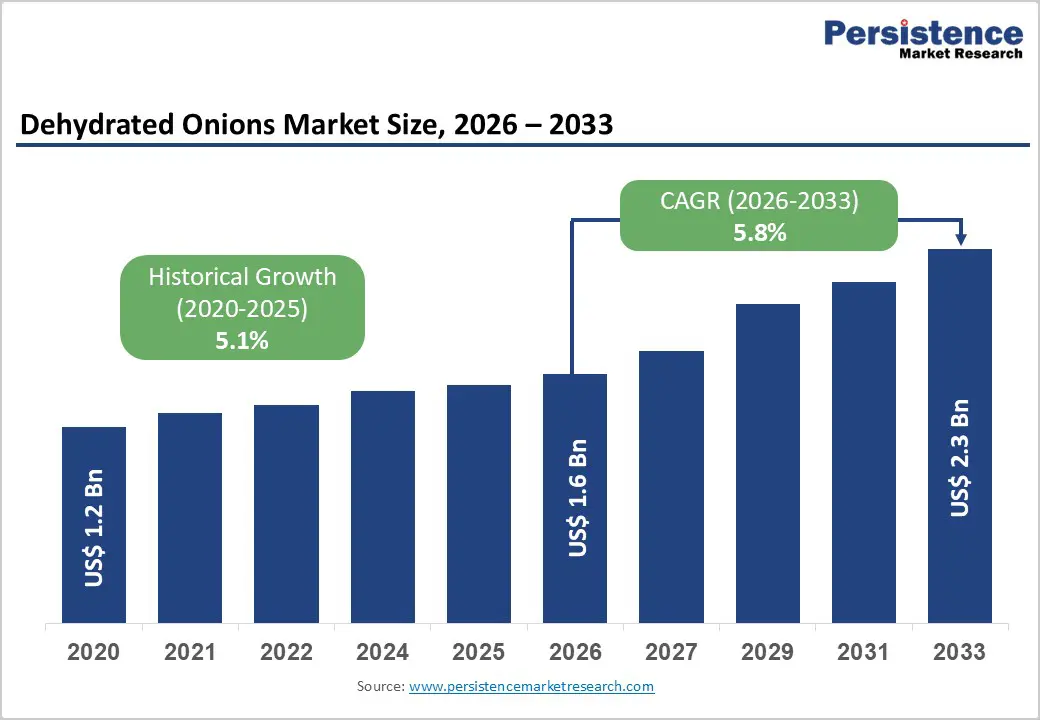
The global dehydrated onions market size is expected to be valued at US$ 1.6 billion in 2026 and projected to reach US$ 2.3 billion by 2033, growing at a CAGR of 5.8% between 2026 and 2033. Rapid growth in convenience and processed foods, together with the need for consistent flavor and longer shelf life, is pushing food manufacturers and foodservice operators to substitute fresh onions with dehydrated formats at scale.
Strong onion production in major growing regions and the development of specialized dehydration hubs such as Mahuva, Gujarat, which alone operates around 120 processing units and over 70 cold stores for dehydrated onions, reinforces global supply security and export capability. In parallel, tightening food safety norms and commodity-specific best-practice guidelines for onions are compelling processors to invest in technology, traceability, and hygienic operations, which further professionalize the industry and support premium pricing.
Key Industry Highlights:
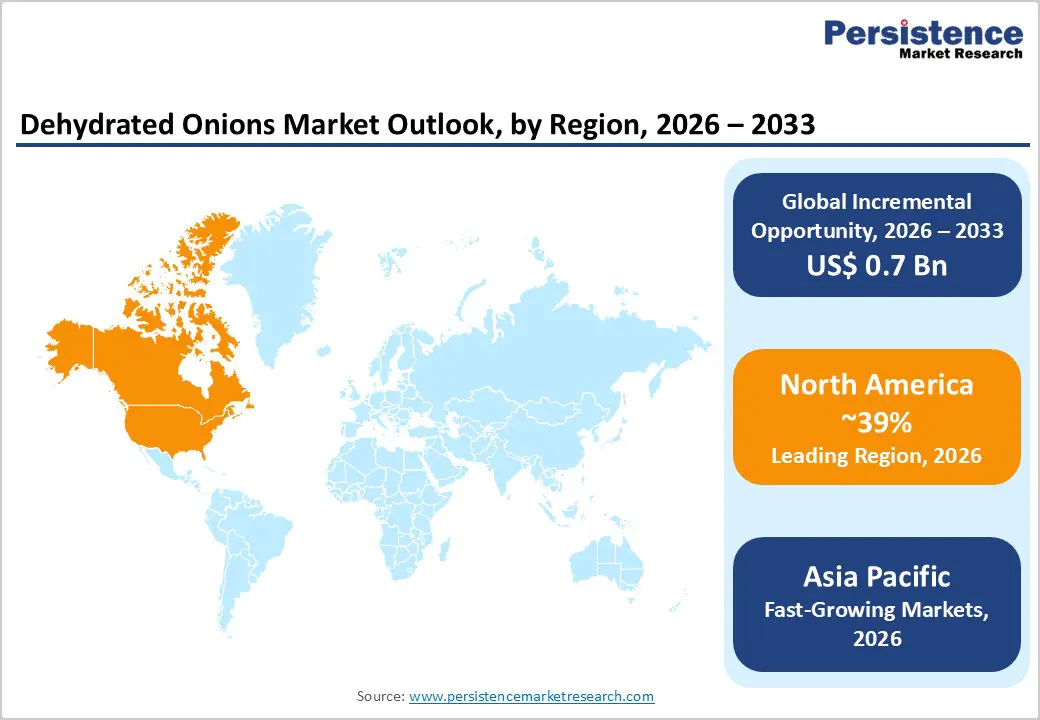
- Leading region: North America currently captures the largest share of the dehydrated onions market, supported by its sizeable processed food industry, extensive quick-service restaurant penetration, and stringent food safety standards that favor high-quality, traceable dehydrated onion suppliers.
- Fastest-growing region: Asia Pacific is the fastest-growing regional market, driven by massive onion production in India, expanding food manufacturing capacity in China, Japan, and ASEAN, and the rapid uptake of dehydrated onions in snacks, instant meals, and foodservice chains.
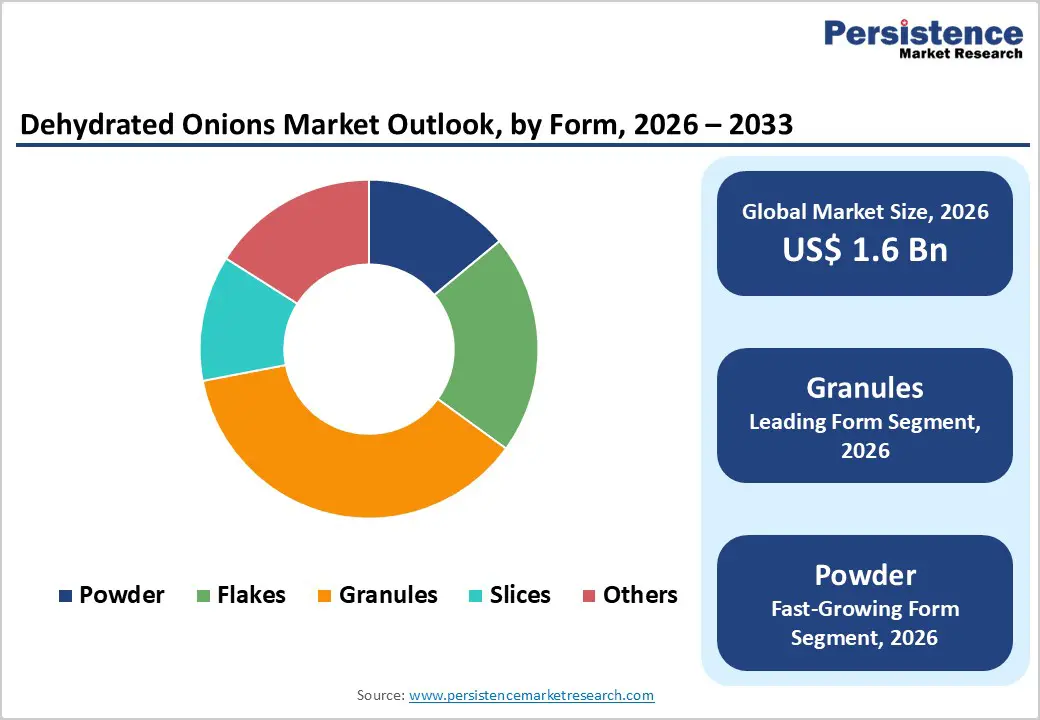
- Dominant Product: Among product forms, granules lead the global market, accounting for about 37% share in 2025, as food processors prefer their free-flowing nature, consistent particle size, and excellent suitability for automated dosing in seasonings and snack applications.
- Fastest-growing Products: Dehydrated onion powder is expected to be the fastest-growing form segment, benefiting from its intense flavor, ease of blending into sauces, soups, and dry mixes, and broad adoption across both industrial formulations and retail spice portfolios worldwide.
| Key Insights | Details |
|---|---|
| Dehydrated Onions Market Size (2026E) | US$ 1.6 billion |
| Market Value Forecast (2033F) | US$ 2.3 billion |
| Projected Growth CAGR (2026 - 2033) | 5.8% |
| Historical Market Growth (2020 - 2025) | 5.1% |
Market Dynamics
Drivers - Rising demand for convenience foods and standardized flavor systems
Global consumption of packaged, ready-to-eat, and ready-to-cook foods continues to rise as urbanization, dual-income households, and on-the-go lifestyles increase across both developed and emerging markets. Dehydrated onions offer a highly consistent, easy-to-dose flavor base for soups, sauces, snacks, instant meals, seasonings, and bakery products, eliminating the labor, waste, and variability associated with peeling and chopping fresh onions at an industrial scale. In major producing and processing regions such as India, where onion output surpasses 30 million tonnes annually and supports a substantial processing and export industry, the ability to convert perishable bulbs into long-shelf-life powders, flakes, and granules is increasingly central to food manufacturers’ formulation strategies. This structural shift towards processed food systems firmly underpins long-term demand for dehydrated onion ingredients.
Need to reduce post-harvest losses and stabilize onion supply chains
Onions are highly prone to post-harvest losses from improper storage, sprouting, and microbial spoilage, leading to significant wastage in major producing countries. A nationwide study in India cited post-harvest losses of around 7.26% for onions, highlighting the economic and food-security burden of unmanaged surplus and volatility in fresh supply. Purpose-built dehydration capacity, such as the plants in Mahuva, Gujarat , that typically process around 100,000 tonnes of onions a year and are targeting 120,000 tonnes in strong harvest seasons, allows surplus bulbs to be stabilized into value-added products with long shelf life and export potential. By reducing physical losses, smoothing seasonal gluts, and enabling global redistribution through trade, dehydrated onions help governments, traders, and food manufacturers manage price swings and availability risks, which in turn fuels sustained investment and market expansion.
Restraints - Volatility in fresh onion production and pricing
Fresh onion production is sensitive to weather shocks, water availability, disease outbreaks, and input-cost inflation, creating recurring cycles of surplus and shortage that directly impact raw-material costs for dehydration plants. In the United States, for example, bulb onion production for fresh use declined by about 8% in 2021, illustrating how even mature, technologically advanced industries remain exposed to climatic and agronomic variability. When farm-gate prices spike, dehydration margins can be compressed, discouraging capacity utilization and delaying investment decisions, especially for smaller processors with limited hedging and storage capabilities.
Stringent food safety and quality compliance burdens
Dehydrated onions, as low-moisture ingredients used widely in high-volume food manufacturing, are subject to strict microbiological, pesticide-residue, and traceability standards from regulators and multinational buyers. In 2022, the National Onion Association and the International Fresh Produce Association updated comprehensive best-practice guidelines for dry bulb onions from field to shelf, reflecting increased scrutiny over hygiene, handling, and pathogen control. Meeting these expectations requires investments in metal detection, optical sorting, hygienic design, validated dehydration protocols, and rigorous documentation, which can strain the finances and capabilities of small and mid-sized processors, particularly in emerging markets.
Opportunities - Premium, clean-label, and organic dehydrated onion offerings
As consumers across Europe, North America, and parts of Asia seek cleaner labels with fewer additives, there is a growing opportunity for producers to differentiate via minimally processed, residue-controlled, and, where feasible, organic dehydrated onions. Export-oriented suppliers emphasize “100% onion” positioning, avoiding preservatives or synthetic flavor enhancers while offering traceable sourcing from specific regions and cultivars, such as high-dry-matter varieties bred for dehydration. This dovetails with broader clean-label trends in snacks, soups, seasonings, and meal kits, where buyers are willing to pay a premium for reliable, compliant ingredients that support brand claims around naturalness and sustainability. Over the forecast horizon, companies that can scale certified organic or low-residue dehydrated onions while maintaining consistent color, flavor, and microbiological profiles stand to capture higher-margin niches and secure long-term contracts with multinational food brands.
Category-wise Analysis
Form Insights
Granules are the leading form segment in the dehydrated onions market, accounting for around 37% of the global market in 2025, owing to their versatility and ease of handling in industrial formulations. Food manufacturers value granules for offering consistent particle size, rapid rehydration, and excellent dispersion in dry seasoning blends, snack coatings, and instant meal bases, which simplifies dosing and quality control. In export hubs such as India, processors routinely convert flakes into granules and powders to match customer specifications across sauces, soups, and ready-to-eat foods, supporting their dominance within the form mix. As more contract blenders and private-label brands seek standardized, free-flowing onion ingredients that fit automated dosing systems, granules are expected to maintain their leadership across both B2B and institutional foodservice applications.
Nature Insights
Conventional dehydrated onions currently command the overwhelming share of the market, reflecting the dominance of conventionally grown onions in major producer countries and the price sensitivity of high-volume applications such as snack seasonings, soup bases, and institutional catering. Large dehydration hubs source onions from open markets and contract farmers focused on yield and storability, channelling significant volumes through cost-optimized, conventional supply chains, as seen in India’s onion belts and similar production zones in China and Egypt. While organic dehydrated onions remain a niche, growing demand for organic packaged foods and clean-label formulations in premium retail and foodservice channels is encouraging select processors to pilot organic or residue-controlled onion lines, creating a future upside segment without displacing the near-term dominance of conventional products.
End-user Insights
Food processing companies form the leading end-user segment for dehydrated onions, using them as core ingredients in seasonings, sauces, snacks, instant noodles, frozen meals, and pet foods. Industrial users benefit from the ability to stock large volumes of stable, low-moisture onion ingredients that do not require refrigeration, simplify global sourcing, and deliver predictable sensory performance across production runs and geographies. Studies and industry case examples show dehydrated onion flakes, granules, and powders being integrated into a wide range of value-added foods, from spice blends and meat products to bakery toppings and gourmet sauces, reflecting the breadth of this B2B demand base. As multinational and regional food brands continue to expand portfolios of convenience and ready-meal products, the food processing segment is expected to retain its position as the primary demand engine for dehydrated onions.
Regional Insights
North America Dehydrated Onions Market Trends and Insights
North America, led by the United States, holds the largest regional share of the dehydrated onions market, supported by a mature processed food industry, extensive quick-service restaurant networks, and high consumption of snack foods and ready meals. The United States ranks among the top onion producers globally, with annual output exceeding 3 million tonnes, forming a strong domestic base for both fresh and processed onion use. At the same time, the region increasingly imports dehydrated onion products from low-cost producers such as India, China, and Egypt, optimizing cost and diversifying supply.
Regulatory scrutiny is a defining feature of the North American landscape. The implementation of the Food Safety Modernization Act (FSMA) framework, along with commodity-specific best practices from the National Onion Association and the International Fresh Produce Association, has raised the bar on hygiene, traceability, and process controls across the onion value chain. These requirements influence sourcing choices for dehydrated onion, favoring suppliers with validated microbial controls, allergen management, and robust documentation systems. Innovation in the region focuses on clean-label seasonings, sodium-reduction strategies, and premium snack formats, all of which rely on high-quality dehydrated onion ingredients to deliver flavor impact without compromising regulatory compliance.
Asia Pacific Dehydrated Onions Market Trends and Insights
The Asia Pacific dehydrated onions market is emerging as a high-growth region due to strong agricultural production and expanding processed food demand. Countries such as India and China are major onion producers, providing abundant raw material for dehydration and large export volumes. India, in particular, has developed a strong processing base in Gujarat and Maharashtra, making it one of the world’s leading exporters of onion flakes, powder, and granules. Rising urbanization, busier lifestyles, and the rapid growth of packaged foods, instant noodles, snacks, and ready-to-cook meals are increasing regional consumption. The expanding quick-service restaurant sector and modern retail penetration further support demand. Additionally, cost-competitive labor and improving food processing infrastructure are attracting global buyers to source from the Asia Pacific. Governments are also promoting food processing under export incentive schemes, strengthening supply chains and quality standards. Growing preference for convenience ingredients among small food manufacturers and rising intra-Asia trade are expected to sustain strong growth momentum in the coming years.
Competitive Landscape
The competitive landscape of the dehydrated onions market is defined by moderate fragmentation, with numerous regional and global players focused on innovation, quality, and supply reliability. Competition centers on product differentiation through form, flavor retention, and cost-efficiency, as well as meeting food safety and organic standards. Companies are investing in advanced drying technologies to improve shelf life and functional properties. Strategic partnerships, expanded distribution networks, and value-added offerings tailored to food processors and retail segments enhance competitiveness. Price pressures from raw material volatility and logistics challenges also influence market dynamics, driving firms to optimize operations and strengthen supply chain efficiency.
Key Developments:
- In November 2025, Sensient Natural Ingredients rebranded itself as Sensient Agricultural Ingredients to better align with its expanded agricultural focus and sustainability initiatives. The company stated that the name change reflected its commitment to traceable, U.S.-grown, non-GMO dehydrated ingredients. Alongside the rebranding, it introduced two new chile varieties, Puya Sol and Sierra Sunrise Datil, strengthening its specialty agricultural product portfolio.
Companies Covered in Dehydrated Onions Market
- Olam International Ltd
- Sensient Technologies Corporation
- Jain Farm Fresh Foods Ltd
- Daksh Foods Pvt. Ltd
- Van Drunen Farms
- Earth Expo Company
- BC Foods Inc
- V.T. Foods Pvt. Ltd
- Jiyan Food Ingredients
- Real Dehydrates Pvt. Ltd
- B.K. Dehy Foods
- Silva International, Inc
- AGRIN EXPORT
- Mevive International Food Ingredients
- Universal Dehydration Pvt. Ltd
- Balaji Dehydration
Frequently Asked Questions
The global dehydrated onions market is expected to reach around US$ 1.6 billion in 2026, supported by steady demand from processed foods, seasonings, and foodservice channels across both developed and emerging economies.
Key demand drivers include the rise of convenience and ready-to-eat foods, the need to reduce post‑harvest onion losses, and the search for shelf-stable, standardized flavoring ingredients that simplify industrial food production while maintaining consistent taste and quality.
North America currently leads the market, leveraging its large processed food industry, dense quick‑service restaurant presence, and stringent food safety regulations that encourage the use of high-quality, traceable dehydrated onion ingredients in a wide range of applications.
The most attractive opportunity lies in premium, clean-label, and potentially organic dehydrated onion products sourced from efficient hubs in Asia Pacific, targeting high-value buyers in North America and Europe that demand residue-controlled, fully traceable ingredients.
Prominent companies include Olam International Ltd., Sensient Technologies Corporation, Jain Farm Fresh Foods Ltd., Van Drunen Farms, BC Foods Inc., Silva International, Inc., and specialized exporters such as AGRIN EXPORT, alongside several Indian and global SMEs focused on onion dehydration and export.


