




- Non-food Packaging
- Beverage Coaster Market
Beverage Coaster Market Size, Share, and Growth Forecast, 2026 - 2033
Beverage Coaster Market by Material (Paper, Cork, Others), Application (Commercial/Hospitality, Household/Residential, Others), Distribution Channel, and Regional Analysis for 2026 - 2033

Beverage Coaster Market Size and Trends Analysis
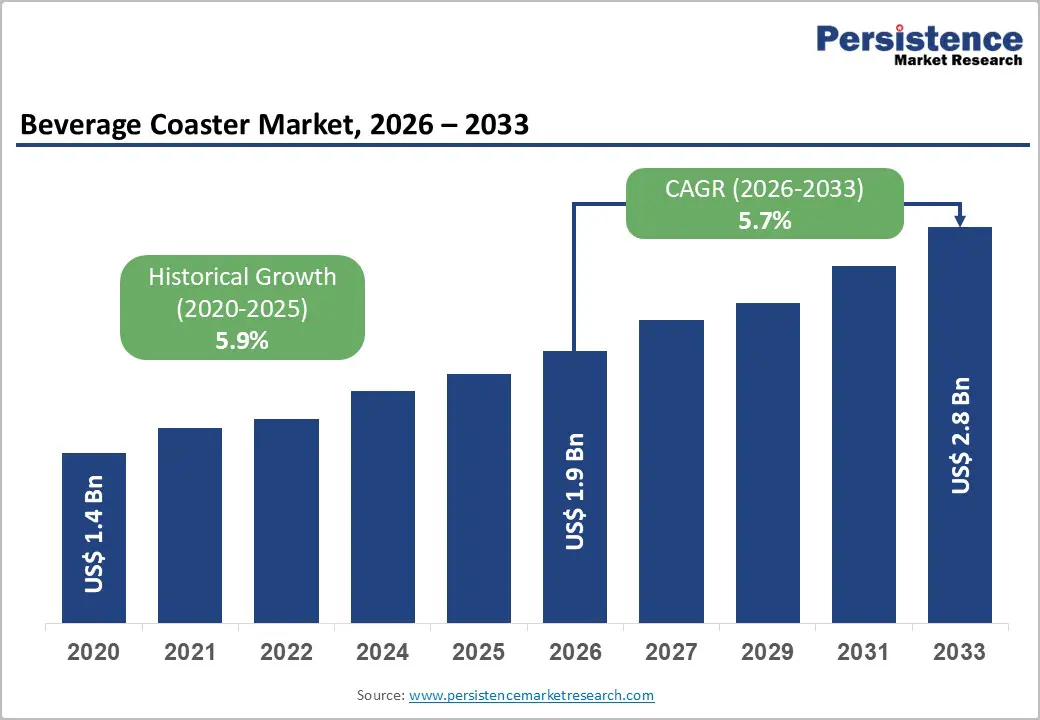
The global beverage coaster market size is likely to be valued at US$1.9 billion in 2026 and is expected to reach US$ 2.8 billion by 2033, growing at a CAGR of 5.7% between 2026 and 2033, driven by the sustained recovery of hospitality and foodservice sectors, rising demand for sustainable materials such as paper and cork, and increasing levels of customization enabled by digital and e-commerce platforms.
Demand growth remains evenly distributed between high-volume commercial applications and premium residential use. On the supply side, manufacturing efficiencies in Asia Pacific, combined with omnichannel distribution strategies, are enhancing margin performance and enabling revenue diversification across both bulk and value-added product segments.
Key Industry Highlights:
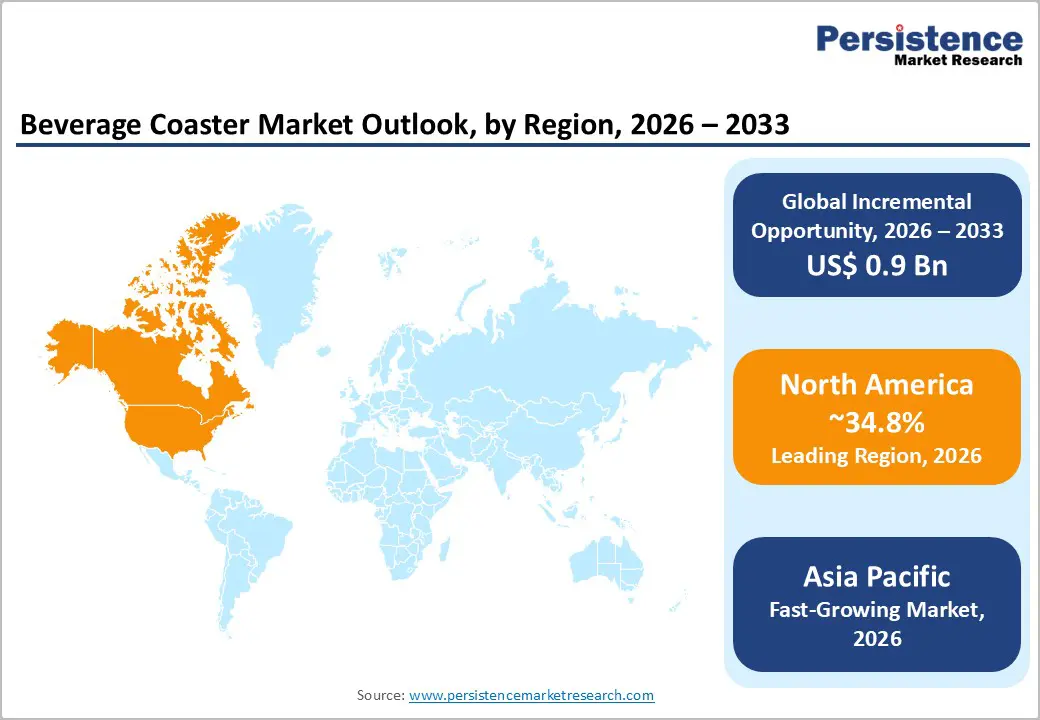
- Leading Region: North America is projected to lead the market with approximately 34.8% share, driven by a dense hospitality network, strong craft beverage culture, and advanced customization and promotional merchandise ecosystems across the U.S. and Canada.
- Fastest-growing Region: Asia Pacific is the fastest-growing region, supported by rapid urbanization, expanding foodservice sectors in China and India, and strong tourism recovery across ASEAN economies.
- Investment Plans: Market investments are focused on automation, digital and on-demand printing, vertically integrated production facilities, and nearshoring strategies. Capital allocation increasingly targets sustainable material processing (recycled paper and cork) and e-commerce-enabled customization platforms to improve margins and reduce supply-chain risk.
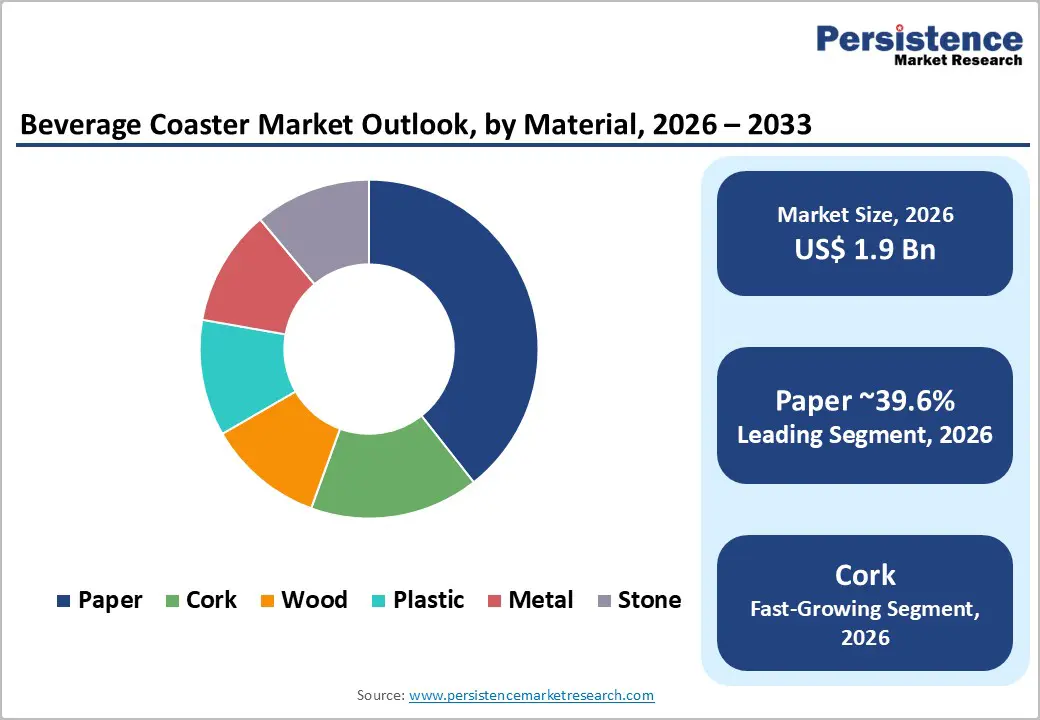
- Dominant Material: Paper (pulpboard) coasters dominate the material segment with 39.6% market share, supported by low production costs, high-speed print compatibility, lightweight logistics, and strong adoption across commercial hospitality and large-scale promotional applications.
- Leading Application: Commercial/hospitality applications represent the largest demand segment with approximately 51.7% share, driven by recurring bulk procurement from restaurants, bars, hotels, breweries, and event organizers seeking cost-efficient branding and hygiene-compliant tabletop solutions.
| Key Insights | Details |
|---|---|
| Beverage Coaster Market Size (2026E) | US$1.9 Bn |
| Market Value Forecast (2033F) | US$2.8 Bn |
| Projected Growth (CAGR 2026 to 2033) | 5.7% |
| Historical Market Growth (CAGR 2020 to 2025) | 5.9% |
Market Factors - Growth, Barriers, and Opportunity Analysis
Growth Analysis - Hospitality Recovery and Mixed-Channel Demand
The global hospitality and foodservice sectors have demonstrated measurable recovery with increased restaurant openings, higher occupancy rates, and expanded event activity. These improvements directly stimulate demand for consumable and branded tabletop accessories, including beverage coasters. Commercial buyers, restaurants, hotels, breweries, and catering operators purchase coasters in bulk for functional use, brand reinforcement, and hygiene compliance. Disposable pulpboard coasters remain cost-effective for high-turn venues, while premium reusable materials are increasingly adopted by upscale establishments. A structural increase in business-to-business (B2B) order volumes, repeat procurement cycles, and broader SKU portfolios. The coexistence of disposable and reusable formats supports higher average selling prices and more diversified revenue streams.
Sustainability and Material Substitution
Procurement teams and consumers increasingly prioritize biodegradable, recyclable, and renewable materials. Cork, bamboo, recycled paper, and sustainably sourced wood are gaining traction across both hospitality and retail segments. Sustainability commitments within corporate supply chains have elevated environmental criteria in vendor selection processes. Cork, in particular, benefits from its renewable harvesting cycle and durability, positioning it as both eco-conscious and premium. Paper-based coasters manufactured from recycled pulp also align with circular economy principles. Suppliers that can demonstrate traceable sourcing, environmental certifications, and reduced carbon footprints are securing higher-value contracts. The transition toward eco-materials supports premium pricing structures and long-term customer loyalty in institutional procurement channels.
Customization and E-Commerce Enablement
Digital commerce continues to expand faster than traditional retail, enabling small-batch production, personalization, and direct-to-consumer (DTC) distribution models. Print-on-demand services allow businesses and individuals to order customized coaster designs in low minimum quantities. Online marketplaces and proprietary e-commerce platforms reduce order friction and enable rapid design proofing, scalable fulfillment, and global reach. Corporate gifting programs, event organizers, breweries, and lifestyle brands increasingly leverage customized coasters as promotional tools. Online enablement increases demand from household and promotional segments, improves supplier margins on small-run orders, and supports recurring purchase models through subscription or reorder programs.
Barrier Analysis - Price Sensitivity and Commoditization
The market contains a significantly low-cost pulpboard segment characterized by price-driven procurement decisions. Large hospitality buyers often prioritize lowest-unit-cost suppliers, compressing margins for manufacturers. Private-label sourcing and global OEM competition intensify pricing pressure. Substitution from alternative tabletop materials, such as napkins or disposable mats, further contributes to commoditization risk. Margin compression of approximately 100-300 basis points in bulk pulpboard segments during competitive bidding cycles, particularly for high-volume contracts.
Raw Material and Supply Chain Volatility
Production relies on pulp, cork, wood, plastics, and metals, all of which are subject to price fluctuations and seasonal supply constraints. Freight rate volatility and trade policy shifts can disrupt export-oriented manufacturers. Just-in-time inventory systems in hospitality supply chains increase exposure to supply interruptions. A 5-10% increase in raw material costs can materially reduce profitability for small- and mid-sized suppliers, often leading to renegotiated contracts or delayed fulfillment cycles.
Opportunity Analysis - Premium and Sustainable Product Premiumization
Premium reusable coasters manufactured from cork, wood, stone, ceramic, or metal present a growing revenue opportunity. If premium reusable formats account for approximately 10-15% of total market revenue by 2033, this could represent a significant value segment within the projected US$ 2.8 billion market. Hospitality brands increasingly integrate premium table accessories into experiential branding strategies. Certified sustainable materials enhance differentiation and pricing leverage. Manufacturers should pursue eco-label certifications, upscale design collaborations, and long-term contracts with premium hotel and restaurant groups.
Private-Label and Promotional Partnerships
Promotional coasters used in corporate gifting, beverage branding, event sponsorship, and brewery marketing create recurring high-margin demand. In certain regions, promotional and co-branded units may represent 10-20% of total coaster volumes. Integrated design-to-delivery solutions, including digital proofing, short production runs, and logistics management, enable suppliers to secure repeat campaigns. Companies offering fast turnaround times and subscription-based reorder systems can increase customer lifetime value while stabilizing revenue streams across event and hospitality cycles.
Category-wise Analysis
Material Insights
Paper and pulpboard coasters are expected to account for approximately 39.6% of market share in 2026, maintaining leadership due to their cost efficiency, disposability, and strong compatibility with high-volume commercial use. Their dominance is most visible in North America and Europe, where bars, breweries, quick-service restaurants, and event venues prioritize hygiene, branding flexibility, and rapid replenishment. Large hospitality groups and beverage chains routinely specify pulpboard coasters because they support single-use hygiene protocols while enabling frequent brand refreshes tied to seasonal menus or promotional campaigns. From a production standpoint, paper coasters benefit from high-speed offset and digital printing, lightweight logistics, and scalable manufacturing.
Breweries and beverage brands across the U.S. and Germany continue to rely on printed pulpboard coasters as a low-cost advertising surface, particularly for limited-edition product launches and taproom promotions. In Europe, long-established hospitality suppliers have expanded their offerings of recycled and FSC-certified paper coasters to align with sustainability expectations without sacrificing price competitiveness. These developments reinforce the paper’s position as the default material for bulk institutional orders, ensuring stable recurring revenue streams for manufacturers despite pricing pressure.
Cork is likely to be the fastest-growing material segment, supported by sustainability-driven procurement policies and rising demand for premium, reusable tabletop accessories. Unlike disposable formats, cork coasters offer durability, moisture resistance, and a strong environmental narrative, owing to the use of renewable cork oak harvesting, particularly in Southern Europe. This has driven adoption across Western Europe and North America, where hospitality operators increasingly integrate sustainability into brand positioning. Premium hotel groups, boutique accommodations, and specialty beverage brands are incorporating cork coasters into guest experiences and promotional kits to reinforce eco-conscious messaging.
Home and lifestyle brands in markets such as Germany, the U.K., and the U.S. have also introduced cork coaster collections as part of broader sustainable homeware assortments. These products command higher average selling prices, driven by longevity, tactile appeal, and design differentiation. Manufacturers' investments in traceable sourcing and eco-certifications further strengthen cork’s competitive position, supporting continued market-share gains in developed markets and premium retail channels.
Application Insights
Commercial and hospitality applications are expected to represent 51.7% of market share in 2026, making this the largest application segment globally. Restaurants, bars, hotels, breweries, cafés, and event venues use coasters as functional moisture-absorbing products while simultaneously leveraging them as high-visibility branding tools. In regions such as North America and Europe, coasters are routinely bundled with broader consumables procurement contracts, including napkins and tableware, to ensure predictable reorder volumes and long-term supplier relationships.
High-turn establishments, including breweries and casual dining chains, predominantly use disposable pulpboard coasters to support hygiene compliance and rapid replacement cycles. In contrast, upscale hotels and premium bars increasingly deploy reusable coasters made from cork, wood, or stone to enhance guest perception and reinforce brand quality. Across Asia Pacific, particularly in urban markets in China, India, and Southeast Asia, the rapid expansion of cafés and casual dining outlets is driving incremental demand for both disposable and branded coaster formats. These dynamics sustain strong B2B volumes and reinforce hospitality as the market’s revenue backbone.
Household and residential applications are likely to be the fastest-growing segment, supported by rising home entertaining, greater awareness of interior décor, and demand for personalized lifestyle products. Consumers increasingly view coasters as decorative accessories rather than purely functional items, particularly in North America, Europe, and urban markets in Asia-Pacific cities.
Growth is closely tied to the expansion of e-commerce and direct-to-consumer channels, which make artisanal, themed, and customizable coaster sets widely accessible. Home décor brands and online marketplaces have introduced curated coaster collections featuring ceramic, cork, stone, and mixed-material designs, often marketed as giftable sets. Seasonal launches, collaborations with interior designers, and limited-edition drops have proven effective in driving premium pricing and faster replacement cycles. In markets such as the U.S., U.K., and Japan, consumers are increasingly purchasing coasters alongside table linens, glassware, and bar accessories, supporting cross-category sales. For manufacturers, this segment offers higher margins and lower volume dependency compared to bulk commercial sales, making it a key growth lever through 2033.
Regional Insights
North America Beverage Coaster Market Trends - Craft Beverage Branding and ESG-Driven Disposable Demand
North America is expected to lead the global beverage coaster market with approximately 34.8% of market share in 2026. The U.S. accounts for the majority of regional revenue, driven by its dense network of restaurants, bars, hotels, and over 9,000 operating craft breweries. The craft beverage movement has been particularly influential; breweries such as Anheuser-Busch’s craft portfolio, Boston Beer Company, and numerous independent taprooms continue to use custom pulpboard coasters as cost-effective branding tools during product launches and seasonal campaigns.
Promotional product suppliers and commercial printers across states such as Wisconsin, Illinois, and California have expanded digital printing capacity to meet recurring small-batch and short-run hospitality demand. Canada contributes through tourism-driven hospitality in provinces such as British Columbia and Ontario, while also maintaining a niche in premium tabletop and sustainable material production.
Corporate sustainability initiatives increasingly shape procurement decisions. Large hospitality groups and contract foodservice operators now integrate ESG criteria into vendor selection, favoring recycled pulpboard and cork substrates. U.S.-based hospitality supply companies have responded by introducing FSC-certified paper coaster lines and compostable variants to align with municipal waste-reduction mandates in states such as California and New York. This regulatory focus on packaging waste and material transparency reinforces demand for recyclable inputs while sustaining volume demand for disposable formats in high-turn venues. Investment trends reflect a push toward operational efficiency and customization scalability. Several North American commercial print firms have invested in automated die-cutting, high-speed digital presses, and vertically integrated finishing facilities to reduce lead times for promotional campaigns. Nearshoring strategies, particularly shifting some production from Asia to Mexico or domestic facilities, have gained traction to mitigate freight volatility experienced in 2024-2025. These developments strengthen North America’s position as a high-value, margin-accretive market, particularly in premium cork, bamboo, and decorative retail segments sold through specialty homeware chains and online platforms.
Europe Beverage Coaster Market Trends - Sustainability-Led Hospitality Consumption and Cork Supply Strength
Europe represents a structurally strong and sustainability-focused beverage coaster market, with Germany, the U.K., France, and Spain as key demand centers. The region benefits from a combination of established hospitality culture, tourism recovery, and stringent environmental regulations that influence material preferences. Germany leads in precision manufacturing and premium coaster production, with suppliers specializing in recyclable substrates and high-quality printing for breweries and beer halls. Its deep-rooted beer culture ensures steady demand, particularly in Bavaria and other brewing regions.
The U.K. sustains robust consumption through its extensive pub network and event industry, with branded beer mats remaining a cultural staple. Short-run digital printing capabilities have expanded to serve craft breweries and distillers seeking customized promotional coasters. France and Spain rely heavily on tourism-driven hospitality, where seasonal increases in restaurants, cafés, and boutique hotels drive bulk and eco-friendly coaster demand. Southern European cork production, particularly in Portugal and Spain, strengthens the regional supply chain for cork-based coasters and enhances sustainability positioning.
European Union directives on packaging waste and recycling influence material substitution, favoring suppliers with certified recycled paper or responsibly sourced cork. Retailers such as IKEA are expanding sustainable tabletop accessory lines, while private equity and strategic consolidation increasingly target environmentally compliant manufacturers. Consequently, Europe remains a premium, regulation-driven market where sustainability credentials enhance pricing power, contract security, and long-term market stability.
Asia Pacific Beverage Coaster Market Trends - Export-Scale Manufacturing with Rapid Hospitality Expansion
Asia Pacific is poised to be the fastest-growing regional beverage coaster market, driven by rapid urbanization, rising disposable incomes, and expanding foodservice ecosystems across China, India, Japan, and Southeast Asia. The region serves as both a global production hub and a growing consumption market. China dominates OEM production and exports of pulpboard and custom-printed coasters, with large manufacturing clusters in Guangdong, Zhejiang, and Jiangsu supplying cost-competitive bulk orders to North America and Europe. Domestic café culture, fueled by chains such as Luckin Coffee and independent specialty cafés, has also increased demand for branded disposable coasters. Investments in automated die-cutting and digital printing enhance export competitiveness and support compliance with Western sustainability standards.
India’s expanding hospitality and quick-service sectors drive steady domestic growth. Urban café chains, breweries in cities such as Bengaluru and Pune, and corporate events are driving demand for customized pulpboard and reusable coasters. Online ordering portals and e-commerce platforms enable short-run production for SMEs, further supporting market expansion.
Japan emphasizes premium design and material quality, with ceramic, wood, and minimalist cork coasters aligned with interior trends, commanding high domestic and export prices. ASEAN economies, including Thailand, Vietnam, and Indonesia, benefit from tourism recovery, with hotels and resorts specifying both disposable and reusable formats. Across Asia Pacific, investments in digital printing, automation, and vertically integrated supply chains enhance efficiency and shorten production cycles. Combined with sustainability certification initiatives, these factors position the region for sustained, high-growth market leadership.
Competitive Landscape
The global beverage coaster market is moderately fragmented, consisting of specialized manufacturers, printing service providers, promotional product suppliers, and retail home décor brands. No single global player dominates the market. Institutional contracts are typically secured by regionally strong suppliers with established distribution networks. Premium retail segments exhibit higher brand concentration, while bulk pulpboard production remains competitive and price-sensitive. Contract manufacturing in Asia supports global supply chains, intensifying competition in commodity segments. Leading companies emphasize sustainable product innovation, cost-efficient pulpboard production, omnichannel expansion, and integrated customization services. Competitive differentiation relies on traceable sourcing, rapid fulfillment capabilities, and scalable digital ordering platforms that enhance repeat purchase frequency and customer retention.
Key Industry Developments
- In October 2025, Printo Document Services Pvt. Ltd. announced a strategic investment in new high-speed die-cutting equipment in India to support rising coaster demand from foodservice and promotional markets across South Asia.
Companies Covered in Beverage Coaster Market
- Hoffmaster Group, Inc.
- KATZ GmbH & Co. KG
- Thirstystone Resources, Inc.
- Totally Bamboo, Inc.
- Dacasso Ltd., Inc.
- Beverage Coasters, Inc.
- Coaster Factory
- Alfred Mank Inc.
- Huhtamaki Group
- Graphic Packaging International
- WestRock Company
- Georgia-Pacific LLC
- Printo Document Services Pvt. Ltd.
- Ahlstrom Holding
- Mondi Group
- Smurfit Kappa Group
- Stora Enso Oyj
- International Paper Company
Frequently Asked Questions
The global beverage coaster market is projected to be valued at US$1.9 billion in 2026.
The beverage coaster market is expected to reach US$2.8 billion by 2033.
Key trends include rising hospitality sector recovery, growing demand for sustainable materials such as cork and recycled paper, increasing customization through digital printing and e-commerce platforms, and premiumization of reusable coaster products in retail and gifting segments.
By material, paper (pulpboard) leads with approximately 39.6% market share, driven by cost efficiency and large-scale commercial use. By application, commercial/hospitality dominates with 51.7% share, supported by recurring bulk procurement from restaurants, bars, hotels, and breweries.
The beverage coaster market is projected to grow at a CAGR of 5.7% between 2026 and 2033.
Major players include Hoffmaster Group, Inc., Katz Group (KATZ GmbH & Co. KG), Thirstystone Resources, Inc., Totally Bamboo, Inc., and Dacasso Ltd., Inc.


