




- Medical Devices
- Aesthetic Lasers and Energy Devices Market
Aesthetic Lasers and Energy Devices Market Size, Trends, Share, Growth, and Regional Forecast, 2026 - 2033
Aesthetic Lasers and Energy Devices Market by Product (Laser Devices, Radiofrequency Devices, Intense Pulsed Light (IPL) Devices, Ultrasound Devices, and Others), by Application (Body Contouring, Laser Hair Removal, Skin Tightening, Skin Rejuvenation, and Others) by End-user (Hospitals, Aesthetic Clinics, Spa and Salon, and Home Care Settings), and Regional Analysis from 2026 - 2033

Aesthetic Lasers and Energy Devices Market Share and Trends Analysis
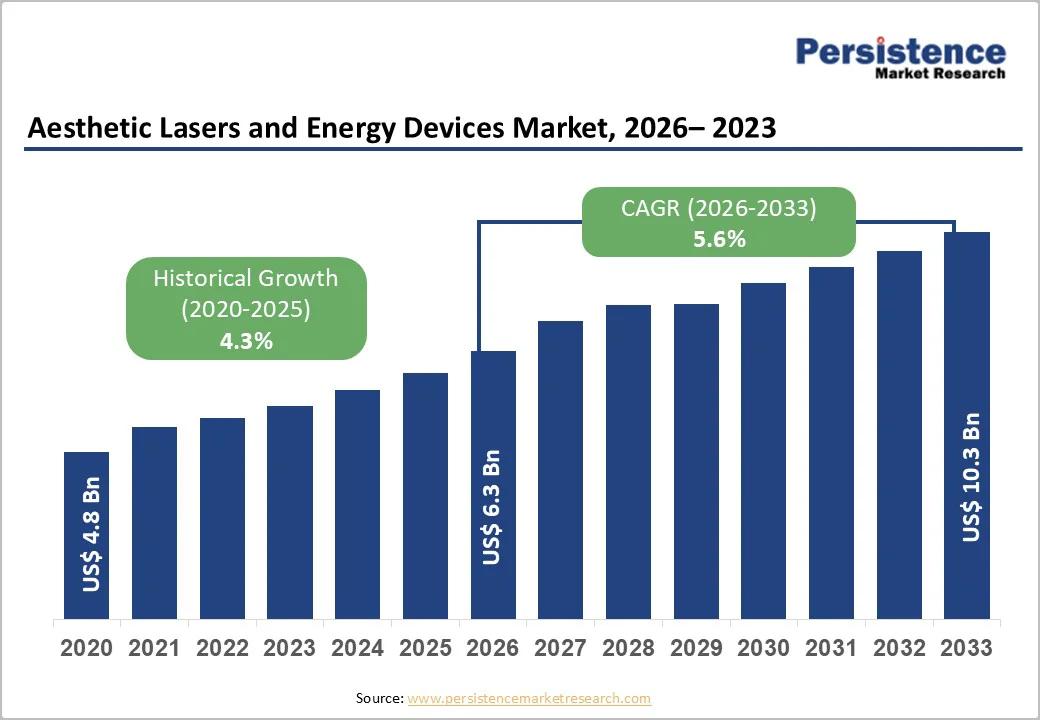
The global aesthetic lasers and energy devices market size is estimated to value at US$ 6.3 billion in 2026 to US$ 10.3 billion by 2033, growing at a CAGR of 5.6% during the forecast period from 2026 to 2033. Global demand for aesthetic lasers and energy devices is rising rapidly, driven by the growing preference for non-invasive cosmetic procedures, increasing awareness of anti-aging and skin-rejuvenation treatments, and adoption of technologically advanced systems across clinical and home-use settings. The expansion of dermatology clinics, medical spas, and chain-based aesthetic centers, combined with higher consumer spending on appearance-enhancing treatments, is accelerating market growth.
Continuous innovations in laser platforms, RF microneedling systems, IPL technologies, and hybrid devices are improving treatment precision, patient comfort, and clinical outcomes. Additionally, strong social media influence, increasing acceptance of aesthetic procedures among younger demographics, and the growing shift toward combination therapies further drive market growth.
Key Industry Highlights
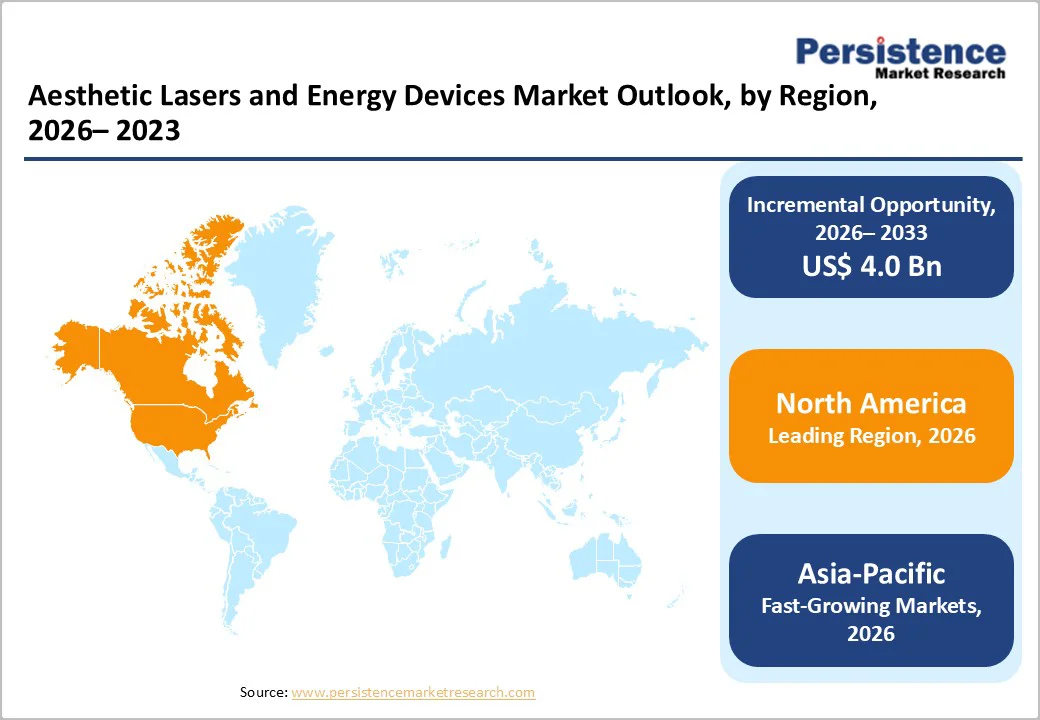
- Leading Region: North America holds the largest share at 47.3%, supported by a mature aesthetic service infrastructure, strong adoption of laser and RF systems, high disposable income, and early access to FDA-cleared technologies.
- Fastest-Growing Region: Asia Pacific is expanding at the fastest pace, driven by a large beauty-conscious population, rising medical tourism, increasing penetration of aesthetic clinics, and strong local manufacturing capabilities for energy-based devices.
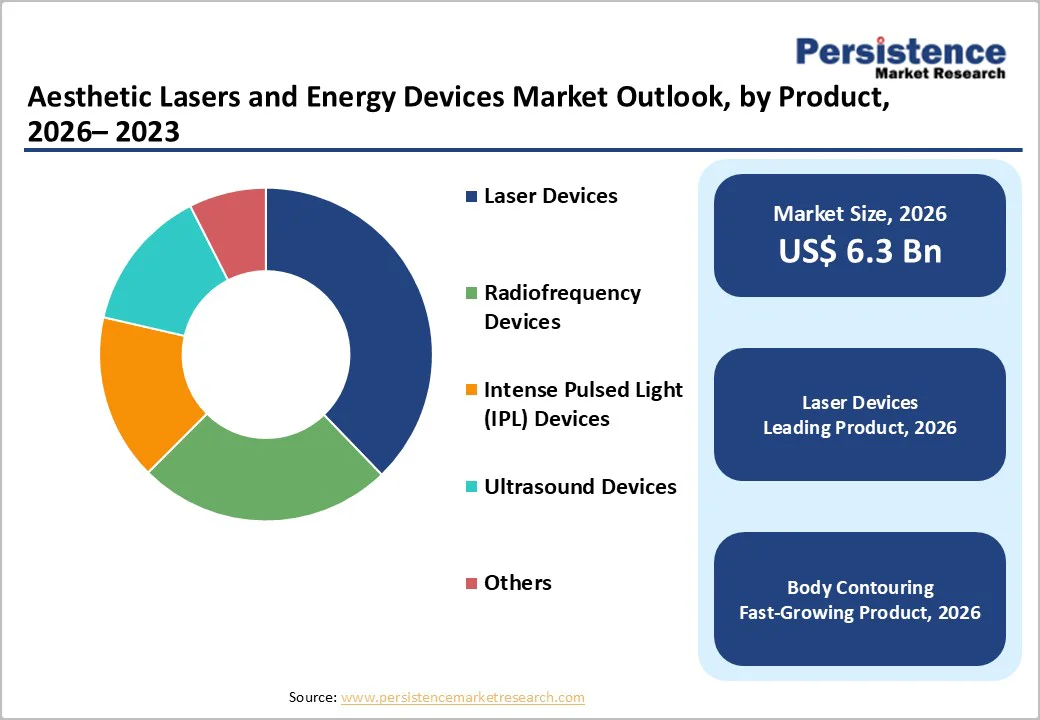
- Leading Product Segment: Laser devices dominate the market due to their broad clinical versatility for hair removal, skin resurfacing, pigment correction, tattoo removal, and vascular treatments.
- Fastest-Growing Product Segment: Radiofrequency (RF) devices are growing most rapidly as clinics invest in advanced RF microneedling, skin-tightening, and body-contouring platforms offering superior collagen remodeling and minimal downtime.
- Leading Application Segment: Laser hair removal remains the top application due to high procedure volume, long-term demand, and widespread availability across clinics and med-spas.
- Fastest-Growing Application Segment: Body contouring is scaling quickly as consumers increasingly seek non-surgical fat reduction, cellulite smoothing, and skin-firming solutions enabled by laser, RF, and ultrasound-based technologies.
| Key Insights | Details |
|---|---|
|
Aesthetic Lasers and Energy Devices Market Size (2026E) |
US$ 1.7 Bn |
|
Market Value Forecast (2033F) |
US$2.8 Bn |
|
Projected Growth (CAGR 2026 to 2033) |
5.2% |
|
Historical Market Growth (CAGR 2020 to 2025) |
4.0% |
Market Dynamics
Driver - Rising Demand for Non-Invasive Cosmetic Procedures and Advancements in Energy-Based Technologies
Rising consumer inclination toward non-invasive, low-downtime aesthetic treatments is driving the aesthetic lasers and energy devices market. For instance, in June 2025, the International Society of Aesthetic Plastic Surgery (ISAPS) highlighted at its Olympiad World Congress in Singapore that over 20.5 million non-surgical cosmetic procedures were performed worldwide in 2024, highlighting the strong global shift toward minimally invasive solutions. This growing preference is reshaping expectations for safe, comfortable, and technology-driven skincare tools, boosting demand for ultrasonic devices known for their gentle, non-surgical rejuvenation benefits, enhanced skin smoothness, and suitability for consistent at-home use.
Rapid technological advancements are significantly enhancing treatment outcomes and accelerating adoption. Innovations such as dual-wavelength lasers, improved cooling technologies, AI-assisted interfaces, and RF microneedling systems have elevated safety, precision, and comfort for a wider range of skin types. Hybrid platforms that combine multiple energy modalities further strengthen clinical versatility, enabling providers to offer comprehensive treatment solutions and driving the market growth.
Restraints - High Treatment Costs and Operational Risks Limiting Wider Adoption
The high cost of advanced laser, RF, and IPL platforms continues to restrict adoption among small and mid-size aesthetic clinics and restrain the overall market growth. Professional treatments typically require multiple sessions, increasing overall consumer expenditure and driving price sensitivity, especially in emerging markets. Additionally, hybrid and multi-modal systems involve significant capital investment and ongoing maintenance costs, which can delay adoption in resource-constrained regions and limit market expansion. Operational risks during aesthetic treatments, such as burns, pigmentation changes, and scarring, remain a significant concern when procedures are not performed correctly. This highlights the need for highly trained practitioners and standardized treatment protocols, which are still unevenly available across global markets. Differences in operator skill levels can undermine patient confidence, limit repeat visits, and slow overall adoption, particularly in developing regions where access to formal training and certification remains limited.
Aesthetic lasers and energy devices face strict regulatory requirements, including FDA clearance in the U.S. and MDR compliance in Europe, which significantly increases the complexity of market entry. Lengthy approval processes, evolving safety standards, and substantial documentation and testing costs create major barriers for manufacturers. These regulatory challenges often delay product launches, restrict the introduction of emerging technologies, and slow overall adoption, particularly for smaller companies with limited resources to navigate multiple regional frameworks.
Opportunity - Advancements in Hybrid Platforms and Rising At-Home Aesthetic Technologies
Rising clinical preference for multimodal treatments such as laser combined with RF microneedling or IPL paired with ultrasound is creating strong opportunities for manufacturers to develop advanced hybrid platforms and boosting the market growth. These integrated systems deliver superior cosmetic outcomes in fewer sessions, enabling clinics to expand their service offerings and improve return on investment. As demand grows for versatile, all-in-one devices, hybrid technologies are expected to witness robust adoption across professional aesthetic centers.
Furthermore, the accelerating shift toward at-home cosmetic treatments is opening a rapidly expanding consumer market for portable laser, IPL, and RF devices. Increased comfort with technology, growing e-commerce penetration, and the desire for cost-effective, convenient self-care solutions are fueling uptake. Manufacturers offering safe, user-friendly, and connected at-home devices supported by digital skin analysis tools are further propelling the overall market growth.
Category-wise Analysis
By Product Insights
The Laser devices segment is projected to dominate the global Aesthetic Lasers and Energy Devices market in 2026, accounting for a revenue share of 37.8%. The segment’s strong performance is primarily driven by the wide clinical versatility of laser platforms, which are used for hair removal, skin resurfacing, tattoo removal, vascular lesion treatment, pigmentation correction, and scar revision. Continuous technological advancements such as improved beam precision, dual-wavelength systems, faster pulse delivery, and enhanced cooling mechanisms, have significantly boosted treatment safety and efficacy across multiple skin types. Growing demand for minimally invasive cosmetic procedures, coupled with rising adoption of diode and alexandrite laser systems in aesthetic clinics, further accelerates market uptake. Additionally, the shift toward multifunctional workstations that combine several laser modalities in one device supports higher clinic returns on investment.
By Application Insights
The laser hair removal segment is projected to dominate the global Aesthetic Lasers and Energy Devices market in 2026, accounting for a revenue share of 40.8%. This is due to the widespread adoption of long-term hair reduction treatments among both men and women, driven by increasing focus on personal grooming and the convenience of semi-permanent results. Clinics and med-spas continue to invest heavily in technologically advanced diode, alexandrite, and Nd:YAG laser platforms that offer faster sessions, improved safety across diverse skin types, and reduced discomfort, which encourages high patient throughput. The availability of cost-effective package-based treatments, rising social media influence, and growing acceptance of aesthetic procedures among younger demographics further support demand. Additionally, advancements in cooling systems, motion-based delivery, and combination laser technologies are making treatments more efficient and accessible.
By End-user Insights
The aesthetic clinics segment is projected to dominate the global aesthetic lasers and energy devices market in 2026, accounting for a revenue share 52.8%. This is driven by the growing preference for professionally supervised, minimally invasive cosmetic procedures that offer greater precision, safety, and customized treatment outcomes. Aesthetic clinics typically invest in advanced, multi-application platforms including laser resurfacing, RF microneedling, and IPL systems, which enables them to cater to diverse skin conditions and aesthetic concerns. Rising consumer trust in trained dermatologists and aesthetic specialists, combined with increased spending on skin rejuvenation, hair removal, and body contouring treatments, supports consistent patient inflow. Additionally, the expansion of chain-based aesthetic centers, the adoption of subscription-based procedure packages, and the rising trend of combination therapy protocols are propelling market growth.
Regional Insights
North America Aesthetic Lasers and Energy Devices Market Trends
The North America market is expected to dominate globally with a value share of 47.3% in 2026, with the U.S. leading the region due to its highly developed aesthetic care ecosystem, strong consumer spending power, and rapid adoption of innovative energy-based devices. The presence of a large base of board-certified dermatologists, plastic surgeons, and well-equipped medical spas supports continuous procedure volumes across laser resurfacing, hair removal, tattoo removal, and skin rejuvenation. High awareness of minimally invasive cosmetic treatments, coupled with strong cultural acceptance of aesthetic enhancement, further fuels growth.
The region also benefits from early regulatory approvals, extensive clinical research activity, and the presence of major manufacturers offering technologically advanced systems with AI-driven interfaces, multi-modal platforms, and improved safety features. Strong marketing influence, rising male participation, and increased demand for preventive aesthetic care among younger demographics continue to boost market growth in North America.
Europe Aesthetic Lasers and Energy Devices Market Trends
The Europe market is expected to grow steadily, driven by the region’s mature healthcare infrastructure, strong regulatory oversight, and rising adoption of advanced non-invasive aesthetic procedures. Countries such as Germany, France, the U.K., Italy, and Spain continue to show increasing demand for laser resurfacing, hair removal, skin tightening, and rejuvenation treatments, supported by a well-established network of dermatologists, aesthetic surgeons, and medical spas. The aging population across Western and Central Europe is also a significant growth catalyst, as consumers increasingly seek safe and effective solutions for wrinkle reduction, pigmentation management, and overall skin quality enhancement. Additionally, growing acceptance of aesthetic treatments among men, combined with heightened social media influence and enhanced public awareness, is expanding the target customer base.
Manufacturers are investing in R&D to meet Europe’s stringent safety and performance standards while introducing AI-driven platforms, energy-efficient devices, and combination therapies. Expanding reimbursement support for select dermatology procedures and rising medical tourism in Eastern Europe drives market growth.
Asia Pacific Aesthetic Lasers and Energy Devices Market Trends
The Asia Pacific market is expected to register a relatively higher CAGR of around 7.6% between 2026 and 2033, driven by multiple structural and demographic factors that are reshaping the demand landscape for aesthetic lasers and energy-based devices across the region. Rapid urbanization, rising disposable incomes, and growing awareness of non-invasive cosmetic treatments are encouraging a broader consumer base, especially younger populations to adopt technologically advanced aesthetic procedures. Countries such as China, South Korea, Japan, and India are witnessing a surge in medical tourism, supported by a strong network of dermatology clinics, aesthetic centers, and globally trained practitioners offering competitively priced treatments.
Additionally, increased social media influence, expanding beauty standards, and the popularity of preventive skincare among millennials and Gen Z are fueling market growth. Manufacturers are also strategically investing in regional distribution partnerships, local manufacturing, and product customization to meet diverse skin types and regulatory requirements, further accelerating growth.
Competitive Landscape
The global aesthetic lasers and energy devices market is highly competitive, with strong participation from companies such as Aesthetics Biomedical, AESTHETIC SCIENCE, LLC, Fotona, Alvi Prague, Hapilin, and OSANO. These players leverage broad distributor networks, advanced clinical-grade platforms, and continuous innovation across laser, RF, IPL, and combination-energy systems. Intensifying demand for minimally invasive cosmetic procedures and adoption of compact, multifunctional workstation devices are further boosting market growth across dermatology clinics, med-spas, and ambulatory aesthetic centers.
Manufacturers are increasingly focusing on AI-enabled treatment planning, app-connected diagnostic interfaces, and hybrid systems that integrate laser resurfacing with RF microneedling or IPL photorejuvenation. Strategic priorities include expanding product portfolios, enhancing safety profiles through real-time monitoring, and adopting aggressive marketing via key opinion leaders (KOLs) and digital campaigns.
Key Industry Developments:
- In October 2025, Cynosure Lutronic introduced the eCO2 3D, a next-generation fractional CO2 laser system positioned as one of the most versatile resurfacing platforms in the aesthetics space. Building on the established eCO2 Plus technology, the new device enhances power, precision, and treatment customization, setting a higher benchmark for advanced skin resurfacing.
- In March 2025, Alma Lasers introduced the latest generation of its award-winning Alma Harmony aesthetics platform, marking a major upgrade in its 20-year product lineage. The new system features a modernized design and enhanced intelligent capabilities, expanding treatment versatility and improving user experience.
- In February 2025, Cynosure Lutronic entered into a multi-country distribution partnership with Amico Aesthetics, a prominent provider of advanced medical technologies across the Middle East. The agreement strengthens Cynosure Lutronic’s regional footprint and supports broader access to its aesthetic device portfolio in high-growth markets.
Companies Covered in Aesthetic Lasers and Energy Devices Market
- Hologic Inc. (Cynosure, Inc.)
- Lumenis
- Syneron Medical Ltd.
- Lynton Lasers Ltd
- EL.EN. S.p.A. (Deka Mela S.r.l.)
- Fotona
- Cutera, Inc.
- Lutronic Corporation
- Beijing Nubway S & T Co., Ltd
- Others.
Frequently Asked Questions
The global aesthetic lasers and energy devices market is projected to be valued at US$ 6.3 Bn in 2026.
Rising demand for non-invasive cosmetic procedures, technological advancements, and expanding aesthetic clinic infrastructure are driving the global aesthetic lasers and energy devices market.
The global aesthetic lasers and energy devices market is poised to witness a CAGR of 5.6% between 2026 and 2033.
Rise of hybrid energy-based platforms, rapid growth in Asia-Pacific markets, and increasing adoption of safe, portable at-home aesthetic devices are creating opportunities in the market.
Aesthetics Biomedical, AESTHETIC SCIENCE, LLC, Fotona, Alvi Prague, Hapilin, and OSANO are some key players in the aesthetic lasers and energy devices market.


