




- Food Ingredients & Additives
- Acetylated Monoglycerides Market
Acetylated Monoglycerides Market Size, Share, Growth, and Regional Forecast, 2025 - 2032
Acetylated Monoglycerides Market by Form (Liquid, and Powder & Beads), by End-user (Food Industry, Pharmaceutical Industry, and Others), and Regional Analysis from 2025 - 2032

Acetylated Monoglycerides Market Share and Trends Analysis
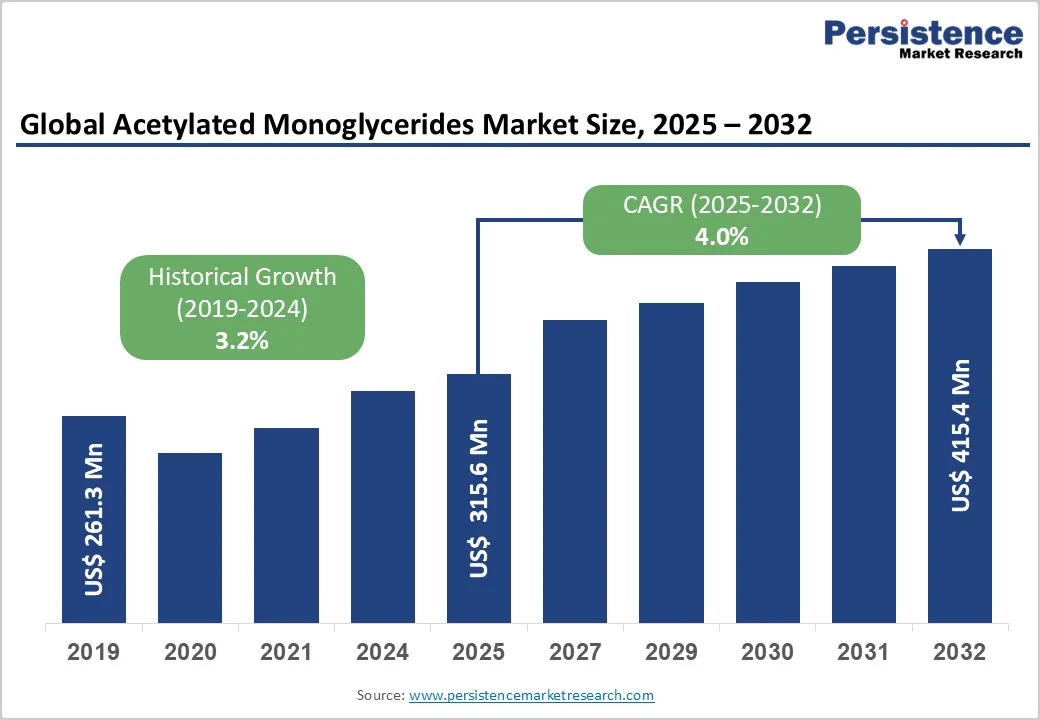
The global acetylated monoglycerides market size is likely to be valued US$ 315.6 million in 2025 and is projected to reach US$ 415.4 million at a CAGR of 4.0% during the forecast period from 2025 to 2032. The global market is experiencing steady growth, driven by rising demand for functional emulsifiers in food processing, pharmaceutical drug delivery systems, and clean-label ingredient innovation.
Manufacturers increasingly prioritize product quality enhancement, extended shelf life, and improved stability in bakery, dairy, and confectionery products. Rising consumer awareness of acetylated monoglycerides' benefits, coupled with regulatory support from food safety authorities and pharmaceutical organizations, strengthens market expansion across developed and emerging economies.
Key Industry Highlights
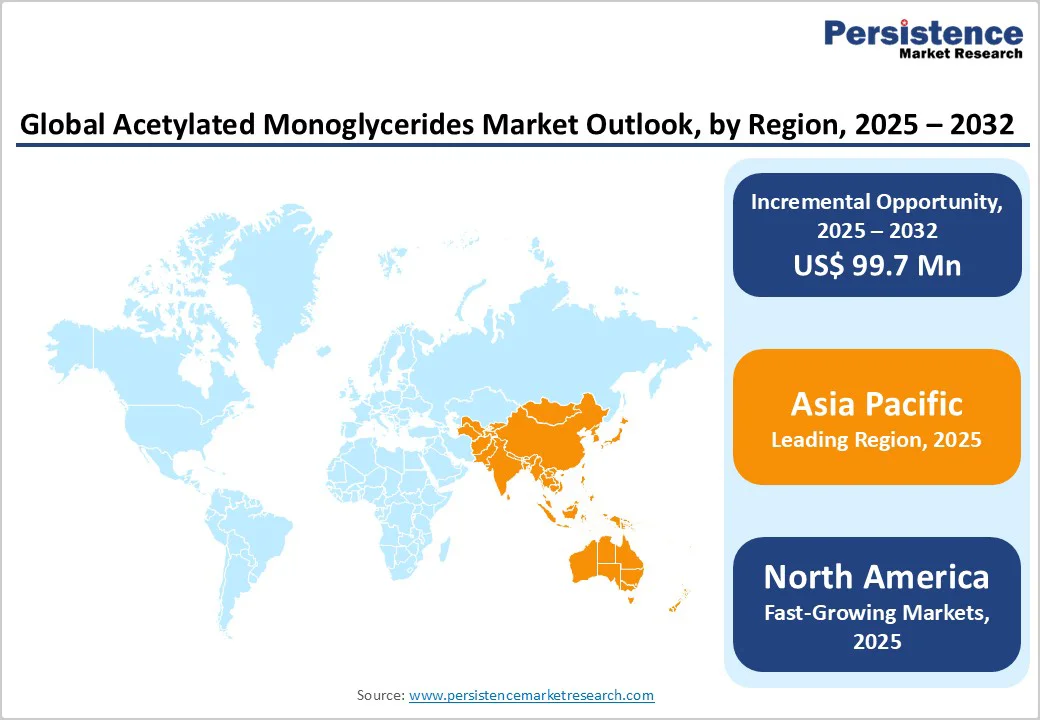
- Leading Region: North America leads global acetylated monoglycerides consumption, driven by the advanced food processing industry and strong regulatory support from the FDA GRAS status, positioning the region as the dominant market leader with significant influence.
- Fastest Growing Region: Asia Pacific represents the fastest-growing regional market supported by expanding food manufacturing capabilities, industrialization, and increasing processed food consumption, offering significant growth potential for market participants.
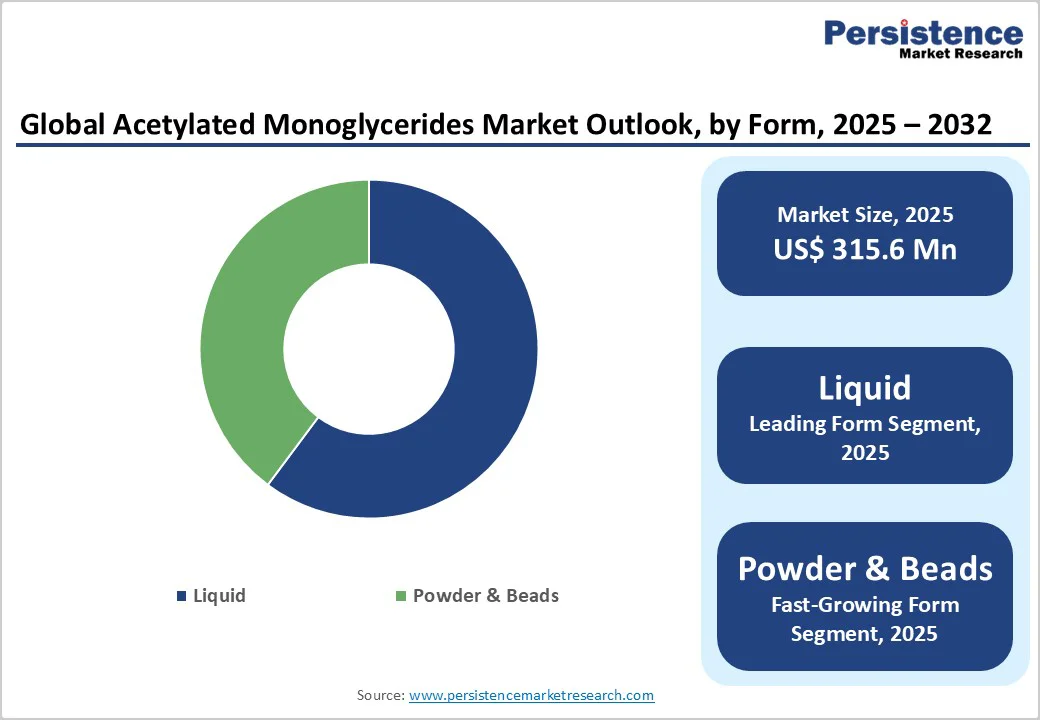
- Dominant Segment: the liquid segment is currently leading, accounting for approximately 59% of the market revenue. This dominance is attributed to liquid acetylated monoglycerides' superior dispersion characteristics, easier handling in manufacturing processes, and consistent performance in high-temperature food processing applications.
- Market Trend: Increasing preference toward clean-label and healthy products marks important market trends that shape AMG demand.
| Key Insights | Details |
|---|---|
|
Acetylated Monoglycerides Market Size (2025E) |
US$ 315.6 Mn |
|
Market Value Forecast (2032F) |
US$ 415.4 Mn |
|
Projected Growth (CAGR 2025 to 2032) |
4.0% |
|
Historical Market Growth (CAGR 2019 to 2024) |
3.2% |
Market Dynamics
Driver - Rising Demand for Processed and Convenience Foods
The global shift towards processed and convenience foods is significantly driving the acetylated monoglycerides market expansion. According to the U.S. Department of Agriculture, processed food consumption has increased by 15% over the past five years, with bakery and confectionery products leading this growth trend. Acetylated monoglycerides serve as crucial emulsifiers that improve texture, extend shelf life, and enhance product stability in processed foods. The FDA recognizes acetylated monoglycerides under 21 CFR 172.828 as a safe food additive, providing regulatory confidence to manufacturers. Additionally, the growing foodservice industry, quick-service restaurants, and ready-to-eat meal segments are increasingly incorporating specialty ingredients and food additives like AMG to meet consumer expectations for quality, consistency, and extended freshness, creating substantial growth opportunities for market participants.
Restraints - Stringent Regulatory Norms
Additives, although used in minor quantities, are critical for performance in end-use materials, food, plastic, or any other product. This makes it imperative for customers who are using these additives to validate their quality and performance thoroughly.
In addition to performance, since many of these additives are used in food, feeds, and food packaging materials, they also need to comply with stringent health and environment-related regulations globally. Any failure in quality standards may lead to the loss of reputation and goodwill of a company, order cancellations, and customer loss.
Food products and their ingredients, food contact packaging materials, pharma packaging, feed nutrition additives, and cosmetic substances are subject to high regulatory standards. Similar regulations also apply to plastic additives used in manufacturing packaging materials used for food packaging and medical products. Expensive and lengthy validation tests create a high entry barrier for any company while targeting new customers, geographies, and applications.
Opportunity - Environmental Safety Concerns Around Harmful Emulsifiers
Growing environmental and health concerns regarding synthetic emulsifiers are driving a shift in the cosmetics sector toward safer and more sustainable alternatives. Traditional emulsifiers are increasingly being scrutinized for their potential to cause skin irritation and long-term ecological harm. This trend is creating significant opportunities for acetylated monoglyceride (AMG) producers, as AMGs are biodegradable, skin-friendly, and derived from renewable sources. Cosmetic brands are reformulating their products to align with clean-label and eco-friendly standards, boosting demand for naturally derived emulsifiers. Consumers today actively prefer skincare and personal care products made with ingredients that are both effective and environmentally responsible. As a result, manufacturers of AMGs can leverage this shift by promoting their products as safe, plant-based, and compliant with global sustainability norms. For instance, DuPont’s Nutrition & Biosciences (now part of International Flavors & Fragrances Inc.) offers GRINDSTED Soft-N-SAFE and GRINDSTED ACETEM emulsifiers, designed specifically for gentle and skin-compatible cosmetic applications.
Category-wise Analysis
By Form, Liquid Acetylated Monoglycerides Dominate the Acetylated Monoglycerides Market
The liquid form segment dominates the global acetylated monoglycerides market, accounting for approximately 61% of the market revenue in 2025. This dominance is attributed to liquid AMG's superior functionality in food processing applications, particularly in bakery and dairy products where uniform mixing and consistent emulsification are critical manufacturing requirements. Liquid acetylated monoglycerides offer superior dispersion characteristics, easier handling during manufacturing processes, and better compatibility with existing equipment compared to powder forms. The European Food Safety Authority notes that liquid emulsifiers provide more consistent performance in high-temperature applications used in industrial food production. Additionally, major food manufacturers prefer liquid forms due to their compatibility with existing production equipment, reduced processing time requirements, and superior mixing efficiency. The convenience factor, combined with enhanced product stability, improved texture delivery, and consistent formulation results, reinforces the liquid segment's dominant market position across various food processing applications globally.
By End-user, Food Industry Leads the Market, Pharmaceutical Industry Emerges as the Fastest-Growing Category
The food industry remains the leading end-user of acetylated monoglycerides (AMG) globally, driven by their wide-ranging functional benefits in dairy, bakery, and confectionery applications. In dairy products, AMGs enhance texture, prevent fat separation, and improve overall product stability. In bakery formulations, they strengthen dough, maintain moisture, and extend shelf life, ensuring consistent quality and freshness. Their role as effective emulsifiers also supports smoother blending of ingredients, which is crucial for maintaining uniformity in processed food production. Recognized under the Codex Alimentarius as a safe and essential food additive, AMGs are widely incorporated by global food manufacturers such as Nestlé, Unilever, and PepsiCo. The rising demand for processed and convenience foods, coupled with evolving consumer expectations for texture, stability, and freshness, continues to reinforce the use of specialty emulsifiers. This growing reliance on high-performance food additives positions the food industry as the dominant and most influential segment in the acetylated monoglycerides market.
Region-wise Insights
North America Acetylated Monoglycerides Market Trends
In North America, the demand for acetylated monoglycerides is surging due to the region's advanced food processing industry infrastructure and stringent quality standards. The U.S. dominates regional consumption, with major food manufacturers and pharmaceutical companies headquartered in the country driving significant demand for high-quality emulsifiers and pharmaceutical excipients. The FDA's GRAS (Generally Recognized as Safe) status for AMG provides regulatory confidence and encourages widespread adoption across food and pharmaceutical applications.
The North American market benefits from a strong research and development infrastructure, with universities, private research institutions, and pharmaceutical companies collaborating on advanced food additive technologies. Consumer preference for processed and convenience foods, coupled with increasing health consciousness and demand for clean-label ingredients, drives demand for functional emulsifiers. The region's well-established distribution networks, supply chain efficiency, and strong regulatory support make North America a key hub for acetylated monoglycerides innovation, commercialization, and consumption.
Asia and Pacific Acetylated Monoglycerides Market Trends
Asia Pacific emerges as the fastest-growing region for acetylated monoglycerides, driven by rapid industrialization, urbanization, and expanding food processing capabilities. China and India lead regional growth, supported by increasing disposable incomes, changing dietary preferences toward processed foods, and growing middle-class consumer segments. The region's large-scale bakery and confectionery manufacturing, particularly in China and Southeast Asia, creates substantial demand for functional emulsifiers like AMG.
Manufacturing advantages include cost-effective production, abundant raw material availability, and skilled labor position Asia Pacific as a key production hub and emerging market. Countries like Malaysia and Indonesia, major palm oil producers, provide strategic sourcing advantages for AMG manufacturers and supply chain optimization. The region's growing middle class, rapid urbanization trends, and increasing processed food consumption drive demand for quality food additives and specialty ingredients in food formulations and manufacturing applications.
Market Competitive Landscape
The global acetylated monoglycerides market is highly competitive, characterized by intense innovation and product differentiation. Leading players focus on high-quality, sustainable, and specialty variants such as organic-certified or clean-label acetylated monoglycerides. Companies are investing in advanced processing techniques, attractive packaging, and expanded distribution through retail and e-commerce channels to enhance market presence. Market leaders employ strategic differentiation through product purity levels, regulatory compliance certifications, sustainable sourcing practices, technical support services, and strong customer relationships. Emerging business model trends include direct-to-manufacturer sales, customized formulation development, and integrated supply chain solutions. The growing demand for clean-label, pharmaceutical-grade, and specialty ingredients drives continuous product development and innovation.
Key Industry Developments:
- January 2022, Kerry Group opened a new state-of-the-art production facility in Saudi Arabia. The company invested approximately US$ 84.17 Mn in Northern Africa, the Middle East, and Turkey.
- In 2021, BASF SE expanded its product portfolio of palm-based surfactants with RSPO (Roundtable on Sustainable Palm Oil) certifications in the European market.
Companies Covered in Acetylated Monoglycerides Market
- Fine Organics
- Henan Zhengtong Food Technology Co., Ltd
- Kerry Group
- Lifelong Chemical Co., Ltd
- Musim Mas Group
- RIKEN VITAMIN Co., Ltd.
- Spell Organics Ltd.
- Zhengzhou Dahe Food S&T Co., Ltd
- Zhengzhou Yizeli Industrial Co., Ltd
- Others
Frequently Asked Questions
The global acetylated monoglycerides market is projected to be valued at US$ 315.6 Mn in 2025.
Increasing need for plasticizers drives demand for acetylated monoglycerides.
The global acetylated monoglycerides market is poised to witness a CAGR of 4.0% between 2025 and 2032.
Increasing environmental safety concerns about the harmful use of emulsifiers is prominent in the market.
Companies such as Fine Organics, Henan Zhengtong Food Technology Co., Ltd, Kerry Group, Lifelong Chemical Co., Ltd, and Musim Mas Group are some of the major players operating in the global acetylated monoglycerides market.


