




- Pharmaceuticals
- Atrophic Scar Treatment Market
Atrophic Scar Treatment Market Size, Share, Growth, and Regional Forecast, 2026 to 2033
Atrophic Scar Treatment Market by Product Type (Topical, Laser, Surface treatment, Injectable), Distribution Channel, and Regional Analysis from 2026 to 2033

Atrophic Scar Treatment Market Share and Trends Analysis
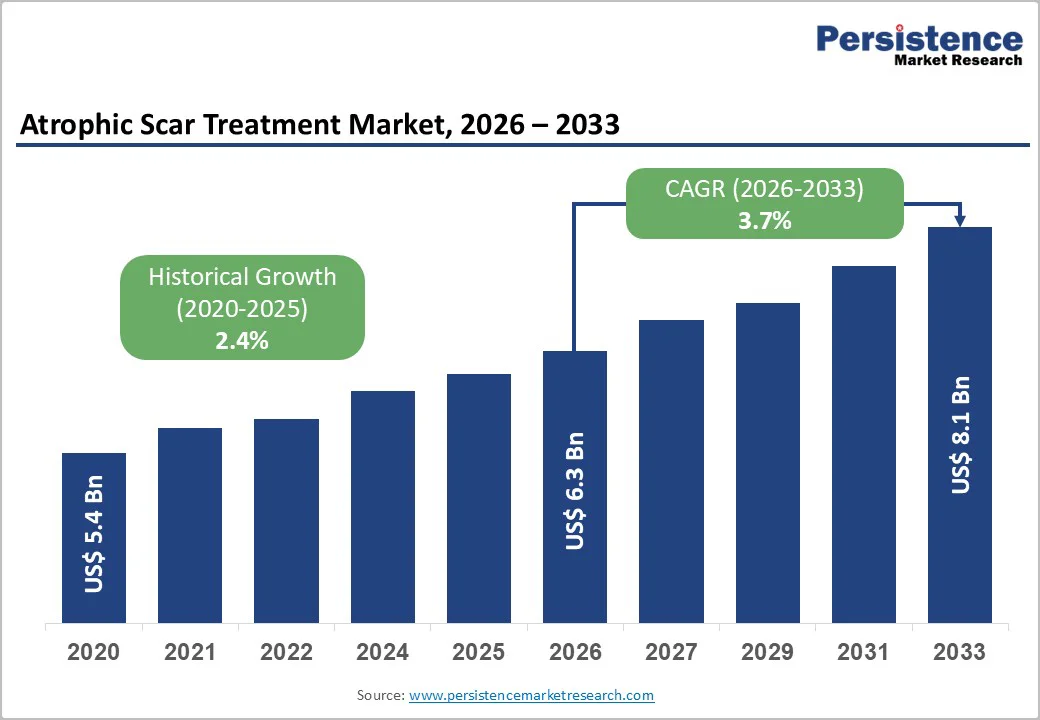
The global atrophic scar treatment market size is likely to be valued at US$6.3 billion in 2026 and projected to reach US$8.1 billion by 2033. The market is projected to record a CAGR of 3.7% during the forecast period from 2026 to 2033.
Rising cases of acne, surgical scars, and demand for advanced aesthetic solutions has encouraged the market growth. Treatments such as lasers, topical silicone products, dermal fillers, and microneedling are widely preferred for improving skin texture and restoring volume loss. Clinics and dermatology centers are major treatment providers, while e-commerce boosts sales of OTC scar-care products. Technological advancements such as fractional CO2 lasers and regenerative fillers support faster healing and improved cosmetic outcomes. Rising awareness about facial aesthetics, expanding dermatology clinics, and increased disposable income further propel market expansion globally.
Key Industry Highlights:
- The growing prevalence of acne, dermatological procedures, and surgeries is increasing cases of atrophic scars. Higher incidence among teenagers and young adults drives treatment demand.
- Fractional CO2, picosecond, and erbium-based laser devices are witnessing strong preference due to deep tissue remodeling, collagen stimulation, and rapid visible improvement.
- Dermal fillers, especially hyaluronic acid-based injectables, offer immediate improvement for deep rolling or boxcar scars.
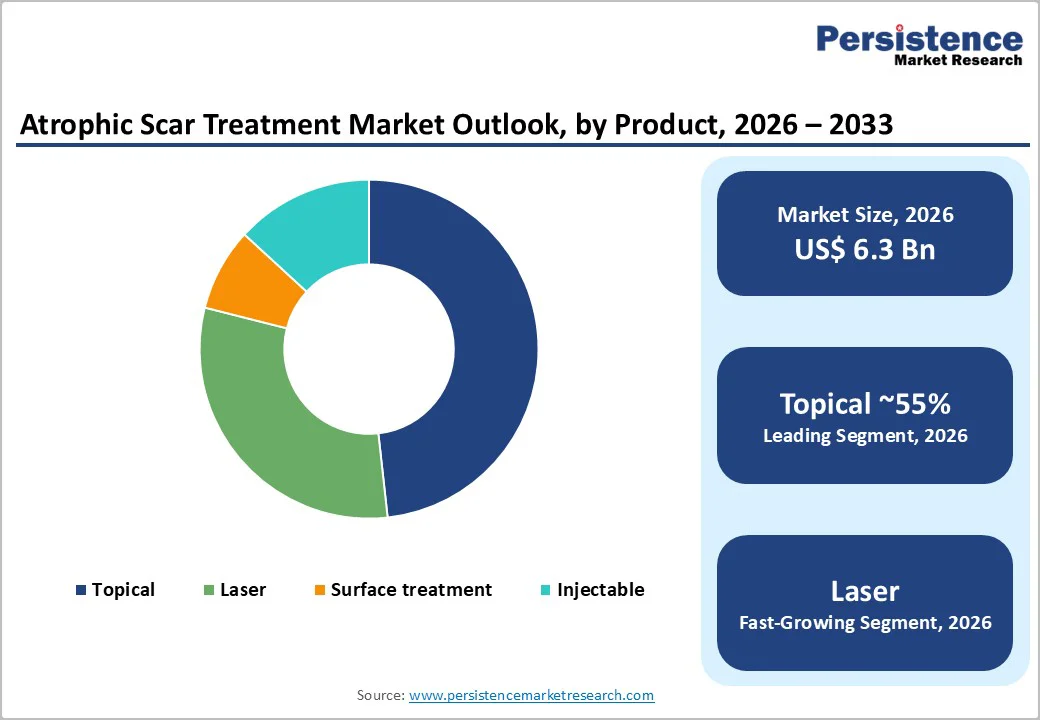
- Leading Product Type: Topical formulations such as silicone gels, silicone sheets, creams, serums, and regenerative ointments are widely preferred due to low cost, self-use convenience, OTC availability, and strong consumer adoption.
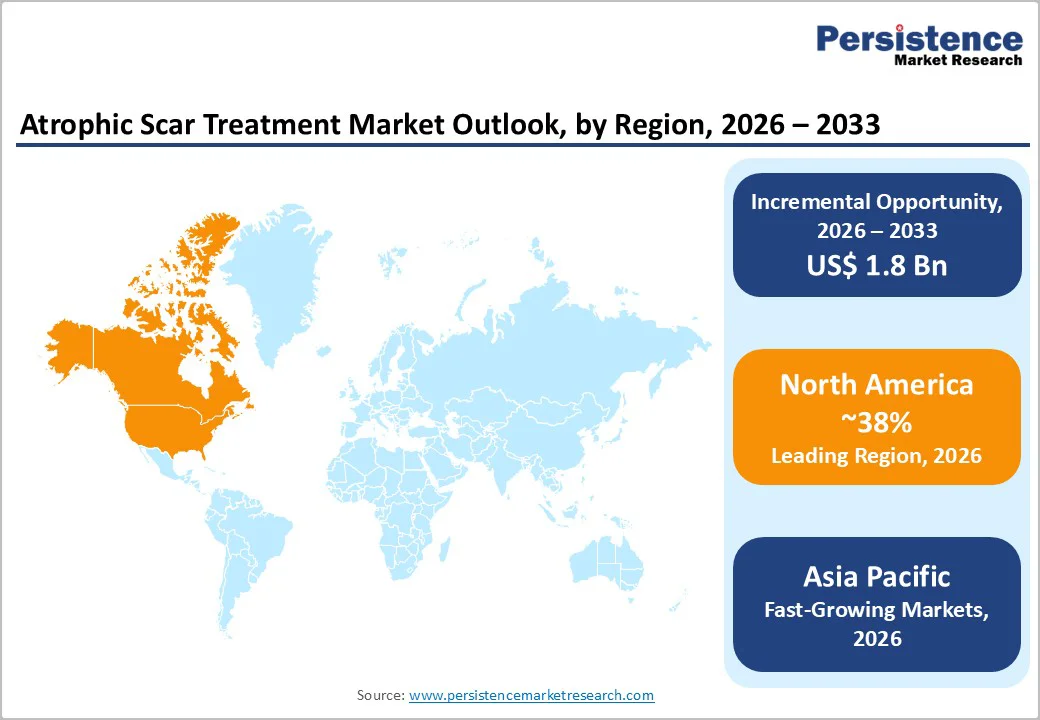
- Leading region: North America leads the Atrophic Scar Treatment Market due to its high prevalence of acne, surgical procedures, and burn injuries, which increases patient volume for scar revision.
| Key Insights | Details |
|---|---|
| Atrophic Scar Treatment Market Size (2026E) | US$6.3 Bn |
| Market Value Forecast (2033F) | US$8.1 Bn |
| Projected Growth (CAGR 2026 to 2033) | 3.7% |
| Historical Market Growth (CAGR 2020 to 2025 | 2.4% |
Market Dynamics
Driver - Adoption of Multi-Modality Dermatology Protocols
Adoption of multi-modality dermatology protocols has emerged as a major advancement in atrophic scar management. Instead of relying on a single therapy such as laser resurfacing alone, dermatologists now combine multiple complementary procedures-CO2 or Er:YAG resurfacing, subcision for tethered scars, platelet-rich plasma (PRP) injections for regenerative healing, and hyaluronic acid dermal fillers to immediately lift deep depressions. This sequential and layered approach allows treatment of different scar depths, structural adhesions, and collagen deficiencies simultaneously. Multi-session therapy plans are often personalized based on scar severity, skin type, downtime preference, and expected outcome timelines. PRP or growth-factor-rich serums are increasingly added post-laser to speed re-epithelialization and support collagen stimulation.
Subcision helps release fibrotic strands while fillers maintain volume during collagen remodeling. The clinical result is visibly smoother texture, fewer treatment failures, and improved patient satisfaction due to holistic improvement rather than partial correction. This trend also boosts patient retention and creates packaged revenue models for dermatology clinics, making multi-modality therapy an emerging commercial driver.
Restraints - Risk of Post-Inflammatory Hyperpigmentation (PIH) in Darker Skin
Post-Inflammatory Hyperpigmentation (PIH) remains a major challenge in atrophic scar treatment, particularly for patients with darker skin tones classified as Fitzpatrick IV-VI. In these individuals, even mild trauma from procedures such as laser resurfacing, chemical peels, or microneedling can trigger melanocyte overactivity, resulting in unwanted hyperpigmented patches. This risk significantly limits the aggressiveness of conventional resurfacing treatments, forcing dermatologists to adopt conservative fluence settings or partial coverage protocols, which may compromise efficacy.
The prevalence of higher Fitzpatrick skin types in regions like Asia, the Middle East, and Latin America amplifies this constraint, restricting widespread adoption of advanced laser technologies. Furthermore, PIH can be psychologically distressing, reducing patient satisfaction despite technical improvement in scar morphology. Addressing this requires careful pre- and post-treatment pigmentation management, use of non-ablative lasers, and topical depigmenting agents, making clinical planning complex and increasing treatment time and costs. This restraint uniquely affects both market adoption and procedural innovation.
Opportunity - Nanotechnology-Based Delivery Systems
Nanotechnology-based delivery systems represent a cutting-edge opportunity in the atrophic scar treatment market by revolutionizing how active ingredients are delivered to the skin. Traditional topical formulations often face limitations in penetrating the dense dermal tissue of atrophic scars, resulting in suboptimal efficacy. Nano-carriers such as liposomes, solid lipid nanoparticles, and polymeric nanospheres-enable encapsulation of bioactive compounds like peptides, growth factors, hyaluronic acid, and anti-inflammatory agents, protecting them from degradation while ensuring targeted delivery deep into scar tissue. This precision enhances collagen remodeling, stimulates fibroblast activity, and accelerates tissue regeneration, addressing the core structural deficits in atrophic scars.
Furthermore, nanocarriers allow controlled, sustained release of actives, reducing the frequency of application and improving patient adherence. By combining safety, efficiency, and convenience, nanotechnology-enhanced topical therapies offer a unique differentiation point for companies seeking premium, high-efficacy scar treatments. This innovation also opens avenues for personalized formulations tailored to scar type, skin tone, and healing stage, positioning it as a transformative advancement in scar management.
Category-wise Analysis
By Product Type, the Topical Segment is leading in the Market
Topical products hold the largest share in the Atrophic Scar Treatment Market due to their accessibility, cost-effectiveness, and ease of use. Unlike laser or injectable procedures, topical treatments such as silicone gels, sheets, creams, and serums can be self-administered at home, allowing continuous application during the critical healing phase. They are recommended by dermatologists immediately after wound closure or minor surgical interventions, which helps prevent severe atrophic scarring. Their non-invasive nature minimizes downtime and reduces procedural risks, making them attractive to a wide demographic, including teenagers with acne scars and adults with post-surgical scars.
Furthermore, strong distribution through pharmacies, e-commerce platforms, and retail channels ensures widespread availability. Advances in formulation, such as the incorporation of peptides, growth factors, and hydrating agents, enhance efficacy, reinforcing consumer trust. Collectively, convenience, affordability, clinical recommendation, and proven outcomes position topical therapies as the dominant product type globally.
By Distribution Channel, Hospitals and Clinics Segment Leads the Market
Hospitals and clinics dominate the Atrophic Scar Treatment Market because they serve as the primary settings for high-value, procedure-based therapies that cannot be administered at home. Treatments such as laser resurfacing, microneedling, subcision, platelet-rich plasma (PRP) injections, and dermal fillers require skilled dermatologists or plastic surgeons, specialized equipment, and controlled clinical environments to ensure safety and optimal results. These facilities also provide pre- and post-procedure care, including monitoring for side effects, managing downtime, and offering personalized treatment plans based on scar type, severity, and patient skin characteristics.
Additionally, hospitals and aesthetic clinics often bundle multiple therapies into multi-session packages, increasing treatment efficacy and driving higher revenue per patient. While pharmacies, drug stores, and e-commerce platforms primarily distribute topical gels, creams, and OTC products, the clinical expertise, technological capabilities, and patient trust inherent to hospitals and clinics make them the leading distribution channel, capturing the largest market share globally.
Region-wise Insights
North America Atrophic Scar Treatment Trends
North America leads the atrophic scar treatment market, driven by high aesthetic awareness, advanced healthcare infrastructure, and strong adoption of innovative dermatology procedures. The U.S. accounts for the majority of regional revenue, fueled by widespread use of lasers, dermal fillers, and combination therapies in dermatology and aesthetic clinics. The rising incidence of acne, surgical scars, and burn injuries creates a substantial patient pool seeking effective scar correction. Consumers in urban centers increasingly prefer minimally invasive, multi-modality treatments that combine laser resurfacing, PRP, and topical care for optimal outcomes.
Additionally, regulatory approvals, robust insurance coverage for certain procedures, and early adoption of technologically advanced devices such as fractional CO2 and picosecond lasers enhance treatment accessibility. Digital awareness campaigns and tele-dermatology further support patient education and product adoption, solidifying North America, particularly the U.S., as the market leader.
Asia Pacific Atrophic Scar Treatment Market Trends
Asia Pacific atrophic scar treatment market is emerging rapidly due to rising aesthetic awareness, growing disposable incomes, and increasing prevalence of acne, post-surgical, and burn-related scars. Countries such as India, China, Japan, and South Korea are witnessing strong adoption of both clinic-based and home-use scar treatments. Urban populations are increasingly seeking minimally invasive procedures like laser resurfacing, microneedling, and dermal fillers, often complemented by topical silicone products. Expanding dermatology clinics, cosmetic centers, and e-commerce platforms improve accessibility and affordability of scar management solutions.
Additionally, younger demographics show high engagement with social media-driven beauty trends, boosting demand for preventive and corrective treatments. Government support for healthcare infrastructure, coupled with technological adoption in aesthetic devices, positions the Asia Pacific region as a high-growth market with significant opportunities for both global and regional players in the atrophic scar treatment segment.
Market Competitive Landscape
The atrophic scar treatment market is moderately fragmented, with competition driven by innovation, product efficacy, and regional presence. Key differentiation factors include multi-modality treatment protocols, advanced topical formulations, and technologically superior laser and injectable devices. Companies focus on improving clinical outcomes, patient satisfaction, and treatment convenience to gain a competitive edge. Strategic initiatives such as mergers, acquisitions, new product launches, and geographic expansion enhance market positioning.
Key Industry Developments:
- In May 2025, A recent clinical trial revealed that treating acne and atrophic scars simultaneously was not only safe and effective but also more efficient than traditional stepwise methods. This prospective split-face controlled study involved 30 patients with symmetrical facial acne and atrophic scars and aimed to evaluate the efficacy and safety of concurrent treatment.
Companies Covered in Atrophic Scar Treatment Market
- Smith & Nephew
- Mölnlycke Health Care
- Merz Pharma
- Lumenis
- Cynosure
- Candela
- Perrigo Company
- Sonoma Pharmaceuticals
- Bausch Health
- CCA Industries
- Avita Medical
- Alliance Pharma
- Suneva Medical
- Pacific World Corporation
- Scarguard Labs
- Others
Frequently Asked Questions
The global atrophic scar treatment market is projected to be valued at US$6.3 Bn in 2026.
Increasing cases of acne, post-surgical scars, and burn-related scars create a higher demand for effective scar management solutions.
The global atrophic scar treatment market is poised to witness a CAGR of 3.7% between 2026 and 2033.
Development of bioactive gels, growth-factor-rich serums, and collagen-stimulating formulations.
Smith & Nephew, Mölnlycke Health Care, Lumenis, and others.


