




- Industrial Machinery
- Vertical Form Fill Seal VFFS Machine Market
Vertical Form Fill Seal VFFS Machine Market Size, Share, and Growth Forecast, 2026 - 2033
Vertical Form Fill Seal VFFS Machine Market by Technology (Automatic, Semi-Automatic, Others), Packaging Type (Pillow Bags, Doypacks, Others), End-use Industry, Material Type, and Regional Analysis for 2026 - 2033

Vertical Form Fill Seal VFFS Machine Market Size and Trends Analysis
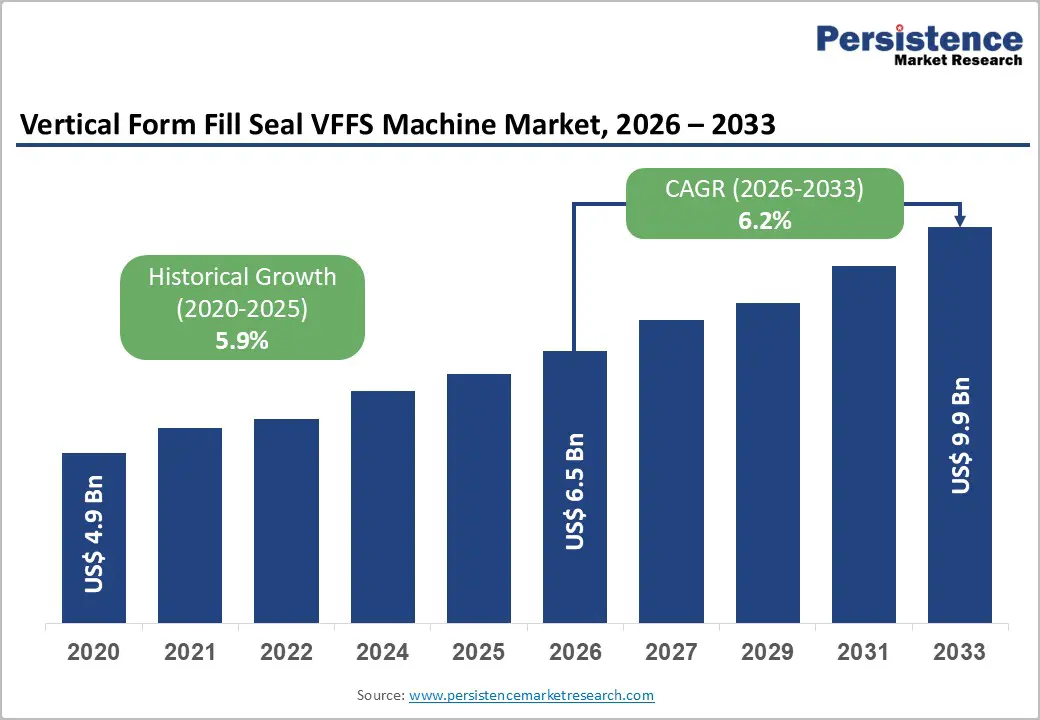
The global vertical form fill seal VFFS machine market is likely to be valued at US$6.5 billion in 2026 and is expected to reach US$9.9 billion by 2033, growing at a CAGR of 6.2% during the forecast period between 2026 and 2033, driven by accelerating automation across food and beverage packaging lines, increasing demand for single-serve and flexible pouch formats such as pillow packs, doypacks, and sachets, and rising regulatory and brand-driven pressure to adopt recyclable and biodegradable packaging materials. Asia-Pacific leads the global market, supported by strong manufacturing capacity, expanding packaged-food consumption, and rapid modernization of packaging infrastructure.
Key Industry Highlights
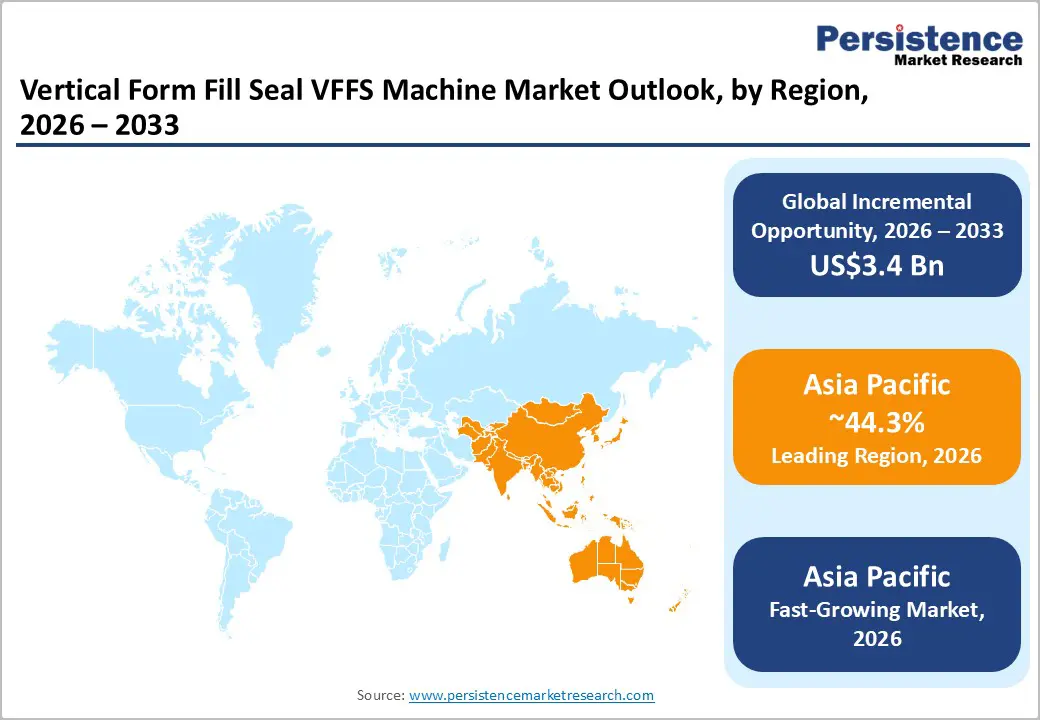
- Leading Region: Asia Pacific is projected account for over 44.3% of market share in 2026, driven by high packaged food consumption in China, rapid automation adoption in India, and strong precision machinery demand in Japan.
- Fastest-growing Region: Asia Pacific, fueled by regulatory tightening on food safety, expansion of organized retail, and localized manufacturing investments.
- Investment Plans: Capital deployment is concentrated in fully automatic, servo-driven VFFS platforms, digital retrofits, and regional service infrastructure, with more than 60% of new investments focused on automation upgrades, aftermarket services, and sustainability-compatible machine designs.
- Dominant Technology: Automatic VFFS machines, to hold over 52.6% market share in 2026, driven by high throughput requirements (100-250 bags per minute), labor cost pressures, and demand from large-scale food and FMCG producers.
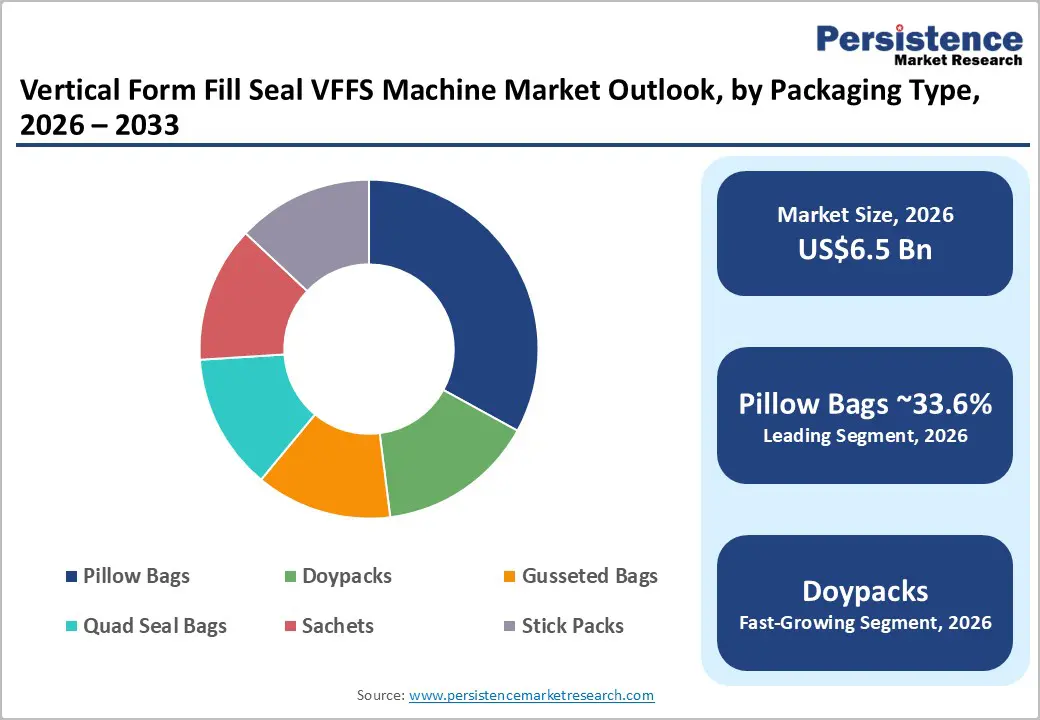
- Leading Packaging Type: Pillow bags, to represent 33.6% of the total packaging format share, supported by material efficiency, mechanical simplicity, and suitability for high-speed snack, confectionery, and dry food packaging lines.
| Key Insights | Details |
|---|---|
| Vertical Form Fill Seal VFFS Machine Market Size (2026E) | US$6.5 Bn |
| Market Value Forecast (2033F) | US$9.9 Bn |
| Projected Growth (CAGR 2026 to 2033) | 6.2% |
| Historical Market Growth (CAGR 2020 to 2025) | 5.9% |
Market Factors - Growth, Barriers, and Opportunity Analysis
Growth Analysis - Acceleration of Automation and Industry 4.0 Integration
The adoption of automatic VFFS machines integrated with advanced line automation systems has increased significantly across mature and emerging markets. Manufacturers are increasingly deploying servo-driven baggers with integrated weighing, metal detection, vision inspection, and real-time line analytics to reduce labor dependency and improve overall equipment effectiveness. Automatic VFFS systems now account for the majority of new equipment orders as producers seek higher throughput, consistent seal quality, and predictive maintenance capabilities. Automation increases average order value through advanced software, servo components, and line integration, while reducing payback periods despite higher initial capital expenditure. Investment activity is particularly concentrated in snack foods, confectionery, and frozen food lines operating at speeds exceeding 120 bags per minute.
Growth of Single-Serve, Convenience, and E-commerce Packaging
Food and beverage remains the dominant end-use industry, accounting for 61% of total VFFS demand. Rising consumer preference for portion-controlled, on-the-go, and e-commerce-friendly packaging formats has accelerated the adoption of pillow bags, doypacks, and sachets. These formats require packaging equipment capable of rapid changeovers, short production runs, and consistent quality across multiple SKUs. As a result, manufacturers are increasingly investing in modular automatic VFFS platforms equipped with quick-change film spindles, recipe-driven controls, and multi-format capability. This shift supports higher throughput per line, stimulates demand for retrofits, and sustains a steady replacement cycle for older mechanical bagging systems.
Sustainability and Packaging Material Transition
Regulatory initiatives and corporate sustainability commitments are driving the adoption of recyclable, mono-material, and biodegradable packaging films. These materials require precise temperature control, adapted sealing jaws, and optimized film handling to maintain seal integrity at commercial speeds. Equipment suppliers are prioritizing materials science and seal technology innovation to address these requirements. Machines capable of processing paper composites, monopolyethylene structures, and multilayer films command premium prices and create substantial retrofit opportunities. With biodegradable materials identified as the fastest-growing material category, demand for compatible VFFS equipment is generating a multi-year replacement and upgrade cycle among mid- and large-scale manufacturers.
Barrier Analysis - High Capital Intensity and Variable Return on Investment
VFFS machines span a wide range of costs, from basic tabletop units to high-speed, multi-lane servo-driven systems. High-performance automatic machines and fully integrated lines require substantial upfront investment, often exceeding five figures. These capital requirements can delay adoption among small and mid-sized enterprises and increase sensitivity to economic cycles. Purchasing decisions are strongly influenced by access to financing, production volume stability, and total cost of ownership assessments. In cost-sensitive markets, capital constraints continue to favor semi-automatic solutions or extended use of legacy equipment.
Raw Material and Supply Chain Volatility
Volatility in polymer pricing, packaging substrates, and electronic components used in servo drives and control systems presents ongoing challenges for both equipment manufacturers and end users. During periods of supply tightness, original equipment manufacturers often prioritize higher-margin, configurable machines, thereby extending lead times for standardized models. Sudden increases in polymer prices, historically reaching 20-30% in extreme cycles, can materially raise packaging costs per unit and compress margins, indirectly delaying equipment investments or forcing project rescheduling.
Opportunity Analysis -Retrofitting and Lifecycle Service Expansion
A significant portion of the global installed base consists of mechanically driven VFFS machines, creating a strong opportunity for digital retrofitting and lifecycle services. Retrofit solutions include PLC upgrades, servo conversions, remote monitoring, and OEE analytics, allowing manufacturers to extend machine life without full system replacement. Service and retrofit revenues can represent approximately 10-20% of annual new equipment spending for established OEMs, offering predictable, recurring income streams. As manufacturers seek to optimize existing assets and defer large capital investments, demand for retrofits and service contracts is expected to increase steadily.
Emerging Markets and Localization Strategies
Asia Pacific, already the leading region with more than 44.3% market share, along with parts of Latin America, presents strong growth opportunities as mid-sized manufacturers transition from semi-automatic to automatic VFFS solutions. Localized production, regional partnerships, and cost-optimized automation platforms enable suppliers to serve price-sensitive customers previously excluded from premium European offerings. The availability of local service networks, spare parts, and financing options plays a critical role in vendor selection. Companies that combine proven global technology with localized manufacturing and support infrastructure are well-positioned to expand market share.
Category-wise Analysis
Technology Insights
Automatic VFFS machines are anticipated to retain a majority market share through the forecast period, having accounted for over 52.6% of the market share in 2026. Their leadership is supported by high throughput capabilities, servo-driven accuracy, recipe memory systems, and intuitive human-machine interfaces that significantly reduce labor dependence and packaging errors. Large-scale food, snack, and FMCG manufacturers prefer automatic continuous-motion and rotary jaw systems capable of operating at sustained speeds of 100-250 bags per minute. Applications such as potato chips, breakfast cereals, frozen vegetables, and powdered beverages rely heavily on these systems for consistent output. Hygienic stainless-steel designs, washdown compatibility for wet products, and bundled aftermarket service contracts further strengthen adoption in high-volume, multi-shift production environments.
Semi-automatic VFFS machines are anticipated to record the fastest growth rate over the forecast period, driven by increasing penetration in cost-sensitive and emerging markets. These systems offer lower upfront capital requirements, simpler installation, and operational flexibility, making them suitable for small and mid-sized processors. Regional snack brands, spice packers, and contract manufacturers frequently deploy semi-automatic units to balance throughput with affordability. Modular upgrade options, such as retrofitting servo-driven film control, date coders, or nitrogen flushing, enable gradual automation as production scales. This expanding installed base also supports long-term revenue opportunities from spare parts, retrofits, and maintenance services, resulting in a structurally segmented, two-tier technology market across regions.
Packaging Type Insights
Pillow bags are expected to remain the dominant packaging format over the forecast period, accounting for approximately 33.6% of the market in 2026. Their continued leadership is linked to efficient film usage, mechanical simplicity, and compatibility with high-speed VFFS operations. Pillow bags are widely used for snacks, bakery products, confectionery, rice, pulses, and instant food mixes. Major branded snack producers and private-label food manufacturers favor this format for its low material waste, reliable sealing performance, and consistent line efficiency. The format’s suitability for both metallized and laminated films supports cost optimization while maintaining adequate shelf life for dry food products.
Doypacks are anticipated to be the fastest-growing packaging format, supported by rising demand for premium presentation, stand-up functionality, and resealable closures. Growth is particularly strong in liquid sauces, ready-to-eat foods, pet nutrition, and health-focused product categories where shelf differentiation plays a critical role in consumer choice. Examples include single-serve condiments, protein powders, and specialty coffee blends. Technological improvements in forming shoulders, bottom-gusset sealing, and zipper integration have expanded doypack compatibility on modern VFFS platforms. These advances enable higher-margin packaging solutions and allow brand owners to pursue premiumization strategies while leveraging existing vertical form-fill-seal infrastructure.
Regional Insights
North America Vertical Form Fill Seal VFFS Machine Market Trends - Automation-Led Demand for High-Throughput, Hygienic Packaging Lines
North America represents a high-value and technology-intensive market, characterized by advanced automation adoption, high labor costs, and strong regulatory oversight. The U.S. leads regional demand due to the presence of large multinational food processors such as PepsiCo, Kraft Heinz, General Mills, and Kellogg’s, all of which operate high-throughput snack and dry food production lines that rely heavily on automated VFFS equipment. Rising labor shortages and wage inflation have accelerated investments in fully-automatic, servo-driven VFFS machines, particularly continuous-motion systems designed for multi-shift operations. Private-label growth among major retailers, including Walmart and Costco, has further increased demand for flexible, high-speed packaging solutions capable of rapid SKU changeovers.
Regulatory requirements enforced by the U.S. Food and Drug Administration (FDA) and the USDA emphasize hygienic design, traceability, and contamination control, favoring stainless-steel, washdown-ready VFFS platforms with integrated inspection and coding systems. Equipment suppliers such as ProMach, Barry-Wehmiller, and BW Packaging have expanded their North American portfolios through acquisitions and platform standardization, offering turnkey packaging lines that combine VFFS machines, checkweighers, metal detectors, and case packing. Investment activity increasingly targets retrofits, digital upgrades, and long-term service agreements, positioning North America as a premium but highly competitive market where uptime, compliance, and lifecycle cost optimization drive purchasing decisions.
Europe Vertical Form Fill Seal VFFS Machine Market Trends-OEM-Driven Innovation Focused on Sustainable Film Compatibility
Europe remains a mature and innovation-driven market, supported by a strong original equipment manufacturing base and a high concentration of export-oriented packaging machinery suppliers. Countries such as Germany, Italy, and Spain play a central role, with manufacturers including Bosch Packaging Technology (Syntegon), IMA Group, and Ulma Packaging supplying advanced VFFS systems to both regional and global customers. Demand is diversified across food, pharmaceutical, and fresh produce applications, with pharmaceutical sachets, medical powders, and portion-controlled food packs sustaining steady equipment utilization. Germany’s engineering leadership and Spain’s strength in fresh produce packaging continue to anchor regional demand.
Sustainability has become a defining market force, driven by EU packaging waste directives and extended producer responsibility (EPR) regulations that are accelerating equipment upgrades for recyclable, compostable, and mono-material films. European food brands such as Nestlé, Unilever, and Danone have publicly committed to recyclable packaging targets, prompting investments in VFFS machines with advanced seal technology capable of handling thinner and lower-temperature films. European OEMs continue to invest in R&D focused on seal integrity, energy efficiency, and reduced compressed-air consumption, reinforcing the region’s role as a technology development and pilot market. While replacement cycles remain measured, consistent modernization activity supports stable long-term demand.
Asia Pacific Vertical Form Fill Seal VFFS Machine Market Trends-Volume Growth Powered by Packaged Food Expansion and Localized Automation
Asia-Pacific is expected to be the largest and fastest-growing regional market, accounting for more than 44.3% of global demand, driven by rapid urbanization, rising packaged food consumption, and strengthened food safety regulations. China dominates volume demand, supported by large domestic food producers and a robust local machinery manufacturing ecosystem that supplies cost-competitive VFFS equipment across Asia and Africa. India is experiencing accelerated adoption of mid-tier and semi-automatic systems as branded packaged foods, spices, and ready-to-eat segments expand, with companies such as ITC, Britannia, and Tata Consumer Products investing in scalable packaging automation. Japan, meanwhile, maintains a steady demand for high-precision, compact VFFS machines used in confectionery, pharmaceutical, and specialty food applications.
Growth across the region is reinforced by tightening food safety standards, including China’s updated GB packaging regulations and India’s FSSAI compliance requirements, which are driving a shift away from manual packaging toward mechanized solutions. Global suppliers such as TNA Solutions, Ishida, and Syntegon are expanding regional footprints through localized manufacturing, joint ventures, and service hubs to remain competitive against domestic players. Localization strategies, price-performance optimization, and after-sales support are critical success factors, making Asia Pacific the primary engine of global market expansion and the most strategically important region for long-term capacity investments.
Competitive Landscape
The global vertical form fill seal VFFS machine market is moderately concentrated, with a group of established global manufacturers dominating high-end automatic systems and lifecycle services. A broad base of regional suppliers competes aggressively on pricing and lead times, particularly in semi-automatic and entry-level segments. Competitive differentiation is driven by service coverage, material-processing capability, digital integration, and speed of format change.
Market leaders prioritize innovation for new packaging materials, expansion of service and retrofit offerings, regional production footprints, and selective acquisitions to strengthen capabilities in high-speed and regulated applications.
Key Industry Developments
- In March 2025, TNA Solutions showcased its Robag 3e VFFS units at SNAXPO 2025, enabling one technician to manage up to five lines at speeds of up to 250 bags per minute, enhancing automation in high-volume snack packaging operations.
- In February 2025, Syntegon launched the SVX Agile VFFS system, a fully recyclable mono-material compatible machine rated at 300 pouches per minute with an advanced cross-seal drive for high-speed flexible packaging formats.
Companies Covered in Vertical Form Fill Seal VFFS Machine Market
- Syntegon Technology
- GEA Group
- IMA Group
- Ulma Packaging
- Ishida Co., Ltd.
- ProMach
- BW Packaging Systems
- TNA Solutions
- Nichrome
- Mespack
- Cama Group
- Marchesini Group
- Multivac
- WeighPack Systems
- PFM Packaging Solutions
- Ronchi Mario Group
- Bosch Packaging Technology (brand legacy)
- Ohlson Packaging Group
Frequently Asked Questions
The global vertical form fill seal VFFS machine market size is likely to be valued at US$ 6.5 billion in 2026.
By 2033, the global VFFS machine market is expected to reach US$9.9 billion.
Key trends include increasing adoption of fully automatic and servo-driven VFFS systems, growing compatibility with recyclable and mono-material films, rising demand for high-speed continuous-motion machines, and expanding investments in aftermarket services, digital retrofits, and predictive maintenance to improve equipment uptime.
The automatic technology segment leads the market, accounting for over 52.6% share, supported by high throughput capabilities, reduced labor dependency, and strong demand from large-scale food and FMCG manufacturers.
The vertical form fill seal VFFS machine market is projected to grow at a CAGR of 6.2% between 2026 and 2033.
Major players with strong and diversified VFFS portfolios include Syntegon Technology, IMA Group, TNA Solutions, ProMach, and BW Packaging Systems.


