




- Chipsets & Processors
- SLA Management Market
SLA Management Market Size, Share, and Growth Forecast, 2026 - 2033
SLA Management Market by Component Type (Software, Services), Organization Size (Small and Medium Enterprises, Large Enterprises), Application (IT & Telecommunication, BFSI, Healthcare, Others), and Regional Analysis for 2026 - 2033

SLA Management Market Size and Trends Analysis
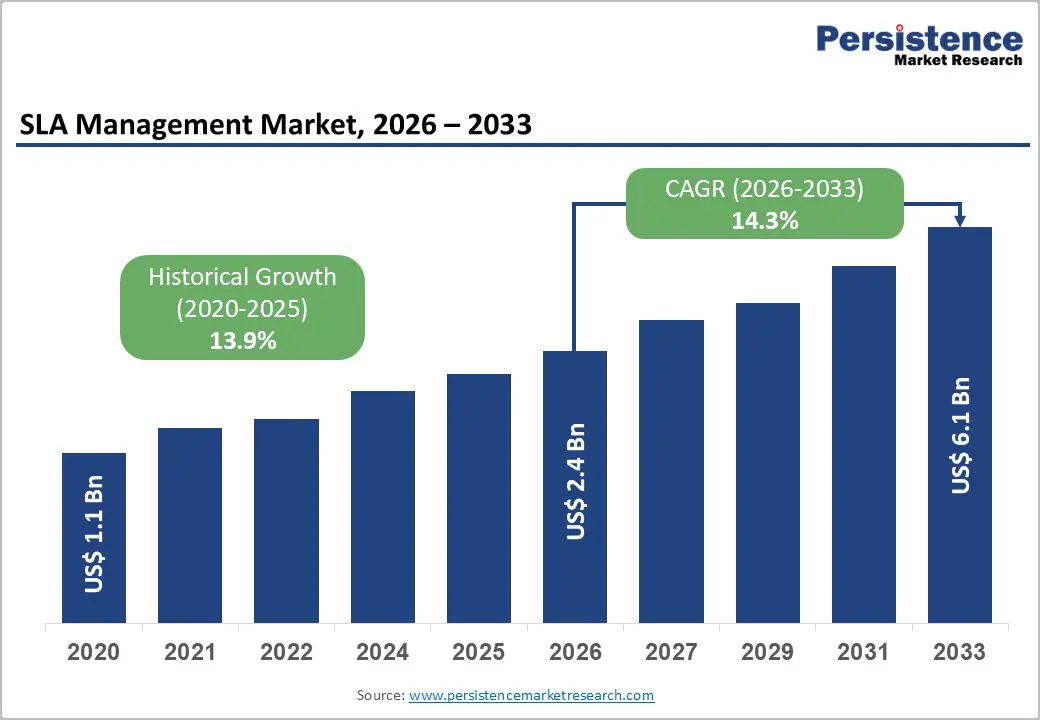
The global SLA management market size is likely to be valued at US$2.4 billion in 2026 and is expected to reach US$6.1 billion by 2033, growing at a CAGR of 14.3% during the forecast period from 2026 to 2033, driven by the increasing adoption of cloud-based IT services, digital transformation initiatives, and growing reliance on multi-vendor IT ecosystems, which necessitate robust (service level agreement) SLA monitoring, tracking, and compliance frameworks.
Organizations across industries are prioritizing automated service level agreement management solutions to ensure service reliability, reduce operational risks, and maintain consistent performance amid rising IT complexity. Regulatory and compliance requirements in sectors such as BFSI, healthcare, and government reinforce the adoption of structured SLA frameworks.
Key Industry Highlights:
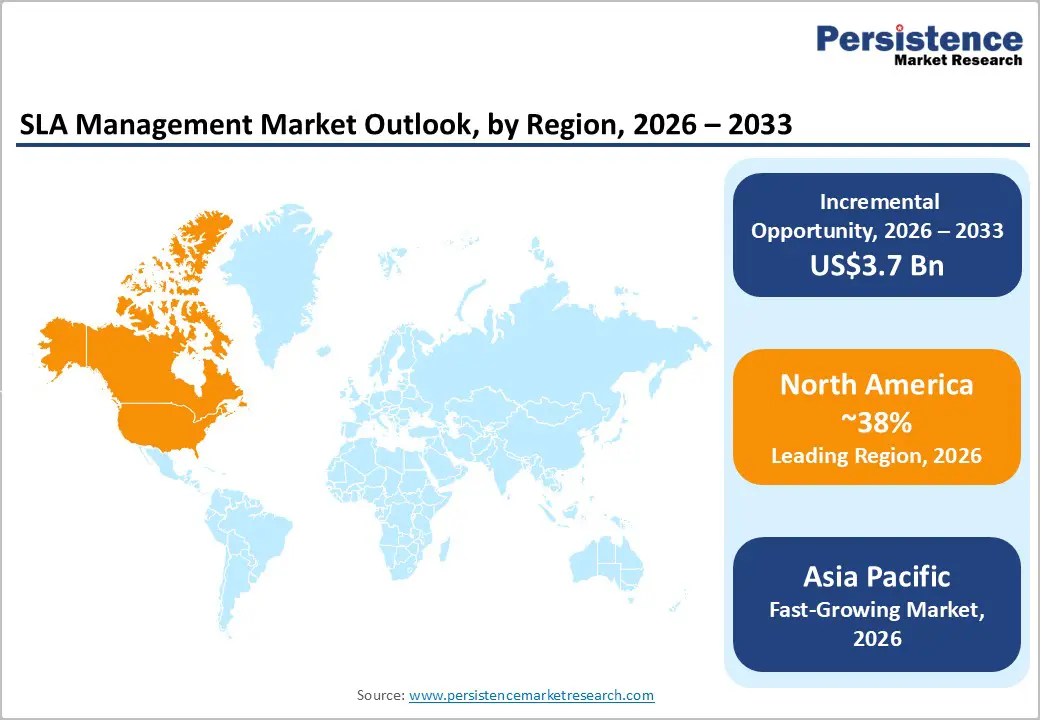
- Leading Region: North America is anticipated to be the leading region, accounting for a market share of 38% in 2026, driven by mature IT infrastructure, widespread cloud adoption, regulatory compliance requirements, and increasing demand for AI-enabled SLA management solutions.
- Fastest-growing Region: Asia Pacific is likely to be the fastest-growing region, driven by rapid digitalization, expanding IT and telecom sectors, government initiatives, and increasing adoption of cloud-based and scalable SLA solutions.
- Leading Component Type: The software segment is projected to represent the leading component type in 2026, accounting for 60% of the revenue share, due to its core role in automation, monitoring, and reporting functionalities.
- Leading Organization Size: Large enterprises are projected to represent the leading organization size in 2026, accounting for 70% of the revenue share, due to complex multi-vendor environments and higher IT budgets.
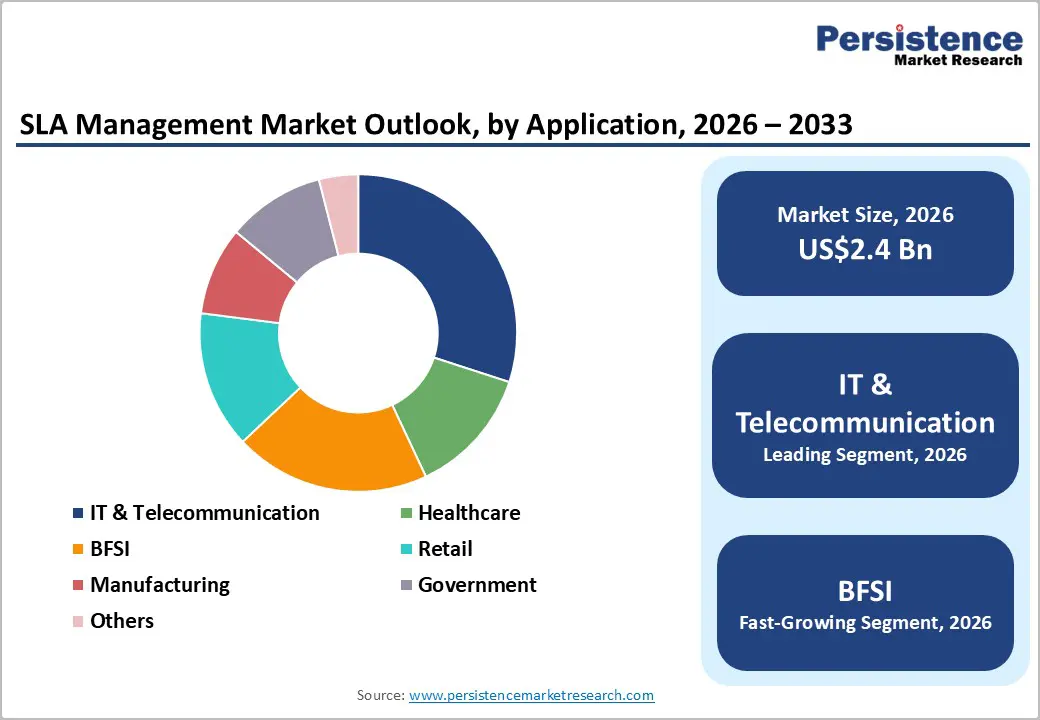
- Leading Application: IT & telecommunication is anticipated to be the leading application type, accounting for over 50% of the revenue share in 2026, driven by high dependency on uptime and performance metrics.
| Key Insights | Details |
|---|---|
|
SLA Management Market Size (2026E) |
US$2.4 Bn |
|
Market Value Forecast (2033F) |
US$6.1 Bn |
|
Projected Growth (CAGR 2026 to 2033) |
14.3% |
|
Historical Market Growth (CAGR 2020 to 2025) |
13.9% |
Market Factors - Growth, Barriers, and Opportunity Analysis
Increasing Cloud Adoption and Digital Transformation
Enterprises are increasingly transitioning from traditional IT infrastructures to hybrid and cloud-native environments, creating new challenges in monitoring service performance, managing multi-vendor contracts, and ensuring compliance with service commitments. SLA management solutions offer centralized platforms for real-time tracking, automated monitoring, reporting, and performance analytics, helping organizations maintain operational efficiency, minimize downtime, and deliver consistent service quality. These platforms typically include customizable dashboards, automated alerts for SLA violations, and comprehensive historical performance reports, empowering IT teams to make data-driven decisions. Integration with existing IT service management (ITSM) tools further streamlines workflows and reduces the need for manual oversight.
The acceleration of digital transformation has heightened demand for advanced, AI-enabled SLA management solutions. Sectors such as BFSI, healthcare, IT & telecom, and government depend on these tools for regulatory compliance, risk mitigation, and improved customer experience, as service disruptions can lead to operational and financial losses. AI-powered SLA platforms provide predictive analytics, anomaly detection, and proactive incident management to minimize service interruptions. They also enable governance across multi-vendor SLAs, ensuring accountability throughout complex IT ecosystems. Cloud-based SLA platforms offer scalability, cost-efficiency, and accessibility, allowing organizations of all sizes, including SMEs, to implement enterprise-grade service management without major infrastructure investments.
Integration Challenges with the Existing IT Infrastructure
Many enterprises operate a mix of legacy systems, on-premises applications, and cloud-based platforms, making seamless integration challenging. Disparate systems often require customization, configuration, and specialized technical expertise to ensure centralized tracking, monitoring, and reporting of SLAs. These challenges can lead to higher deployment costs, longer implementation timelines, and operational disruptions, particularly for large organizations with complex multi-vendor environments. Ensuring compatibility with IT service management (ITSM) tools, ERP systems, and network monitoring platforms can be time-consuming, and failure to integrate effectively may reduce the reliability of SLA enforcement.
Integration difficulties also affect data consistency, secure information flow, and real-time performance monitoring across platforms. SMEs, while increasingly adopting cloud-based SLA tools, may face hurdles in aligning these solutions with existing software stacks. As a result, enterprises may experience delayed ROI, reduced operational efficiency, and limited utilization of AI-driven automation and analytics features. Inconsistent data formats and fragmented reporting structures can hinder actionable insights. Organizations may also encounter compatibility issues with vendor-specific APIs, which restrict full system interoperability.
AI-Driven Predictive Compliance and Industry Convergence
The SLA management market is witnessing significant opportunities through AI-driven predictive compliance, which enables organizations to anticipate potential service level breaches and take proactive measures. By leveraging advanced machine learning and analytics, SLA management platforms can analyze historical performance data, detect anomalies, and provide actionable insights for risk mitigation and operational optimization. Industries such as BFSI (Banking, Financial Services, and Insurance), healthcare, IT & telecom, and government rely heavily on these solutions to maintain regulatory compliance, enhance service reliability, and minimize downtime. AI-powered tools also facilitate automated reporting, real-time alerts, and performance optimization, reducing manual monitoring and improving decision-making across enterprise IT environments.
Industry convergence is creating a broader adoption landscape for SLA management platforms. Enterprises increasingly operate across multiple sectors, requiring unified SLA monitoring frameworks that can manage diverse operational requirements and vendor agreements. Cloud-based, AI-enabled platforms support this convergence by offering scalable, flexible solutions integrated with ITSM, ERP, and other enterprise systems. This enables standardization of service management practices, enhances vendor accountability, and opens new opportunities for managed services, consulting, and cross-industry deployments. Integration with emerging technologies such as IoT and edge computing is enhancing predictive capabilities, while analytics-driven SLA benchmarking across industries helps enterprises optimize performance and reduce operational risks.
Category-wise Analysis
Component Type Insights
The software segment is expected to lead the SLA management market, accounting for approximately 60% of total revenue in 2026, due to its pivotal role in automation, monitoring, reporting, and real-time SLA tracking. Enterprises increasingly rely on software solutions to consolidate service level data from multiple vendors and cloud platforms, enhancing operational efficiency and reducing downtime. Software platforms also provide integrated dashboards, AI-enabled alerts, and predictive analytics, enabling IT teams to proactively manage performance and maintain compliance. For example, ServiceNow’s SLA management module allows large enterprises to monitor service commitments across complex IT environments, automate incident escalation, and generate comprehensive reports for stakeholders.
The services segment is likely to represent the fastest-growing segment in 2026, driven by consulting, implementation, integration, and managed support needs. Organizations often face challenges integrating SLA platforms with existing IT infrastructures, requiring specialized service providers to ensure smooth deployment and optimal functionality. Services also include ongoing maintenance, updates, and troubleshooting, which are critical for enterprises relying on complex multi-vendor environments. For example, BMC Software’s professional services help organizations implement SLA management tools across diverse IT systems and optimize workflows. The growth of the services segment reflects the increasing trend of enterprises outsourcing complex SLA management tasks to experts, enabling them to focus on core operations while ensuring compliance, performance monitoring, and efficient service delivery.
Organization Size Insights
The large enterprises segment is expected to lead the SLA management market, accounting for approximately 70% of the total revenue in 2026, due to their complex multi-vendor environments, higher IT budgets, and extensive operational scale. These organizations require sophisticated SLA tools to ensure service consistency across operations, meet compliance requirements, and optimize IT performance. Large enterprises benefit from centralized dashboards, automation, and advanced reporting capabilities that help manage service levels effectively. For example, IBM’s SLA management solutions for enterprise clients provide end-to-end monitoring, predictive analytics, and multi-region reporting.
Small and medium enterprises (SMEs) are likely to represent the fastest-growing segment in 2026, supported by cloud-based, scalable, and cost-effective solutions. SMEs are increasingly adopting SaaS SLA platforms to gain enterprise-level service management capabilities without investing heavily in infrastructure or IT personnel. Cloud-based offerings simplify deployment, reduce upfront costs, and provide real-time monitoring and automation tailored to smaller organizational needs. For example, Freshworks SLA tools for SMEs enable streamlined tracking of service commitments, automated alerts, and reporting for customer support teams.
Application Insights
The IT & telecommunication segment is projected to lead, capturing around 50% of the total revenue share in 2026, due to the high dependency on uptime, network performance, and service reliability. Telecom and IT companies rely heavily on SLA management to monitor performance metrics, manage vendor contracts, and ensure uninterrupted service delivery to end users. Platforms provide real-time dashboards, predictive analytics, and automated reporting, which are critical for avoiding service disruptions and maintaining customer satisfaction. For example, AT&T uses SLA management platforms to monitor network service levels, ensure compliance with contractual agreements, and provide consistent connectivity for millions of customers.
BFSI (Banking, Financial Services, and Insurance) is likely to be the fastest-growing application in 2026, driven by regulatory compliance requirements, risk management, and the transition to digital banking services. Financial institutions depend on SLA tools to ensure service availability, monitor IT vendor performance, and adhere to stringent financial regulations. SLA management solutions provide automated reporting, alerts for potential breaches, and performance analytics, helping banks and insurance companies reduce operational risks and maintain service continuity. For example, HDFC Bank is leveraging SLA platforms to monitor digital banking services, manage IT vendor performance, and ensure compliance with financial regulations.
Regional Insights
North America SLA Management Market Trends
North America is expected to lead the market, capturing approximately 38% of the share in 2026, driven by its mature IT services ecosystem, high cloud adoption, and proactive investments in automation, analytics, and AI-enabled SLA capabilities. These technologies allow organizations to monitor service reliability and compliance in real time. Regulatory and compliance requirements in sectors such as BFSI (Banking, Financial Services, and Insurance), healthcare, and government further boost demand for robust SLA solutions that provide audit trails, predictive breach alerts, and transparent performance metrics. Cloud-native SLA platforms are increasingly favored due to their scalability, seamless updates, and integration with enterprise systems such as ITSM and ERP, helping businesses optimize vendor performance and enhance service delivery.
Leading vendors are strategically innovating and expanding in North America to meet evolving enterprise demands. For instance, ServiceNow has upgraded its SLA management solutions with AI-driven predictive analytics and automated breach detection, enabling organizations to proactively mitigate SLA risks and improve service outcomes. Strategic partnerships between technology providers and managed service providers are shaping the market by delivering customized solutions for hybrid cloud environments and complex multi-vendor ecosystems. These trends underscore North America’s emphasis on intelligent, integrated, and compliance-ready SLA management as a critical element of modern IT operations.
Europe SLA Management Market Trends
Europe is expected to be a key market for SLA management in 2026, driven by regulatory compliance, data privacy, and service quality requirements across industries such as BFSI, healthcare, and telecommunications. Organizations across the region are increasingly adopting SLA management solutions to meet stringent regulations, including GDPR and industry-specific mandates, which demand robust tracking, automated reporting, and comprehensive performance governance across IT environments. Countries such as the U.K., Germany, and France are at the forefront of this trend, supported by digital transformation initiatives and ongoing investments in modernizing IT infrastructure for hybrid and multi-cloud environments.
The region is also emphasizing cross-provider SLA governance and standardized digital frameworks to ensure interoperable service agreements across national and organizational boundaries. Collaborative initiatives, such as FACIS, a European SLA governance framework, aim to harmonize SLA definitions and metrics, enabling clearer multi-provider cloud and edge service contracts throughout the EU. European vendors and service providers are enhancing their SLA offerings with AI-enabled analytics and automated compliance features, helping organizations predict breaches more effectively and optimize overall performance.
Asia Pacific SLA Management Market Trends
The Asia Pacific region is expected to be the fastest-growing market for SLA management in 2026, driven by rapid digitalization, expanding IT infrastructure, and increasing enterprise investments in cloud-based and managed IT services. The growing need for real-time performance monitoring, compliance tracking, and automated reporting across complex hybrid and multi-cloud environments is fueling adoption. For instance, ServiceNow has expanded its SLA management solutions in the region, offering AI-enabled analytics and real-time dashboards to help large enterprises and telecom operators monitor service performance and ensure compliance.
The region is seeing increased focus on managed services and AI-powered SLA analytics to address rising IT complexity and performance expectations. Enterprises are increasingly leveraging third-party expertise to deploy, customize, and optimize SLA platforms, reducing internal resource demands and accelerating time-to-value. The adoption of predictive analytics and automated alerts enables organizations to proactively manage potential SLA breaches, enhancing service continuity and customer satisfaction. As digital transformation progresses and cloud adoption deepens, Asia Pacific’s SLA management market continues to benefit from strong technological investments and government initiatives supporting IT modernization.
Competitive Landscape
The global SLA management market is moderately fragmented, characterized by a mix of established technology leaders, specialized vendors, and emerging niche players competing across diverse enterprise segments. Large incumbents maintain market leadership through extensive product portfolios and global reach, while smaller, agile companies differentiate themselves with innovative, industry-focused solutions. The market landscape is being shaped by the growing adoption of cloud-based SLA platforms, AI and analytics integration, and the shift toward managed services, driving continuous improvements in automation, real-time monitoring, and predictive compliance capabilities.
Key players, including ServiceNow, BMC Software, IBM Corporation, Ivanti, Freshworks, Cherwell Software, and ManageEngine (Zoho Corporation), hold a significant market presence by leveraging R&D investments, broad integration capabilities, and comprehensive SLA management suites embedded within larger IT service management platforms. Vendors compete through ongoing product innovation, strategic acquisitions to enhance technological capabilities, and superior customer support offerings. For instance, ServiceNow’s continuous platform enhancements and AI-driven SLA analytics strengthen its competitive position by enabling enterprises to proactively monitor and manage service performance and compliance.
Key Industry Developments:
- In November 2025, Y Soft Corporation, a leading provider of enterprise office solutions, announced the launch of its experience-driven, tiered cloud Service Level Agreement (SLA) for YSoft SAFEQ Cloud. The new SLA reflects Y Soft’s transition from on-premises solutions to a cloud-first delivery model, where the company now plays a central role in managing infrastructure and ensuring continuous service performance. The SAFEQ Cloud SLA focuses on two core pillars: service availability and support responsiveness. Y Soft commits to defined uptime and accessibility levels to ensure reliable cloud operations, while also guaranteeing timely and meaningful support through clearly defined response times.
Companies Covered in SLA Management Market
- ServiceNow
- BMC Software
- IBM Corporation
- Micro Focus
- Ivanti
- Freshworks
- Zendesk
- Cherwell Software
- SysAid Technologies
- ManageEngine (Zoho Corporation)
- Axios Systems
- SolarWinds
- TOPdesk
- Serviceaide
- NinjaOne
Frequently Asked Questions
The global SLA management market is projected to reach US$2.4 billion in 2026.
Growing cloud adoption, digital transformation, rising IT complexity, and the need for automated service performance monitoring and regulatory compliance.
The SLA management market is expected to grow at a CAGR of 14.3% from 2026 to 2033.
AI-driven predictive SLA compliance, cloud-native and scalable platforms, industry-specific solutions, and growing demand for managed SLA services across multi-vendor IT environments.
ServiceNow, BMC Software, IBM Corporation, Micro Focus, Ivanti, and Freshworks are the leading players.


