




- Healthcare Services
- Reusable Incontinence Products Market
Reusable Incontinence Products Market Size, Share, and Growth Forecast, 2026 - 2033
Reusable Incontinence Products Market by Product Type (Reusable Adult Diapers, Reusable Protective Underwear, Others), Material Type (Cotton, Bamboo Fiber, Others), End-user (Adults, Geriatrics, Pediatric Patients, Individuals with Disabilities), and Regional Analysis for 2026 - 2033

Reusable Incontinence Products Market Share and Trends Analysis
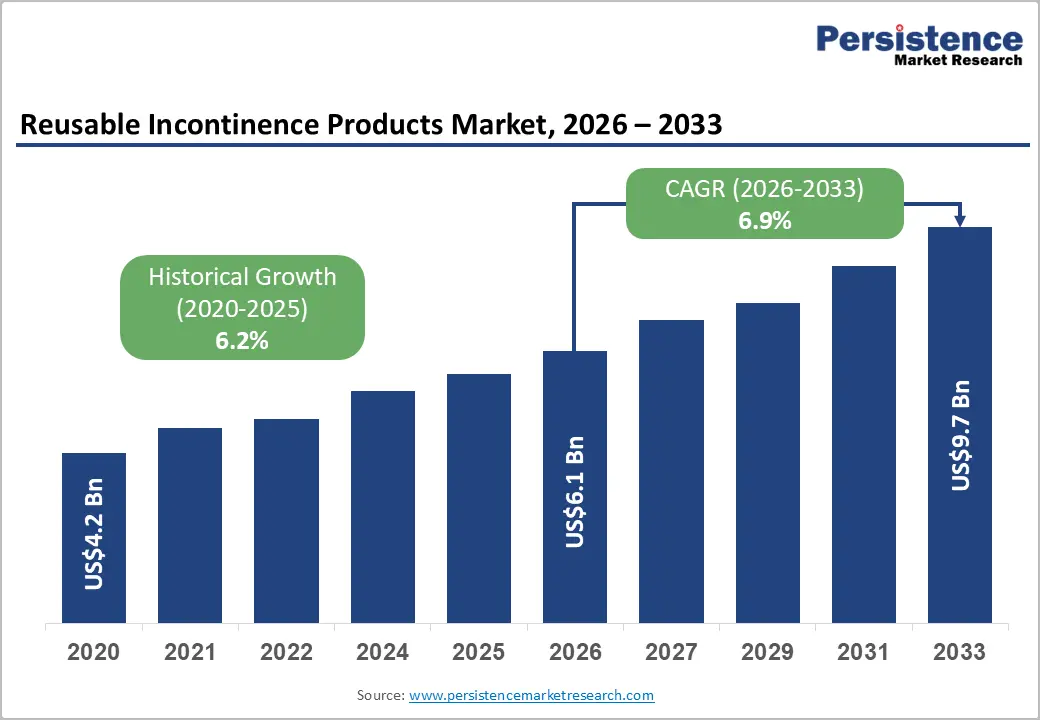
The global reusable incontinence products market size is likely to be valued at US$6.1 billion in 2026 and is estimated to reach US$9.7 billion by 2033, growing at a CAGR of 6.9% during the forecast period from 2026 to 2033, driven by rising elderly population levels, increasing preference for sustainable hygiene solutions, and broader healthcare accessibility.
Demand growth reflects a stronger consumer focus on cost-efficient continence management products with extended usability cycles. Regulatory emphasis on waste reduction and textile sustainability is encouraging healthcare facilities and consumers to shift toward washable alternatives.
Key Industry Highlights:
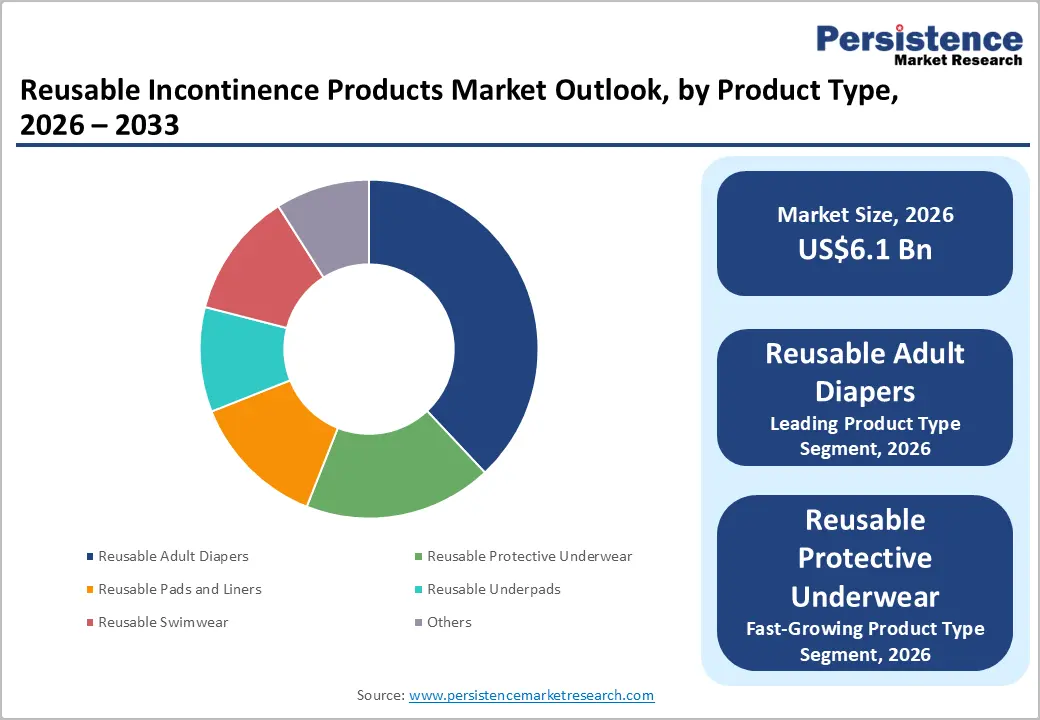
- Leading Product Type: Reusable adult diapers are set to hold around 38% revenue share in 2026, driven by high clinical demand for maximum absorption capacities in managed care environments.
- Fastest-growing Product Type: Reusable protective underwear is projected as the fastest-growing segment, supported by rising demand among active, ambulatory individuals who require discreet management solutions.
- Leading End-user: Geriatrics is estimated to hold roughly 51% revenue share in 2026, due to the linear relationship between advancing age and the physiological degradation of urinary sphincter control mechanisms.
- Fastest-Growing End-user: Adults are forecast to record the fastest growth, driven by expanding awareness, reducing social stigma, and an increasing incidence of early-onset bladder instability.
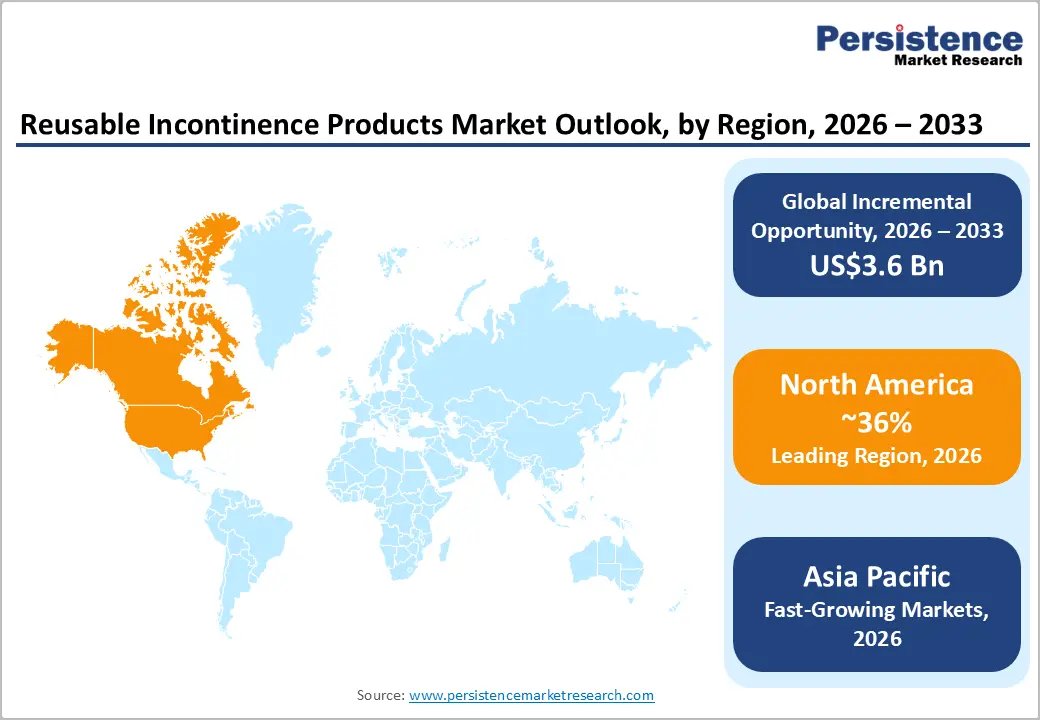
- Regional Leadership: North America is projected to capture roughly 36% of the market share in 2026, while Europe is forecast to record the fastest growth due to comprehensive extended producer responsibility frameworks.
- Competitive Environment: The market reflects a moderately fragmented structure, with key players such as Essity AB and Medline Industries leveraging scale, supply chain integration, and processing efficiency to maintain competitive positioning.
DRO Analysis
Driver - Environmental Regulations and Sustainable Healthcare Practices
Waste reduction policies and sustainability targets are influencing procurement strategies across hospitals, assisted living centers, and community healthcare systems. Reusable products reduce landfill waste generated by disposable hygiene products, supporting environmental compliance objectives. Consumer preference for sustainable household products is also creating stronger retail demand for washable pads, protective underwear, and underpads manufactured using recyclable textile materials.
The United States Environmental Protection Agency reported in 2025 that disposable absorbent hygiene products contribute several million tons of municipal waste annually. Healthcare institutions are integrating reusable textile solutions into sustainability programs to lower waste management costs and reduce environmental impact. Product manufacturers are responding through the development of organic cotton fabrics, antimicrobial textile coatings, and low-water washing compatibility technologies.
Restraint - High Laundering and Maintenance Requirements
Reusable incontinence products require frequent washing, drying, and storage management, limiting convenience for users with mobility restrictions or limited caregiver support. Institutional adoption may slow when healthcare facilities face higher utility consumption and textile processing costs. Extended laundering cycles also increase operational complexity within high-volume long-term care environments.
Manufacturing costs linked to multilayer absorbent fabrics and antimicrobial materials create pricing pressure across mid-range product categories. Smaller manufacturers face limited scalability because textile sourcing and quality certification requirements raise production expenses. Margin pressure intensifies when low-cost disposable alternatives remain widely available through healthcare reimbursement programs.
Opportunity - Innovation in Sustainable Absorbent Textile Technologies
Advanced textile engineering is enabling the development of reusable products with improved absorbency, skin protection, and antimicrobial performance. Manufacturers investing in bamboo fiber blends, leak-proof barriers, and hypoallergenic fabrics are positioned to capture demand from environmentally conscious consumers. Innovation pathways linked to biodegradable textile components can further align reusable product categories with circular healthcare objectives.
Government support for sustainable manufacturing and textile recycling infrastructure is encouraging investment in eco-friendly hygiene products. Product differentiation through ergonomic design and washable multilayer systems can improve premium pricing opportunities. Expansion into pediatric continence management and rehabilitation centers also creates untapped growth potential for reusable absorbent textile solutions.
Category-wise Analysis
Product Type Insights
Reusable adult diapers are anticipated to secure around 38% of the reusable incontinence products market share in 2026, reflecting the high clinical demand for maximum absorption capacities in managed care environments. The utilization of adjustable tab styles in chronic care facilities optimizes shifting procedures for non-ambulatory patients suffering from severe bladder voiding episodes. This structural design provides secure fluid containment, reducing the frequency of bedding changes and lowering facility laundry volumes.
Reusable protective underwear is expected to be the fastest-growing segment, propelled by rising demand among active, ambulatory individuals who require discreet management solutions that mirror standard undergarments. The integration of sleek, low-profile absorbent cores within pull-on styles allows users to maintain professional and social engagements without visible profiling through clothing. This design evolution enhances user confidence, accelerating adoption among younger demographics managing stress urinary incontinence.
Material Type Insights
Cotton products are poised to dominate with a forecast market share of over 42% of the reusable incontinence products market in 2026, powered by the historical consumer trust in natural fibers and the inherent hypoallergenic characteristics of the textile. The deployment of multi-layered woven cotton structures within standard protective inserts minimizes skin irritation and allergic reactions across sensitive patient demographics. The material demonstrates exceptional resilience during high-temperature institutional laundering processes, ensuring structural longevity.
Bamboo fiber is estimated to be the fastest-growing segment, fueled by rising market alignment with highly sustainable, eco-friendly raw materials that offer intrinsic performance benefits. The utilization of processed bamboo cellulose in absorbent core layers yields superior fluid absorption rates compared to standard organic textiles. The naturally occurring antimicrobial agents within bamboo structures suppress bacterial proliferation, significantly reducing odor development during prolonged wear times.
End-user Insights
Geriatrics is likely to be the leading segment with a projected 51% of the reusable incontinence products market share in 2026, due to the linear relationship between advancing age and the physiological degradation of urinary sphincter control mechanisms. The integration of high-capacity reusable briefs within senior living communities reduces institutional waste management expenses while preserving the dermal health of long-term residents. This demographic exhibits the highest concentration of chronic, severe incontinence cases globally.
Adults are anticipated to be the fastest-growing segment, fueled by expanding awareness, reducing social stigma, and an increasing incidence of early-onset bladder instability resulting from obesity and postpartum pelvic floor weaknesses. The adoption of stylish, washable protective underwear by working professionals allows for uninterrupted workplace participation and active lifestyle maintenance. This segment benefits from targeted digital marketing strategies that emphasize body-positive, sustainable lifestyle choices.
Regional Insights
North America Reusable Incontinence Products Market Trends
North America is expected to lead with an estimated 36% of the reusable incontinence products market share in 2026, supported by highly integrated healthcare networks, extensive long-term care infrastructure, and stringent corporate waste reduction mandates. The rapid expansion of specialized senior living facilities necessitates bulk procurement contracts for durable, launderable personal care items to control escalating operating costs.
U.S. Reusable Incontinence Products Market Insights
The U.S. market is projected to experience stable expansion driven by the implementation of state-level restrictions on non-hazardous institutional waste volumes. The presence of leading domestic textile innovators accelerates the commercialization of high-performance antimicrobial garments across regional distribution channels.
Canada Reusable Incontinence Products Market Insights
The Canada market is forecast to display consistent growth due to federal sustainability initiatives targeting the elimination of single-use plastic components in public procurement systems. Expanding geriatric populations across provinces such as Ontario and Quebec drive institutional demand within provincially funded healthcare facilities.
Europe Reusable Incontinence Products Market Trends
Europe is forecast to be the fastest-growing market for reusable incontinence products, stimulated by comprehensive extended producer responsibility frameworks, high landfill taxation rates, and proactive consumer alignment with circular economy principles. Regional regulatory mandates penalize the utilization of non-recyclable plastic hygiene options, forcing institutional procurement managers to adopt reusable fabric configurations.
Germany Reusable Incontinence Products Market Insights
The German market is expected to dominate regional revenues due to advanced healthcare infrastructure and the integration of reusable personal care products within statutory health insurance reimbursement schemes. Strict industrial waste management codes incentivize long-term care hospitals to establish automated, in-house textile processing facilities.
U.K. Reusable Incontinence Products Market Insights
The U.K. market is likely to expand rapidly as the National Health Service implements carbon-reduction procurement protocols designed to eliminate disposable waste streams. Rising consumer preference for organic bamboo and cotton alternatives drives retail sales expansion across e-commerce ecosystems.
Asia Pacific Reusable Incontinence Products Market Trends
Asia Pacific market is expected to witness a structural transformation driven by the unprecedented scale of population aging within primary East Asian nations and expanding healthcare infrastructure. Rising middle-class disposable incomes alter consumer spending capabilities, shifting preferences toward premium personal care options that offer long-term financial savings.
China Reusable Incontinence Products Market Insights
China is projected to experience rapid volume acceleration driven by extensive domestic supply chain integration and scaling manufacturing efficiencies in the technical textile sectors. Expanding urban senior care facility networks adopt standardized washable underpads to lower ongoing operational management expenditures.
Japan Reusable Incontinence Products Market Insights
Japan is expected to lead the region in per-capita consumption value due to extreme demographic aging metrics and a deep cultural focus on advanced personal hygiene solutions. Japanese textile science corporations pioneer ultra-thin nanofiber absorption layers that provide high liquid retention while maintaining conventional underwear thickness profiles.
Competitive Landscape
The global reusable incontinence products market is moderately fragmented, with regional manufacturing entities and specialized textile brands maintaining localized market shares. Competitors differentiate through material compositions, proprietary absorption technologies, and direct-to-consumer digital marketing architectures. Strategic distribution partnerships with major institutional healthcare groups preserve base revenue volumes for leading market participants.
The competitive ecosystem includes prominent industry participants such as ConvaTec Group, Essity AB, Kimberly-Clark Corporation, Medline Industries, and Cardinal Health. These enterprises leverage extensive supply chain networks, automated production technologies, and established institutional relationships to sustain market positioning. Smaller, agile brands focus heavily on organic material certifications to capture eco-conscious consumer segments.
Key Industry Developments:
- In March 2026, Essity AB launched TENA washable protective boxers for men featuring reusable leak-protection technology, reinforcing innovation and sustainability-focused product development.
- In February 2026, Ontex Group launched the Sensitive incontinence care range featuring skin-friendly absorbent technology, reinforcing innovation in reusable and dermatologically focused continence care solutions.
Companies Covered in Reusable Incontinence Products Market
- ConvaTec Group
- Essity AB
- Kimberly-Clark Corporation
- Medline Industries
- Cardinal Health
- Hartmann Group
- Mölnlycke Health Care
- Asaleo Care
- Ontex Group
- Attends Healthcare Products
- Principle Business Enterprises
- Domtar Corporation
- First Quality Enterprises
Frequently Asked Questions
The global reusable incontinence products market is projected to reach US$6.1 billion in 2026.
Rising elderly population levels, increasing prevalence of urinary incontinence, and growing preference for sustainable and cost-efficient hygiene solutions drive the reusable incontinence products market.
The reusable incontinence products market is poised to witness a CAGR of 6.9% from 2026 to 2033.
Expansion of home healthcare services, innovation in sustainable absorbent textile technologies, and rising adoption of eco-friendly continence care products create key market opportunities.
Some of the key market players include ConvaTec Group, Essity AB, Kimberly-Clark Corporation, Medline Industries, and Cardinal Health.


