




- Specialty & Fine Chemicals
- Precipitated Barium Sulfate Market
Precipitated Barium Sulfate Market Size, Share, and Growth Forecast, 2026 - 2033
Precipitated Barium Sulfate Market by Purity (High Purity [>99%], Others), Form (Powder, Suspension, Masterbatch), Application (Paints and Coatings, Others), End-user (Automotive, Construction, Others), and Regional Analysis for 2026 - 2033

Precipitated Barium Sulfate Market Size and Trends Analysis
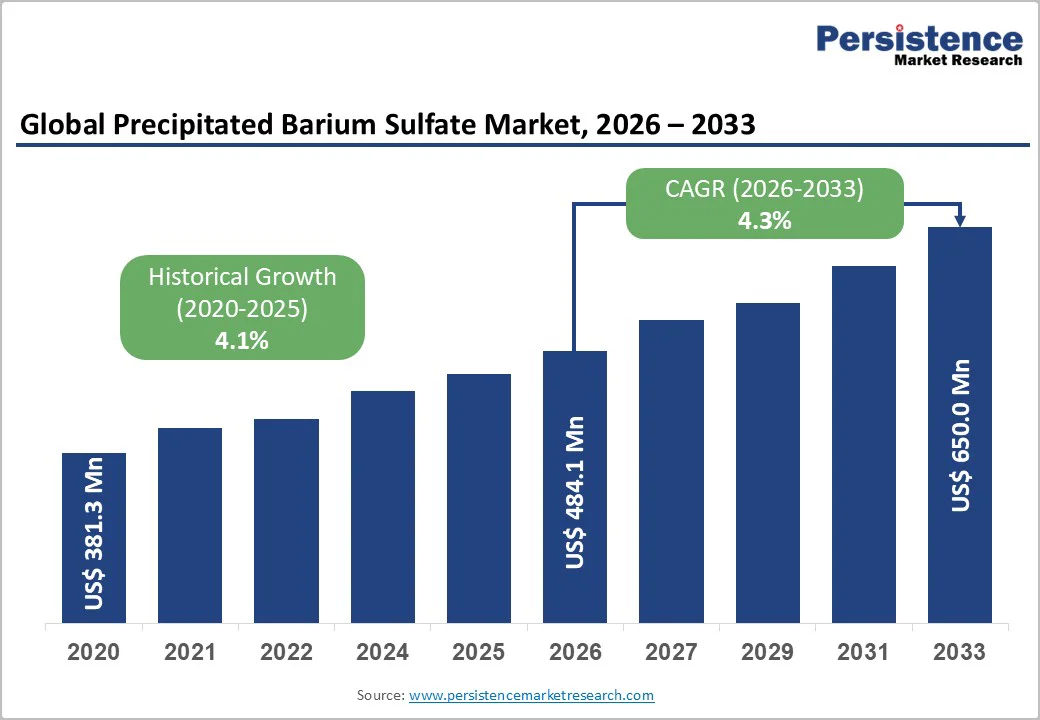
The global precipitated barium sulfate market size is likely to be valued at US$484.1 million in 2026, and is expected to reach US$650.0 million by 2033, growing at a CAGR of 4.3% during the forecast period from 2026 to 2033, driven by the increasing prevalence of high-performance fillers in paints & coatings, rising demand for X-ray contrast agents in healthcare, and advancements in nano-grade production.
Demand for lightweight, opaque materials, especially in automotive, is driving strong growth for precipitated barium sulfate. Advances in high-purity, sub-micron grades are further boosting adoption by improving dispersion and durability. Rising use in sustainable packaging, particularly across the Asia Pacific, is also a major contributor to current market growth.
Key Industry Highlights:
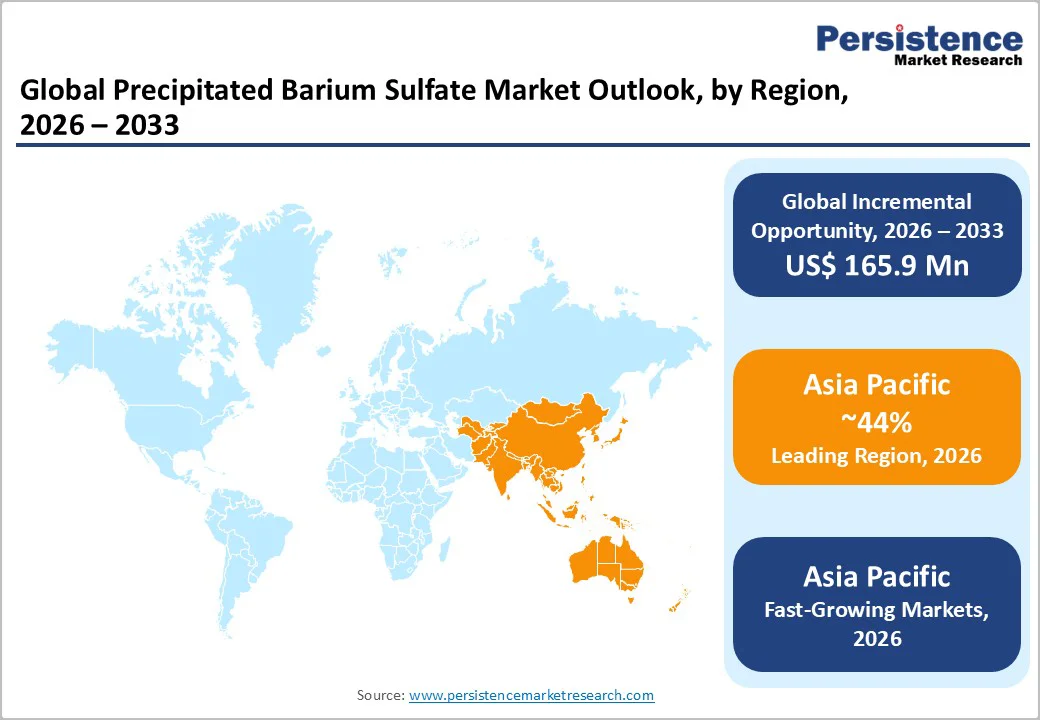
- Leading Region: Asia Pacific, to command a 44% market share in 2026, driven by massive manufacturing hubs, high prevalence of coatings demand, and strong R&D activities in China.
- Dominant Purity: High Purity [>99%], to hold approximately 45% of the market share, due to pharmaceutical needs.
- Leading Form: Powder, to account for over 60% of the market revenue, driven by ease of handling.
- Leading Application: Paints and coatings, to contribute nearly 40% of the market revenue, due to opacity requirements.
- Leading End-user: Automotive, with approximately 25% share, driven by lightweighting.
- Key Market Driver: Surging demand for high-opacity fillers in coatings and contrast agents in medical imaging is accelerating precipitated barium sulfate adoption.
- Market Opportunity: Growth in 3D printing and energy storage batteries creates strong opportunities for sub-micron and nano-grade variants.
| Key Insights | Details |
|---|---|
|
Precipitated Barium Sulfate Market Size (2026E) |
US$484.1 Mn |
|
Market Value Forecast (2033F) |
US$650.0 Mn |
|
Projected Growth (CAGR 2026 to 2033) |
4.3% |
|
Historical Market Growth (CAGR 2020 to 2025) |
4.1% |
Market Factors - Growth, Barriers, and Opportunity Analysis
Rising Use of High-Performance Fillers in Coatings and Growing Demand for X-ray Contrast Agents
The rising prevalence of high-performance fillers in paints & coatings globally is a primary driver of the precipitated barium sulfate market. In the coatings industry, manufacturers increasingly rely on high-purity and nano-grade BaSO4 as functional fillers to enhance the opacity, whiteness, and durability of paints and coatings. These fillers improve hiding power, abrasion resistance, UV stability, and gloss, meeting the evolving aesthetic and performance requirements of industrial, automotive, and architectural applications.
The trend toward lightweight, energy-efficient materials in automotive and aerospace sectors further increases demand for specialized fillers that can reinforce polymer matrices without compromising performance. The healthcare sector is fueling demand for pharmaceutical-grade BaSO4 as a radiopaque agent in X-ray, CT scans, and other diagnostic imaging procedures. Its chemical inertness, high density, and safety make it ideal for producing reliable contrast media. Increasing medical imaging procedures, the prevalence of chronic diseases, and broader access to diagnostic services globally are driving consistent adoption.
High Development and Raw Material Costs
The high costs associated with development and raw material sourcing of precipitated barium sulfate pose a significant restraint on market growth. Production of ultra-fine or sub-micron BaSO4 requires advanced precipitation technologies, precise particle size control, and surface treatment processes to ensure uniformity, dispersion, and functional performance. These processes are capital-intensive, demanding sophisticated equipment, stringent quality control, and skilled labor, which significantly increase operational expenditures.
Raw materials, such as barium carbonate or naturally derived barite, are subject to price volatility due to limited supply, regional mining constraints, and fluctuations in global chemical markets. High-purity grades demand additional purification steps, further adding to cost. Energy consumption during production, coupled with chemical usage and wastewater management, contributes to elevated operational expenses. Smaller or new market entrants face barriers due to these high development costs, limiting their ability to compete with established players who benefit from economies of scale. Regulatory compliance for environmental safety and occupational health increases overheads.
Innovations in Nano-grade and Sustainable Precipitated Barium Sulfate
Innovations in nano-grade and sustainable precipitated barium sulfate are creating transformative opportunities across coatings, plastics, electronics, and energy storage industries. Nano-grade BaSO4 is gaining strong momentum due to its ultrafine particle size, superior dispersion, and enhanced surface area, which significantly improve opacity, mechanical strength, and conductivity properties in advanced formulations. These attributes make it ideal for next-generation automotive coatings, high-performance polymers, composite materials, and Li-ion battery components. The development of agglomeration-free nano technologies further boosts consistency, allowing manufacturers to achieve uniformity in critical applications such as 3D printing materials and electronic insulators.
Sustainability-driven innovation is another major growth catalyst. Producers are adopting low-carbon manufacturing processes, optimizing energy consumption, and exploring renewable raw material integration to meet tightening environmental regulations, particularly in Europe. Water-based production, waste minimization systems, and circular material recovery enable greener BaSO4 grades for eco-conscious industries. Bio-based and recyclable formulations are emerging as long-term opportunities as customers push for sustainable fillers in paints, packaging, and consumer goods.
Category-wise Analysis
Purity Insights
High purity [>99%] is projected to dominate the market, accounting for approximately 45% of the share in 2026. Its growth is driven by extensive use in medical imaging, where low impurity levels and exceptional consistency are critical for patient safety and diagnostic clarity. High-purity grades, such as those produced by companies such as Fuhua Chem, deliver superior opacity and chemical stability, making them essential for pharmaceutical contrast media and high-grade formulations. For example, high-purity barium sulfate is commonly used in oral and rectal contrast suspensions for CT scans, enabling clearer visualization of gastrointestinal abnormalities.
Sub-micron and nano-grade precipitated barium sulfate is the fastest-growing segment, driven by rising demand in electronics, advanced polymers, and battery technologies. These ultra-fine grades offer superior dispersion, high surface area, and excellent compatibility with conductive and composite systems, making them crucial for next-generation lightweight and high-strength materials. Innovations in agglomeration-free production and controlled particle engineering are accelerating adoption, especially across North America and Europe’s advanced manufacturing industries. For example, nano-grade barium sulfate is increasingly used in high-performance lithium-ion battery separators to enhance thermal stability and prevent short circuits, supporting safer and more efficient energy storage systems.
Form Insights
Powder is likely to lead the market, holding approximately 60% of the share in 2026, driven by its easy handling, long shelf life, and efficient blending into coatings, plastics, and rubber formulations. Its fine particle size, high purity, and stable performance make it the preferred choice for manufacturers seeking consistent quality and improved material properties. Strong demand from paints, automotive components, and industrial applications further strengthens its dominance. For example, powder-form barium sulfate is widely used in powder coatings for appliances and metal furniture to enhance gloss, scratch resistance, and color uniformity, ensuring durable and aesthetically appealing finishes.
Suspension is the fastest-growing segment, driven by rising demand for ready-mix and easy-to-use formulations in paints and coatings. Its excellent stability, controlled viscosity, and uniform dispersion reduce processing time while improving coating smoothness and consistency. Suspension-grade precipitated barium sulfate also enhances film uniformity and prevents sedimentation, making it ideal for high-performance and large-scale applications. As manufacturers prioritize efficiency and consistent quality, its adoption continues to accelerate across industrial and specialty coatings. For example, water-based architectural paints increasingly use barium sulfate suspensions to achieve uniform coverage and improved opacity, reducing the need for multiple coating layers.
Application Insights
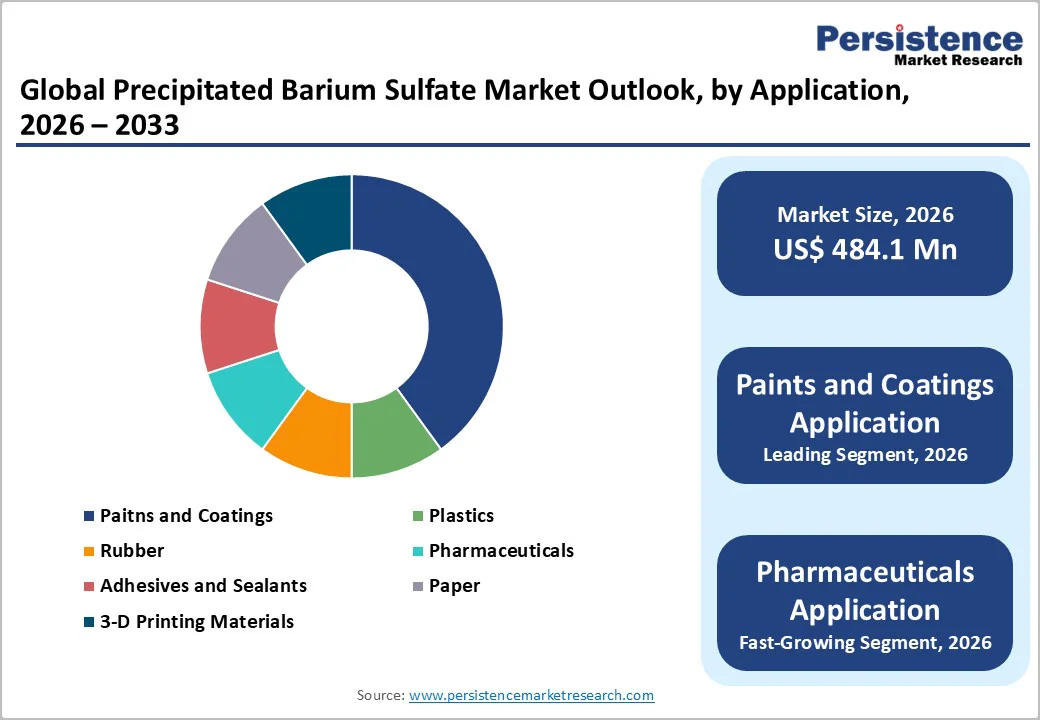
Paints and coatings are anticipated to dominate the market, contributing nearly 40% of revenue in 2026, driven by their extensive use in industrial, automotive, and architectural applications. Precipitated barium sulfate enhances opacity, gloss, and durability, making it a preferred filler for high-performance finishes. Its strong hiding power, chemical resistance, and low oil absorption support premium aesthetics and long-lasting protection across various coating types. For example, automotive OEM coatings increasingly incorporate barium sulfate to achieve superior scratch resistance and smoother topcoat finishes, ensuring better color consistency and longevity in modern vehicle exteriors.
Pharmaceuticals are the fastest-growing segment, driven by rising demand for advanced diagnostic imaging and expanding access to healthcare services. High-purity precipitated barium sulfate is preferred for its safety, chemical stability, and superior opacity, making it essential for X-ray and CT contrast media. Rising diagnostic volumes, early disease screening, and increased chronic disorder monitoring further strengthen its adoption. Growing investments in imaging equipment across hospitals and diagnostic centers also support market expansion. For example, barium sulfate suspensions are widely used in gastrointestinal imaging to clearly visualize the esophagus and intestines, enabling faster and more accurate detection of ulcers, tumors, and blockages.
End-user Insights
The automotive segment is anticipated to dominate the market, with approximately 25% share in 2026, driven by demand for lightweight components, high-performance coatings, and durable polymer parts. Precipitated barium sulfate is widely used as a filler in plastics, paints, and underbody materials, supporting improved strength, UV resistance, and cost efficiency. Growing EV production further boosts its adoption across automotive applications. For example, major automakers increasingly use barium sulfate–enhanced polypropylene composites in bumper fascias and interior panels to achieve higher rigidity and scratch resistance while keeping the overall vehicle weight low, which directly improves fuel efficiency and EV driving range.
Electronics and energy storage are the fastest-growing segments, fueled by the rising demand for advanced Li-ion batteries and electronic components. Precipitated barium sulfate enhances insulation, thermal stability, and material durability. Its use in conductive and composite formulations supports safer, high-performance battery systems, making it essential for EVs, consumer electronics, and next-generation energy storage technologies. For example, in electric vehicles, barium sulfate–reinforced polymer composites are increasingly used in battery housings to improve heat resistance and prevent thermal runaway, directly contributing to safer and more efficient EV battery packs.
Regional Insights
North America Precipitated Barium Sulfate Market Trends
Growth in North America is supported by robust demand from the automotive, construction, plastics, oil & gas, and pharmaceutical sectors. The region prioritizes high-purity, high-performance materials, making precipitated BaSO4 a preferred choice in advanced coatings, engineered plastics, and contrast media applications. The United States dominates the regional market, driven by strong manufacturing capabilities, extensive R&D investments, and a mature industrial ecosystem.
The rising adoption of ultrafine and nano-grade precipitated barium sulfate, particularly in automotive OEM coatings, high-durability industrial paints, and specialty polymer formulations. These materials are essential for achieving improved gloss, abrasion resistance, thermal stability, and UV protection. Growth in the medical imaging sector, especially CT and X-ray contrast media, continues to boost consumption of pharmaceutical-grade BaSO4. Sustainability is gaining traction, with companies exploring eco-efficient production processes, reduced energy consumption, and improved material recovery systems. Major players in North America are also forming strategic partnerships and expanding local supply chains to reduce import dependency and ensure product availability.
Europe Precipitated Barium Sulfate Market Trends
Europe is driven by the region’s strong focus on high-performance materials, sustainability, and regulatory compliance. Demand is primarily supported by advanced industries such as automotive coatings, industrial paints, plastics, adhesives, and pharmaceuticals, where precipitated BaSO4 is valued for its high purity, controlled particle size, and excellent chemical inertness. Countries such as Germany, France, and the U.K. lead consumption due to their well-established automotive and industrial manufacturing bases.
Europe is witnessing the rising adoption of ultrafine and nano-grade precipitated barium sulfate, especially in powder coatings, engineering plastics, and composite materials used in lightweight automotive and aerospace applications. Strict EU environmental standards such as REACH are pushing manufacturers toward cleaner production processes, optimized energy usage, and low-emission technologies. Companies are increasingly investing in sustainable manufacturing and recycling initiatives. The growing emphasis on innovation-driven partnerships and R&D investments, particularly among major players such as Solvay and Huntsman. These efforts aim to enhance product performance, reduce environmental footprint, and support the development of next-generation coatings and materials.
Asia Pacific Precipitated Barium Sulfate Market Trends
Asia Pacific is the dominating and fastest-growing market for precipitated barium sulfate, projected to hold 44% of the share in 2026, driven by rapid industrial expansion, rising manufacturing output, and increasing adoption of high-performance functional additives. China remains the core demand center due to its dominant coatings, plastics, automotive, and construction industries, which rely heavily on precipitated BaSO4 for superior whiteness, chemical resistance, and durability. India and Southeast Asian economies are also contributing to demand growth as infrastructure development accelerates and local manufacturing scales up.
The rapid shift toward nano-grade and high-purity precipitated barium sulfate, driven by its growing use in advanced coatings, powder coatings, high-end plastics, and electronics components. APAC manufacturers are increasingly investing in modern production technologies to improve consistency, particle size control, and environmental compliance. Sustainability is another emerging trend, with producers focusing on energy-efficient processes, lower-emission manufacturing, and cleaner waste-handling mechanisms to meet tightening environmental regulations in China and Japan. Strategic collaborations between global players and regional manufacturers are also rising, enabling technology transfer and cost optimization.
Competitive Landscape
The global precipitated barium sulfate market is highly competitive, shaped by a combination of multinational chemical corporations and specialized regional manufacturers. In North America and Europe, established players such as Solvay and Huntsman Corporation maintain a strong foothold through advanced R&D capabilities, long-term customer relationships, and diversified product portfolios tailored for high-performance applications in coatings, plastics, and pharmaceuticals. Their technological expertise and global distribution networks enable them to consistently supply high-purity and surface-modified grades that meet stringent industry standards.
The Asia Pacific region is witnessing rapid expansion, driven by manufacturers such as Fuhua Chem, who leverage cost-effective production, localized supply chains, and customized solutions for fast-growing industries such as automotive, construction, and packaging. These regional players increasingly invest in precision processing technologies to improve particle uniformity and purity. Companies are focusing on nano-grade and sub-micron innovations, which deliver superior dispersion, opacity, and mechanical performance, offering a competitive edge in premium applications.
Key Industry Developments
- In March 2025, major suppliers, including Hubei Qinba New Materials and Shaanxi Fuhua Chemical, announced price increases for precipitated barium sulfate, citing significant rises in raw material and production costs.
Companies Covered in Precipitated Barium Sulfate Market
- Solvay
- Huntsman Corporation
- Cimbar Performance Minerals
- Barium & Chemicals, Inc.
- Fuhua Chem
- Nippon Chemical Industry
- Sakai Chemical
- Sachtleben Chemie GmbH
- Alfa Aesar
- Guizhou Redstar Development Co., Ltd.
- Chemate Technology Co., Ltd.
- Xinji Chemical
Frequently Asked Questions
The global precipitated barium sulfate market is projected to reach US$484.1 million in 2026.
The rising prevalence of high-performance fillers in paints & coatings and demand for X-ray contrast agents in healthcare are key drivers.
The precipitated barium sulfate market is poised to witness a CAGR of 4.3% from 2026 to 2033.
Advancements in nano-grade and sustainable precipitated barium sulfate are the key opportunities.
Solvay, Huntsman Corporation, Cimbar Performance Minerals, Barium & Chemicals, Inc., and Fuhua Chem are the key players.


