




- Food Ingredients & Additives
- Nisin Market
Nisin Market Size, Share, and Growth Forecast 2026 - 2033
Nisin Market by Form (Powder, Liquid), End-user (Food & Beverages, Pharmaceuticals, Animal Feed, Cosmetics), and Regional Analysis, 2026 - 2033

Nisin Market Share and Trends Analysis
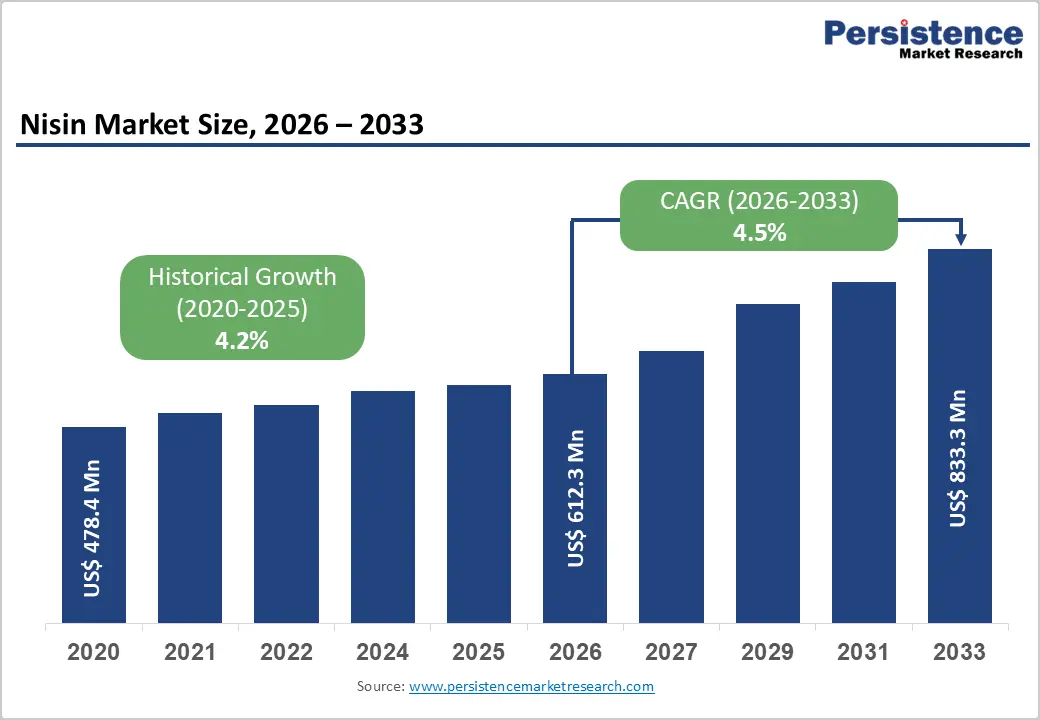
The global nisin market size is expected to be valued at US$ 612.3 million in 2026 and projected to reach US$ 833.3 million by 2033, growing at a CAGR of 4.5% between 2026 and 2033. Robust demand for natural food preservatives, regulatory support from bodies such as the U.S. Food and Drug Administration (FDA) and European Food Safety Authority (EFSA), and rising consumption of packaged foods underpin this steady expansion.
Nisin’s status as a natural bacteriocin with broad-spectrum activity against Gram-positive spoilage and pathogenic bacteria makes it an attractive alternative to synthetic preservatives, aligning with clean-label and sustainability trends in global food and beverage markets.
Key Market Highlights
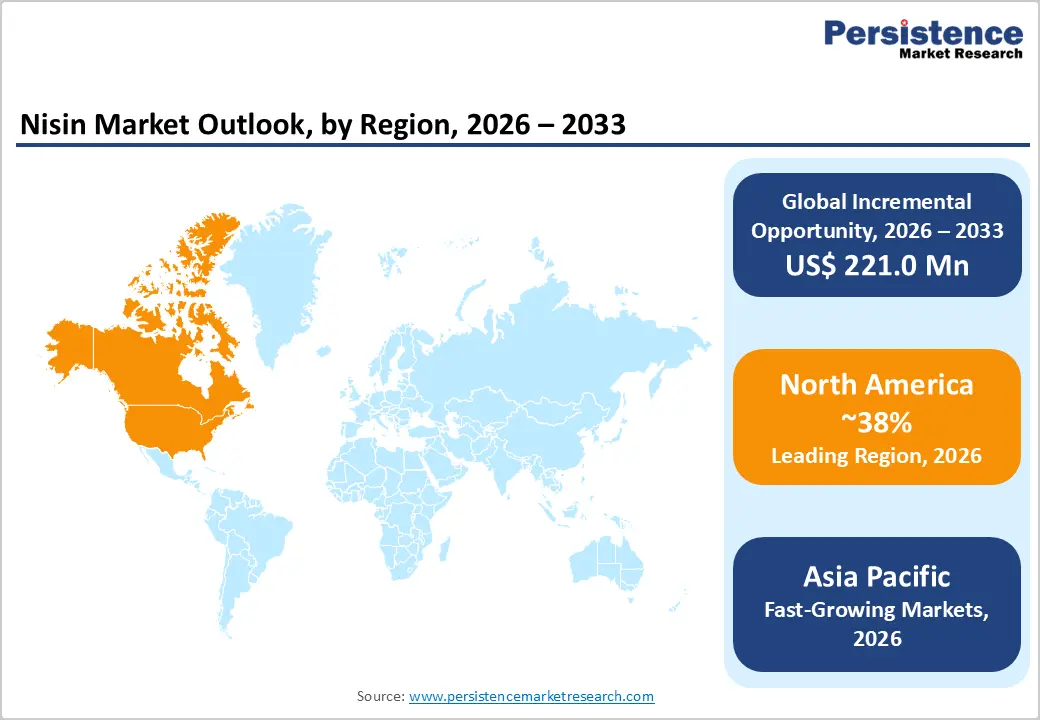
- North America is projected to remain the leading regional market for nisin, driven by U.S. regulatory leadership, strong demand for processed cheese and meat, and an advanced innovation ecosystem focused on natural antimicrobials and clean-label formulation.
- Asia Pacific is expected to be the fastest-growing nisin market, supported by the rapid expansion of processed foods in China, India, Japan, and ASEAN, as well as strong regional manufacturing capacity and investments in biological preservative research and development.
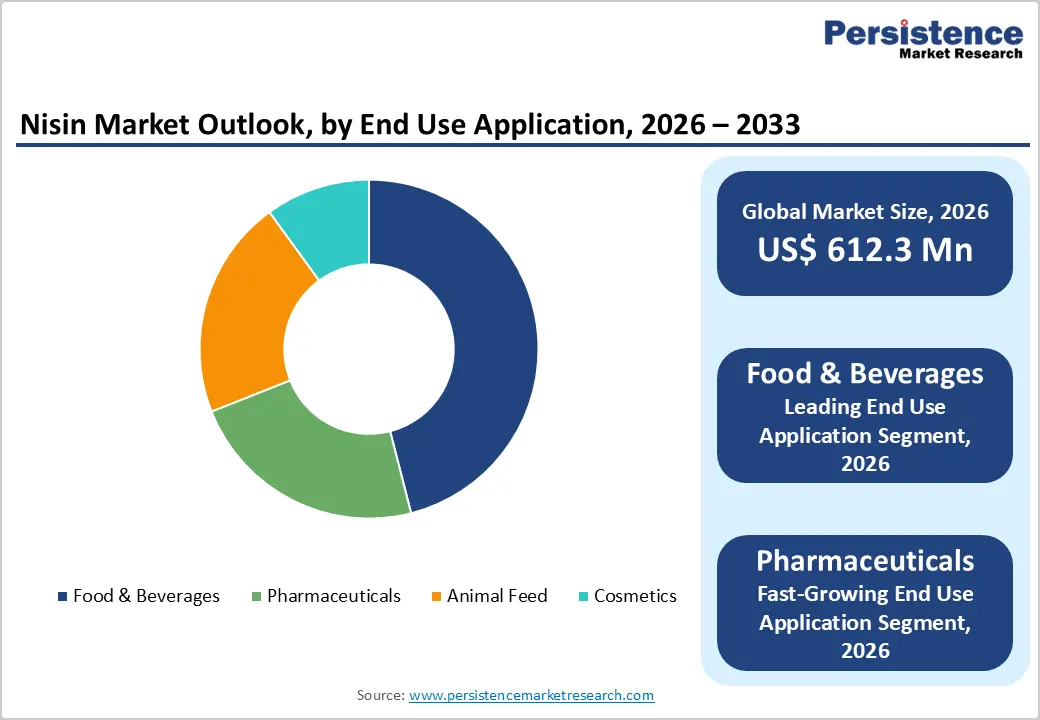
- In terms of applications, the Food & Beverages segment dominates with an estimated 46% market share in 2025, reflecting nisin’s widespread use in dairy, processed meats, canned foods, and beverages as a proven, label-friendly preservative.
- The Pharmaceuticals end-use segment is anticipated to register the fastest growth through 2033, as research on nisin’s anticancer properties, microbiome-modulation potential, and suitability for advanced delivery systems moves from laboratory studies to commercial development.
- A key market opportunity lies in integrated solutions that combine nisin with active packaging, hurdle technologies, and animal nutrition products, enabling improvements in food safety, reductions in antibiotic use in livestock, and expansion into high-margin health and wellness applications.
| Key Insights | Details |
|---|---|
| Nisin Market Size (2026E) | US$ 612.3 million |
| Market Value Forecast (2033F) | US$ 833.3 million |
| Projected Growth CAGR (2026 - 2033) | 4.5% |
| Historical Market Growth (2020 - 2025) | 4.2% |
Market Dynamics
Drivers - Strong shift toward natural and clean-label food preservation
A key growth driver for the nisin market is the accelerating shift from synthetic preservatives to natural, clean-label alternatives across processed meat, dairy, ready-to-eat meals, and beverages. Nisin, produced by Lactococcus lactis, is a bacteriocin that has been used safely for more than 60 years and is approved as E234 in the European Union, with a new acceptable daily intake of 1 mg/kg body weight per day confirmed by EFSA.
In the United States, nisin preparation is affirmed as GRAS under 21 CFR 184.1538 for use in processed cheese spreads, and additional GRAS notices allow its use as an antimicrobial agent in meat and poultry products. These regulatory endorsements across more than 50 countries, combined with consumer preference for labels free from synthetic preservatives, are driving greater adoption of nisin in mainstream food manufacturing.
Demonstrated efficacy in extending the shelf life of high-risk foods
Another important factor is the extensive scientific evidence showing nisin’s ability to inhibit key spoilage and pathogenic bacteria in high-risk foods such as cheese, dairy desserts, processed meat, and ready-to-eat products. Studies on fresh and processed cheeses demonstrate that nisin at concentrations of 0.1-0.25 mg/mL (1-25 ppm) can significantly reduce or eliminate Listeria monocytogenes and other Gram-positive bacteria during refrigerated storage, effectively extending shelf life while maintaining product quality.
Similar results have been reported in pork meat, where spraying nisin solutions improved microbial stability over about 1 week at low temperature compared with dipping treatments, underscoring its value in meat processing. As manufacturers seek to reduce food waste and enhance safety without resorting to aggressive heat treatment, these performance advantages reinforce nisin’s commercial attractiveness.
Restraints - Limited activity against Gram-negative bacteria and formulation challenges
Despite its strengths, nisin exhibits limited direct efficacy against Gram-negative bacteria due to their protective outer membranes, often requiring combination with other hurdles, such as chelating agents, mild heat, or high-pressure processing, for optimal performance. In complex food matrices such as high-fat meats, its activity may be reduced due to interactions with lipids and proteins, requiring careful formulation and sometimes higher dosages. These technical constraints can restrict standalone use in certain foods and increase development costs for manufacturers aiming to replace synthetic preservatives entirely.
Regulatory dosage limits and potential resistance concerns
Nisin’s use levels are regulated, with maximum permitted concentrations in specific categories (e.g., up to 12 mg/kg in unripened cheese and 25 mg/kg in heat-treated meat products in the European Union), which can limit flexibility in some applications. While safety has been reaffirmed, scientific reviews emphasize the need to monitor potential bacterial resistance to bacteriocins, including nisin, especially if used more widely in therapeutic or microbiome-targeted applications. This necessitates ongoing investment in surveillance, stewardship strategies, and development of engineered nisin variants, which may slow adoption in highly regulated sectors such as pharmaceuticals.
Opportunities - Expansion into pharmaceutical, microbiome, and anticancer applications
A major opportunity lies in the rapid expansion of nisin applications beyond food preservation into pharmaceuticals, microbiome modulation, and oncology. Recent in vitro and in vivo studies show that purified nisin can exhibit selective toxicity toward cancer cells, inducing caspase-dependent apoptosis while sparing normal cells, highlighting its potential as an adjunct anticancer agent.
Research in pigs has also shown that orally ingested nisin can survive gastrointestinal transit and modulate gut microbiota composition, opening pathways for nisin-based nutraceuticals and microbiome therapeutics. As global interest is growing for antimicrobial peptides and alternatives to conventional antibiotics, these findings position the pharmaceuticals as the fastest-growing end-use segment in the nisin market
Rising use in active packaging, meat and dairy preservation, and animal nutrition
Another strong opportunity is the integration of nisin into active packaging films, advanced delivery systems, and animal nutrition products. Nisin-loaded films and coatings for cheese, meat, and deli products have been shown to reduce surface contamination and extend chilled shelf life, supporting sustainability goals by lowering food waste.
In dairy, its routine use at levels of about 1-25 ppm helps control spoilage bacteria and late-blowing defects while preserving sensory quality. In animal nutrition, studies reporting improved broiler growth performance and reduced gastrointestinal bacterial counts when nisin is combined with ionophore coccidiostats indicate potential to partially replace antibiotic growth promoters in poultry production systems. As regulators and producers worldwide seek to curb antibiotic use in livestock, nisin-based feed and water additives represent a promising, high-growth opportunity area.
Category-wise Analysis
Form Insights
Within the form segment, powdered nisin is estimated to account for around 72% of global market revenue in 2025, making it the leading form, while liquid nisin is expected to be the fastest-growing format between 2025 and 2032. Powdered nisin offers superior stability, ease of dosing, and compatibility with dry blending operations used in processed cheese, powdered soups, seasonings, and dry-cured meats.
Regulatory approvals by authorities such as the FDA, EFSA, and the Joint FAO/WHO Expert Committee on Food Additives (JECFA) typically describe nisin preparations in powder form, reinforcing its adoption in standardized ingredient systems.
Scientific studies in cheese and meat preservation overwhelmingly rely on powdered or reconstituted powder forms, evidencing strong performance in controlling Listeria monocytogenes and other Gram-positive bacteria during chilled storage. These functional and logistical advantages justify powdered nisin’s dominant share, while liquid formulations gain traction in ready-to-drink beverages and high-moisture applications where in-line dosing is preferred.
End-user Insights
By end-user, food & beverages is the leading segment, accounting for approximately 46% of the nisin market in 2025, while pharmaceuticals is the fastest-growing segment. Nisin is extensively used in dairy products, processed cheese, meat and poultry, canned foods, and certain beverages to inhibit pathogens such as Listeria monocytogenes, Staphylococcus aureus, and Clostridium botulinum spores, enabling milder processing and extended shelf life. EFSA and FDA reaffirm its safety as a food additive, encouraging wider adoption in mainstream foods and beverages.
At the same time, growing evidence of nisin’s anticancer activity and its ability to modulate the gut microbiome is stimulating rapid expansion in pharmaceutical, nutraceutical, and biotechnology pipelines, positioning these applications as key contributors to future market growth.
Regional Insights
North America Nisin Market Trends and Insights
North America, led by the United States, is estimated to represent about 38% share in 2025, retaining its status as the largest regional market. The region benefits from early regulatory acceptance of nisin; the FDA affirmed nisin preparation as GRAS in the late 1980s for processed cheese spreads and later recognized its safe use on cooked meat and poultry, establishing a strong legal foundation for adoption in multiple categories. Widespread consumption of processed cheese, deli meats, ready meals, and refrigerated convenience foods in the U.S. and Canada supports consistent demand.
North America also hosts a sophisticated innovation ecosystem for natural antimicrobials and ingredient systems. Companies associated with the Danisco brand have long marketed nisin-based products, such as Nisaplin®, used to control spoilage and pathogenic bacteria in dairy and meat products.
Ongoing research collaborations between universities, food companies, and biotech firms on topics such as nisin bioengineering, resistance management, and advanced delivery systems reinforce the region’s leadership in technology development and regulatory science. Together, these factors ensure that North America remains a high-value, innovation-driven market for nisin across both food and emerging pharmaceutical applications.
Asia Pacific Nisin Market Trends and Insights
Asia Pacific is the fastest-growing regional market for nisin, driven by rapid urbanization, rising incomes, and strong growth in processed foods, beverages, and functional dairy products. Countries such as China, Japan, India, and members of the Association of Southeast Asian Nations (ASEAN) are experiencing steady increases in consumption of convenience foods, chilled desserts, ready-to-eat meats, and bakery products, all of which benefit from natural preservative systems.
This manufacturing strength allows Asia Pacific suppliers to serve both domestic and export markets competitively, while ongoing investments in R&D and engineering centers focused on biological preservatives further upgrade capabilities. Growing attention to food safety incidents and a shift away from chemical preservatives in key markets like China and India are accelerating the transition toward natural solutions such as nisin.
In parallel, rising interest in functional foods, dietary supplements, and cosmetic applications that leverage nisin’s antimicrobial properties is expanding addressable demand beyond traditional food and beverage categories.
Competitive Landscape
The global nisin market exhibits a moderately competitive and evolving landscape shaped by rising demand for natural preservatives and clean-label solutions. Competition is driven by established players with strong technological capabilities, broad distribution networks and regulatory compliance, alongside a growing number of regional and niche producers focused on specialized formulations and cost-effective production methods.
Firms increasingly engage in strategic collaborations, innovation in fermentation and product differentiation to extend applications across food, beverage, pharmaceutical and emerging sectors.
Key Developments:
- In September 2025, Researchers revealed that nisin-like biosynthetic gene clusters were far more widespread and diverse across global microbiomes than previously known. They identified over 100 new nisin-like variants, including several in species not previously recognized to produce nisin, indicating extensive gene transfer and adaptation among microbes.
Companies Covered in Nisin Market
- DuPont de Nemours, Inc.
- Koninklijke DSM
- N.V., GALACTIC S.A.
- Siveele B.V.
- Shandong Freda Biotechnology Co., Ltd.
- Chihon Biotechnology Co., Ltd
- Handary S.A
- Mayasan Biotech / Mayasan Food Industries A.S
- Zhejiang Silver-Elephant Bioengineering Co., Ltd
- Amtech Biotech Co., Ltd
- Cayman Chemical Company, Inc
- Continental Resources,
- International Flavors & Fragrances Inc. (Danisco)
Frequently Asked Questions
The global nisin market is expected to reach around US$ 612.3 million in 2026, supported by rising demand for natural preservatives in dairy, meat, ready meals, and beverages, alongside favorable regulatory approvals in major markets.
The strongest demand driver is the shift toward clean-label and natural food preservation, as manufacturers replace synthetic additives with bacteriocins like nisin to meet consumer expectations for safer, minimally processed products and to support longer shelf life.
North America currently leads the global nisin market, with the United States accounting for a large share due to early FDA approvals, high consumption of processed cheese and meat, and active innovation in natural antimicrobial solutions.
A key opportunity is the expansion of nisin into pharmaceutical, microbiome, and animal nutrition applications, where emerging research supports its use in anticancer therapies, gut microbiome modulation, and as a partial alternative to antibiotic growth promoters.
Major players include DuPont de Nemours, Inc., Koninklijke DSM N.V., GALACTIC S.A., Siveele B.V., Shandong Freda Biotechnology Co., Ltd., Chihon Biotechnology Co., Ltd., Handary S.A., Amtech Biotech Co., Ltd., Cayman Chemical Company, Inc., Continental Resources, and other regional suppliers of food-grade and pharmaceutical-grade nisin.


