




- Processed Food
- Mozzarella Cheese Alternatives Market
Mozzarella Cheese Alternatives Market Size, Share, and Growth Forecast 2026 – 2033
Mozzarella Cheese Alternatives Market by Cheese Type (Cheddar and White Cheddar Cheese, Gouda), Source (Cow Milk, Buffalo Milk), Form (Slices, Cubes), End-user (Restaurants and Households), and Regional Analysis, 2026 – 2033

Mozzarella Cheese Alternatives Market Size and Trends Analysis
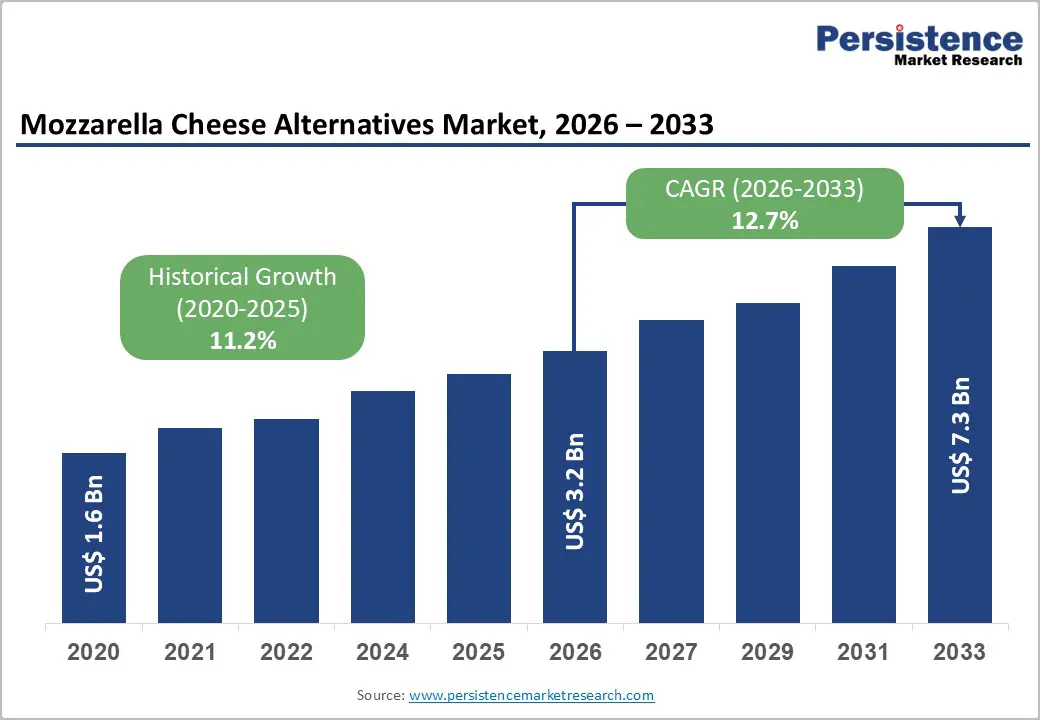
The global mozzarella cheese alternatives market size is likely to be valued at US$3.2 billion in 2026 and is expected to reach US$7.3 billion by 2033, growing at a CAGR of 12.7% during the forecast period from 2026 to 2033, driven by rising demand for dairy-free pizza and ready meals, increasing lactose intolerance and flexitarian diets, and continuous product innovation improving meltability and texture. It is further supported by expanding foodservice adoption, especially across quick-service restaurant chains providing vegan options.
Key Industry Highlights:
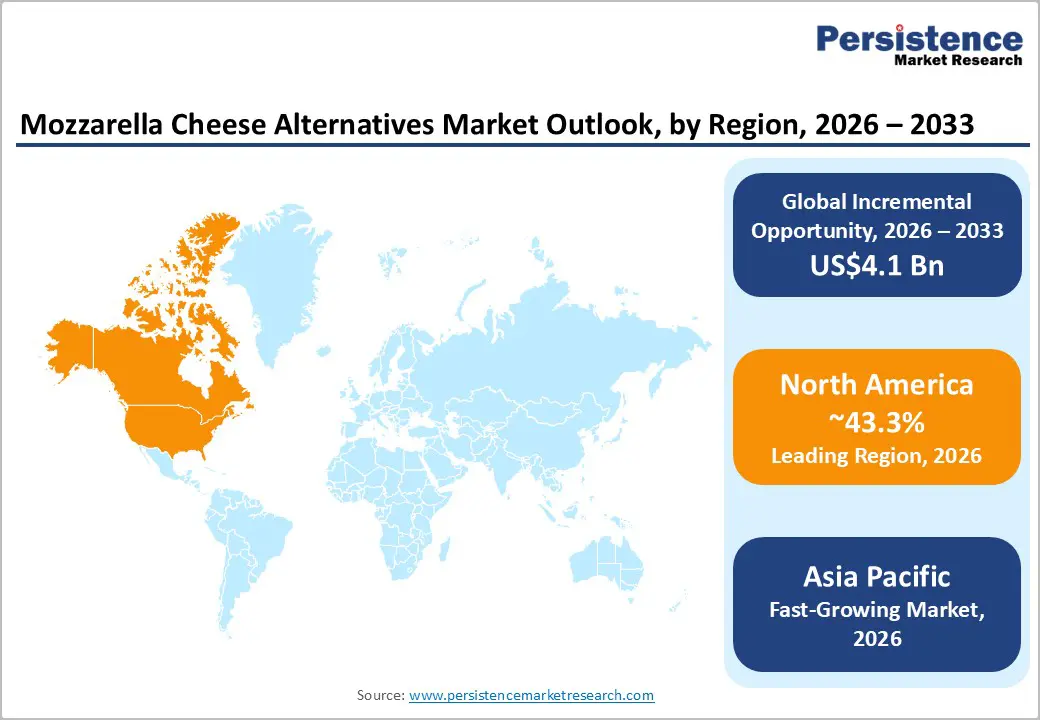
- Leading Region: North America, with about a 43.3% share in 2026, backed by its well-established plant-based food segment and high demand for dairy-free pizza.
- Fast-growing Region: Asia Pacific, spurred by rising lactose intolerance and increasing exposure to Western diets.
- Leading Cheese Type: Cheddar and white cheddar cheese, approximately 34.8% share in 2026, as they are easy to replicate in terms of taste and texture.
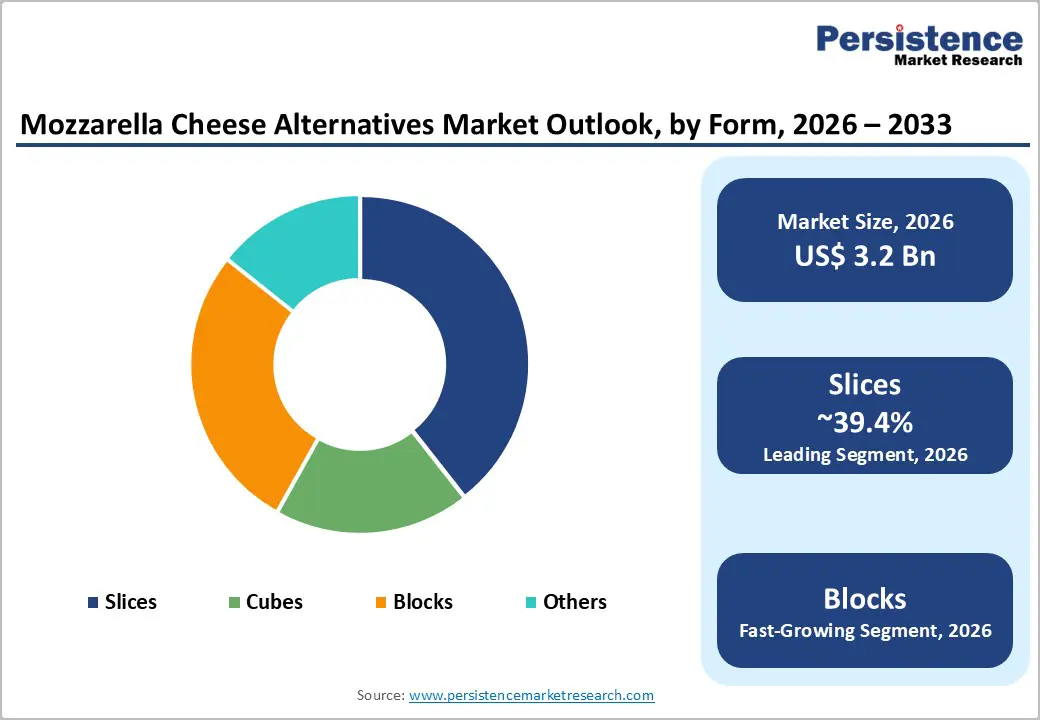
- Dominant Form: Slices, with a nearly 39.4% share in 2026, as they deliver convenience and portion control.
- Research Study: In June 2026, researchers published a study in Applied Food Research describing the development of an aquafaba-based vegan mozzarella analogue made from chickpea-derived aquafaba, cashews, and starches. The study evaluated texture, microstructure, sensory attributes, and melting performance against dairy mozzarella and commercial plant-based alternatives, showing ongoing efforts to improve next-generation mozzarella substitutes.
DRO Analysis
Driver - Rising Prevalence of Lactose Intolerance Globally
Lactose intolerance is far more widespread than many realize. According to data published in the National Library of Medicine, around 65% of the global population is lactose intolerant. The condition is especially prevalent in certain regions. The National Institutes of Health notes that it affects nearly 90% of adults in East Asia. For these consumers, even small amounts of dairy can trigger bloating, cramps, and discomfort.
Mozzarella, being one of the most widely used cheeses in pizza and pasta, is a daily dietary reality for many, making dairy-free alternatives a practical need and not just a lifestyle choice. The U.S. Department of Agriculture (USDA) reported that plant-based milk accounted for around 16% of total retail milk sales value in the U.S. in 2024, up from just 8% in 2018. It is a signal that lactose-driven demand is actively influencing how consumers shop.
Surging Shift toward Vegan, Vegetarian, and Flexitarian Diets
The shift toward plant-based eating goes beyond strict veganism. As consumers prioritize health, sustainability, and ethical food choices, vegan cheese is moving beyond niche shelves and entering mainstream diets, spurred by the rise of flexitarian lifestyles, where people reduce dairy intake without fully eliminating it. Concern about cholesterol and saturated fat also plays a key role.
Rising awareness of obesity and cholesterol issues associated with dietary shifts is pushing more consumers toward plant-based cheese as a healthier alternative. In the last few years, several companies globally have introduced new vegan cheese variants to address flexitarian demand and improve texture consistency across retail and foodservice channels.
Restraint - Lack of Natural Protein and Calcium in Commercial Plant-Based Cheese
Despite rising popularity, most commercial plant-based mozzarella alternatives fall short on nutrition. A peer-reviewed study published in the journal Foods (MDPI, 2025) found that plant-based cheese substitutes contained, on average, 60 times less protein, 8 times less calcium, and 50% more salt per 100g compared to semi-hard dairy cheese.
A separate U.S.-based analysis of 245 plant-based cheese products, published in Nutrients (NCBI), found that only 3% had 5g or more of protein per serving, while almost 60% had high levels of saturated fat, especially fostered by coconut oil-based formulations. This nutritional gap creates a key barrier for health-conscious consumers who switch to plant-based alternatives expecting comparable benefits, only to find a product that may be more processed and less nourishing than the dairy original it replaces.
Opportunity - Emergence of Precision Fermentation
Precision fermentation is enabling a new class of mozzarella alternatives that behave like real dairy when heated. Instead of relying on coconut oil and starch blends, companies are now producing casein, the key protein responsible for cheese melt and stretch, through microbial fermentation. California-based New Culture, founded in 2019, combines traditional cheese-making methods with fermentation-derived casein and self-affirmed its novel casein as GRAS (Generally Recognized as Safe) in early 2024, claimed as a world first for animal-free casein.
In parallel, Leprino Foods, the world's largest mozzarella manufacturer supplying 85% of the pizza market's cheese, partnered with Dutch start-up Fooditive Group in July 2024, securing exclusive worldwide rights to commercialize Fooditive's precision-fermented dairy protein. These developments showcase that the technology is moving well beyond start-ups into mainstream production pipelines.
Introduction to New Protein Bases
Formulators are actively reworking the protein base of plant-based mozzarella to improve both nutrition and flavor. Pea protein has taken over as the leading plant protein in food and beverage products with vegan claims, with soy following closely, and sunflower protein emerging as a next-generation ingredient being monitored for broad use. This shift is already producing measurable results.
A 2025 study conducted by the University of Guelph's Marangoni Lab found that Burcon NutraScience's Peazazz C pea protein isolate and Solatein sunflower protein isolate significantly outperformed a leading competitor's pea protein in a plant-based cheese application. It provided the desired stretch, melt, oil binding, and shredability expected of commercial mozzarella-style cheese, while maintaining a clean and mild flavor. This addresses the recurring consumer complaint about the heavy coconut aftertaste in old plant-based formulations.
Category-wise Analysis
Cheese Type Insights
The cheddar and white cheddar cheese segment is predicted to lead with a share of approximately 34.8% in 2026, as cheddar-style alternatives were the first to gain mass adoption in the plant-based cheese segment. They are easier to replicate in terms of texture and flavor compared to mozzarella or specialty cheeses. Various early brands such as Daiya Foods Inc. and Follow Your Heart built their portfolios around cheddar shreds and slices. Retail data from multiple industry reports show cheddar variants dominating shelf space in supermarkets, especially in North America and Europe.
Jack cheese (including Monterey Jack-style variants) is estimated to be the fastest-growing segment over the forecast period. This category performs strongly as it melts well and is widely used in Mexican-style dishes such as nachos, quesadillas, and tacos. Brands often position Jack-style products as a closer functional substitute to mozzarella in certain applications, especially in foodservice. Its neutral flavor also makes it adaptable across cuisines, which supports higher adoption compared to niche cheeses such as Jarlsberg or Romano.
Form Insights
Slices are anticipated to dominate with a share of nearly 39.4% in 2026, owing to their rising demand in sandwiches, burgers, and quick-service restaurants. They are easy to use, portion-controlled, and widely adopted in fast-food chains providing vegan options. Companies such as Upfield (Violife) and Kite Hill have extended slice formats, boosted by their high turnover in retail and foodservice.
Blocks are expected to remain in the second position in 2026. These are preferred for home cooking and foodservice applications where shredding or grating is required, especially for pizza and pasta. This form is closely linked to mozzarella-style usage, as consumers often shred blocks to replicate traditional cheese behavior. The rise of cooking at home and DIY pizza trends has supported steady demand for block formats, even though they require more effort compared to ready-to-use slices.
Regional Insights
North America Mozzarella Cheese Alternatives Market Trends
North America is predicted to dominate in 2026 with a share of approximately 43.3%, as it has the most well-established plant-based food sector in the world. Consumers are already familiar with dairy alternatives. Large retail chains, restaurants, and foodservice operators actively stock vegan cheese products. The region also benefits from superior innovation from companies such as Daiya, Miyoko’s, Violife, Good Planet Foods, and Follow Your Heart. Another advantage is the large pizza and convenience-food market, where mozzarella alternatives are heavily used. The U.S. Food and Drug Administration (FDA) has also issued guidance on labeling plant-based alternatives, providing surging regulatory clarity for manufacturers.
U.S. Mozzarella Cheese Alternatives Market Trends
A share of nearly 59.8% is expected to be held by the U.S. in 2026, as consumers are increasingly seeking lactose-free, allergen-friendly, and plant-based foods without necessarily adopting a fully vegan lifestyle. This has broadened the customer base beyond vegans. Foodservice demand is also rising. Various pizzerias, quick-service restaurants, and meal-kit providers now deliver dairy-free cheese options. Product development has improved significantly in recent years, with manufacturers focusing on stretchability, browning, and meltability to better replicate traditional mozzarella. The country remains the global center for plant-based food innovation, attracting substantial investment into fermentation-derived dairy proteins and next-generation cheese alternatives.
Asia Pacific Mozzarella Cheese Alternatives Market Trends
Asia Pacific is anticipated to be the fastest-growing region in 2026 with a share of nearly 34.5%, as the region combines a large lactose-intolerant population with rising disposable income and surging awareness of plant-based nutrition. Urban consumers are becoming more willing to experiment with non-dairy products, especially among younger demographics. E-commerce has also played a prominent role by making specialty products available beyond key cities. Plant-based cheese remains a relatively small category compared with plant-based milk, which means there is significant room for expansion as consumer awareness increases. Industry studies indicate that plant-based cheese is among the fastest-growing segments in the broad dairy alternatives market in Asia Pacific.
China Mozzarella Cheese Alternatives Market Trends
China will likely lead in Asia Pacific in 2026 with a share of around 37.6%, owing to a combination of health, demographic, and policy factors. Lactose intolerance is widespread among the local population, encouraging interest in dairy alternatives. Consumers are also becoming more health-conscious and environmentally aware.
The country's massive e-commerce infrastructure, led by platforms such as JD.com and Tmall, has improved access to plant-based products nationwide. Government initiatives supporting food innovation and sustainable food production have further encouraged investment in alternative proteins. Notably, mozzarella is currently the largest product segment in China's vegan cheese market, reflecting the rising popularity of Western-style foods such as pizza and baked dishes.
India Mozzarella Cheese Alternatives Market Trends
In 2026, India is projected to account for a share of approximately 18.4%, supported by its large vegetarian population, rising awareness of vegan diets, and increasing concerns about animal welfare and sustainability. Urban consumers in cities such as Mumbai, Bengaluru, Delhi, and Pune are pushing demand for plant-based foods. The country's start-up network has also become more active, with local companies introducing dairy-free milk, cheese, and paneer alternatives customized to local tastes.
Another factor is the high consumer focus on food quality and transparency, which is encouraging some consumers to explore plant-based alternatives. However, affordability remains important, so growth is occurring steadily rather than explosively. Consumer discussions increasingly highlight demand for locally produced vegan cheese and dairy alternatives that can match traditional dairy products in taste and price.
Europe Mozzarella Cheese Alternatives Market Trends
Europe will likely see decent growth over the forecast period, with a share of nearly 13.1% in 2026, as plant-based foods have already achieved relatively high consumer awareness. Growth is being augmented more by product premiumization than by first-time adoption. Consumers now seek clean-label products, sustainable ingredients, and minimally processed foods. Europe’s regulations around sustainability and emissions reduction are also encouraging investment in alternative proteins. Countries such as Germany, the U.K., France, and the Netherlands have well-developed vegan food markets, supporting continued demand for plant-based mozzarella used in retail and foodservice channels.
Germany Mozzarella Cheese Alternatives Market Trends
Germany will likely register a substantial share of approximately 41.5% in 2026. The country has a highly developed vegan and flexitarian consumer base, supported by superior retail penetration and widespread supermarket availability of dairy alternatives. Local consumers are particularly receptive to sustainability-focused food choices and are often early adopters of food innovations. The country also hosts several food-tech start-ups working on fermentation-based dairy proteins and next-generation cheese alternatives. Hence, demand for mozzarella substitutes continues to benefit from both consumer interest and technological development.
France Mozzarella Cheese Alternatives Market Trends
A share of around 23.6% is predicted to be held by France in 2026. Traditional dairy products remain deeply embedded in local food culture, which creates a higher barrier for plant-based cheese adoption compared with some neighboring countries. However, younger consumers are becoming more open to flexitarian diets, and foodservice operators are now adding vegan menu options. Premium plant-based cheeses are gaining traction, especially in urban areas such as Paris, Lyon, and Marseille. Growth is hence likely to come from gourmet and specialty products that emphasize taste, texture, and culinary performance rather than from low-cost mass-market alternatives.
Competitive Landscape
The global mozzarella cheese alternatives market is moderately fragmented, with no single company dominating worldwide. A handful of brands such as Violife, Daiya, Miyoko's, Follow Your Heart, and Kite Hill hold dominant positions, but regional specialists and artisanal producers continue to capture significant demand, especially in premium and foodservice segments. The top players collectively account for less than half of the market, indicating substantial competition from small-scale brands.
Foodservice has become the key battleground for competitive advantage. Restaurant chains, pizza operators, and ready-meal manufacturers prioritize cheese performance over brand loyalty. It is creating opportunities for suppliers that can provide consistent melting behavior and cost efficiency. Several leading brands have broadened foodservice partnerships in North America and Europe to secure long-term contracts with restaurants and institutional buyers.
Key Industry Developments:
- In February 2026, an international group of researchers introduced PREFER (PREcision FERmentation Ontology), a standardized framework designed to improve data sharing and process optimization in precision fermentation. The initiative is expected to support the development of fermentation-derived dairy proteins and casein alternatives, which are increasingly being explored for high-performance mozzarella substitutes.
- In December 2025, Bettani Farms (formerly Climax Foods) acquired vegan cheese brands Numu and Stockeld Dreamery as part of a broad consolidation strategy. Numu is specifically known for supplying dairy-free mozzarella to pizzerias across North America. Bettani Farms indicated that the acquisitions would accelerate the commercialization of its proprietary casein alternative ingredient.
- In January 2025, Misha’s Inc. announced the acquisition of dairy-free cheese producer Vertage, broadening its portfolio into shredded and sliced plant-based cheeses, including mozzarella-style products. The company stated that the deal would also provide access to Fresh Del Monte’s production and logistics network, supporting future product launches and broad distribution.
Companies Covered in Mozzarella Cheese Alternatives Market
- Upfield (Violife)
- Daiya Foods Inc.
- Danone S.A.
- Miyoko's Creamery
- Good Planet Foods
- Tofutti Brands Inc.
- Kite Hill
- Treeline Cheese
- Bute Island Foods Ltd. (Sheese)
- Field Roast (Chao Cheese)
- GreenVie Foods
- New Roots AG
- Nush Foods
- Parmela Creamery
- Tyne Chease Ltd.
- Others
Frequently Asked Questions
The global mozzarella cheese alternatives market is projected to be valued at US$3.2 billion in 2026.
The mozzarella cheese alternatives market is expected to reach US$7.3 billion by 2033.
Key market trends include the rising popularity of precision fermentation and the launch of clean-label formulations.
Slices are expected to be the leading form with a share of nearly 39.4% in 2026, as leading foodservice chains rely on uniform and ready-to-use formats that reduce preparation time.
The mozzarella cheese alternatives market is expected to grow at a CAGR of 12.7% from 2026 to 2033.
Upfield (Violife), Daiya Foods Inc., and Danone S.A. are a few key market players.


