




- Specialty & Fine Chemicals
- Mannosylerythritol Lipids Market
Mannosylerythritol Lipids Market Size, Trends, Share, and Growth Forecast 2026 - 2033
Mannosylerythritol Lipids Market by Product Type (MEL-A, MEL-B, MEL-C, MEL-D), Source (Natural, Synthetic), Industry (Household Detergents, Personal Care & Cosmetics, Pharmaceuticals, Food Industry, Others), and Regional Analysis for 2026 - 2033

Mannosylerythritol Lipids Market Size and Trend Analysis
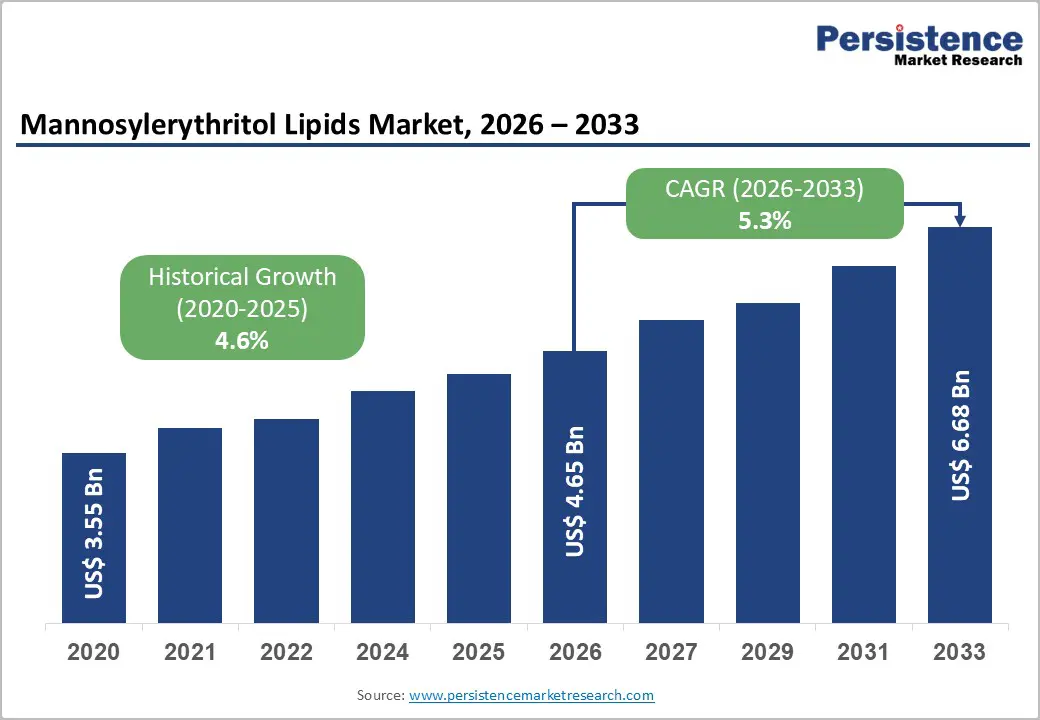
The global mannosylerythritol lipids market size is likely to reach US$ 4.7 billion in 2026 and is projected to reach US$ 6.7 billion by 2033, growing at a CAGR of 5.3% between 2026 and 2033.
The market expansion is primarily driven by escalating consumer demand for sustainable and biodegradable surfactants across personal care and household cleaning applications, coupled with stringent environmental regulations promoting bio-based alternatives to petroleum-derived chemicals. The superior functional properties of mannosylerythritol lipids (MELs), including exceptional moisturizing effects, antimicrobial activity, and skin compatibility, are accelerating their adoption in premium cosmetic formulations and pharmaceutical applications.
Key Industry Highlights:
- Regional Leader: Europe commands leadership in the Mannosylerythritol Lipids Market, with 38% of the global market, driven by the European Union's stringent sustainability regulations and circular-economy initiatives such as the WASTE2FUNC project.
- Fastest-Growing Region: Asia Pacific emerges fastest-growing region, driven by Japan's technological leadership in biosurfactant innovation and China's massive manufacturing infrastructure.
- Leading Segment: MEL-B dominates the product type segment with approximately 52% market share, driven by its superior antimicrobial, moisturizing, anti-aging, and fibroblast-stimulating properties.
- Fastest-Growing Segment: Personal Care & Cosmetics is the fastest-growing end-use segment, driven by premium positioning in the Natural and Organic Personal Care Market, with certification standards such as COSMOS ORGANIC.
- Key Market Opportunity: Waste-based feedstock utilization presents the most significant market opportunity, with AmphiStar securing €6 million in private funding following the successful demonstration of commercial-scale biosurfactant production from agricultural and food waste through the CBE-JU project WASTE2FUNC.
| Key Insights | Details |
|---|---|
|
Mannosylerythritol Lipids Market Size (2026E) |
US$ 4.7 Bn |
|
Market Value Forecast (2033F) |
US$ 6.7 Bn |
|
Projected Growth CAGR (2026-2033) |
5.3% |
|
Historical Market Growth (2020-2025) |
4.6% |
Market Dynamics
Drivers - Accelerating Shift Toward Sustainable and Bio-Based Surfactants
The global transition toward sustainable chemistry is fundamentally reshaping surfactant demand dynamics, with MELs emerging as a preferred alternative to conventional synthetic surfactants. According to research published by the National Center for Biotechnology Information, biosurfactants exhibit significantly lower ecotoxicity and greater biodegradability than petroleum-derived counterparts. BASF SE, one of the world's leading chemical manufacturers, announced in April 2024 the expansion of its biomass-balanced product portfolio for the detergent and cleaning industry across Europe, including approximately 20 biomass-balanced EcoBalanced products that replace fossil raw materials with renewable resources.
The European Union's stringent cosmetics regulations under Regulation (EC) No. 1223/2009 and increasing consumer preference for natural and organic personal care products are compelling formulators to incorporate bio-based ingredients. This regulatory and consumer-driven momentum is particularly evident in the Natural and Organic Personal Care Market, where certification standards such as COSMOS and NATRUE mandate specific percentages of natural-origin ingredients, creating substantial opportunities for MEL adoption.
Expanding Applications in Pharmaceutical and Food Industries
Mannosylerythritol Lipids are gaining significant traction beyond traditional cosmetic applications due to their diverse biological activities and functional versatility. Studies published in peer-reviewed journals demonstrate that MELs exhibit potent antimicrobial, anti-inflammatory, and cell-stimulating properties, making them valuable ingredients in pharmaceutical formulations for wound healing and the treatment of skin injuries. Research conducted by Japan's National Institute of Advanced Industrial Science and Technology confirms that MEL-B exhibits exceptional moisturizing activity, comparable to natural ceramides, but with higher water solubility and more efficient microbial production economics.
The food processing industry is increasingly exploring MELs as natural preservatives and anti-spoilage agents, particularly in breadmaking applications where they effectively inhibit microbial contamination without compromising product quality. MELs are also being investigated as biopesticides for agricultural applications and as stabilizing agents for metallic nanoparticles in advanced materials research. The convergence of these multi-industry applications, supported by ongoing biotechnology innovations in fermentation processes, is establishing MELs as versatile platform molecules with expanding commercial relevance.
Restraints - High Production Costs and Economic Challenges Against Synthetic Surfactants
Despite their superior environmental and functional profiles, Mannosylerythritol Lipids face significant cost disadvantages compared to established synthetic surfactants, with production economics remaining a critical barrier to widespread market penetration. Around 6,000 variants of commercially available synthetic surfactants dominate the market due to their well-established production infrastructure and economies of scale.
The complex downstream processing requirements for MEL extraction, including separation from fermentation media and purification protocols, substantially increase manufacturing expenses and limit price competitiveness in cost-sensitive applications such as household detergents. Industry experts at Kanebo Cosmetics Inc. acknowledge that while MEL-B offers exceptional functional benefits, its market price remains significantly higher than conventional surfactants, restricting adoption primarily to premium personal care formulations where performance justifies the cost premium.
Technical Challenges in Large-Scale Production and Supply Chain Dependencies
The commercial production of Mannosylerythritol Lipids is constrained by technical complexities associated with optimizing fermentation yields and establishing reliable supply chains for renewable feedstocks. Current MEL production predominantly relies on fungal fermentation with hydrophobic carbon sources, such as plant oils, and yield optimization requires sophisticated bioprocess engineering and strain development.
The European Union initiative Circular Bio-based Europe estimated in 2022 that only 4% of the global surfactant market consists of fully bio-based products, highlighting the nascent stage of biosurfactant commercialization. Geographic concentration of feedstock sources, particularly reliance on sugar imports from regions such as Brazil for first-generation fermentation substrates, creates supply vulnerability and sustainability concerns. The isolation and purification of MELs from culture media pose technical challenges that affect production scalability and cost-effectiveness, requiring continued innovation in downstream processing technologies, such as nanofiltration, to enhance commercial viability.
Opportunity - Innovation in Waste-Based Feedstock Utilization and Circular Economy Models
The emerging approach of producing Mannosylerythritol Lipids (MELs) from agricultural and food waste presents a significant opportunity to reduce costs while strengthening sustainability credentials. The CBE-JU WASTE2FUNC project, led by AmphiStar and Ecover, demonstrated commercial-scale biosurfactant production from waste streams, enabling Ecover’s “Too Good to Waste” product line. Building on this success, AmphiStar secured €6 million to develop facilities for eco-friendly biosurfactants derived from waste. This circular model reduces reliance on first-generation sugars and alleviates concerns about competition for food resources.
Similar advancements are occurring in the bio-lubricants sector, where waste valorization technologies are driving synergies across renewable chemical markets. As fermentation processes evolve to handle diverse waste substrates and regulatory frameworks increasingly promote circular business models, waste-based MEL production has the potential to achieve cost parity with synthetic surfactants while delivering superior environmental performance, positioning it as a transformative development for market economics.
Penetration of Asian Markets Driven by Manufacturing Innovation
The Asia Pacific region represents significant growth potential for Mannosylerythritol Lipids (MELs), driven by advanced biotechnology, supportive regulations, and increasing demand for natural ingredients. Japan leads global innovation in biosurfactant development, with companies such as Toyobo Corporation, Biotopia Co., Ltd., and Kanebo Cosmetics Inc. advancing commercial MEL production and applications in cosmetics and personal care.
India and ASEAN countries are experiencing rapid growth in personal care consumption, with urban consumers showing strong preferences for sustainable formulations. Recent initiatives, such as BASF SE’s delivery of biomass-balanced DMAPA to Galaxy Surfactants in September 2025, highlight multinational commitment to the region. These factors position the Asia Pacific as the fastest-growing market for MELs.
Category-wise Analysis
Product Type Insights
MEL-B holds the largest share of the Mannosylerythritol Lipids market, accounting for approximately 52%, due to its strong functional properties and commercial viability. It is particularly suited for cosmetic applications, offering superior antimicrobial, moisturizing, anti-aging, and skin-repair benefits compared to other MEL variants.
Research from Japan’s AIST confirms that MEL-B provides greater hydrophilicity than natural ceramides and forms stable liquid crystalline structures, which help retain water and active ingredients. These advantages have led several companies to focus on MEL-B production. Patent data from Kanebo Cosmetics Inc. indicates that MEL-B can be incorporated into both oil-based and water-based formulations, enabling versatile product development. Its ability to create stable emulsions, combined with excellent skin compatibility and low irritation, makes MEL-B ideal for leave-on skincare products requiring high safety standards.
Source Insights
Natural-source Mannosylerythritol Lipids (MELs) account for approximately 78% of the market, reflecting their production through fungal fermentation and strong consumer preference for natural ingredients. MELs are biosurfactants naturally produced by various fungal species, particularly those in the Ustilaginaceae family, such as Pseudozyma tsukubaensis, through fermentation processes utilizing hydrophobic carbon sources, including vegetable oils from soybeans and olives. This process qualifies MELs as natural-origin under certification standards like COSMOS and EU Regulation 848/2018, provided feedstocks and manufacturing practices meet required criteria.
Industry and research institutions are investing in fermentation optimization and strain engineering to improve yields while maintaining natural classification. Givaudan Active Beauty achieved a 91% reduction in environmental impact through precision fermentation with its PrimalHyal™ technology in January 2024. The natural sourcing advantage is especially relevant in Europe, where regulatory frameworks and consumer demand for clean beauty favor authentic natural ingredients. While synthetic production routes are possible, market dynamics strongly support maintaining natural methods to preserve premium positioning and regulatory compliance.
Industry Insights
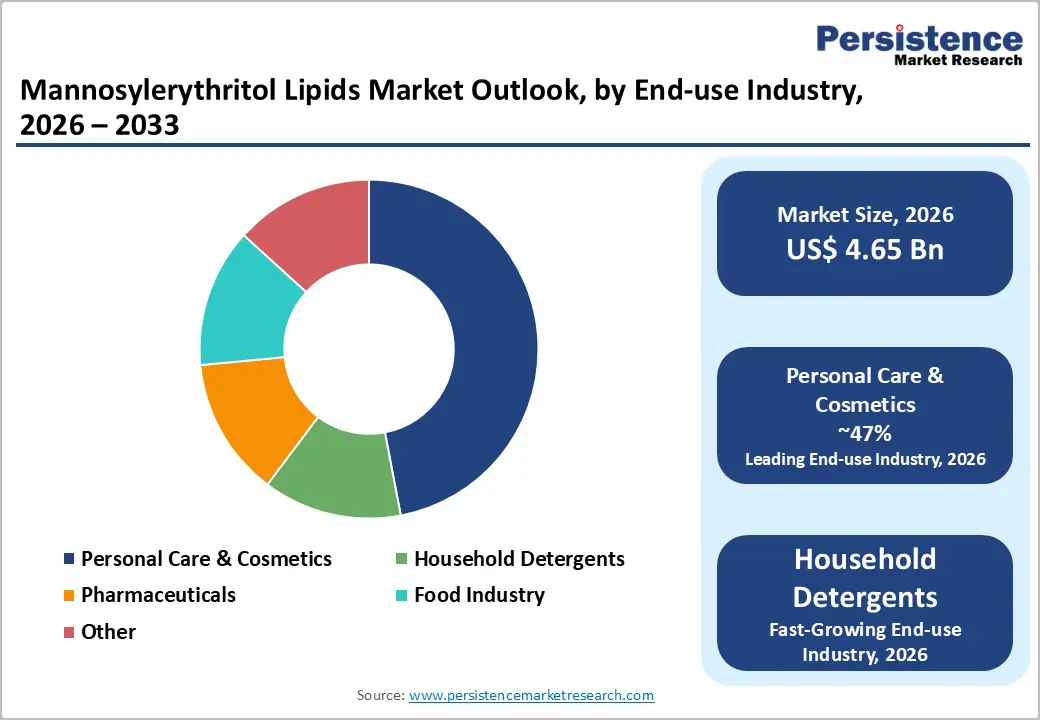
The Personal Care & Cosmetics segment is the leading end-use category in the Mannosylerythritol Lipids (MELs) market, accounting for approximately 47% of total market share. This dominance is driven by premium positioning and consumer willingness to pay for natural, multifunctional ingredients. MEL properties align closely with the growing demand for sustainable, effective, and safe components in the natural and organic personal care sector. Givaudan Active Beauty launched in September 2024 its [N.A.S.]™ Vibrant Collection, featuring 100% natural-origin active extracts, exemplifying the industry trend toward hybrid formulations that combine efficacy with natural positioning.
Kanebo Cosmetics Inc. has also successfully integrated MEL-B into premium skincare products, including innovative oil-essence formulations that deliver lightweight textures and superior skin absorption. The skincare sub-segment benefits from MEL’s proven ability to repair skin damage, stimulate cell activity, and provide moisturization comparable to natural ceramides, with enhanced water solubility and ease of formulation. Certification standards such as COSMOS ORGANIC and NATRUE, which require high percentages of natural-origin ingredients, are creating structural demand for biosurfactants like MELs in certified cosmetic products.
Regional Insights
North America Mannosylerythritol Lipids Market Trends
North America maintains market leadership in the Mannosylerythritol Lipids sector, driven by sophisticated consumer awareness, robust regulatory frameworks promoting sustainable chemistry, and concentrated innovation ecosystems in specialty chemicals and biotechnology. The U.S. dominates regional demand due to its mature natural personal care market. The U.S. FDA regulatory framework places increasing emphasis on ingredient transparency and safety validation, which benefits biosurfactants capable of demonstrating comprehensive safety profiles through rigorous testing.
BASF SE operates major DMAPA production facilities in North America with capacity contributing to the company's total 70,000 metric tons per year global production, supporting downstream biosurfactant development and enabling regional supply chain integration. The region's advanced contract manufacturing infrastructure and sophisticated formulation expertise in prestige beauty brands create favorable conditions for MEL market penetration, particularly in high-margin skincare and specialty cosmetic applications where ingredient innovation commands competitive advantage.
Europe Mannosylerythritol Lipids Market Trends
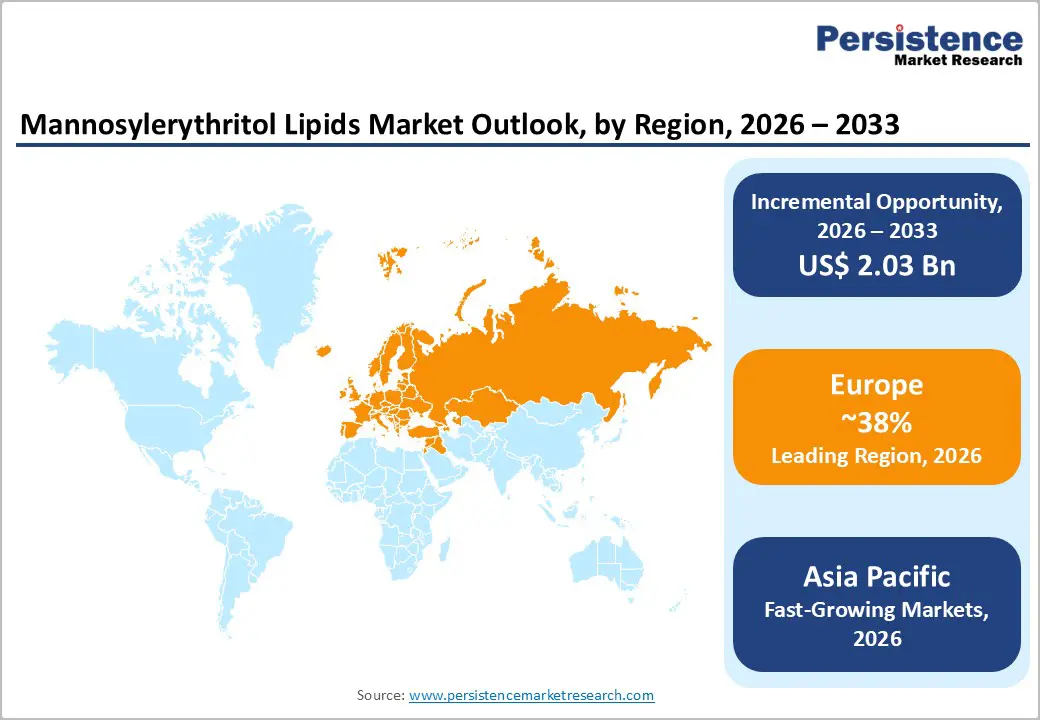
Europe leads the market with 38% share, propelled by the most stringent environmental and cosmetic safety regulations globally, coupled with deeply embedded consumer sustainability consciousness. The European Union's Cosmetics Regulation (EC) No. 1223/2009 establishes comprehensive safety requirements, including mandatory Cosmetic Product Safety Reports (CPSR) that favor well-characterized natural ingredients with established safety profiles. Germany, the U.K., France, and Spain lead regional demand, with Germany serving as a crucial innovation hub for green chemistry and industrial biotechnology.
BASF announced in April 2024 a strategic expansion of its biomass-balanced EcoBalanced product range, specifically targeting the detergent and cleaning industry across Europe, doubling its commitment to sustainable solutions by introducing approximately 20 biomass-balanced products that replace fossil feedstocks with renewables from organic waste. The CBE-JU project WASTE2FUNC successfully demonstrated in Europe the commercial viability of waste-derived biosurfactants, with Ecover incorporating these ingredients into marketed home care products, establishing precedent for circular economy business models.
Asia Pacific Mannosylerythritol Lipids Market Trends
Asia Pacific exhibits the most dynamic growth trajectory in the Mannosylerythritol Lipids market, driven by manufacturing scale advantages, advanced fermentation technology, and rapidly expanding middle-class consumption of premium personal care products. Japan has established itself as the global center of excellence for MEL research and commercialization, with Toyobo Corporation, Biotopia Co., Ltd., and Kaneko Cosmetics Inc. leading commercial production and application development.
BASF SE significantly strengthened its regional presence by announcing in September 2025 the delivery of its first biomass-balanced DMAPA to Galaxy Surfactants for producing sustainable CAPB (Cocamidopropyl Betaine) for personal care applications, explicitly targeting the region's growing demand for eco-conscious formulations. Technological breakthroughs in fermentation processes and genetic engineering of microorganisms are making biosurfactant production increasingly cost-competitive in the region, where labor and feedstock costs provide inherent advantages.
Competitive Landscape
The mannosylerythritol lipids market exhibits a moderately consolidated structure characterized by a limited number of specialized producers with established fermentation capabilities, alongside emerging biotechnology companies developing novel production platforms. Market leaders pursue differentiation strategies through proprietary fermentation strains, downstream processing innovations, and application-specific product development targeting premium segments. Strategic expansion initiatives focus on capacity scaling, geographic market penetration, and vertical integration into specialized applications such as pharmaceuticals and food preservation. The market is witnessing intensifying competition from multinational chemical corporations such as BASF SE and specialty ingredient suppliers like Givaudan Active Beauty, which are leveraging extensive distribution networks and customer relationships to introduce biosurfactant portfolios.
Key Market Developments:
- September 2025: BASF SE delivered its first biomass-balanced 3-dimethylaminopropylamine (DMAPA) to Galaxy Surfactants in the Asia Pacific for producing sustainable Cocamidopropyl Betaine (CAPB) for personal care applications, targeting significant CO2 emission reductions compared to conventional products.
- April 2024: BASF SE announced a strategic expansion of its biomass-balanced EcoBalanced product portfolio for the detergent and cleaning industry across Europe, introducing approximately 20 biosustainable surfactant ingredients that replace fossil raw materials with renewables from organic waste streams, supporting customer sustainability objectives.
- January 2024: Givaudan Active Beauty unveiled PrimalHyal™ 50 Life, achieving a groundbreaking 91% reduction in environmental impact for hyaluronic acid production through precision fermentation and strain engineering, demonstrating leadership in sustainable active cosmetic ingredient development.
Top Companies in Mannosylerythritol Lipids Market
BASF SE (Ludwigshafen, Germany) stands as the world's leading chemical company, maintaining a comprehensive biosurfactants portfolio through strategic investments, including a majority stake in Allied Carbon Solutions, a Japanese manufacturer of biomass-derived surfactants, including sophorolipids. BASF's Care Chemicals division pursues the Care 360° Solutions for Sustainable Life initiative, prioritizing sustainability through biomass-balanced product offerings and renewable feedstock integration.
Kanebo Cosmetics Inc. (Tokyo, Japan) has established itself as a pioneer in Mannosylerythritol Lipid commercialization, conducting extensive research on MEL-B properties and developing proprietary cosmetic formulations that leverage the biosurfactant's exceptional moisturizing and cell-activating effects. The company's research demonstrates that MEL efficiently repairs skin damage and forms unique liquid crystalline structures that function as reservoirs for water and active ingredients, enabling innovative product textures ranging from stretchy milky lotions to transparent formulations.
Givaudan Active Beauty (Vernier, Switzerland) operates as a global reference in high-precision beauty ingredients, maintaining specialized fermentation facilities in France's Champagne region dedicated to precision fermentation of active cosmetic ingredients using local carbon sources from wheat and beetroot. The company achieved breakthrough sustainability credentials with PrimalHyal™ 50 Life in January 2024, demonstrating a 91% reduction in environmental impact through revolutionary production methods.
Companies Covered in Mannosylerythritol Lipids Market
- Damy Chemicals
- Ecover
- Agae Technologies
- Toyobo Corporation
- Biotopia Co., Ltd.
- Kanebo Cosmetics Inc.
- Givaudan Active Beauty
- Suraya Corporation Ltd.
- Jeneil Biotech Inc.
- BASF SE
- Jeneil Biosurfactant Company
Frequently Asked Questions
The global Mannosylerythritol Lipids market is valued at US$ 4.7 Bn in 2026 and is projected to reach US$ 6.7 Bn by 2033, growing at a CAGR of 5.3% during the forecast period.
The market is primarily driven by escalating consumer demand for sustainable and biodegradable surfactants, stringent environmental regulations promoting bio-based alternatives, and superior functional properties, including exceptional moisturizing effects, antimicrobial activity, and skin compatibility that are accelerating adoption in premium cosmetic formulations.
MEL-B dominates the market with approximately 52% market share due to its optimal balance of antimicrobial, moisturizing, anti-aging, and fibroblast-stimulating properties.
Europe commands leadership in Mannosylerythritol Lipids Market, with 38% of the global market, propelled by the European Union's stringent sustainability regulations, with circular economy initiatives like the WASTE2FUNC project.
Waste-based feedstock utilization presents the most significant market opportunity, with AmphiStar securing €6 million in private funding following the successful demonstration of commercial-scale biosurfactant production from agricultural and food waste through the CBE-JU project WASTE2FUNC.
Leading companies include BASF SE, Kanebo Cosmetics Inc., Givaudan Active Beauty, Toyobo Corporation, Biotopia Co., Ltd., and Damy Chemicals Co., Ltd.


