




- Specialty & Fine Chemicals
- Liquefied CO₂ Market
Liquefied CO₂ Market Size, Share and Growth Forecast, 2026-2033
Liquefied CO₂ Market by Sources (Hydrogen, Ethyl Alcohol, Ammonia, Natural Gas, Others), Application (Food & Beverages, Chemicals, Electronics, Agriculture, Healthcare, Wastewater Treatment), and Regional Forecast for 2026-2033

Liquefied CO2 Market Share and Trends Analysis
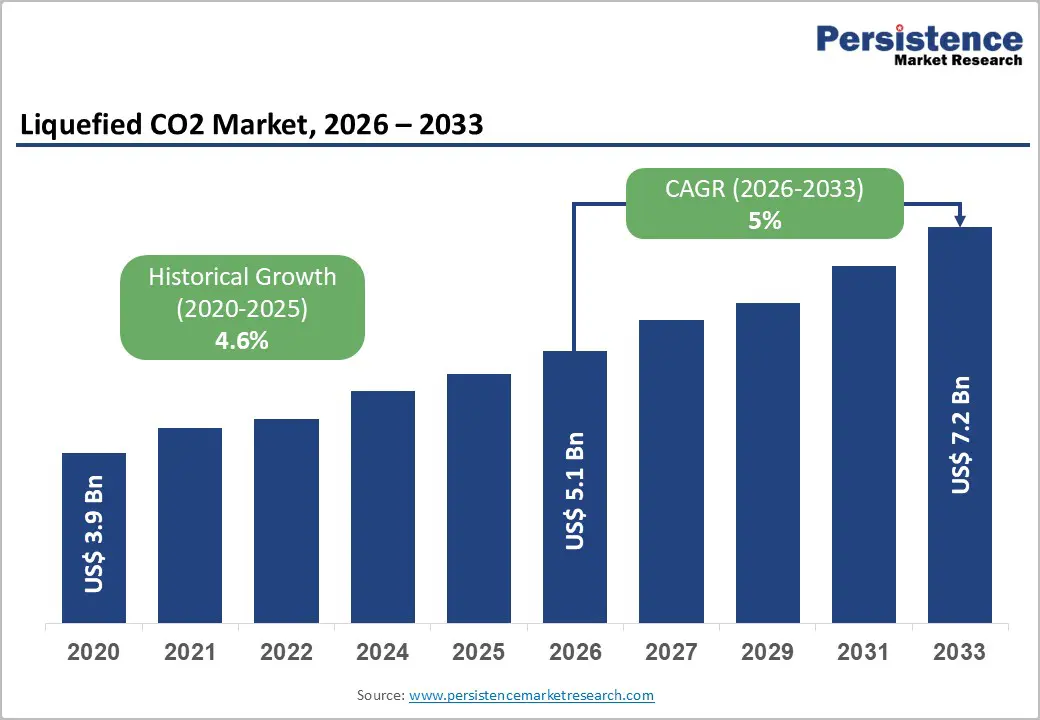
The global liquefied CO2 market size is likely to be valued at US$ 5.1 billion in 2026, and is projected to reach US$7.2 billion by 2033, growing at a CAGR of 5% during the forecast period of 2026–2033. This expansion is driven by consistent demand from key sectors such as food and beverage carbonation, chemical processing, and healthcare applications.
The recovery of CO2 from industrial by-products is also gaining momentum, supported by regulatory efforts to reduce atmospheric emissions and improve carbon utilization efficiency. These factors have encouraged significant investments in CO2 capture and liquefaction infrastructure, laying the foundation for sustained market growth. Technological advancements in purification and storage systems have further improved the reliability and quality of liquefied CO2 supply, strengthening confidence among end-users and supporting long-term market stability.
The integration of innovative solutions is enabling producers to meet evolving industry standards and expand their customer base. As global industries prioritize sustainability and resource efficiency, the liquefied CO2 market is well-positioned to benefit from ongoing regulatory support and technological progress.
Key Industry Highlights
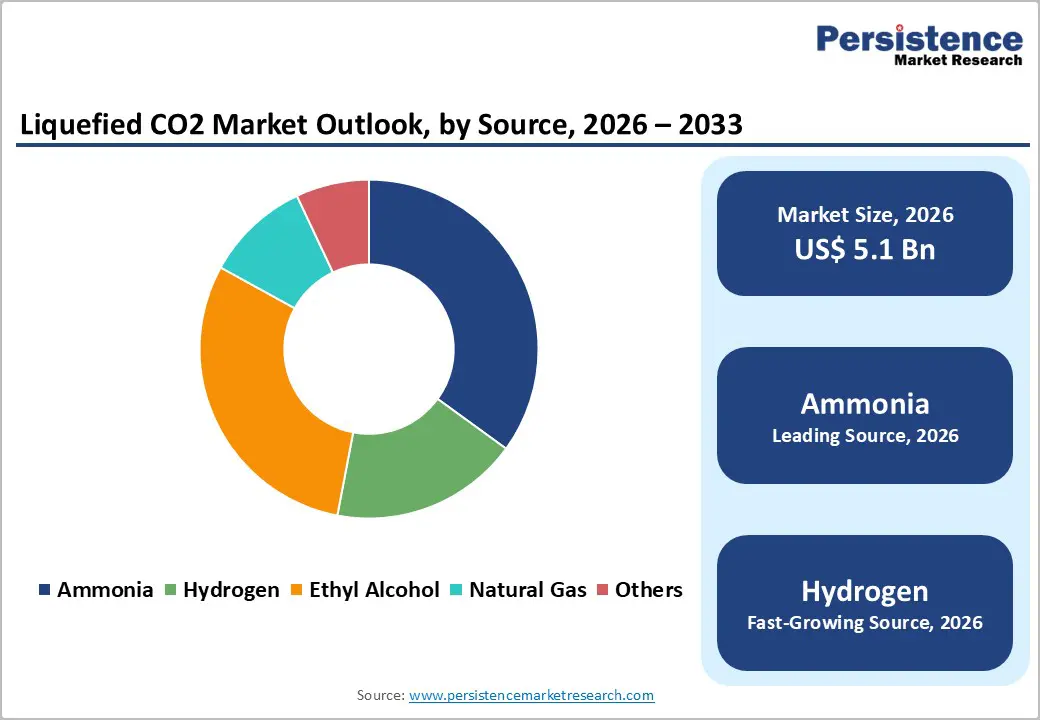
- Dominant Source: Ammonia-based CO2 recovery is expected to hold approximately 35% of the market share, supported by large-scale fertilizer production and integrated recovery infrastructure.
- Fastest-Growing Source: Hydrogen-based CO2 recovery is projected to grow at an estimated 6.2% CAGR from 2026–2033, driven by clean hydrogen investments and the increased adoption of carbon capture technologies.
- Fastest-Growing Application: Healthcare is expected to register the highest 2026-2033 CAGR of roughly 6.5%, driven by the expansion of pharmaceutical manufacturing and the widening use of medical-grade CO2.
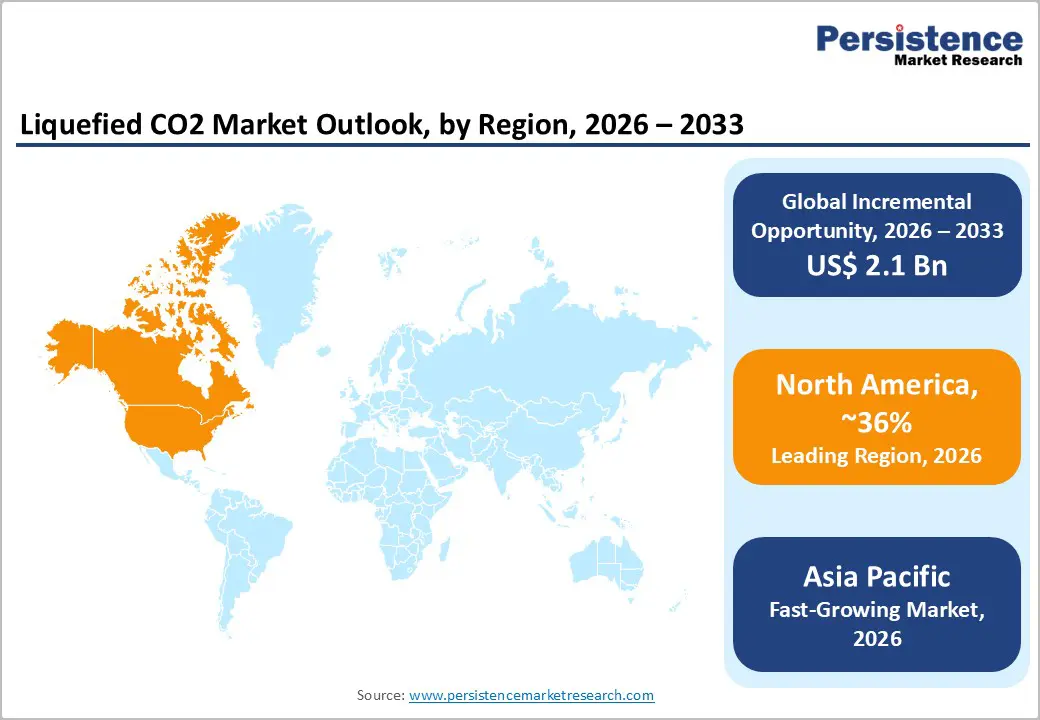
- Regional Growth Leadership: North America is projected to dominate with an estimated 35% share, while Asia Pacific is expected to be the fastest-growing market, registering around 6.8% CAGR through 2033.
- Strategic Opportunity Landscape: The integration of carbon capture, utilization, & storage (CCUS) can open up new growth avenues, creating opportunities worth billions, supported by industrial decarbonization mandates.
- September 2025: Rashtriya Chemicals & Fertilizers Ltd (RCF) began the commercial production at its new liquid carbon dioxide plant at Trombay, diversifying beyond fertilizers into food & beverage, healthcare, and industrial applications.
| Key Insights | Details |
|---|---|
| Liquefied CO2 Market Size (2026E) | US$ 5.1 Bn |
| Market Value Forecast (2033F) | US$ 7.2 Bn |
| Projected Growth (CAGR 2026 to 2033) | 5% |
| Historical Market Growth (CAGR 2020 to 2025) | 4.6% |
Market Factors – Growth, Barriers, and Opportunity Analysis
Expanding Utilization of Liquefied CO2 across Key Industries
The liquefied CO2 market growth is being driven by broad-based demand across food and beverage processing, industrial recovery, and healthcare applications, with food and beverages remaining the primary consumption pillar. According to industry associations, over 65% of global carbonated beverage production relies on liquefied CO2 for carbonation, chilling, and modified atmosphere packaging. Major energy companies are capitalizing on this dependence, using it to diversify their operations and make headways into more consumer-centric industries.
For example, in July 2025, BOC's new CO2 processing facility in Victoria, Australia, commenced operations, producing over 60,000 tons of beverage-grade liquid CO2 annually, enough to carbonate 7.5 billion liters of drinks.
On the supply side, industrial recovery of CO2 from hydrogen, ammonia, and ethanol production has gained importance as manufacturers align operations with circular utilization and emission-reduction mandates. Regulatory measures in North America and Europe continue to discourage CO2 venting, encouraging liquefaction and commercial reuse across multiple end-use sectors. Healthcare demand also strengthened as hospitals and pharmaceutical manufacturers expanded the use of medical-grade CO2 for minimally invasive procedures and drug production.
Thus, the regional governments supported investments in healthcare infrastructure and low-emission industrial gas systems, while leading industrial gas companies announced upgrades to purification and liquefaction facilities to improve supply reliability and regulatory compliance, supporting sustained market growth.
Structural Supply Constraints and High Infrastructure Compliance Requirements
This restraint arises from the combined impact of upstream supply dependence and stringent infrastructure compliance obligations, which limit the flexibility and scalability of the liquefied CO2 market. Liquefied CO2 supply is structurally tied to ammonia, ethanol, and hydrogen production, as CO2 is largely recovered as a by-product. The temporary shutdowns of fertilizer plants across Germany and the U.K. resulted in regional CO2 supply shortfalls exceeding 20%, directly disrupting food processing operations and hospital gas supplies. These events demonstrated how industrial downtime can rapidly translate into downstream shortages, constraining market reliability.
The strict food-grade, medical-grade, and transport safety regulations increase both operational complexity and time-to-market for new capacity. The European and North American regulators intensified inspections of industrial gas facilities supplying healthcare and food sectors, requiring upgrades to purification, monitoring, and traceability systems. Transport compliance for pressurized cryogenic gases further restricts logistics flexibility, particularly for cross-border supply. Thus, the leading industrial gas producers focused on upgrading existing infrastructure rather than rapid capacity expansion, while smaller players faced elevated entry barriers, limiting short-term supply responsiveness and reinforcing this as a key market restraint.
CCUS Deployment and Cold-Chain Expansion to Generate New Opportunities
The deepening role of liquefied CO2 in CCUS ecosystems, combined with rising industrial and logistics demand. Governments across the U.S., Canada, and the European Union (EU) collectively committed over US$ 12 billion toward CCUS incentive programs, accelerating the development of capture and utilization projects across energy, chemicals, and food processing sectors. Liquefaction remains essential for transporting captured CO2 from emission sources to utilization hubs, supporting applications such as food processing, chemical synthesis, and industrial reuse. These policy-backed initiatives are strengthening long-term demand visibility for liquefied CO2 across developed markets.
Parallel opportunities are emerging from rapid industrialization in the Asia Pacific and the expansion of advanced cold-chain infrastructure. Between 2022 and 2025, industrial output in China, India, and ASEAN economies grew at an average annual rate of 5.4%, driving higher consumption of liquefied CO2 in welding, electronics manufacturing, and food processing. The global investments in cold-chain logistics exceeded US$ 300 billion, fueled by pharmaceutical exports, biologics, and frozen food trade, where CO2-based refrigeration is increasingly preferred for its safety and residue-free properties. During the year, regional governments and leading industrial gas suppliers announced plans to expand liquefaction capacity and logistics networks, positioning liquefied CO2 as a critical enabler of industrial growth and temperature-controlled trade.
Category-wise Insights
Source Insights
Ammonia production is expected to remain the dominant source of liquefied CO2, accounting for approximately 35% of supply, primarily recovered as a by-product of fertilizer manufacturing. Large-scale fertilizer facilities in North America and Europe provide integrated capture and liquefaction infrastructure, ensuring high-purity and cost-efficient CO2 output. Yara International completed upgrades at its European ammonia plants, enhancing purification systems to meet stricter environmental and safety regulations.
This high-purity CO2 is widely used across food processing, healthcare, and chemical industries. Government initiatives in Germany and the U.K. promoting low-emission fertilizer production further reinforce the strategic importance of ammonia-derived CO2.
Liquefied CO2 recovery from hydrogen production is likely to be the fastest-growing source, with a projected growth rate of 6.2% CAGR, driven by clean hydrogen and blue hydrogen projects incorporating carbon capture technologies. Air Products commissioned CO2 recovery units at its U.S. hydrogen plants, supplying high-purity CO2 for food and industrial use. The expansion aligns with government decarbonization mandates in the U.S. and Europe, providing an emerging, scalable CO2 feedstock.
Hydrogen-derived CO2 also supports integration with CCUS hubs, enabling efficient transport and reuse in chemical and food applications. Investments in purification and liquefaction technology are improving yield and quality. Increased refinery hydrogen demand and emission-reduction incentives are accelerating growth.
Application Insights
The food and beverage sector is projected to be the largest consumer of liquefied CO2, contributing approximately 40% of the demand, driven by carbonation, freezing, and modified atmosphere packaging. Coca-Cola Bottling Co. implemented CO2-based packaging enhancements across multiple emerging markets, responding to rising beverage consumption and expanding exports. Regulatory requirements for food safety and shelf-life extension reinforce stable CO2 demand globally.
Industrial gas suppliers upgraded production and logistics networks in North America and Europe during the year to ensure an uninterrupted supply. Investments in modernized cold-chain infrastructure further promoted CO2-based refrigeration solutions. CO2 adoption enhances product quality and reduces spoilage, maintaining its dominant application status. The sector’s dependence on high-purity CO2 underscores its central role in market growth.
Healthcare applications are expanding at an estimated 6.5% CAGR through 2033, driven by the broadening utilization of medical-grade CO2 for minimally invasive surgeries, cryotherapy, and pharmaceutical manufacturing. Apollo Hospitals in India expanded its CO2-based surgical and cryotherapy services, increasing demand for high-purity CO2. Rising surgical volumes and biologics production, particularly in the Asia Pacific, have reinforced consistent consumption.
Regional governments in China and India launched initiatives to expand healthcare infrastructure, including medical gas supply improvements. Leading industrial gas suppliers upgraded liquefaction and purification facilities to meet stringent medical-grade standards during 2025. The sterile and residue-free properties of liquefied carbon dioxide make it ideal for sensitive healthcare applications, positioning healthcare as the fastest-growing and strategically critical application segments.
Regional Insights
North America Liquefied CO2 Market Trends
North America is likely to lead and account for approximately 35% of the liquefied CO2 market share in 2026, led by the United States. Market leadership is driven by strong food and beverage processing industries, advanced healthcare infrastructure, and well-established industrial gas networks. Regulatory frameworks, including the emission control policies of the U.S. Environmental Protection Agency (EPA), have incentivized CO2 recovery and discourage venting.
In 2025, Linde plc commissioned an upgraded liquefaction and purification unit at its Texas hydrogen plant, enhancing high-purity CO2 supply for food and medical applications. Investments focused on CCUS integration and optimized logistics strengthened regional supply reliability. These developments reinforce North America’s position as the dominant market. Ongoing modernization of cold-chain networks ensures consistent downstream availability across multiple industries.
The competitive landscape is shaped by advanced technology adoption and strategic consolidation. In 2025, several U.S.-based industrial gas producers announced expansion of liquefaction capacity to meet rising demand in healthcare and food processing. Government incentives for low-emission industrial operations encouraged upgrades to purification and storage infrastructure.
These measures enhance resilience against potential supply disruptions and support long-term market growth. North America continues to lead in both production scale and technological innovation. The combination of regulatory support, infrastructure investment, and industrial demand ensures sustained dominance in global market share.
Europe Liquefied CO2 Market Trends
Europe is a mature market for liquefied CO2, with Germany, the U.K., France, and Spain as leading consumers. Harmonized EU regulations for food safety and industrial emissions drive consistent demand for high-purity CO2 across food, healthcare, and chemical applications. BASF expanded CO2 storage and distribution facilities at its Ludwigshafen site in Germany following temporary supply disruptions from fertilizer plant shutdowns. Sustainability mandates favor technologically advanced suppliers with integrated recovery and liquefaction systems, reinforcing market stability. CO2 usage in regulated applications, such as medical-grade supply and food packaging, supports steady demand in the region.
European producers also focus on compliance-driven infrastructure upgrades. In 2025, industrial gas companies completed the modernization of purification and monitoring systems to meet stricter EU emission and safety regulations. Investments in cross-border CO2 transport infrastructure strengthened supply resilience across Germany, France, and the U.K. Government-backed programs supporting CCUS integration and industrial decarbonization encouraged plant modernization. While the market is mature, these regulatory and infrastructure developments ensure high reliability and quality standards. Technologically advanced operations and integrated supply chains continue to make Europe a strategic, high-value market for liquefied CO2.
Asia Pacific Liquefied CO2 Market Trends
Asia Pacific is anticipated to be the fastest-growing market for liquefied CO2, with China, India, Japan, and ASEAN economies driving growth. Expanding food processing, electronics manufacturing, and healthcare infrastructure underpins strong market momentum. A prominent example is the inauguration of a new liquefaction plant in Gujarat, India, by Air Liquide to supply food-grade and medical carbon dioxide, reflecting regional capacity expansion. Government-backed industrialization initiatives and investments in ethanol and hydrogen production strengthened local CO2 recovery potential. Lower production costs and supportive policies enhance competitiveness, making the region attractive for long-term growth.
The region benefits from rising demand coupled with infrastructure development. China’s Ministry of Industry and Information Technology supported the modernization of healthcare gas supply and cold-chain logistics networks, driving the adoption of CO2-based refrigeration. Multinational gas companies invested in liquefaction and transport infrastructure to meet growing demand for food and healthcare. An exponential increase in packaged food exports and pharmaceutical manufacturing in key Asia-Pacific economies has further stimulated CO2 use. These developments contribute to the region’s projected 6.8% CAGR from 2026 to 2033, establishing Asia Pacific as the fastest-growing and strategically critical market for liquefied CO2.
Competitive Landscape
The global liquefied CO2 market structure is moderately consolidated, with leading industrial gas companies such as Linde plc, Air Liquide, Air Products and Chemicals, Praxair, and Yara International collectively controlling a substantial portion of global supply. These established players leverage integrated capture-to-liquefaction infrastructure, extensive distribution networks, and long-standing relationships with food, beverage, healthcare, and chemical industries. They continually invest in facility modernization, CCUS integration, purification technology, and logistics optimization to maintain supply reliability and comply with stringent regulatory requirements for food-grade, medical-grade, and industrial CO2.
Meanwhile, regional and niche suppliers focus on specialized applications, local distribution, and emerging markets. Companies operating smaller liquefaction units target sectors such as healthcare, specialty chemicals, and cold-chain logistics. Entry barriers, including high capital expenditure, strict regulatory compliance, and feedstock dependence on ammonia, hydrogen, or ethanol production, limit new entrants. However, trends such as the expansion of CCUS projects, growth in healthcare and cold-chain applications, and industrial decarbonization initiatives are enabling regional players and new entrants to expand through targeted capacity additions and technology partnerships. These developments are creating opportunities for both established and emerging suppliers to capture incremental market demand.
Key Industry Developments
- In August 2025, the Northern Lights consortium began commercially injecting liquefied CO2 from Heidelberg Materials' Brevik cement plant via ship to the Øygarden terminal and into the North Sea seabed reservoir at 1.6 miles depth. The facility starts with 1.7M tons/year capacity (expanding to 5.5M by decade-end), serving industrial emitters such as Stockholm Exergi under European carbon market pressures and marking the world's first commercial carbon capture and storage (CCS) service.
- In June 2025, Linde signed a long-term agreement to supply oxygen and nitrogen to the 1.4 million-ton low-carbon ammonia plant in Louisiana, investing over US$ 400 million in a new Air Separation Unit. The ASU is expected to start in 2029, supporting joint-venture partners CF Industries, JERA, and Mitsui & Co.
- In May 2025, Air Liquide partnered with Manildra Group to build Australia’s largest biogenic CO2 plant in Bomaderry, NSW, capturing CO2 from wheat fermentation. Construction began in H2 2025, with operations planned for 2027, targeting over 90,000 tons/year of food-grade CO2 to supply the local food and beverage industry.
Frequently Asked Questions
The global liquefied CO2 market is projected to reach USD 5.1 billion in 2026.
Growth is fueled by rising demand from food and beverage processing, industrial CO2 recovery initiatives, expansion of healthcare applications, and adoption in cold-chain and controlled atmosphere logistics.
The market is expected to grow at a CAGR of 5% from 2026 to 2033.
Opportunities lie in CCUS integration, expansion of industrial gas networks in Asia Pacific, healthcare and medical applications, and advanced cold-chain logistics. Growth is further supported by government-backed industrialization and decarbonization initiatives.
Linde plc, Air Liquide, Air Products and Chemicals, Praxair, Yara International, and Taiyo Nippon Sanso are among the leading global suppliers.


