




- Pharmaceuticals
- Hyaluronic Acid Based Dermal Fillers Market
Hyaluronic Acid Based Dermal Fillers Market Size, Share, Growth, and Regional Forecast, 2026 to 2033
Hyaluronic Acid Based Dermal Fillers Market by Product Type (Single Phase Products, Duplex Products), Application (Wrinkle Removal, Lip Augmentation, Rhinoplasty, Others), End User, by Regional Analysis, from 2026 to 2033

Hyaluronic Acid Based Dermal Fillers Market Share and Trends Analysis
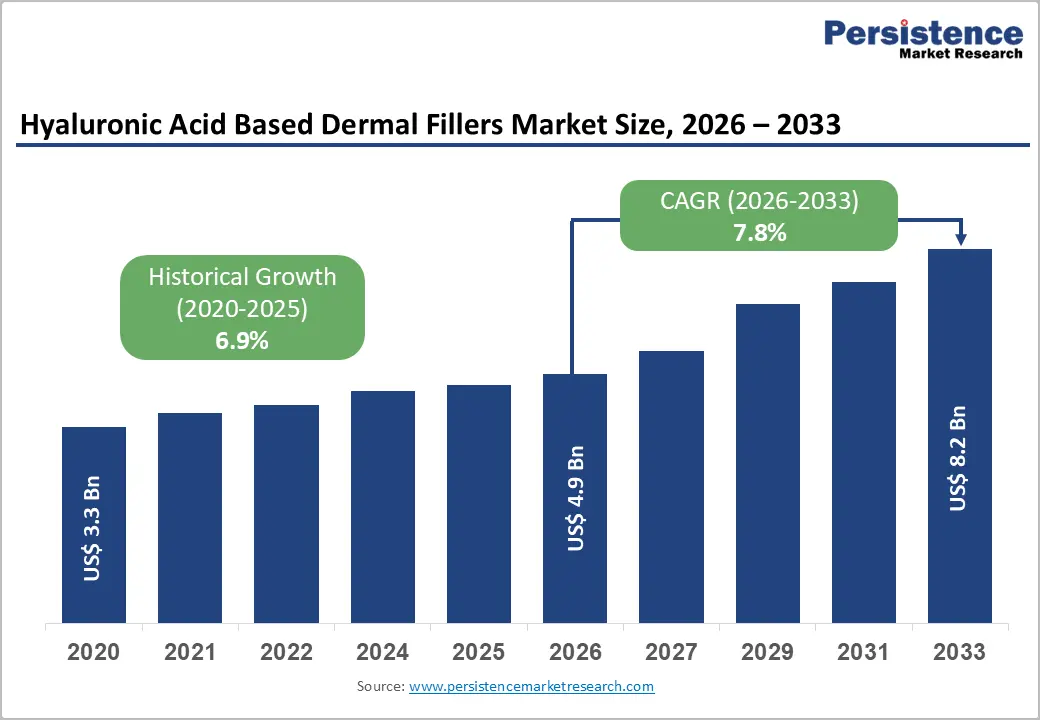
The global hyaluronic acid-based dermal fillers market size is expected to be valued at US$ 4.9 billion in 2026 and projected to reach US$ 8.2 billion by 2033, growing at a CAGR of 7.8% between 2026 and 2033.
An increase in disposable incomes in developing economies is further increasing individual ability and willingness to spend on aesthetic procedures. Hyaluronic acid (HA) is a preferred choice for dermal fillers owing to its biocompatibility, low risk profile, and natural aesthetic results, which have led to its continued dominance in the global dermal filler market. Consumers across the globe are seeking quick, effective, and safe procedures, thereby making HA-based fillers suitable for individuals looking for restoration of facial volume and other targeted therapies.
The introduction of products like Juvéderm Voluma and Restylane Lyft has introduced long-lasting and less invasive solutions that cater to different skin types and facial areas, thereby increasing their appeal. The trend toward long-lasting effects of dermal fillers, with some lasting 18 to 24 months, is expected to drive continued market growth.
Key Industry Highlights
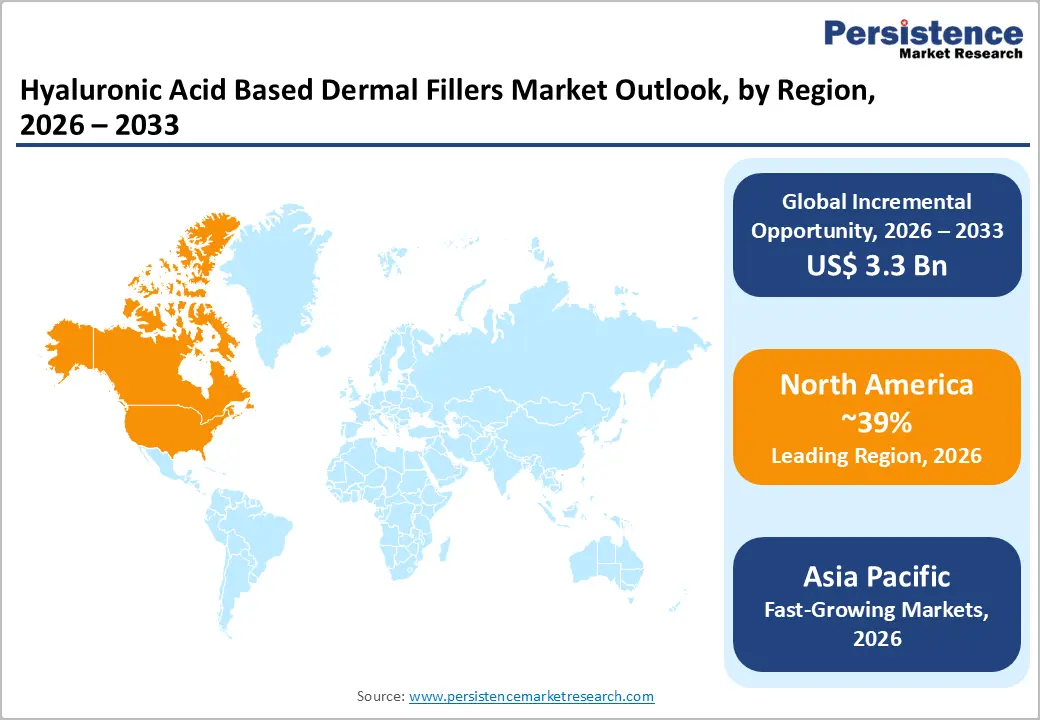
- Leading Region: North America leads due to advanced aesthetic infrastructure, high procedure volumes, strong purchasing power, and early adoption of premium HA fillers.
- Fastest-Growing Region: Asia Pacific is the fastest-growing region, driven by rising aesthetic awareness, medical tourism, disposable incomes, and strong demand in South Korea.
- Dominant Segment: Single-phase HA dermal fillers dominate, preferred for smooth texture, natural-looking results, ease of application, and longer-lasting effects.
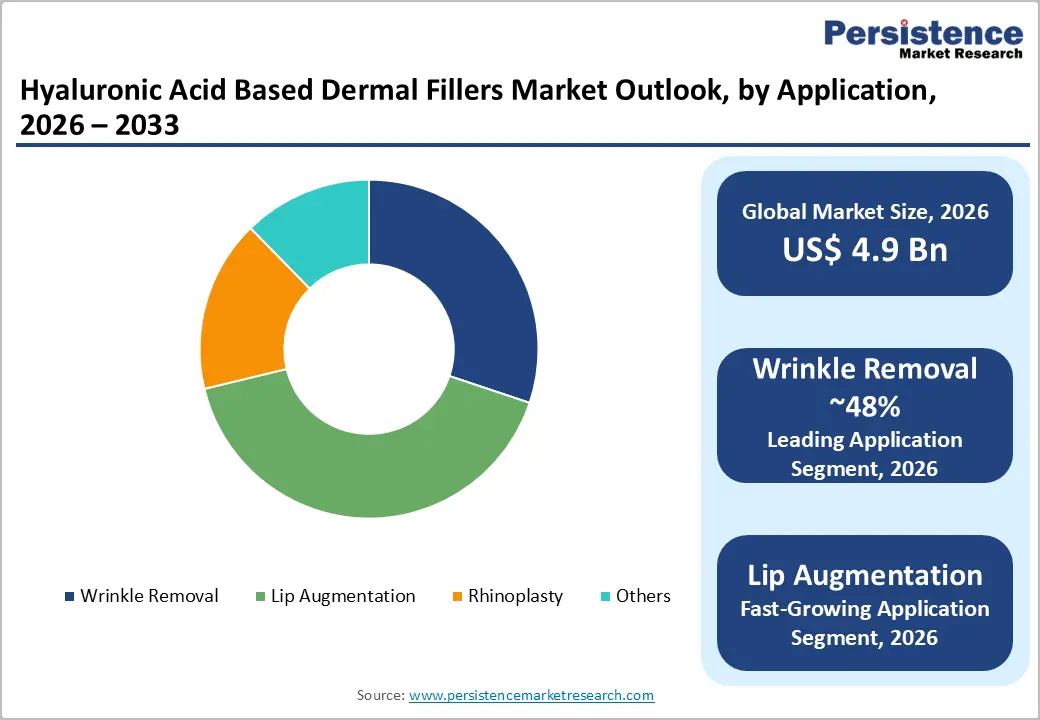
- Fastest-Growing Segment: Lip Augmentation grows fastest, supported by social media influence, younger demographics, repeat procedures, and demand for natural volume enhancement.
| Key Insights | Details |
|---|---|
| Hyaluronic Acid-Based Dermal Fillers Market Size (2026E) | US$ 4.9 Bn |
| Market Value Forecast (2033F) | US$ 8.2 Bn |
| Projected Growth (CAGR 2026 to 2033) | 7.8% |
| Historical Market Growth (CAGR 2020 to 2025) | 6.9% |
Market Dynamics
Driver - Non-invasive Aesthetic Procedures to Witness a Surge in Demand
Individuals across the globe are opting for non-surgical treatments owing to their convenience, reduced costs compared to conventional surgical processes, and minimal recovery time. A report published by the American Society of Plastic Surgeons (ASPS) indicated that in 2022, the U.S. alone saw 17 million minimally invasive cosmetic procedures, with dermal fillers among the most popular treatments. This reflects a shift towards aesthetic enhancements that provide swift results with minimal disruption to daily life. A study by the Aesthetic Surgery Journal found a 30% increase in the number of non-invasive procedures performed globally from 2018 to 2022. Their ability to address concerns like wrinkles, facial volume loss, and lip enhancement without the requirement for general anesthesia has made non-invasive procedures like dermal fillers popular.
Technological Advancements in Hyaluronic Acid-Based Dermal Fillers
Technological advancements in hyaluronic acid-based dermal fillers significantly enhance their effectiveness, appeal, and safety, thereby driving the market's growth. Innovations in cross-linking technology improve the longevity and aesthetic results of these fillers.
Latest technologies, such as OxiFree, are often used in MaiLi dermal fillers by Sinclair Pharma, helping preserve the natural properties of hyaluronic acid, resulting in a natural look and long-lasting effects. Micro-needle injection techniques are revolutionizing dermal filler application by reducing discomfort while enhancing precision during treatment.
The use of hybrid fillers combining hyaluronic acid with other substances, such as calcium hydroxylapatite or poly-L-lactic acid, further expands treatment options, enabling customized treatments.
Restraints - Regulatory Challenges likely to Surge Costs
Regulatory challenges are a significant restraint in the hyaluronic acid-based dermal filler market, thereby affecting product development, market entry, and availability. The regulatory approval process for cosmetic and medical devices varies across regions. Meeting these requirements can be time-consuming and costly for manufacturers.
In the U.S., dermal fillers must be approved by the Food and Drug Administration (FDA), which requires extensive clinical trials to demonstrate their safety and efficacy. The lengthy process for approval is both time consuming and expensive, thereby increasing the overall costs for manufacturers, ultimately affecting product pricing and accessibility.
Dermal fillers are classified as medical devices in Europe and therefore must comply with the Medical Device Regulation (MDR), which came into effect in 2021. This mandates manufacturers to conduct rigorous testing, including clinical evaluation, post-market surveillance, and risk assessments. This further raises costs for manufacturers, making it difficult for smaller companies to enter the market.
Opportunity - Rise of Medical Tourism Opens up New Avenues for Growth
Medical tourism is estimated to emerge as a significant growth driver for the hyaluronic acid-based dermal filler market as patients across the globe seek affordable and superior quality cosmetic procedures abroad. Several countries are offering competitive pricing and skilled professionals for aesthetic procedures, including dermal fillers, thereby attracting a rising number of international patients.
South Korea, Brazil, Turkey, India, and Thailand are key destinations for aesthetic medical tourism, renowned for their advanced medical infrastructure and expertise in cosmetic treatments. Over 25% of medical tourists in South Koreas in 2022 sought aesthetic procedures, including dermal fillers. Turkey attracts around 700,000 medical tourists annually. Many of these tourists choose cosmetic enhancements owing to their cost-effective offerings, which are 40% to 60% cheaper than in Western countries, where treatment charges can exceed US$600 to US$800 per session. Medical tourism hubs are catering to patients by bundling cosmetic procedures with travel packages, thereby offering a blend of luxury and healthcare.
Social Media Plays a Crucial Role in the Evolution of Beauty Standards
Social media and celebrity culture heavily influence beauty standards. Studies suggest that 72% of millennials and Gen Z consumers seek cosmetic treatments, heavily influenced by social media influencers and celebrities.
Platforms like Instagram and TikTok have created a space where people can visualize and discuss facial aesthetics. This constant exposure encourages individuals to seek enhancements in features such as sharp jawlines, contoured cheekbones, and fuller lips, which are easily achievable with dermal fillers.
The young demographics, particularly Gen-Z, are embracing these procedures for not just corrective purposes but for achieving “idealized” looks that resonate with current beauty trends. A report by the American Society of Plastic Surgeons found a 12% increase in dermal filler use among individuals ages 20 to 39 from 2019 to 2022.
The rise in “selfie culture” has further accelerated this trend. Enhanced cameras and filters highlight facial symmetry and features, fostering greater self-awareness of one’s appearance. Inclusivity in beauty standards has created diverse opportunities.
People from various ethnicities and skin types are seeking personalized filler treatments tailored to their unique facial features. Influencers and celebrities are openly sharing their experiences with dermal fillers, assisting in destigmatizing these procedures. This transparency further encourages prospective consumers to view fillers as routine self-care rather than excessive vanity.
Category-wise Analysis
By Product Type Insights
Single-phase hyaluronic acid dermal fillers are gaining global adoption due to their refined texture, uniform gel structure, and ease of injection, which collectively support more natural aesthetic outcomes. These fillers are manufactured through advanced crosslinking processes that create a homogeneous gel, enabling smoother extrusion and improved tissue integration. Continuous technological advances in crosslinking methods have significantly improved gel consistency, elasticity, and resistance to degradation. As a result, modern single-phase fillers offer longer durability, with effects typically lasting between 12 and 18 months. Clinicians favor these products for their predictable performance, reduced risk of lump formation, and improved patient comfort during procedures.
Additionally, ongoing product refinements focused on optimizing crosslinking density have improved volumizing capability while maintaining softness, supporting broader use across facial indications. Rising consumer demand for subtle, long-lasting, and minimally invasive aesthetic solutions continues to reinforce the strong growth trajectory of single-phase hyaluronic acid dermal fillers.
By Application Insights
Hyaluronic acid-based dermal fillers used for non-surgical rhinoplasty, commonly referred to as liquid nose jobs, have experienced notable growth in recent years. This application has emerged as a preferred alternative to traditional surgical rhinoplasty, particularly among individuals seeking temporary and reversible enhancements. Non-surgical rhinoplasty enables correction of minor asymmetries, nasal bridge irregularities, and contour deficiencies without anesthesia, incisions, or prolonged recovery periods. In 2022, liquid rhinoplasty accounted for approximately 15-20% of all non-surgical facial aesthetic procedures, underscoring its growing share of overall dermal filler demand. The U.S. recorded an estimated 18% increase in non-surgical nose reshaping procedures between 2021 and 2022, reflecting growing patient acceptance. Cost advantages, minimal downtime, and immediate visible results further support adoption. These factors collectively position rhinoplasty as a steadily expanding application within the hyaluronic acid dermal fillers market.
Region-wise Insights
North America Hyaluronic Acid-Based Dermal Fillers Market Trends
North America continues to represent a mature and innovation-driven market for hyaluronic acid-based dermal fillers. High procedure volumes are supported by strong aesthetic awareness, an aging population seeking non-invasive anti-aging solutions, and widespread acceptance of cosmetic treatments among both women and men. The region benefits from a well-established network of dermatology and medical aesthetics clinics, alongside trained practitioners skilled in advanced injection techniques. Product demand is increasingly shifting toward premium fillers offering longer duration, improved safety profiles, and tailored indications for lips, wrinkles, and facial contouring. Regulatory clarity and frequent product approvals further encourage innovation and the commercialization of next-generation formulations.
Additionally, the growing influence of social media and celebrity culture continues to normalize aesthetic enhancements, particularly among younger demographics. Combination treatments involving fillers and neuromodulators are also gaining popularity, reinforcing sustained demand for hyaluronic acid dermal fillers across the region.
Asia Pacific Hyaluronic Acid-Based Dermal Fillers Market Trends
The Asia Pacific hyaluronic acid-based dermal fillers market is experiencing rapid expansion, driven by rising disposable incomes, urbanization, and increasing interest in facial aesthetics. Countries such as South Korea, China, Japan, and India are witnessing strong growth driven by expanding medical aesthetics infrastructure and a growing pool of trained practitioners. Cultural preferences for subtle, natural-looking enhancements have increased demand for softer fillers with precise contouring capabilities. Medical tourism plays a significant role, particularly in Southeast Asia, where cost-effective procedures attract international patients. Younger consumers are increasingly adopting fillers for preventive and enhancement purposes rather than solely for age correction. Local manufacturers are also gaining traction by offering competitively priced products tailored to regional facial anatomy. Digital marketing, influencer-led awareness, and growing acceptance of minimally invasive procedures continue to accelerate market penetration, positioning Asia Pacific as the fastest-growing regional market for hyaluronic acid dermal fillers.
Competitive Landscape
The competitive landscape of the hyaluronic acid-based dermal fillers market is characterized by continuous innovation and strategic expansion. Leading players are increasingly adopting advanced technologies such as OxiFree hyaluronic acid formulations to enhance filler stability, durability, and biocompatibility, thereby improving treatment outcomes and patient satisfaction. Companies are also focusing on developing application-specific products targeting wrinkles, lips, and facial contouring to address evolving consumer preferences. In parallel, market participants are pursuing strategic acquisitions and partnerships to broaden their product portfolios and strengthen geographic presence. Emphasis on expansion in high-growth emerging markets reflects rising aesthetic awareness, increasing disposable incomes, and growing acceptance of minimally invasive cosmetic procedures.
Key Industry Developments:
- In September 2025, Allergan Aesthetics, an AbbVie company, launched the “Naturally You with Injectable Hyaluronic Acid Fillers” campaign to deliver clear, evidence-based education on hyaluronic acid injectable fillers.
- In February 2025, Evolus, Inc., a performance beauty company focused on expanding its aesthetic portfolio, announced that the U.S. Food and Drug Administration (FDA) approved Evolysse™ Form and Evolysse™ Smooth, its first two injectable hyaluronic acid (HA) gel products under the Evolysse™ brand.
- In June 2024, SkinCeuticals, headquartered in New York, launched HA intensifier multi-glycan hyaluronic acid volumizing serum, which is designed to plump, contour, and complement dermal filler injections.
- In May 2024, Galderma, based in Lausanne, launched Restylane VOLYME in China, one of the fastest-growing aesthetics markets. The product is designed to contour and volumize the mid-face region to support the patient in achieving a youthful and revitalized look.
- In May 2024, California-based Evolus announced its expansion into the U.S. dermal filler market with Evolysse, a first-generation cold-technology HA from Symatese.
- In April 2024, Galderma Korea, headquartered in Seoul, announced the launch of Restylane Eyesight, a new product featuring Galderma’s proprietary “NASHA” technology, in June.
Companies Covered in Hyaluronic Acid Based Dermal Fillers Market
- Allergan Aesthetics (AbbVie Inc.)
- Galderma
- Anika Therapeutics Inc.
- Merz Pharmaceuticals
- Genzyme Corporation
- Bio plus Co. Ltd.
- LG Life Sciences
- Sinclair Pharma
- Sculpt Luxury
- Dermal Fillers Ltd.
- Bioxis Pharmaceutical
- Sinclair Pharma; Laboratories
- Bohus BioTech AB
- Others
Frequently Asked Questions
The global hyaluronic acid based dermal fillers market is projected to be valued at US$ 4.9 Bn in 2026.
Rising aging population, growing aesthetic awareness, minimally invasive procedures, longer-lasting formulations, and expanding dermatology clinics worldwide.
The global market is expected to witness a CAGR of 7.8% between 2026 and 2033.
Growth in emerging economies, male aesthetics adoption, combination therapies, advanced cross-linking technologies, and increasing medical tourism demand.
North America is the leading region in the global hyaluronic acid based dermal fillers market.


