




- Agrochemicals
- Horticulture Bioplastic Market
Horticulture Bioplastic Market Size, Share, and Growth Forecast, 2026 – 2033
Horticulture Bioplastic Market by Material Type (Polylactic Acid (PLA), Polyhydroxyalkanoates (PHA), Others), Application (Mulching Films, Seedling Trays, Others), and Regional Analysis for 2026 – 2033

Horticulture Bioplastic Market Size and Trends Analysis
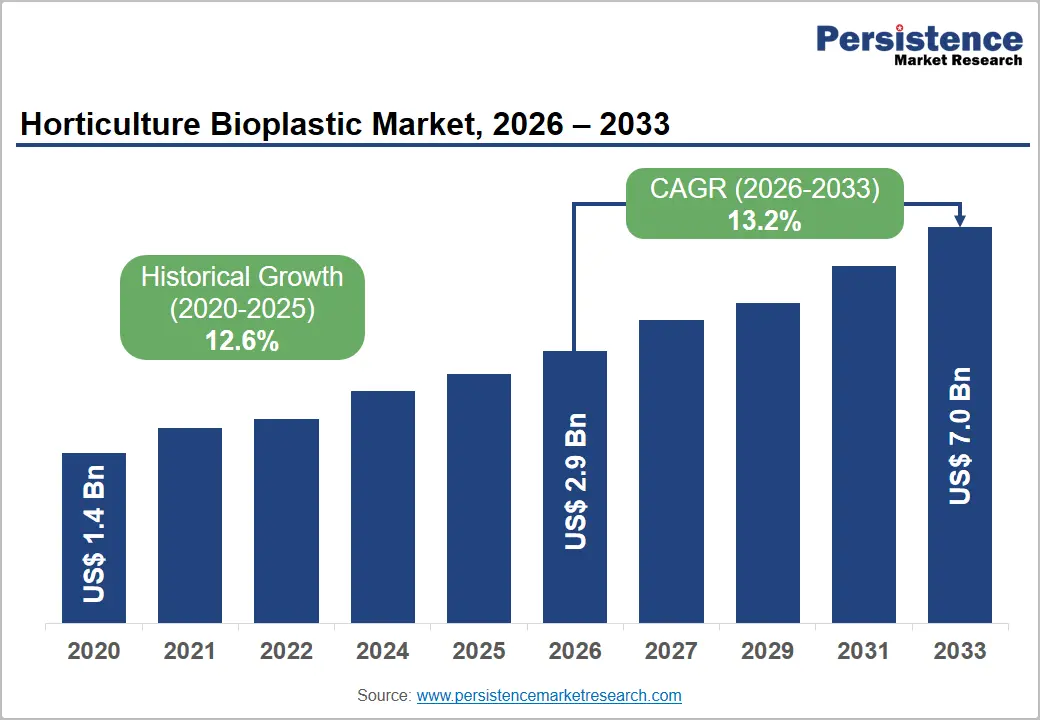
The global horticulture bioplastic market size is likely to be valued at US$2.9 billion in 2026 and is expected to reach US$7.0 billion by 2033, growing at a CAGR of 13.2% during the forecast period from 2026 to 2033, driven by increasing adoption of environmentally sustainable materials across commercial horticulture, greenhouse cultivation, nurseries, and landscaping applications.
Rising concerns regarding plastic waste accumulation, soil contamination, and regulatory restrictions on conventional plastics are encouraging growers to shift toward biodegradable alternatives such as PLA, PHA, starch blends, and cellulose-based products. Demand for bioplastic mulch films, seedling trays, planters, greenhouse covers, and compost bags continues to expand due to their ability to improve operational efficiency while supporting sustainability objectives.
Key Industry Highlights:
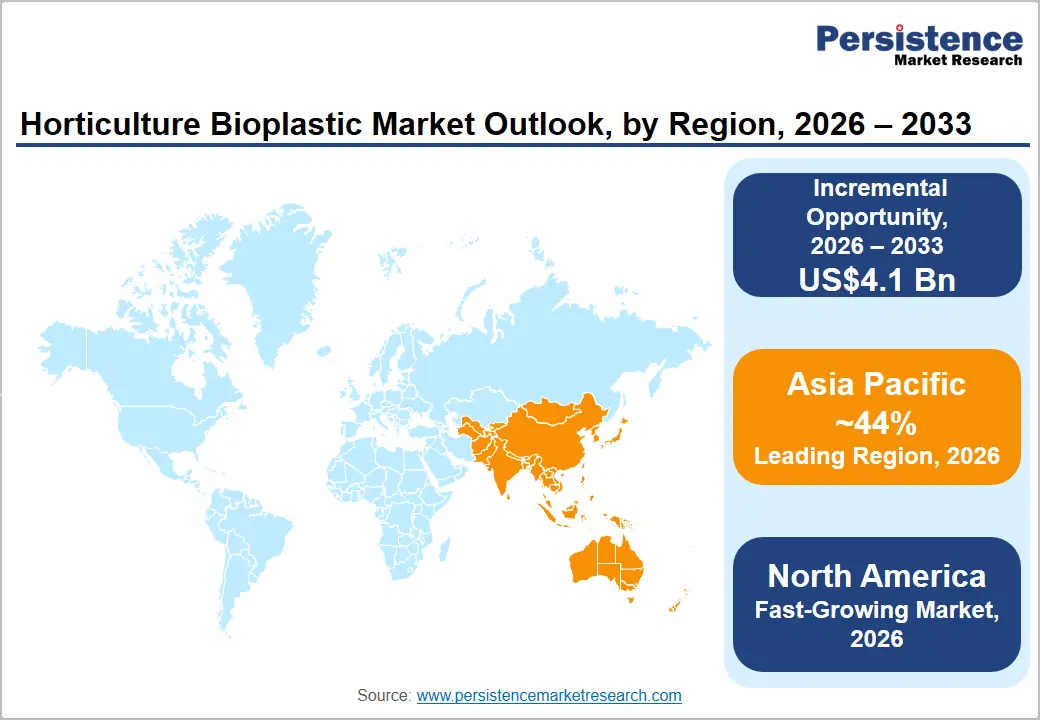
- Leading Region: Asia Pacific is anticipated to be the leading region, accounting for a market share of 44% in 2026, driven by strong agricultural production, expanding bioplastics manufacturing capacity, and supportive sustainability initiatives.
- Fastest-growing Region: North America is likely to be the fastest-growing region, supported by strong innovation capabilities, favorable regulatory policies, and widespread adoption of sustainable agricultural materials.
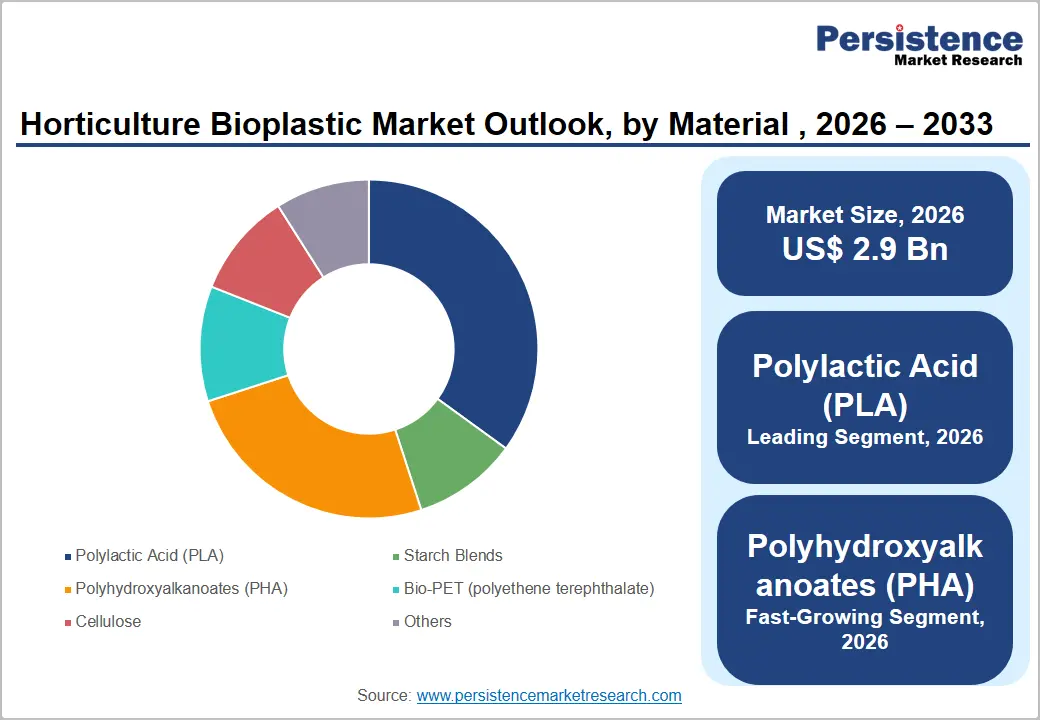
- Leading Material Type: Polylactic acid (PLA) is projected to represent the leading material type in 2026, accounting for 36% of the revenue share, due to its widespread use in horticultural films, trays, and compostable products.
- Leading Application: Mulching films are anticipated to be the leading application, accounting for over 41% of the revenue share in 2026, supported by strong demand for biodegradable alternatives to conventional agricultural plastics.
- Key Opportunity: Rising emphasis on sustainable crop production and plastic waste reduction is creating substantial opportunities for innovative bioplastic materials that combine high performance with complete biodegradability in horticultural applications.
DRO Analysis
Driver - Technological Advancements in Material Performance
Continuous improvements in Polylactic Acid (PLA), Polyhydroxyalkanoates (PHA), cellulose-based materials, and starch blends have enhanced mechanical strength, flexibility, moisture resistance, and biodegradation performance. These developments enable bioplastics to withstand demanding horticultural environments while maintaining crop productivity. Manufacturers are increasingly introducing tailored formulations designed for mulch films, seedling trays, compost bags, and planters.
Enhanced processing compatibility with conventional manufacturing equipment also reduces production complexity and encourages adoption among horticulture product manufacturers seeking sustainable alternatives to petroleum-based plastics without compromising operational efficiency. Material innovation is also improving the functional lifespan of horticultural bioplastics, making them more suitable for commercial farming and greenhouse applications.
Advanced polymer blending technologies help optimize degradation rates according to crop cycles and environmental conditions. Research institutions and industry participants are investing in next-generation biopolymers that offer improved thermal stability and soil compatibility. These innovations reduce concerns related to premature degradation and inconsistent performance.
Restraint - Performance and Durability Limitations in Field Conditions
Many biodegradable materials experience variations in strength, flexibility, and degradation behavior when exposed to fluctuating temperatures, ultraviolet radiation, soil moisture, and microbial activity. Such inconsistencies can affect the effectiveness of mulch films, greenhouse covers, and plant containers during extended cultivation periods. Growers often require materials capable of maintaining structural integrity throughout the entire crop cycle.
The challenge becomes more significant in regions with extreme climatic conditions where horticultural products face prolonged exposure to heat, rainfall, and mechanical stress. Bioplastics degrade faster or slower than intended depending on local soil and weather characteristics, creating uncertainty for end users. Limited standardization across biodegradable material formulations contributes to performance variability. Growers accustomed to conventional plastics may hesitate to transition without proven long-term reliability.
Opportunity - Development of Advanced PHA and Blends
PHA-based materials offer excellent biodegradability in soil environments, making them particularly attractive for agricultural and horticultural applications. Growing environmental concerns and regulatory pressure to reduce plastic waste are encouraging manufacturers to invest in next-generation biodegradable polymers. Advanced blends combining PHA with PLA, starch, or cellulose can improve strength, flexibility, and processing performance while maintaining favorable environmental characteristics.
Increasing research and commercialization efforts are accelerating the availability of advanced PHA formulations suitable for diverse horticultural conditions. Manufacturers are focusing on reducing production costs and enhancing material properties to compete more effectively with conventional plastics.
Customized blends can be engineered to achieve controlled degradation rates, enabling products to remain functional throughout cultivation cycles before naturally decomposing. This capability is particularly valuable in commercial horticulture where operational efficiency and environmental compliance are critical.
Category-wise Analysis
Material Type Insights
Polylactic acid (PLA) is expected to account for 36% of revenue in 2026, due to its excellent balance of biodegradability, processability, and commercial availability. PLA is extensively utilized in horticultural applications such as mulch films, seedling trays, plant pots, and compostable cultivation products because it can be processed using existing plastic manufacturing infrastructure. A notable example includes NatureWorks LLC, which supplies PLA-based biopolymers used in compostable agricultural and horticultural products worldwide.
Polyhydroxyalkanoates (PHA) are likely to represent the fastest-growing segment. The increasing preference for fully biodegradable materials that can decompose naturally in soil environments is driving demand for PHA-based products. Growing investments in research and development have enhanced PHA performance, enabling its use in mulch films, seedling trays, compost bags, and specialty cultivation products. For example, Danimer Scientific, which has been actively developing PHA-based biodegradable materials that support the transition toward sustainable agricultural and horticultural applications.
Application Insights
Mulching films are projected to lead the market, capturing around 41% of the revenue share in 2026, supported by their widespread use in commercial crop cultivation and horticultural production systems. Biodegradable mulching films help suppress weed growth, conserve soil moisture, regulate temperature, and improve crop productivity while eliminating the need for costly plastic retrieval and disposal processes. For instance, BASF SE, which offers biodegradable polymer technologies used in mulch film applications designed to support sustainable horticultural and agricultural practices.
Seedling trays are likely to be the fastest-growing application. The growing adoption of protected cultivation, greenhouse farming, and commercial nursery operations is increasing demand for sustainable propagation solutions. Bioplastic seedling trays provide adequate strength during plant growth while offering the advantage of biodegradability after use, reducing waste management challenges for growers. A notable example includes Novamont S.p.A., whose biodegradable bioplastic technologies are increasingly utilized in nursery and seedling production applications.
Regional Insights
North America Horticulture Bioplastic Market Trends
North America is likely to be the fastest-growing region, supported by increasing sustainability initiatives, stricter regulations on conventional plastic use, and rising demand for environmentally friendly cultivation materials. For example, NatureWorks LLC, which continues expanding PLA biopolymer solutions used in horticultural and agricultural products, supports the transition toward renewable and compostable materials.
U.S. Horticulture Bioplastic Market Trends
The U.S. is expected to dominate the regional market, accounting for approximately 88% of the market share in 2026, driven by growing adoption of sustainable farming practices and biodegradable cultivation products. State-level restrictions on single-use plastics are encouraging the use of compostable alternatives. Greenhouse and nursery operators are increasingly adopting bioplastic trays and pots. Research institutions continue developing advanced biodegradable materials with improved field performance. Commercial horticulture producers are focusing on reducing plastic waste generation.
Canada Horticulture Bioplastic Market Trends
Canada is likely to be a significant market for horticulture bioplastics, holding approximately 12% of the regional market share in 2026, supported by increasing environmental awareness and sustainability initiatives. Growers are adopting biodegradable mulch films and compostable cultivation products to support waste reduction goals. Greenhouse cultivation continues to expand, creating opportunities for sustainable horticultural products. Research activities related to biodegradable polymers are increasing across the country.
Europe Horticulture Bioplastic Market Trends
Europe is likely to be a significant market for horticulture bioplastic in 2026, due to strong environmental regulations, circular economy objectives, and widespread adoption of sustainable agricultural practices. The region continues to encourage the replacement of conventional plastics with biodegradable alternatives across horticulture and agriculture. A notable example includes Novamont S.p.A., which develops biodegradable bioplastic materials widely used in agricultural and horticultural applications throughout Europe.
U.K. Horticulture Bioplastic Market Trends
The U.K. is likely to account for approximately 22% of the European horticulture bioplastic market in 2026, supported by environmental regulations and sustainable farming initiatives. Growers are increasingly seeking alternatives to traditional agricultural plastics. Compostable mulch films and biodegradable plant containers are gaining wider acceptance across commercial horticulture operations. The expansion of protected cultivation is creating additional opportunities for sustainable products. Research into biodegradable materials continues to support innovation.
Germany Horticulture Bioplastic Market Trends
Germany is anticipated to dominate the regional market, accounting for around 30% of the Europe market share in 2026, due to strong sustainability policies and advanced manufacturing capabilities. The country actively promotes biodegradable materials across agricultural and horticultural sectors. Commercial growers are increasingly utilizing compostable mulch films and cultivation products. Research organizations continue developing high-performance bio-based polymers. Circular economy initiatives are encouraging reduced dependence on conventional plastics.
Asia Pacific Horticulture Bioplastic Market Trends
The Asia Pacific region is anticipated to be the leading region, accounting for a market share of 44% in 2026, driven by its expanding agricultural activities, increasing environmental concerns, and government support for sustainable materials. The region benefits from large horticultural production bases and growing awareness regarding plastic waste management. For instance, Total Corbion PLA continues expanding PLA production and supporting the availability of bio-based materials for agricultural and horticultural applications.
China Horticulture Bioplastic Market Trends
China is projected to dominate the regional market, holding around a 35% share of the market in 2026, due to its large agricultural sector and increasing environmental regulations. Adoption of biodegradable mulch films is expanding rapidly in horticultural cultivation. Domestic manufacturers are increasing investments in biopolymer production capacity. Research efforts are focused on improving material performance and affordability.
India Horticulture Bioplastic Market Trends
India is expected to emerge as a significant market, accounting for approximately 20% share in 2026, due to expanding horticultural production and growing environmental awareness. Demand for bioplastic mulch films is increasing among horticultural growers seeking efficient and environmentally friendly cultivation methods. The country is witnessing growing investments in bio-based material manufacturing. Nursery operators are increasingly utilizing compostable trays and plant containers.
Competitive Landscape
The global horticulture bioplastic market exhibits a moderately fragmented structure, driven by increasing demand for sustainable cultivation materials, continuous advancements in biodegradable polymer technologies, and expanding regulatory support for reducing conventional plastic waste in agriculture and horticulture. Growing investments in bio-based feedstocks, production capacity expansion, and material innovation are reshaping the competitive environment.
With key leaders including BASF SE, NatureWorks LLC, Novamont S.p.A., Total Corbion PLA, BioBag International AS, and FKuR Kunststoff GmbH, the industry continues to benefit from strong product development activity and growing adoption across commercial horticulture operations. These players compete through material performance enhancement, biodegradability improvements, strategic partnerships, product portfolio diversification, and expansion of bio-based polymer production capabilities.
Key Industry Developments:
- In November 2025, Novamont S.p.A. achieved new certification milestones for its Mater-Bi® biodegradable mulch film products, supporting broader adoption of sustainable horticultural films across regulated agricultural markets.
- In June 2025, BioBag International AS introduced enhanced agricultural-grade biodegradable film solutions engineered for demanding cultivation environments, expanding the application of compostable materials in horticulture.
Companies Covered in Horticulture Bioplastic Market
- BASF SE
- Novamont S.p.A.
- NatureWorks LLC
- Total Corbion PLA
- Cardia Bioplastics
- Green Dot Bioplastics
- BioBag International AS
- FKuR Kunststoff GmbH
Frequently Asked Questions
The global horticulture bioplastic market is projected to reach US$2.9 billion in 2026.
Growing demand for biodegradable and sustainable alternatives to conventional plastics in horticulture, supported by environmental regulations and increasing adoption of eco-friendly cultivation practices, is driving market growth.
The horticulture bioplastic market is expected to grow at a CAGR of 13.2% from 2026 to 2033.
Expanding adoption of advanced biodegradable bioplastics in mulch films, seedling trays, planters, and greenhouse applications presents significant growth opportunities across commercial horticulture and sustainable agriculture sectors.
BASF SE, Novamont S.p.A., NatureWorks LLC, Total Corbion PLA, and Cardia Bioplastics are the leading players.


