




- Nutraceuticals & Functional Foods
- Flaxseed Oil Market
Flaxseed Oil Market Size, Share, and Growth Forecast, 2026-2033
Flaxseed Oil Market by Product Type (Cold-Pressed, Hot-Pressed, Extraction-Based), Nature (Organic, Conventional), Application (Food, Cosmetics, Pharmaceuticals, Others), and Regional Analysis for 2026-2033

Flaxseed Oil Market Share and Trends Analysis
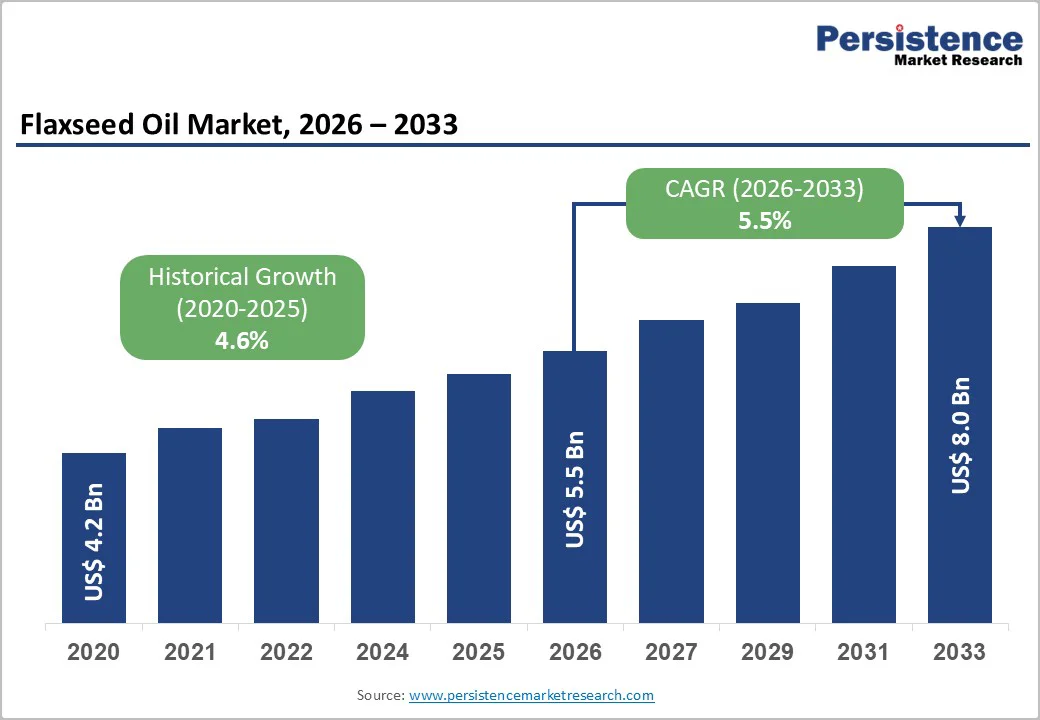
The global flaxseed oil market size is likely to be valued at US$ 5.5 billion in 2026 and is projected to reach US$ 8.0 billion by 2033, growing at a CAGR of 5.5% during the forecast period 2026-2033. Market expansion is primarily supported by the rising consumption of plant-based omega-3 fatty acids, increasing use of flaxseed oil in functional foods and nutraceutical formulations, and expanding demand from cosmetics and pharmaceutical applications. Regulatory recognition of alpha-linolenic acid (ALA) benefits, coupled with clean-label preferences and advances in cold-press extraction technologies, continues to strengthen market adoption across developed and emerging economies.
Key Industry Highlights
- Dominant Product Type: Cold-pressed flaxseed oil is expected to command approximately 45% of revenue in 2026, while extraction-based flaxseed oil is projected to grow fastest at 6.1% CAGR through 2033, driven by higher yield efficiency.
- Leading Nature Segment: Conventional flaxseed oil is anticipated to rule an estimated 70% revenue share in 2026, whereas organic flaxseed oil is likely to expand at about 6.4% CAGR through 2033, supported by a soaring demand for certified, clean-label ingredients.
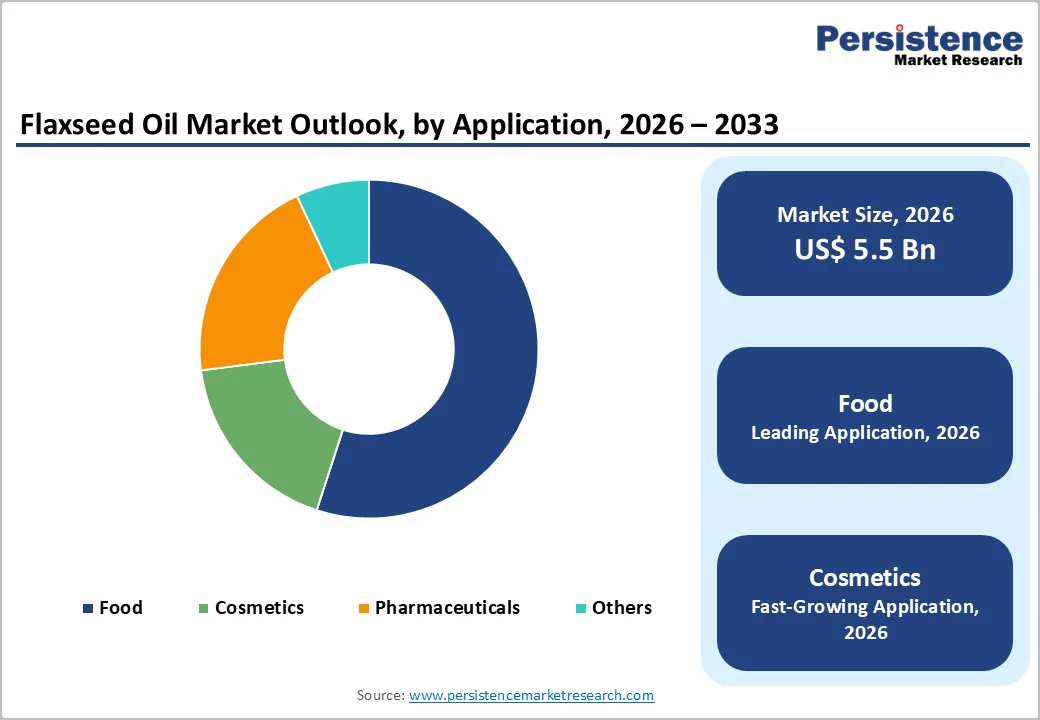
- Dominant Applications: Food applications are projected to account for around 55% of revenues in 2026, while cosmetics are expected to grow the fastest at 6.7% CAGR through 2033, reflecting the increased use of plant-derived oils in natural skincare and haircare formulations.
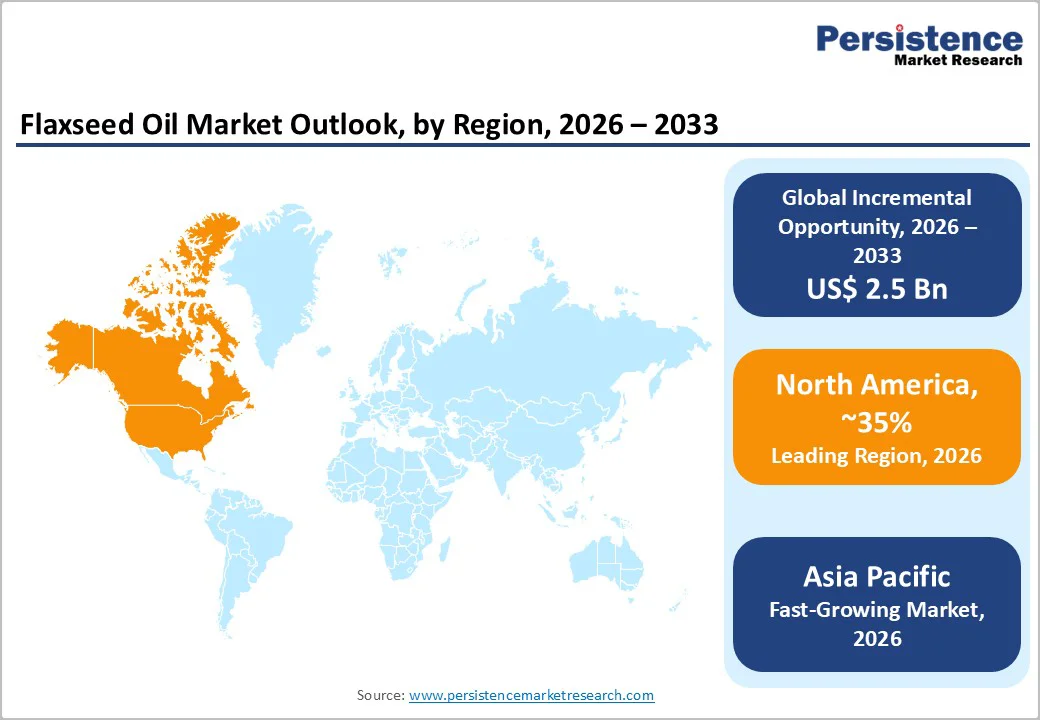
- Regional Leadership: North America is expected to hold roughly 35% share in 2026, while Asia Pacific is anticipated to be the fastest-growing market at an approximate 2026-2033 CAGR of 6.5%, aided by massive domestic flaxseed cultivation.
- Primary Growth Catalyst: Rising preference for plant-derived omega-3 fatty acids as sustainable alternatives to marine-based oils is primarily catalyzing market growth.
| Key Insights | Details |
|---|---|
| Flaxseed Oil Market Size (2026E) | US$ 5.5 Bn |
| Market Value Forecast (2033F) | US$ 8.0 Bn |
| Projected Growth (CAGR 2026 to 2033) | 5.5% |
| Historical Market Growth (CAGR 2020 to 2025) | 4.6% |
Market Factors – Growth, Barriers, and Opportunity Analysis
Accelerated Flaxseed Oil Adoption in Nutraceuticals, Supplements, and Personal Care
The flaxseed oil market growth is likely to gather speed, owing to the role of this ingredient as a plant-based source of omega-3 fatty acids, particularly ALA, which supports cardiovascular and metabolic health. Persistent dietary omega-3 gaps have encouraged manufacturers to adopt flaxseed oil as a non-marine alternative, with integration into bakery products, dairy alternatives, and nutrition-focused foods expanding consumption volumes. Its compatibility with vegetarian diets and sustainability preferences further strengthens long-term demand.
The adoption of flaxseed oil across nutraceuticals, supplements, and personal care is accelerating. In January 2025, for example, Abbott Laboratories launched a microencapsulated flaxseed oil ingredient for pediatric and adult clinical nutrition, enhancing stability and bioavailability of omega-3s. In July 2025, NOW Foods introduced high-oleic flaxseed oil softgels enriched with vitamin E, targeting mainstream wellness consumers and expanding supplement and pharmaceutical applications. Cosmetic formulations are increasingly incorporating flaxseed oil for its emollient and soothing properties, broadening market reach and reinforcing overall growth.
Supply-Driven Cost Volatility and Oxidative Stability Limitations
One key constraint facing the market is raw material price volatility arising from its dependence on agricultural flaxseed production, which is influenced by weather variability and trade-related disruptions. For instance, during late 2024 and early 2025, higher European Union (EU) import tariffs on Russian flaxseed, alongside Russia’s export duties, reduced cross-border availability. At the same time, reduced export volumes from Kazakhstan further tightened supply for European processors. These combined factors led to elevated raw material prices and procurement uncertainty, indicating a sharp decline in EU flaxseed processing activity, with volumes falling to multi-year lows. This volatility limits long-term fixed pricing contracts and places sustained margin pressure on small- and mid-scale manufacturers.
Oxidation sensitivity represents a significant technical restraint for flaxseed oil across multiple end uses. Its high polyunsaturated fatty acid content makes it highly reactive to oxygen, light, and heat exposure. Oxidation can begin within hours to days under ambient conditions, rapidly degrading oil quality. Even under controlled storage environments, the typical shelf life is limited to approximately six to nine months. During extended transportation or inconsistent temperature control, shelf life may decline to three to four months. These constraints restrict use in high-heat food processing and long distribution chains. As a result, producers must rely on specialized packaging, cold storage, and frequent quality testing, increasing operational complexity and costs.
Novel Opportunities across Functional Nutrition and Health-Focused Applications
Companies operating in the flaxseed oil market can tap into strong growth opportunities emerging in functional nutrition and fortified health products, particularly in developing economies that are undergoing rapid urbanization and dietary shifts. Rising demand for foods enriched with essential fatty acids is supporting the inclusion of flaxseed oil in fortified staples, infant nutrition products, and ready-to-consume health beverages, enabling volume-driven growth without reliance on premium pricing. For example, in 2025, Solgar launched an organic, cold-pressed flaxseed oil softgel designed for cardiovascular, immune, and skin health support, exemplifying the expanding nutraceutical applications and clean-label positioning of flaxseed oil.
Advancements in cold-press extraction and growing adoption in pharmaceutical and personal care applications are expanding higher-value opportunities. Improved processing technologies enhance oil yield while preserving nutrient integrity, meeting both clean-label requirements and production efficiency targets. Cosmetic brands such as SHIRO incorporated flaxseed oil into microbiome-friendly skincare formulations, highlighting its multifunctional properties. Coupled with the increasing use of alpha-linolenic acid in clinical nutrition, these trends strengthen demand across both mass-market and specialized health segments.
Category-wise Analysis
Product Type Insights
The cold-pressed segment is projected to lead the product category in 2026, accounting for around 45% of the flaxseed oil market revenue share. Its dominance is attributed to superior nutrient retention, especially ALA, and strong consumer preference for minimally processed oils. Cold-pressed variants are widely used across nutraceuticals, functional foods, and cosmetic formulations, supporting steady revenue generation. The segment also benefits from clean-label trends, as consumers increasingly seek oils processed without heat or chemical solvents. This widespread acceptance reinforces its leadership in both developed and emerging markets.
Extraction-based flaxseed oil is expected to represent the fastest-growing product type at a CAGR of about 6.1% through 2033. This growth is driven by scalability, cost efficiency, and suitability for large-scale food manufacturing. Advances in solvent recovery and stabilization technologies improve yields while maintaining quality, enabling broader application in processed foods. Manufacturers increasingly adopt these methods to meet rising demand in mass-market and industrial applications. The combination of affordability and process optimization positions extraction-based oil as the key growth driver for the broader market.
Nature Insights
Conventional flaxseed oil is likely to dominate the nature-based category, contributing approximately 70% of volume sales in 2026. Its broad availability and lower pricing make it the preferred choice for mass-market food processing and industrial applications. Conventional oil’s accessibility supports large-scale integration into bakery products, functional foods, and dietary supplements, reinforcing its continued leadership. Its established supply chain and reliable production volumes also minimize procurement challenges for processors and manufacturers.
Organic flaxseed oil is expected to be the fastest-growing segment, projected to register a CAGR of 6.4% between 2026 and 2033. Its growth is driven by rising consumer confidence in certified organic products and increasing demand for traceable, chemical-free ingredients. Regulatory-backed organic certification enhances credibility, enabling premium positioning in foods, supplements, and personal care products. The willingness of consumers to pay higher prices for organic products supports profitability while encouraging manufacturers to expand production and marketing efforts in this segment.
Application Insights
Food applications are projected to be the largest segment, accounting for around 55% of demand in 2026, led by bakery, dairy alternatives, functional beverages, and fortified foods. Sustained regulatory acceptance and Generally Recognized as Safe (GRAS) status support long-term adoption. The segment also benefits from recurring consumption patterns, integration into daily diets, and alignment with health-conscious trends. Food manufacturers increasingly incorporate flaxseed oil to enhance nutritional profiles, particularly in omega-3 enrichment, reinforcing its dominance across geographies.
Cosmetics and pharmaceutical applications are likely to represent the fastest-growing segment, at a CAGR of roughly 6.7% during the 2026–2033 forecast period. Skincare, haircare, and anti-aging products are increasingly formulated with flaxseed oil due to its emollient, anti-inflammatory, and therapeutic properties. In pharmaceuticals and clinical nutrition, flaxseed oil supports cardiovascular and metabolic health, creating opportunities in supplements, hospital diets, and functional therapeutic formulations. Innovation in these high-value applications continues to drive segment growth and expands the market beyond traditional food uses.
Regional Insights
North America Flaxseed Oil Market Trends
North America is expected to account for approximately 35% of the flaxseed oil market share in 2026, driven primarily by the U.S. Advanced nutraceutical and functional food manufacturing infrastructure, combined with regulatory clarity from the FDA, provides a favorable environment for market expansion. Clean-label trends and growing consumer awareness of plant-based omega-3 sources reinforce demand. In March 2025, for example, Nutiva acquired FlaxUSA’s flaxseed oil division, expanding production capacity and strengthening supply for North America’s food and wellness markets. Venture funding in functional food startups further supports innovation, enabling manufacturers to introduce fortified foods, dietary supplements, and personal care products with premium positioning.
Growth in North America is further supported by innovation-driven expansion in specialty oils and high-value formulations. Ongoing development of cold-pressed and organic variants sustains premium pricing, particularly in nutraceuticals and personal care. Health-conscious consumers increasingly adopt flaxseed oil for cardiovascular and metabolic benefits, enhancing market uptake. Combined with production expansions like Nutiva’s acquisition, these factors ensure steady scaling of production and product variety. Expanding manufacturing capabilities, strategic acquisitions, and innovation in clean-label formulations enable North America to maintain leadership while growing at a decent rate through 2033.
Europe Flaxseed Oil Market Trends
Europe is likely to represent a stable market for flaxseed oil, with Germany, France, and the U.K. as primary consumption hubs. Regulatory harmonization under the European Food Safety Authority (EFSA) guidelines ensures consistent safety standards across food, nutraceutical, and cosmetic applications. Sustainability policies favor plant-based oils over synthetic alternatives, supporting adoption in clean-label foods and natural personal care products. Well-established supply chains further reinforce demand, alongside growing consumer preference for functional ingredients enriched with omega-3 fatty acids. These factors create a favorable environment for both mass-market and premium products. The region continues to attract investment in innovation and product development. Consumer awareness of health and nutrition trends strengthens steady adoption of flaxseed oil.
The growth trajectory of the Europe flaxseed oil market remains moderate, as a result of the increasing uptake of organic and certified oils across multiple applications. Innovation in cosmetics, dietary supplements, and clinical nutrition supports market development and product diversification. Health awareness initiatives and dietary fortification programs encourage consistent consumption. Manufacturers can balance premium positioning with mass-market appeal through strategic marketing and supply chain optimization. Rising interest in plant-based and clean-label ingredients further reinforces adoption. Investment and regulatory support will continue to underpin long-term growth, ensuring steady market expansion in the region.
Asia Pacific Flaxseed Oil Market Trends
Asia Pacific is projected to be the fastest-growing regional market for flaxseed oil, predicted to showcase a CAGR of approximately 6.5% from 2026 to 2033, driven by growing health-conscious consumption. Domestic flaxseed cultivation in China and India, combined with low manufacturing costs, provides competitive advantages for both local and export-oriented production. Expanding urbanization and functional food adoption are driving demand in bakery products, beverages, supplements, and personal care formulations. Rising awareness of plant-based omega-3 oils further supports market growth across urban centers. Investments in nutraceutical and functional food manufacturing improve production capacity and product diversification. Enhanced supply chain infrastructure enables efficient distribution across regional markets.
Regulatory support also strengthens market penetration and consumer trust. For instance, since May 2025, China has been implementing a standard requiring plant-based food colourings to be derived from edible sources and produced through physical methods, banning chemical solvents. This enhances transparency and clean-label positioning, supporting adoption of cold-pressed flaxseed oil in functional foods, beverages, and nutraceutical formulations. Rising household income levels and lifestyle-driven dietary shifts further reinforce consumption growth. Expanding production facilities and domestic manufacturing capacity improve scalability and export potential. Increasing urbanization and health-focused product launches continue to accelerate demand.
Companies Covered in Flaxseed Oil Market
- Archer Daniels Midland
- Cargill, Incorporated
- Shape Foods Inc.
- NOW Foods
- Barlean’s Organic Oils
- Spectrum Organic Products
- Blackmores Limited
- Henry Lamotte Oils GmbH
- Gustav Heess GmbH
- Krishi Oils Limited
- Linwoods Health Foods
- AgMotion, Inc.
- CanMar Foods Ltd.
- Bioriginal Food & Science Corp.
- Heze Zonghoo Jianyuan Biotech
Frequently Asked Questions
The global flaxseed oil market is projected to reach US$ 5.5 billion in 2026.
Rising demand for plant-based omega-3 fatty acids, increasing incorporation in functional foods and nutraceuticals, and expanding applications in cosmetics and pharmaceuticals are the primary growth drivers.
The market is poised to witness a CAGR of 5.5% from 2026 to 2033.
Increasing adoption of functional foods and fortified beverages, technological advancements in cold-press extraction, and expanding pharmaceutical and clinical nutrition applications are unlocking diverse growth opportunities.
Some of the leading market companies include Archer Daniels Midland, Cargill Inc., Shape Foods, NOW Foods, Barlean’s Organic Oils, and Spectrum Organic Products.


