




- Advanced Materials
- Flame Retardant Fabrics Market
Flame Retardant Fabrics Market Size, Share, and Growth Forecast, 2026 - 2033
Flame Retardant Fabrics Market By Product Type (Inherent Flame Retardant Fabrics, Others), Application (Industrial Protective Clothing, Others), End-user (Oil & Gas, Utilities & Manufacturing, Others), and Regional Analysis for 2026 - 2033

Flame Retardant Fabrics Market Size and Trends Analysis
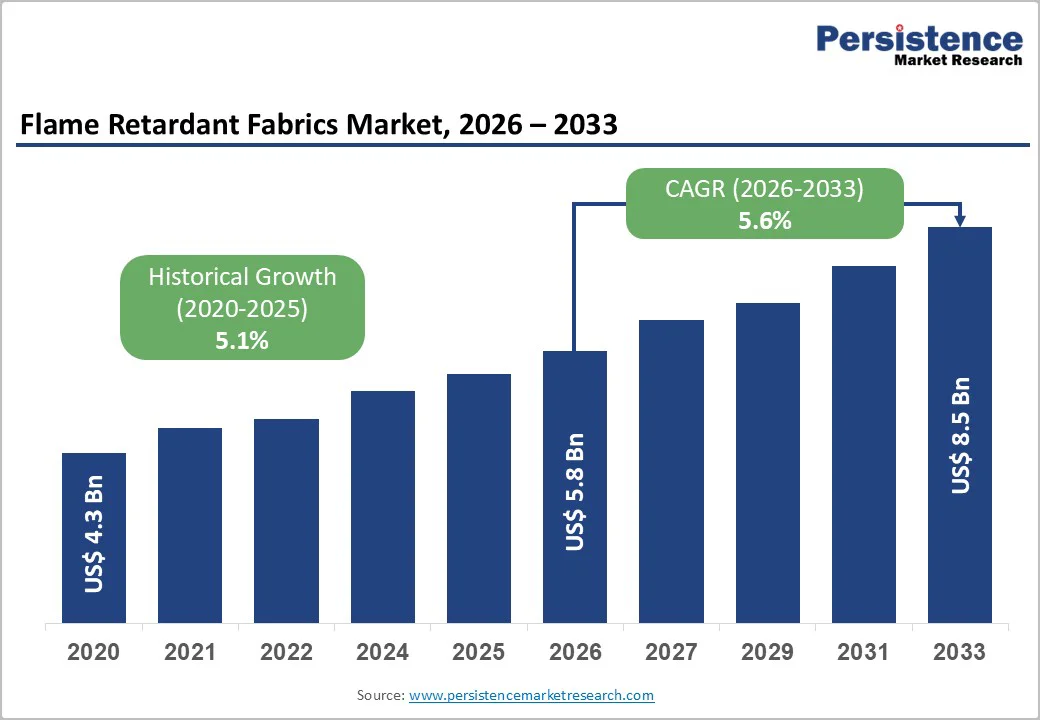
The global flame-retardant fabrics market size is likely to be valued at US$5.8 billion in 2026. It is expected to reach US$8.5 billion by 2033, growing at a CAGR of 5.6% from 2026 to 2033, driven by the increasing prevalence of workplace safety regulations, rising demand for protective clothing in high-risk industries, and advancements in inherent flame-resistant technologies.
Demand for durable, comfortable flame-retardant fabrics is rising, driven by industrial and defense use. Innovations in breathable, eco-friendly formulations and growing fire-safety awareness are further driving market growth.
Key Industry Highlights:
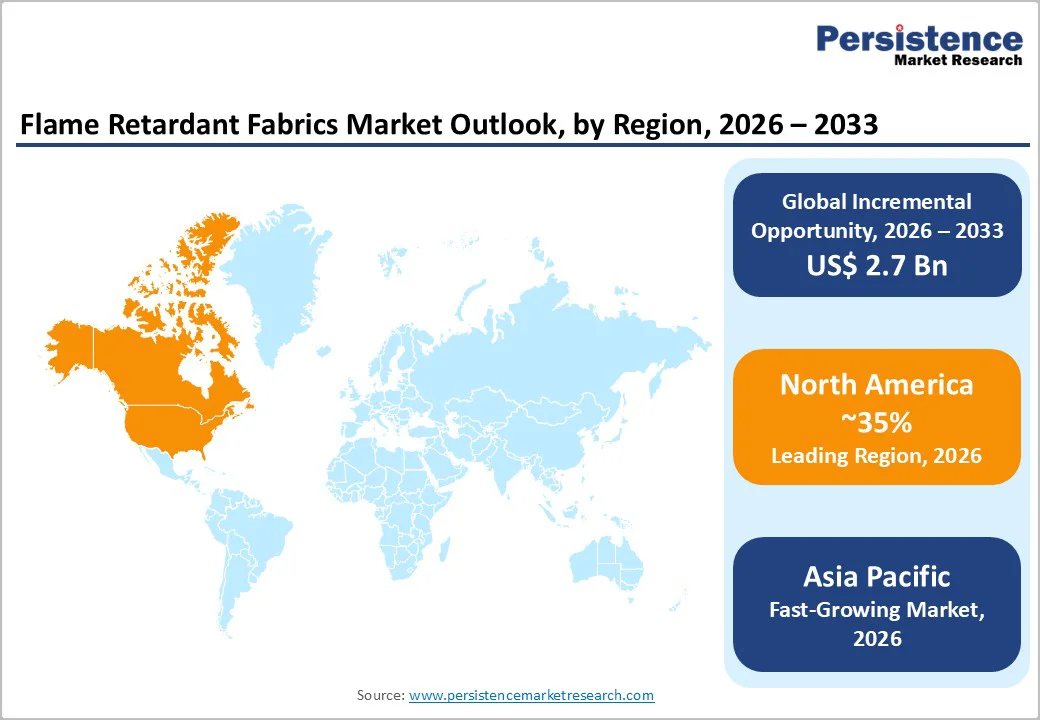
- Leading Region: North America, anticipated to account for a 35% market share in 2026, driven by stringent OSHA and NFPA standards, high industrial safety focus, and strong demand in oil & gas in the U.S.
- Fastest-growing Region: Asia Pacific, fueled by rapid industrialization, rising awareness of worker protection, and growing investments in manufacturing safety in China and India.
- Dominant Product Type: Inherent flame-retardant fabrics, to hold approximately 55% of the market share, as they provide permanent protection without chemical treatments.
- Leading Application: Industrial protective clothing accounts for over 40% of market revenue, driven by mandatory PPE requirements and exposure to flash fires.
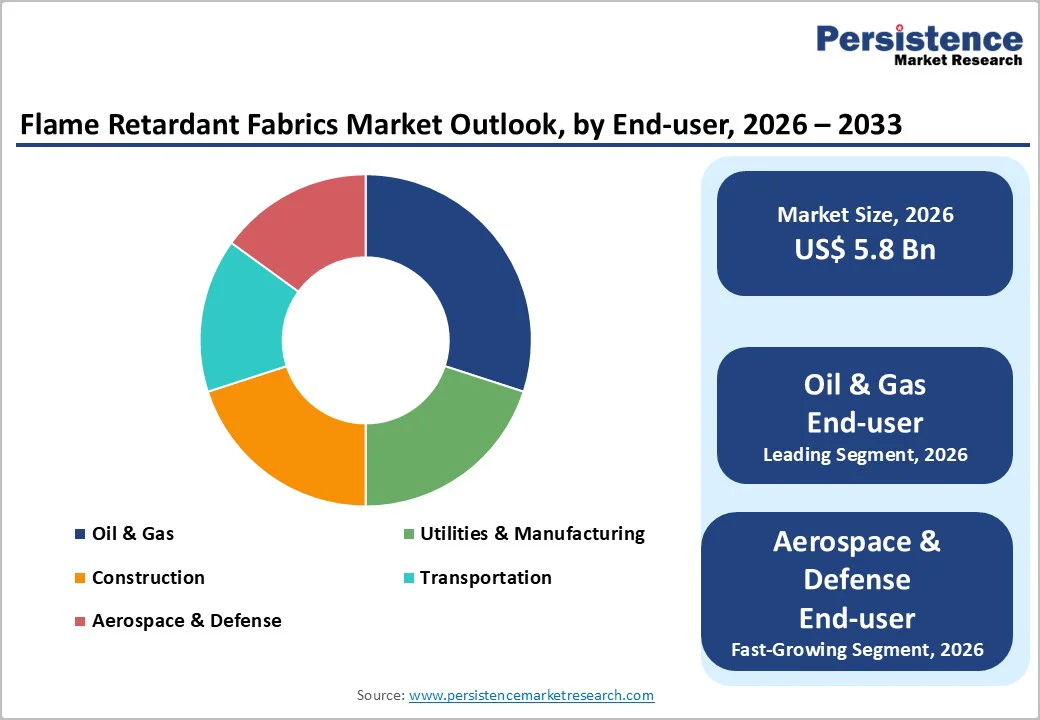
- Leading End-user: Oil & gas, to contribute nearly 30% of the market revenue, due to high-risk operations and regulatory compliance needs.
|
Key Insights |
Details |
|
Flame Retardant Fabrics Market Size (2026E) |
US$5.8 Bn |
|
Market Value Forecast (2033F) |
US$8.5 Bn |
|
Projected Growth (CAGR 2026 to 2033) |
5.6% |
|
Historical Market Growth (CAGR 2020 to 2025) |
5.1% |
Market Factors - Growth, Barriers, and Opportunity Analysis
Increasing Implementation of Workplace Safety Standards and Growing Need for Protective Apparel
Rising enforcement of workplace safety standards, such as NFPA 2112 and EN 11612, is creating significant opportunities for fabric manufacturers, driven by the growing need for protective apparel and the reduction in burn injuries. Traditional non-FR garments pose ignition risks, particularly in oil & gas and manufacturing, leading to higher accident rates and liability. Flame-retardant technologies, including inherent aramid fabrics, treated cotton blends, modacrylic blends, flame-resistant finishes, and hybrid composites, offer self-extinguishing solutions that simplify compliance, reduce replacement costs, and provide critical protection during flash fires or arc flashes.
These fabrics significantly lower the risk of second-degree burns, smoke inhalation, and fatalities while enhancing comfort and ease of laundering, especially with inherent FR materials, making them suitable for high-volume or remote operations. As global safety bodies push for broader PPE coverage and more user-friendly materials, demand is rising across defense apparel, firefighting gear, and transport upholstery.
Performance Trade-offs and Comfort Issues
Performance trade-offs and comfort challenges remain key restraints in the market. FR protective clothing must meet strict safety standards to shield against burns from heat, flames, and arc flash hazards. OSHA mandates that clothing used in arc flash environments must not melt or continue burning, which rules out lightweight, flexible materials like polyester or nylon that can worsen injuries. Employers are therefore required to use heavier, inherently FR fabrics that comply with standards such as NFPA 2112.
However, these high-protection materials often compromise comfort. FR fabrics with superior resistance are typically thicker, less breathable, and heavier, trapping heat and moisture. Studies by government and safety organizations highlight the difficulty of maintaining “thermo-physiological comfort” in FR textiles, as materials that maximize thermal protection often reduce breathability and sweat evaporation, increasing heat stress in wearers.
Developments in Inherent and Eco-Compliant Fabric Platforms
Advances in inherent and eco-friendly flame-retardant fabrics are reshaping global safety by tackling two key challenges: wash durability and environmental impact. Inherent fabrics are designed to retain permanent FR properties, reducing the need for topical treatments and withstanding over 100 washes without degradation. Innovations such as aramid blends, modacrylic spinning, bio-based phosphorus, and recycled fibers enhance durability, reduce chemical effluents, and lower lifecycle costs for industrial and utility applications.
Eco-compliant solutions, including halogen-free finishes, low-VOC treatments, solid coatings, and hybrid laminates, promote sustainable protection by minimizing toxic emissions, the first line of defense against health hazards. These fabrics eliminate brominated compounds, improve breathability, and maintain lightweight performance without heavy chemicals, making them ideal for large-scale protective programs. Emerging technologies such as nano-coatings, bio-derived retardants, and VLP-based weaves further boost char formation and wearer comfort.
Category-wise Analysis
Product Type Insights
Inherent flame-retardant (FR) fabrics are expected to lead the market, capturing around 55% of the share by 2026. Their dominance is fueled by permanent protection, wash durability, and comfort, making them the preferred choice for daily-use PPE. These fabrics offer built-in safety, long-term performance, and regulatory compliance, making them ideal for large-scale industrial applications. For instance, Nomex® Essential 450A is designed for pilots and air crews, providing inherent flame resistance while minimizing static discharge and ensuring comfort both on the ground and in the air. It delivers lightweight, reliable protection in line with the US DoD MIL-C-83429B specification.
Treated flame-retardant fabrics are the fastest-growing segment due to their cost-effectiveness and suitability for disposable or short-term applications. Their topical treatment allows for targeted affordability, lowering upfront costs. Ongoing innovations in durable treatments are enhancing wash resistance, driving rapid adoption in Asia Pacific and Europe, where demand for budget-friendly, compliant fabrics is rising. For example, PYROVATEX® treatments can protect high-risk workwear from fire while maintaining the softness and comfort of cotton, with good wash durability for extended use.
Application Insights
Industrial chemical protective clothing is projected to lead the market, accounting for roughly 40% of the market share by 2026. This is driven by continuous exposure to workplace hazards, large-scale workforce programs, and strong global demand for flame-resistant (FR) gear. Its dominance is reinforced as industries expand safety protocols. Increasing use of defense uniforms and growing firefighting initiatives further highlight the rising demand for specialized apparel. For example, Bulwark Protection, a key manufacturer and distributor, supplies FR coveralls and shirts to sectors such as electric utilities, petrochemical, and oil & gas, protecting workers from flash fires and heat hazards, and illustrating the significant role of industrial protective clothing in the FR fabrics market.
Defense and law enforcement apparel is the fastest-growing segment, fueled by the rising adoption of tactical gear and lightweight FR military uniforms. The shift toward multi-threat, comfortable platforms with improved mobility is accelerating growth. Innovations in hybrid blends and ballistic-compatible fabrics entering field trials are further driving adoption. TenCate Defender® M exemplifies this trend, offering flame resistance, durability, and breathability for military applications. Designed as a lightweight, everyday performance fabric, Defender® M incorporates COOLDERM™ technology to wick moisture, enhancing comfort in high-heat environments. Its inherent FR properties, including Lenzing® FR fibers, provide troops with an additional margin of protection while maintaining mobility and comfort.
End-user Insights
The oil & gas sector is expected to dominate the flame retardant fabrics market, capturing around 30% of the share by 2026, driven by high flash fire risks and a strong global focus on worker safety. Routine PPE programs, offshore safety requirements, and widespread access to certified fabrics sustain steady demand. Increasing emphasis on utilities, manufacturing, and construction further reinforces oil & gas’s market leadership. Workers face hazards such as fire, explosions, chemical exposure, and mechanical risks, particularly in offshore drilling and refining, prompting companies to implement comprehensive PPE programs including protective clothing, helmets, eye/face protection, and respiratory gear.
Aerospace & defense is the fastest-growing segment, driven by demand for lightweight protection, cabin fire safety, and adoption of advanced composites. Enhanced heat resistance, tailored material weights, and improved char formation for aircraft applications drive rapid uptake. Expanding use of FR materials in transportation interiors, electronics, and other high-tech sectors further accelerates growth. For instance, Nomex honeycomb core materials are widely used in lightweight, flame-resistant composites in aircraft for structural, safety, and interior applications, exemplifying the sector’s shift toward high-performance composites that reduce weight while meeting strict fire and safety standards.
Regional Insights
North America Flame Retardant Fabrics Market Trends
North America is expected to hold nearly 35% of the market share by 2026, driven by strict safety regulations, strong R&D capabilities, and high public awareness of fire risks. A robust manufacturing infrastructure in the U.S. and Canada supports widespread adoption of FR fabrics across the industrial, defense, and transportation sectors. Rising demand for inherently easy-to-certify fabrics is further driving adoption, as these options simplify compliance and reduce the challenges associated with treated alternatives.
Technological innovations, such as stable aramids, enhanced modacrylic delivery, and targeted eco-friendly finishes, are attracting significant public and private investment. Government programs and OSHA initiatives continue to promote the use of FR fabric for protection against workplace burns, arc flashes, and wildfire threats, sustaining market demand. Increasing interest in treated grades and applications in home furnishings, particularly for utilities and related sectors, is further expanding the scope of FR fabric usage.
Europe Flame Retardant Fabrics Market Trends
Europe is expected to hold a leading 30% share of the market by 2026, driven by heightened safety awareness, robust regulatory frameworks, and government-led protection programs. Countries, including Germany, France, and the U.K., have established industrial systems that support routine PPE use and encourage adoption of advanced FR fabric solutions. These durable fabrics are especially valued in oil & gas, transport, and regulation-focused sectors, enhancing safety and coverage.
Ongoing technological advancements, such as improved char formation, application-specific delivery, and more breathable FR grades, are further expanding market potential. European authorities are increasingly backing research and trials to address both routine and extreme hazards, boosting market confidence. The growing focus on convenient, wash-durable options aligns with the region’s preventive safety initiatives and efforts to reduce toxic emissions. Public awareness campaigns and compliance programs are expanding reach across urban and rural areas, while manufacturers continue to invest in innovative fibers and finishes to enhance performance.
Asia Pacific Flame Retardant Fabrics Market Trends
Asia Pacific is poised to be the fastest-growing flame-retardant fabrics market in 2026, driven by rising safety awareness, expanding government initiatives, and broader application programs. Countries including India, China, Japan, and Southeast Asian nations are actively promoting protective measures to address industrial hazards and emerging urban safety needs. FR fabrics are especially attractive in the region due to their cost-effective integration, scalability, and suitability for large-scale manufacturing across both urban and rural areas.
Technological innovations are enabling the development of stable, efficient, and easy-to-process FR fabrics that can withstand demanding operational conditions while reducing dependency on frequent replacements. These advancements are vital for enhancing worker protection in remote locations and improving overall coverage. Rising demand across apparel, transportation interiors, and home furnishings is further supporting market growth. Increased industrial investment, public-private partnerships, and expanded research and manufacturing capacity are accelerating adoption, with FR fabrics a preferred choice for their convenience, enhanced protection, and reduced ignition risk.
Competitive Landscape
The global flame-retardant fabrics market is shaped by competition between established textile leaders and emerging specialty producers. In North America and Europe, companies like DuPont and Milliken & Company dominate through strong R&D, extensive distribution networks, and deep industry connections, supported by innovative fibers and protective solutions.
In the Asia Pacific region, Indorama Ventures is advancing through localized offerings that improve accessibility. Inherent FR fabrics enhance durability, minimize wash-off risks, and support large-scale deployments across regions. Strategic partnerships, collaborations, and acquisitions are helping companies combine expertise, expand production capacity, and accelerate commercialization. Eco-friendly formulations address toxicity concerns, enabling wider adoption in regulated markets.
Key Industry Developments
- In May 2025, Rivertex® Technical Fabrics launched Rivercyclon® 450 FR, a strategic move to redefine sustainability and performance in the technical textiles sector. As the first flame-retardant polypropylene-based fabric to meet international fire safety standards, this recyclable, non-PVC solution positions the company at the forefront of eco-compliant innovation. The initiative targets a broad range of technical textile applications, delivering high-performance protection while reinforcing Rivertex®’s commitment to sustainable, market-leading solutions.
- In June 2024, Sunscreen Mermet unveiled a refreshed brand identity to reinforce its focus on technical fabrics for solar protection. The initiative highlights their coated fiberglass fabrics, which provide fire resistance and comply with EN 14501 standards, supporting energy-efficient building solutions while strengthening the company’s positioning in the sustainable building materials market.
Companies Covered in Flame Retardant Fabrics Market
- DuPont
- Milliken & Company
- Teijin
- TenCate Protective Fabrics
- Indorama Ventures
- Huntsman Textile Effects
- PBI Performance Products
- Lanxess AG
- Albemarle Corporation
- Clariant International Ltd.
Frequently Asked Questions
The global flame retardant fabrics market is projected to reach US$5.8 billion in 2026.
The rising prevalence of workplace safety regulations and demand for protective clothing are key drivers.
The flame retardant fabrics market is poised to witness a CAGR of 5.6% from 2026 to 2033.
Advancements in inherent and eco-compliant fabric platforms are key opportunities.
DuPont, Milliken & Company, Teijin, TenCate Protective Fabrics, and Huntsman Textile Effects are the key players.


