




- Healthcare Services
- Fitness App Market
Fitness App Market Size, Trends, Share, Growth, and Regional Forecast, 2026 to 2033
Fitness App Market by App Type (Exercise & Weight Loss, Diet & Nutrition, Activity Tracking), Device (Smartphones, Tablets, Wearable Devices), Platform (Android, iOS, Others), and Regional Analysis from 2026 to 2033

Fitness App Market Share and Trends Analysis
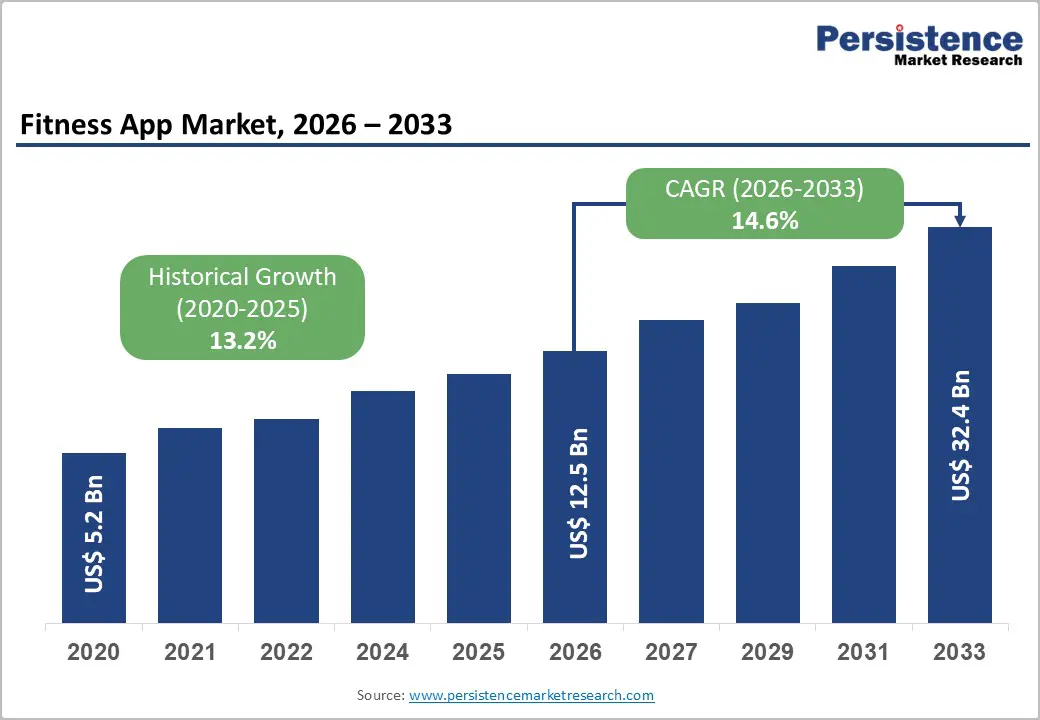
The global fitness app market is projected to grow from US$12.5 billion in 2026 to US$32.4 billion by 2033, at a CAGR of 14.6% over the forecast period.
The fitness app market is expanding rapidly, driven by increasing health awareness, smartphone penetration, and growing adoption of digital fitness solutions. North America leads due to high app monetization, wearable device integration, and strong consumer spending, whereas the Asia-Pacific region is the fastest-growing, supported by a rising mobile user base, fitness consciousness, affordable apps, and expanding digital health ecosystems.
Key Industry Highlights:
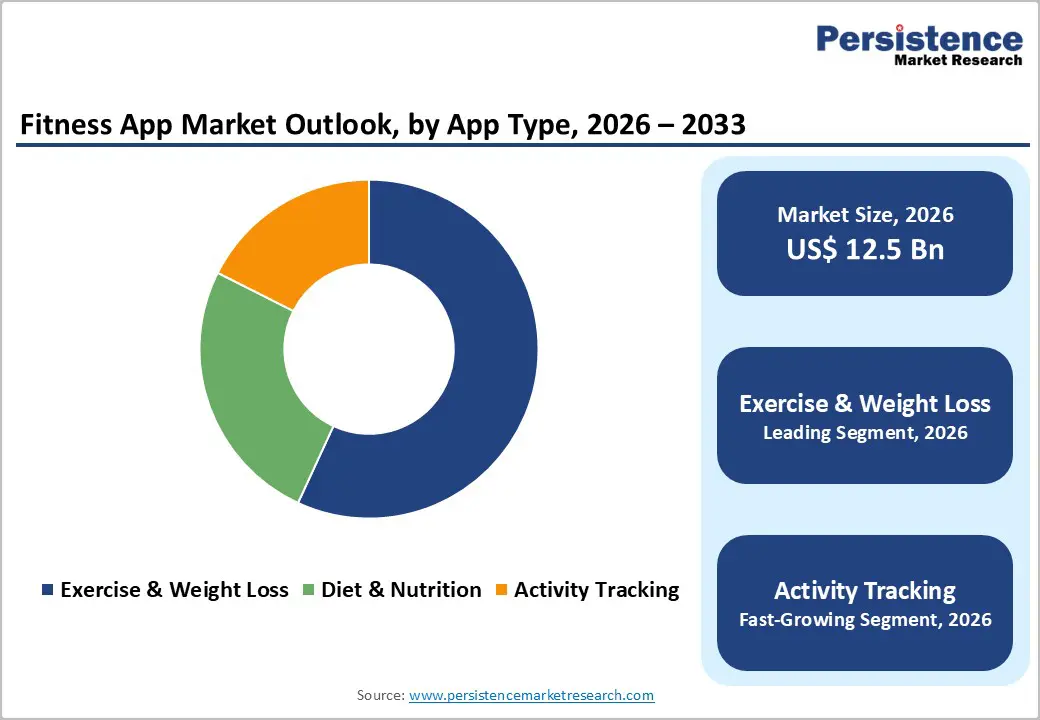
- Dominant Segment: Exercise & Weight Loss apps dominated the fitness app market in 2025, holding 56.9% share due to widespread consumer focus on weight management, structured workouts, and on-demand training programs. High engagement among home fitness, gym-based, and hybrid workout models supported strong adoption across freemium and subscription platforms.
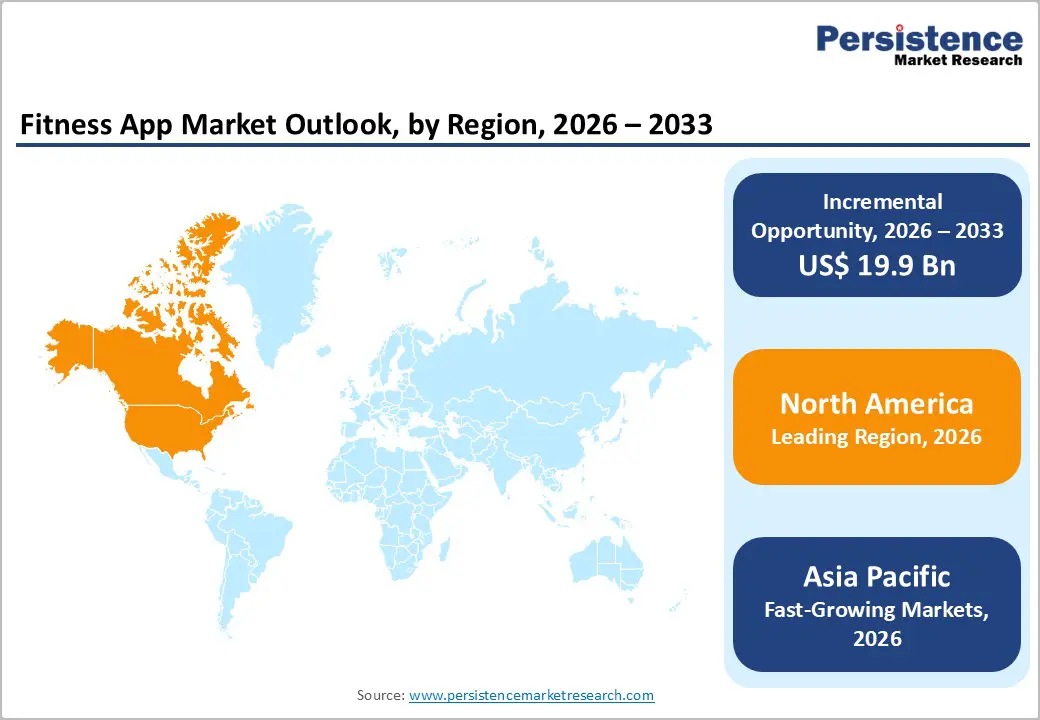
- Dominant Region: North America led the market in 2025 with 41.1% share, supported by high smartphone and wearable penetration, strong subscription spending, and early adoption of connected fitness technologies. Asia-Pacific emerged as the fastest-growing region, driven by rising health awareness, an expanding mobile user base, affordable app pricing, and increasing digital wellness initiatives.
- Market Drivers: Growth is driven by increasing lifestyle-related health issues, rising fitness awareness, proliferation of smartphones and wearables, demand for personalized and AI-driven workouts, and growing acceptance of digital fitness solutions post-pandemic.
- Market Opportunity: Key opportunities include deeper integration of wearables and IoT, AI-powered personalization, expansion into corporate wellness programs, penetration into emerging markets, partnerships with healthcare providers, and the development of holistic fitness apps that combine workouts, nutrition, and mental wellness.
| Key Insights | Details |
|---|---|
| Fitness App Market Size (2026E) | US$ 12.5 Bn |
| Market Value Forecast (2033F) | US$ 32.4 Bn |
| Projected Growth (CAGR 2026 to 2033) | 14.6% |
| Historical Market Growth (CAGR 2020 to 2025) | 13.2% |
Market Dynamics
Driver - Rising health and fitness awareness driven by lifestyle-related diseases and preventive healthcare focus
Rising awareness of health and fitness, particularly regarding lifestyle-related diseases, has become a pivotal driver of the fitness app market. Non-communicable diseases such as cardiovascular conditions, diabetes, and obesity are now major global health concerns: cardiovascular diseases accounted for approximately 17.9 million deaths in 2019, roughly 32 percent of all deaths worldwide, while over 2.5 billion adults were overweight or obese in 2022. Such data heightens public focus on preventive healthcare, prompting individuals to adopt tools that support regular physical activity, weight management, and health monitoring. This awareness directly translates into increased adoption of fitness and health-tracking applications within daily health routines.
Government and industry surveys confirm this behavioral shift toward digital fitness engagement. In the United States, more than half of mobile phone users have downloaded apps to track physical activity, diet, or weight, and more than 65 percent use these tools daily. Similarly, in India, rising health consciousness is reflected in surveys indicating that nearly 80% of consumers use at least one health app or wearable device to monitor exercise, nutrition, or wellness metrics; 70% globally; and 60% are open to AI-supported personalized plans. These adoption patterns underscore how awareness of health risks and preventive care motivates users to integrate fitness apps into their lifestyle.
Restraints - Data privacy and cybersecurity concerns related to personal health information
Data privacy and cybersecurity concerns act as significant restraints on the fitness app market because these apps collect deeply personal health information from biometric and location data to exercise habits and lifestyle details which can be attractive to cybercriminals and third-party data brokers. Studies show that 88% of mobile health and fitness apps can access and potentially share personal data with third parties, and many operate with unclear privacy policies that lack full transparency regarding data use. High-profile breaches in related health data domains (e.g., a U.S. healthcare tech hack affecting 192.7 million individuals) illustrate why consumers may hesitate to share sensitive data with apps.
Moreover, fitness and wellness applications often fall outside the scope of stringent health privacy laws such as HIPAA in the United States, leaving consumer data without the comprehensive federal safeguards that traditional healthcare providers must follow. Numerous security analyses of popular fitness apps reveal common vulnerabilities such as insecure data transmission, third-party sharing, and weak encryption protocols, increasing the risk of unauthorized access and misuse of personal health metrics. With 80% of fitness apps reportedly sharing data with third parties, including advertisers and brokers, users face significant privacy risks that undermine trust and slow market growth.
Opportunity - Expansion into corporate wellness and employee health management programs
Expansion into corporate wellness and employee health management represents a strong opportunity for the fitness app market because employers increasingly view employee well-being as a strategic priority. In the United States, 82 percent of large firms offer workplace wellness programs, and over 60 percent of employees report that such programs help them adopt healthier lifestyle choices, including physical activity and weight management. Digital fitness tools are being integrated into these programs, with 64 percent of companies using wellness apps to engage employees and improve participation. These trends demonstrate that employers are seeking scalable, personalized digital solutions to enhance employee health, boost morale, and achieve measurable wellness outcomes.
Moreover, fitness apps align with documented business and health benefits of workplace wellness initiatives. Employer-sponsored programs have shown improvements in engagement: 70% of employees report increased job satisfaction when wellness offerings are available, and 48% report increased participation when fitness and health initiatives are incentivized. Fitness apps bring flexibility by enabling employees to exercise at convenient times, tailor workouts to individual needs, and maintain consistent activity outside traditional gym settings. In markets such as India, nearly 69% of employees express a need for more digitally personalized wellness benefits, signaling substantial latent demand for fitness app integration in corporate health strategies globally.
Category-wise Analysis
By App Type Insights
Exercise & weight loss dominate the global market, accounting for 56.9% in 2025, as they address broad, pervasive health needs linked to global lifestyle trends. Rising rates of obesity and insufficient physical activity drive consumer demand for accessible workout solutions: the World Health Organization estimates that more than 1.3 billion people aged 30-70 were physically inactive in 2016-2020, and over 2 billion adults were overweight or obese in 2022. This prevalence motivates users to seek structured exercise and weight-management tools, especially on mobile platforms. Moreover, 47% of adults report using digital technologies specifically for physical activity and fitness tracking, with weight loss among the top user goals. These patterns demonstrate why exercise-focused applications attract the largest share of users and engagement globally.
By Device Insights
Smartphones dominate the fitness app market because they provide ubiquitous, always-on access to fitness tools for billions of users worldwide. As of 2025, there are over 6.8 billion smartphone users globally, more than 80% of the world’s population, making them the most common platform for mobile applications. Their built-in sensors (accelerometer, GPS, heart-rate monitors) enable accurate activity tracking without additional hardware, while constant connectivity supports real-time data syncing and social engagement features. Additionally, over % of adults in advanced and emerging economies use smartphones for health-related information and self-monitoring. This pervasive access and convenience drive smartphone preference over tablets and wearables as the primary device for fitness app engagement.
Regional Insights
North America Fitness App Market Trends
North America dominates the fitness app market, accounting for 41.1% of the market in 2025, owing to widespread smartphone and wearable adoption, high consumer health engagement, and robust digital infrastructure. In the United States, 85 % of adults own a smartphone, enabling frequent access to mobile health tools, and 53% of respondents reported using a fitness or health app to track exercise or activity. Additionally, more than 30% of U.S. adults use wearable fitness devices that sync with apps to monitor health metrics in real time. High health awareness is reflected in the fact that only 24% of U.S. adults meet physical activity guidelines, which motivates digital fitness adoption. These factors, ubiquitous connected devices, high app usage for health, and a population actively seeking fitness solutions, drive North America’s leading share.
Europe Fitness App Market Trends
Europe is a significant region in the fitness app market because it combines high levels of digital health engagement, substantial consumer interest in mobile health tools, and substantial public health needs that support sustained app adoption. Surveys across eight European countries show that about 21.9% of adults already use health apps and another 42.7% express interest in future use, indicating a strong latent user base for fitness and wellness applications. Additionally, Europe’s diverse governments and health systems emphasize physical activity and preventive care, as insufficient physical activity accounted for 1.2 million DALYs and 64 000 deaths in the EU in 2021, highlighting the demand for accessible digital fitness solutions.
Asia Pacific Fitness App Market Trends
Asia-Pacific is the fastest-growing region in the fitness app market due to rapid digital adoption, an expanding middle class, and a public health focus on lifestyle diseases. The region accounts for a significant share of global smartphone users, with India and China together representing more than 50 percent of global smartphone shipments in recent years, enabling broad access to mobile apps. Internet use has also surged, with over 3.3 billion active internet users in the region, increasing opportunities to download and engage with fitness applications. At the same time, rising rates of non-communicable diseases, such as diabetes affecting over 463 million people in the Western Pacific and Southeast Asia combined, drive consumer interest in preventive health tools like workout and wellness apps. These structural digital and health trends support robust growth in Asia Pacific.
Competitive Landscape
The competitive landscape in the fitness app market is defined by leading digital fitness platforms (Strava, Apple Fitness, Fitbit), guided workout providers (Nike Training Club, Peloton, Sweat), and wellness-focused apps (FitOn, Alo Moves, Future). Innovation in AI-driven personalization, wearable integration, hybrid workout models, and community engagement, along with strategic partnerships and global expansion, intensifies competition and drives differentiation across the market.
Key Industry Developments:
- In December 2025, Apple Fitness+ expanded to 28 new markets, increasing its global availability and accessibility for users. The service aimed to reach a broader audience, offering on-demand guided workouts, personalized training plans, and integration with Apple Watch metrics. This expansion marked a significant step in Apple’s strategy to grow its digital fitness ecosystem and strengthen its presence in international markets.
- In April 2025, HealthFitness announced a partnership with FitOn Health to enhance its digital fitness offerings for users. The collaboration focused on integrating FitOn’s on-demand workout and wellness programs into HealthFitness’ platform, providing personalized fitness experiences and broader access to guided exercise routines.
Companies Covered in Fitness App Market
- Apple Fitness
- Nike Training Club
- Strava
- FitOn
- Runkeeper
- Hevy
- Peloton App One
- Future
- Strong
- Sweat
- Apple Fitness Plus
- Alo Moves
- Fitbit
- Runna
- Ladder
- Others
Frequently Asked Questions
The global fitness app market is projected to be valued at US$ 12.5 Bn in 2026.
Rising health awareness, smartphone adoption, wearable integration, demand for personalized workouts, and digital fitness engagement drive growth.
The global fitness app market is poised to witness a CAGR of 14.6% between 2026 and 2033.
Integration with wearables, AI personalization, corporate wellness programs, emerging markets, and holistic fitness app development offer opportunities.
Apple Fitness, Nike Training Club, Strava, FitOn, Runkeeper, Hevy.


