




- Inks, Coatings, Adhesives & Sealants (ICAS)
- Exterior Silicone Caulk Market
Exterior Silicone Caulk Market Size, Share, and Growth Forecast, 2026 - 2033
Exterior Silicone Caulk Market by Product Type (Neutral cure silicone caulk, Acid cure silicone caulk), End-user (Building Envelopes, Curtain Walls, Windows and Doors, Siding and Cladding Companies), and Regional Analysis for 2026 - 2033

Exterior Silicone Caulk Market Size and Trends Analysis
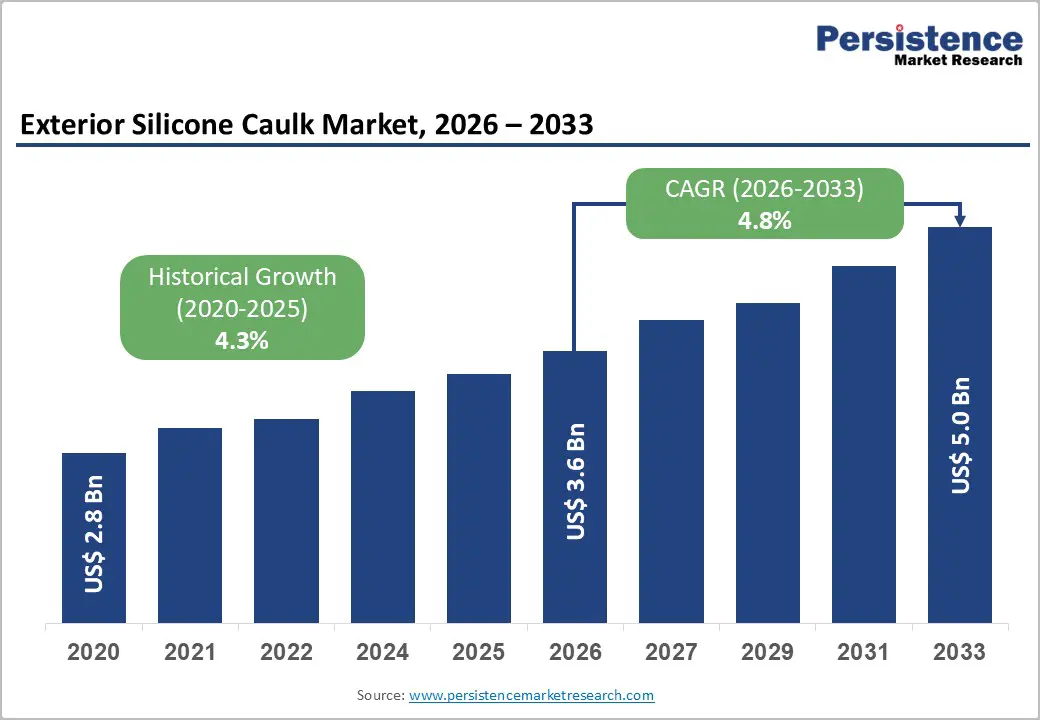
The global exterior silicone caulk market size is likely to be valued at US$3.6 billion in 2026 and is expected to reach US$5.0 billion by 2033, growing at a CAGR of 4.8% during the forecast period from 2026 to 2033, driven by sustained growth in residential, commercial, and industrial construction activities worldwide.
Demand is closely tied to new building development, renovation projects, and infrastructure modernization, where reliable sealing solutions are essential for protecting structures against moisture infiltration, temperature fluctuations, and environmental exposure. Exterior silicone caulk is widely preferred for its excellent weather resistance, UV stability, long-term elasticity, and strong adhesion to diverse substrates such as glass, metal, concrete, masonry, and vinyl. Advancements in neutral cure formulations, low-VOC compositions, and environmentally compliant products are aligning with stricter building codes and sustainability standards.
Key Industry Highlights:
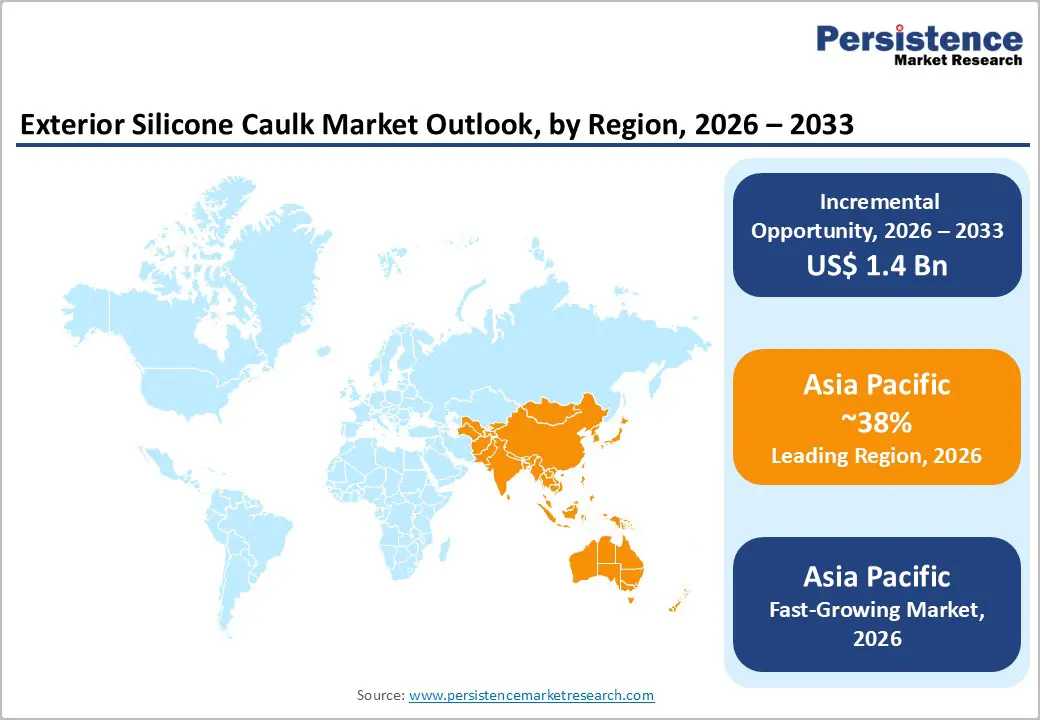
- Leading Region: Asia Pacific, accounting for a market share of 38% in 2026, driven by rapid urbanization and infrastructure expansion across major emerging economies.
- Fastest-growing Region: Asia Pacific, supported by rising residential and commercial construction activities, along with growing demand for durable, weather-resistant sealing materials in large-scale infrastructure and urban development projects.
- Leading Product Type: Neutral cure silicone caulk, accounting for 58% of the revenue share, driven by its non-corrosive properties and broad substrate compatibility in exterior construction applications.
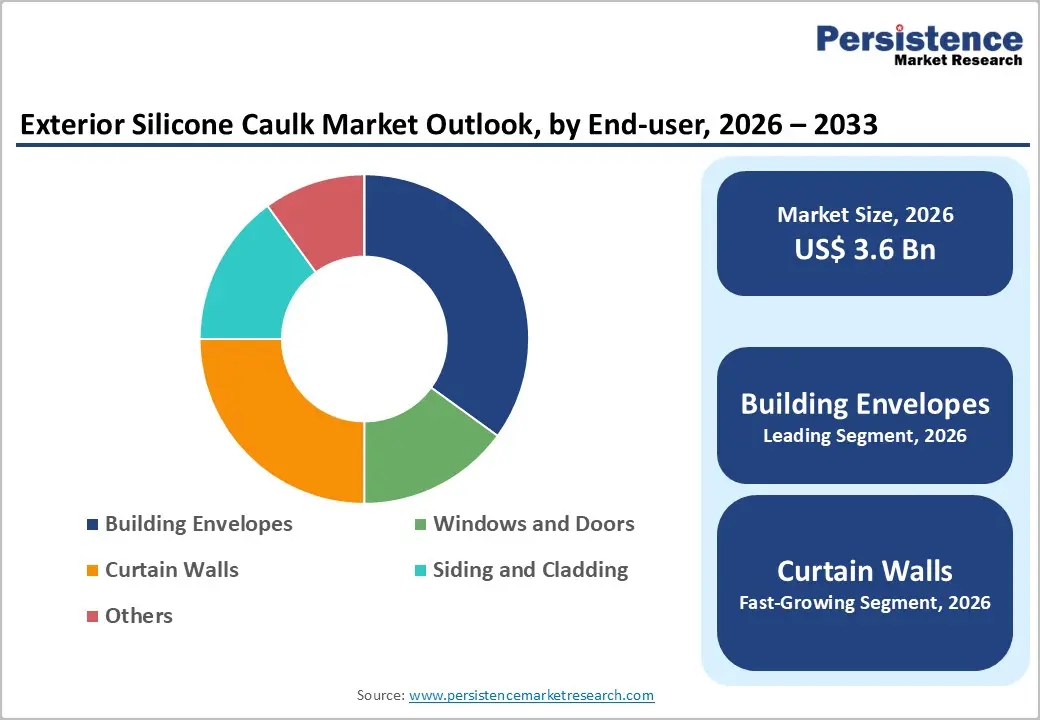
- Leading End-user: Building envelopes, accounting for over 46% of the revenue share in 2026, supported by extensive weatherproofing and energy-efficiency requirements in modern construction.
| Key Insights | Details |
|---|---|
|
Exterior Silicone Caulk Market Size (2026E) |
US$3.6 Bn |
|
Market Value Forecast (2033F) |
US$5.0 Bn |
|
Projected Growth (CAGR 2026 to 2033) |
4.8% |
|
Historical Market Growth (CAGR 2020 to 2025) |
4.3% |
Market Factors - Growth, Barriers, and Opportunity Analysis
Growth Analysis - Regulatory Emphasis on Energy Efficiency and Building Performance
Governments worldwide are strengthening building codes to reduce energy loss, improve thermal insulation, and enhance structural durability. Exterior silicone caulks play a crucial role in sealing joints, gaps, and façade connections, preventing air and moisture infiltration that compromises energy efficiency. Their superior adhesion and long-term flexibility support compliance with green building certifications and sustainability standards. As construction stakeholders prioritize high-performance envelopes, silicone-based sealants become essential components in achieving regulatory compliance and improving overall building lifespan and operational efficiency.
Stricter environmental policies encourage the adoption of low-VOC and environmentally responsible sealant formulations. Manufacturers are investing in advanced neutral cure technologies that meet indoor air quality requirements while maintaining strong exterior performance. Energy-efficient retrofitting projects expand demand, particularly in developed markets, upgrading aging infrastructure. Exterior silicone caulk enhances airtightness in curtain walls, glazing systems, and window perimeters, directly contributing to lower heating and cooling loads.
Extreme Weather Resilience Demands
Increasing exposure to extreme weather conditions strongly drives growth in the exterior silicone caulk market. Buildings today must withstand intense heat, heavy rainfall, UV radiation, freezing temperatures, and high winds. Silicone caulks are widely preferred for their superior weather resistance, elasticity, and ability to maintain adhesion despite thermal expansion and contraction. Their flexibility prevents cracking and seal failure under structural movement, making them ideal for façades, siding, and glazing systems. As climate variability intensifies, contractors and developers prioritize durable sealing solutions that ensure long-term protection against water intrusion and structural degradation.
In coastal and high-humidity regions, resistance to mold, mildew, and salt exposure supports silicone adoption. Infrastructure modernization projects increasingly demand materials capable of sustaining performance over extended service lives with minimal maintenance. Exterior silicone caulk has UV stability and non-shrinking properties reduce the need for frequent repairs, lowering lifecycle costs. Insurance considerations and risk mitigation strategies also push developers toward resilient materials. As extreme weather events become more frequent, demand for high-performance, weatherproof exterior sealants continues to expand across both residential and commercial construction segments.
Barrier Analysis - Competition from Alternative Sealant Chemistries
Polyurethane, acrylic, and hybrid sealants offer cost advantages and specific performance characteristics that attract contractors in budget-sensitive projects. Some alternatives provide paintability or faster surface curing, which may be preferred in certain façade applications. Price-sensitive markets, particularly in emerging regions, may opt for lower-cost solutions where high-performance silicone properties are not deemed essential. This competitive pressure can limit silicone penetration in segments where performance requirements are moderate rather than demanding.
Technological advancements in hybrid polymers are narrowing the performance gap between silicone and competing chemistries. Improved flexibility, adhesion, and durability in modified silane products challenge silicone's traditional dominance. Marketing strategies from alternative sealant manufacturers intensify competition by emphasizing ease of application and broader substrate compatibility. In residential renovation projects, contractors select acrylic-based products for interior and exterior transitions due to convenience.
Performance Limitations in Extreme Conditions
In highly contaminated or poorly prepared surfaces, adhesion can be compromised, leading to premature seal failure. Some formulations may experience challenges in extremely low temperature applications where curing slows significantly. Acid-cure variants release byproducts that can corrode sensitive substrates, restricting their suitability in certain exterior environments. These technical constraints may prompt contractors to consider alternative sealing materials for specialized conditions.
Compatibility concerns with specific coatings, paints, or construction materials can create hesitation in adoption. While silicone offers exceptional UV resistance, improper joint design or excessive movement beyond elasticity limits can reduce effectiveness. In heavy industrial environments with chemical exposure, performance may vary depending on formulation quality. Installation errors also contribute to perceived reliability issues. Such limitations highlight the importance of proper product selection, skilled application, and ongoing product development to ensure consistent performance across diverse environmental conditions.
Opportunity Analysis - High-Performance Glazing Systems
Modern architectural trends favor expansive glass façades and curtain wall systems that require durable, flexible sealing solutions. Silicone caulks provide excellent adhesion to glass and metal substrates while accommodating structural movement caused by temperature fluctuations and wind loads. Their ability to maintain elasticity over time makes them ideal for high-rise commercial buildings and energy-efficient glazing assemblies. As urban skylines evolve, demand for reliable perimeter sealing in complex glazing systems continues to grow.
Increasing adoption of insulated glass units and advanced façade engineering supports the need for long-lasting sealants. Silicone's resistance to UV radiation and environmental stress ensures structural integrity and weatherproofing in exposed installations. Infrastructure projects such as airports, malls, and office towers rely heavily on glazing performance, driving consistent product demand. As architects prioritize aesthetics combined with energy efficiency, high-performance silicone caulks play a crucial role in ensuring both functional durability and visual precision in contemporary building designs.
Sustainable Formulations Development
Increasing environmental awareness and green building initiatives encourage manufacturers to introduce low-VOC (volatile organic compound), solvent-free, and eco-friendly silicone products. Construction stakeholders increasingly prefer materials that align with sustainability certifications and reduced carbon footprint objectives. Advancements in raw material sourcing and manufacturing efficiency are enabling more environmentally responsible production processes without compromising product durability or performance.
Demand for recyclable packaging and reduced hazardous emissions supports innovation in formulation chemistry. Sustainable silicone solutions enhance indoor and outdoor air quality while maintaining superior weather resistance and longevity. Governments and regulatory bodies are promoting environmentally compliant materials, creating competitive advantages for manufacturers investing in green technologies. Sustainability is becoming central to construction strategies worldwide.
Category-wise Analysis
Product Type Insights
Neutral cure silicone caulk is expected to lead the exterior silicone caulk market, accounting for approximately 58% of revenue in 2026, driven by its non-corrosive curing mechanism and superior compatibility with sensitive substrates such as metals, natural stone, concrete, and coated surfaces. Its low-odor formulation and strong adhesion properties make it highly suitable for exterior façades, building envelopes, and perimeter sealing applications where long-term durability is critical. For example, in high-rise commercial façade systems, neutral cure silicone is widely used around aluminum framing and stone cladding to prevent corrosion and ensure structural longevity, reinforcing its leading position across residential and commercial construction projects.
Acid cure silicone caulk is likely to represent the fastest-growing segment, supported by its quick-curing properties and cost-effectiveness in applications where substrate sensitivity is minimal. It releases acidic byproducts during curing, and it remains highly effective for non-porous surfaces such as glass and certain ceramics. Its rapid skin formation and strong initial adhesion make it suitable for glazing tasks and smaller-scale exterior sealing needs. For example, in standard window glazing installations within low-rise residential buildings, acid cure silicone is frequently selected due to its efficient curing time and economical pricing.
End-user Insights
Building envelopes are projected to lead the market, capturing around 46% of the revenue share in 2026, supported by the critical need for comprehensive weatherproofing and structural protection in modern buildings. Exterior silicone caulk plays a vital role in sealing expansion joints, façade interfaces, and structural connections to prevent air and water infiltration. For example, in large commercial office complexes, silicone sealants are extensively applied across façade joints and panel connections to enhance thermal performance and long-term durability. The scale and complexity of envelope systems in contemporary architecture strongly support this segment’s dominant position.
Curtain walls are likely to be the fastest-growing, driven by expanding glazing applications and architectural trends favoring glass-intensive designs. Exterior silicone caulk ensures flexibility and structural movement accommodation in curtain wall assemblies and window perimeters exposed to wind loads and temperature variations. For example, in newly developed mixed-use towers featuring extensive glass curtain walls, silicone sealants are critical for maintaining watertight and airtight performance. Increasing adoption of energy-efficient glazing technologies continues to accelerate growth within this segment.
Regional Insights
North America Exterior Silicone Caulk Market Trends
North America is likely to be a significant market for exterior silicone caulk, driven by ongoing construction and renovation activities across the U.S. and Canada. With a strong emphasis on weather-resistant and energy-efficient buildings, builders and contractors increasingly favor silicone sealants for their superior adhesion, elasticity, and durability in exterior applications. For example, Sika AG’s exterior silicone offerings are widely used in commercial façade applications, where long-term performance and compliance with energy efficiency standards are essential.
Manufacturers and suppliers in North America are also focusing on product innovation and formulation improvements to meet evolving industry requirements. Low-VOC and sustainable silicone caulk formulations are gaining traction as builders strive to meet environmental certification criteria and indoor air quality goals. The growth of the DIY home improvement segment has broadened the consumer base beyond professional contractors, with retail availability of easy-to-apply silicone sealants driving uptake in residential exterior maintenance projects. Strategic distribution partnerships with major home improvement retailers expand market reach and product accessibility.
Europe Exterior Silicone Caulk Market Trends
Europe is likely to witness a significant market for exterior silicone caulk, due to rigorous building performance standards, renovation activities in older urban centers, and increasing demand for durable façade sealing solutions capable of withstanding diverse climatic conditions. Government regulations across the European Union emphasize energy efficiency, sustainability, and the reduction of carbon emissions, prompting widespread adoption of high-performance silicone sealants in both commercial and residential construction. In countries, stringent building codes require advanced weatherproofing and airtightness, reinforcing the preference for silicone caulk due to its excellent UV resistance, long-term elasticity, and superior adhesion to various substrates.
Manufacturers in the region are responding with innovations in sustainable and low-VOC formulations to align with environmental and health standards. For example, Henkel AG & Co. KGaA has expanded its portfolio of exterior silicone sealants engineered for improved durability and environmental compliance, catering to both professional contractors and large institutional projects. The growth of retrofit projects, particularly energy-efficiency upgrades in commercial and public buildings, supports market expansion. Strategic collaborations between suppliers and construction firms are enhancing product availability and technical support across Europe.
Asia Pacific Exterior Silicone Caulk Market Trends
The Asia Pacific region is anticipated to be the leading and the fastest-growing region, accounting for a market share of 38% in 2026, driven by sustained urbanization, infrastructure development, and increasing construction activity across key economies. Rapid growth in residential and commercial construction, including high-rise buildings, industrial complexes, and transportation hubs, has elevated the demand for effective sealing solutions that can endure varied climatic conditions. Government investments in infrastructure, affordable housing projects, and smart city initiatives bolster construction growth, creating significant opportunities for exterior silicone caulk applications in building envelopes, curtain walls, and façade joints.
Manufacturers are increasingly focusing on localized production, technical support, and product customization to meet regional performance requirements and cost expectations. For example, RPM International Inc., through its subsidiaries, has introduced a range of exterior silicone caulk products tailored to withstand high humidity and temperature fluctuations common in Asia Pacific climates, appealing to both commercial contractors and retail consumers. The availability of advanced neutral cure and sustainable formulations aligns with rising environmental standards and green building initiatives, expanding market penetration.
Competitive Landscape
The global exterior silicone caulk market exhibits a moderately fragmented structure, driven by the presence of numerous regional and international manufacturers offering a wide range of sealing solutions to meet evolving construction and performance demands. Market dynamics are characterized by competition across product quality, formulation technology, and regional distribution networks. Companies are investing in research and development to introduce advanced silicone caulks with improved weather resistance, sustainability credentials, and user-friendly application properties.
With key leaders including Sika AG, Dow Chemical Co., Henkel AG & Co. KGaA, 3M Co., RPM International Inc., and Bostik Ltd., the competitive landscape reflects both established chemical giants and specialized sealant manufacturers striving for market share through performance innovation and service capabilities. These players compete through continuous product enhancements, expanded distribution channels, and targeted marketing efforts that highlight durability, environmental compliance, and application versatility.
Key Industry Developments:
- In September 2025, Dow Inc. announced the launch of DOWSIL™ EG-4175 Silicone Gel, a high-performance protective material designed for next-generation insulated gate bipolar transistor (IGBT) modules used in electric vehicles and renewable energy systems. The advanced silicone gel withstands temperatures up to 180°C, enabling higher voltage and higher power-density applications, including 800V EV battery systems and high-efficiency inverters for photovoltaic panels and wind turbines. Engineered with strong dielectric properties, low silicone oil bleed, vibration absorption capability, and self-healing characteristics, the material enhances reliability, reduces power losses, and improves overall system efficiency.
- In March 2025, Flex Seal Family of Products launched Flex Caulk™ Silicone, a 100% silicone caulk and sealant designed for durable, waterproof sealing in both residential and professional applications. The new product expands the company’s Flex Caulk line by complementing its existing hybrid formula and features a pressurized can with the proprietary Trigger Flow Nozzle™, eliminating the need for a traditional caulking gun. Flex Caulk™ Silicone offers resistance to water, UV exposure, chemicals, and mildew, while preventing shrinking, cracking, or brittleness over time.
Companies Covered in Exterior Silicone Caulk Market
- 3M Co.
- ARDEX GmbH
- Bostik Ltd.
- Dow Chemical Co.
- Franklin International
- General Electric Co.
- Henkel AG and Co. KGaA
- Illinois Tool Works Inc.
- Innovative Chemical Products
- LATICRETE International Inc.
- McCormick Paints
- Oatey Co.
- Oldcastle BuildingEnvelope
- Red Devil Inc.
- RPM International Inc.
- Sashco Inc.
- Sika AG
Frequently Asked Questions
The global exterior silicone caulk market is projected to reach US$3.6 billion in 2026.
Rising residential and commercial construction activities, increasing demand for weather-resistant building envelope solutions, and growing emphasis on energy-efficient and durable sealing materials.
The exterior silicone caulk market is expected to grow at a CAGR of 4.8% from 2026 to 2033.
Key market opportunities lie in high-performance glazing systems, sustainable low-VOC silicone formulations, expanding infrastructure projects in emerging economies, and growing demand for durable sealing solutions in energy-efficient buildings.
3M Co., ARDEX GmbH, Bostik Ltd., Dow Chemical Co., Franklin International, and General Electric Co. are the leading players.


