




- Specialty & Fine Chemicals
- Ethylhexyl Stearate Market
Ethylhexyl Stearate Market Size, Share, and Growth Forecast, 2026 - 2033
Ethylhexyl Stearate Market by Product Type (Cosmetic Grade Ethylhexyl Stearate, Others), Formulation Type (Water-Based Formulations, Others), Application (Cosmetics and Personal Care, Others), End-use Industry, and Regional Analysis for 2026 - 2033

Ethylhexyl Stearate Market Size and Trends Analysis
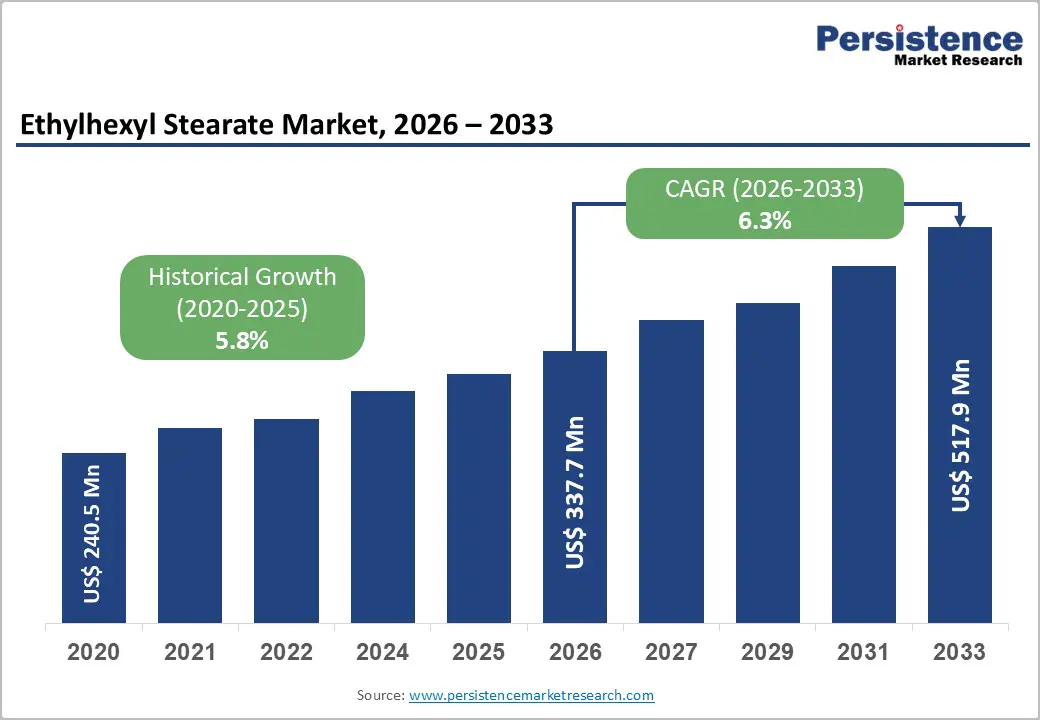
The global ethylhexyl stearate market size is likely to be valued at US$337.7 million in 2026, and is expected to reach US$517.9 million by 2033, growing at a CAGR of 6.3% during the forecast period from 2026 to 2033, driven by the increasing prevalence of natural emollient demand in cosmetics, rising demand for safe excipients in pharmaceuticals, and advancements in bio-based ester technologies.
Growing demand for versatile, non-irritating ethylhexyl stearate, especially in beauty and personal care products and the food industry, is accelerating adoption across end-user industries. Advances in cosmetic and pharmaceutical grade formulations are further boosting uptake by offering more stable, skin-friendly options. Increasing recognition of ethylhexyl stearate as critical for sensory enhancement in emerging markets remains a major driver of market growth.
Key Industry Highlights:
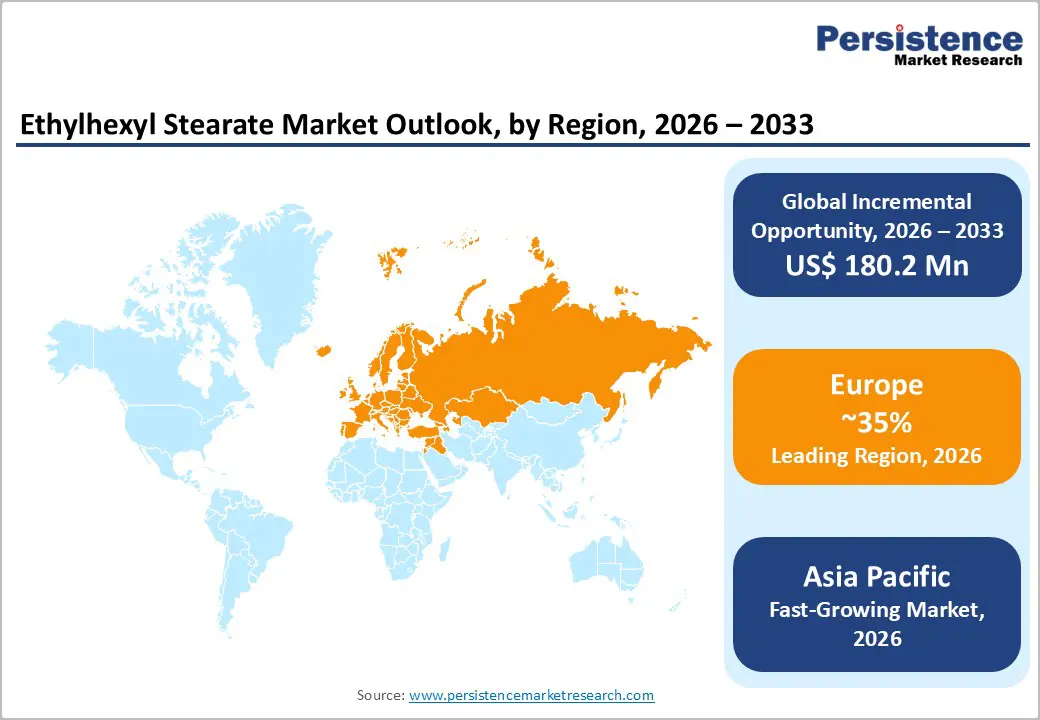
- Leading Region: Europe, anticipated to account for a 35% market share in 2026, driven by advanced cosmetics manufacturing, stringent safety standards, and strong demand in Germany and France.
- Fastest-growing Region: Asia Pacific, fueled by the booming beauty industry, rising personal care spending, and growing pharmaceutical production in China and India.
- Dominant Product Type: Cosmetic-grade ethylhexyl stearate, to hold approximately 50% of the market share, as it provides excellent emollience and spreadability.
- Leading Formulation Type: Oil-based formulations account for over 45% of the market revenue, due to superior stability and compatibility in creams.
- Leading Application: Cosmetics and personal care, to contribute nearly 55% of the market revenue, due to its role in moisturizers, sunscreens, and lip products.
- Leading End-Use Industry: Beauty and personal care, with approximately 55% share, due to high-volume usage in skincare and haircare.
| Key Insights | Details |
|---|---|
| Ethylhexyl Stearate Market Size (2026E) | US$337.7 Mn |
| Market Value Forecast (2033F) | US$517.9 Mn |
| Projected Growth (CAGR 2026 to 2033) | 6.3% |
| Historical Market Growth (CAGR 2020 to 2025) | 5.8% |
Market Factors - Growth, Barriers, and Opportunity Analysis
Increasing Consumer Awareness of Skin Health
Increasing consumer awareness of skin health is driving higher demand for skincare and personal care products that promote hydration, protection, and improved skin condition, thereby boosting the market for functional ingredients such as ethylhexyl stearate. In India, the regulatory framework under the Drugs & Cosmetics Act, 1940, and the Cosmetic Rules, 2020 requires skincare and cosmetic products to meet quality, safety, labeling, and registration standards, helping build consumer trust in safe and effective products. Increased transparency and product information through proper labeling under these regulations allow consumers to make informed choices about skincare benefits, reinforcing their awareness of skin health needs and how ingredients can support them.
Globally, strong regulatory oversight, such as the U.S. FDA’s cosmetics labeling requirements, ensures that ingredient lists are provided, enabling consumers to seek out products with ingredients that improve texture, moisturization, and skin conditioning. Skin health is not just cosmetic; many people experience dermatological issues that drive them to seek care and products. For instance, acne affects up to 50 million Americans annually, and conditions such as atopic dermatitis or eczema affect significant population segments.
Fluctuating Raw Material Prices
Fluctuating raw material prices are a key restraint on the ethylhexyl stearate market as its production depends heavily on two primary inputs, stearic acid and 2-ethylhexanol. Stearic acid is largely derived from natural fats and oils such as palm oil or animal tallow, whose prices are highly sensitive to agricultural output, weather conditions, sustainability policies, and global supply-demand imbalances. Any disruption in oilseed or palm oil production can quickly translate into higher stearic acid costs.
2-ethylhexanol is linked to the petrochemical value chain, making its pricing vulnerable to volatility in crude oil prices, energy costs, and refinery operating rates. Sudden fluctuations in crude oil markets or changes in energy prices directly affect manufacturing expenses. For ethylhexyl stearate producers, these combined uncertainties make it difficult to maintain stable pricing and predictable margins. Cost volatility also impacts downstream industries such as cosmetics and pharmaceuticals, where formulators often work with fixed budgets and long-term supply contracts. When raw material prices rise sharply, manufacturers may delay procurement, reduce production volumes, or switch to alternative emollients with more stable costs.
Clean-Label & Bio-Based Innovation
Clean-label and bio-based innovation represents a major opportunity for the ethylhexyl stearate market as consumer preferences and regulatory expectations increasingly favor transparency, sustainability, and environmentally responsible ingredients. Modern consumers are increasingly informed about ingredient origins and actively seek products perceived as safer, simpler, and derived from renewable sources. This shift encourages manufacturers to redesign formulations using ingredients that deliver strong performance while aligning with clean-label positioning.
Ethylhexyl stearate can be produced using plant-based stearic acid derived from renewable vegetable oils, allowing formulators to offer products that meet sustainability goals without sacrificing texture, spreadability, or sensory appeal. This creates opportunities for suppliers to market bio-based or naturally sourced variants, particularly for premium skincare, baby care, and sensitive-skin products. Clean-label formulations also benefit brands by supporting claims related to environmental impact reduction, responsible sourcing, and compliance with evolving cosmetic standards. From a regulatory perspective, many markets are tightening chemical safety and disclosure requirements, encouraging ingredient suppliers to adopt greener manufacturing processes and traceable raw materials.
Category-wise Analysis
Product Type Insights
Cosmetic-grade ethylhexyl stearate is anticipated to dominate the market, accounting for approximately 50% of the revenue share in 2026. Its dominance is driven by superior emollience, spreadability, and safety, making it preferred for skincare. Cosmetic-grade ethylhexyl stearate provides a smooth feel, ensures stability, and contributes to luxury, making it suitable for large-scale beauty campaigns. According to the Environmental Working Group (EWG) database, No7 HydraLuminous+ 2% Hyaluronic Acid Night Gel uses ethylhexyl stearate as a key ingredient. In this moisturizer, ethylhexyl stearate functions as an emollient, enhancing spreadability, skin softness, and overall sensory feel. Its inclusion ensures the cream applies smoothly, absorbs well, and leaves a non-greasy, luxurious finish, which is critical for customer satisfaction in daily skincare routines.
Pharmaceutical-grade ethylhexyl stearate is the fastest-growing segment, driven by its excipient purity and expanding use in topical drugs. Its controlled profile makes it ideal for targeted delivery, reducing irritation. Continuous innovations in pharma compliance are further strengthening safety, driving rapid adoption across North America and Europe, where demand for high-purity, dermatologically tested esters is accelerating. CNTREECHEM’s 2 Ethylhexyl Stearate product is explicitly noted for pharmaceutical applications, where it serves as an excipient in ointments, creams, and softgel/suppository formulations. In these formulations, it improves the spreadability and absorption of active ingredients while minimizing irritation, aligning with the functional needs of regulated topical drugs.
Formulation Type Insights
Oil-based formulations are expected to lead the market, holding approximately 45% of the revenue share in 2026, driven by superior stability, large cream programs, and strong global demand for rich textures. Their dominance continues as brands expand their anhydrous product offerings. Rising adoption of water-based hybrids and expanded emulsion campaigns highlight the growing focus on versatility. Weleda Skin Food Original Ultra-Rich Body Cream is a widely available and long-established product known for its rich, oil-infused texture that deeply hydrates and locks moisture into the skin. It contains high levels of plant oils such as sunflower seed oil and sweet almond oil, which nourish the skin and create a protective lipid layer that contributes to strong stability and a rich sensory feel characteristic of oil-based creams.
Water-based formulations are expected to be the fastest-growing segment, driven by strong demand for lightweight products and the expanding use of aqueous systems in serums. The shift toward refreshing, non-greasy textures with faster absorption is accelerating adoption, particularly among consumers seeking comfortable, everyday skincare solutions. Advances in emulsifier technologies and the growing adoption of gel-based emulsions in beauty product development are further supporting market growth. A well-known example is a water-based serum that combines hyaluronic acid and vitamin B5, formulated to deliver deep hydration and improve skin texture. This highlights how water-centric, fast-absorbing formulations continue to gain favor among consumers seeking simple, effective, and versatile skincare essentials.
Application Insights
The cosmetics and personal care segment is projected to dominate the market, accounting for nearly 55% of revenue in 2026, as it remains the primary hub for emollient use, large-scale skincare programs, and managing diverse formulations that require smooth, refined textures. Strong vertical integration, access to skilled formulators, and the capability to produce both high-volume and premium blends are driving higher ingredient consumption across this segment. Cosmetic manufacturers are leading the adoption of oil-based formulations while also actively advancing water-based formulation trials. Skincare products such as Estée Lauder’s Advanced Night Repair serum and L’Oréal’s Revitalift range exemplify how major brands emphasize formulation quality, smooth application, emollient performance, and sensory appeal to meet everyday skincare needs. These flagship product lines continue to support high consumption of Fs and sustain broad formulation programs across global markets.
Pharmaceuticals are likely to be the fastest-growing segment, driven by their strong therapeutic relevance and expanding use of emollients and lipid-based excipients in topical formulations. These products offer convenient, fast, and accessible delivery, making them attractive to formulators who prioritize stability, safety, and regulatory compliance. Increased healthcare outreach, a growing emphasis on treatment efficacy, and broader availability of both routine and premium ester-based ingredients are further accelerating adoption, particularly across urban and semi-urban markets. The U.S. FDA’s Inactive Ingredient Database (IID), which catalogs excipients used in FDA-approved pharmaceutical products, includes numerous emollients and lipid-based excipients commonly used in topical creams, gels, and lotions to enhance drug delivery, formulation stability, and skin feel. Their presence in approved drug products highlights how pharmaceutical companies rely on high-purity, well-characterized formulation ingredients to meet stringent regulatory standards in therapeutic applications.
End-use Industry Insights
The beauty & personal care segment is expected to dominate with over 35% revenue share in 2026, as the compound is widely used as an emollient, emulsifier, opacifying agent, and texture enhancer in skincare, haircare, and cosmetic formulations. Its ability to improve product feel, stability, and appearance makes it essential in creams, lotions, shampoos, conditioners, and makeup products. Rising global demand for premium skincare, personal grooming products, and multifunctional cosmetics, especially in the Asia Pacific and Europe, further strengthens its dominance. According to the Environmental Working Group (EWG) ingredient database, ethylhexyl stearate appears in products from major cosmetic brands, including Neutrogena sunscreens and Yes To facial cleansers, where it functions as an emollient and texture enhancer in moisturizers and makeup. The healthcare & pharmaceuticals segment is likely to be the fastest-growing, driven by increasing use in topical medicines, dermatological products, and advanced drug-delivery formulations. The ingredient offers excellent skin compatibility, low irritation, and strong solubilizing properties, making it suitable for ointments, creams, transdermal systems, and wound-care products. The rising prevalence of chronic skin conditions, aging populations, and higher demand for topical and preventive healthcare solutions further support growth. Ethylhexyl stearate is utilized as an excipient in pharmaceutical topical and transdermal drug delivery systems, where it acts as an emollient, solvent, and penetration enhancer. It helps dissolve lipophilic active pharmaceutical ingredients (APIs) and improves their permeation through the skin, thereby enhancing the effectiveness of drug delivery in ointments and creams.
Regional Insights
North America Ethylhexyl Stearate Market Trends
Market growth in North America is supported by the region’s well-established cosmetics and personal care infrastructure, strong R&D capabilities, and high consumer awareness of emollient benefits. Advanced manufacturing ecosystems in the U.S. and Canada enable robust formulation programs, ensuring the broad availability of ethylhexyl stearate across cosmetic, pharmaceutical, and industrial applications. Growing demand for cosmetic-grade, easy-to-use, and readily incorporable formats is further accelerating adoption, as these options enhance sensory performance and reduce formulation challenges associated with alternative ingredients.
Ongoing innovation in ethylhexyl stearate, including the development of more stable esters, improved emulsification performance, and bio-based enhancements, is attracting increased investment from both public and private sectors. Government initiatives and clean beauty movements are encouraging the replacement of synthetic oils linked to irritation or environmental concerns, sustaining long-term demand. In parallel, rising focus on pharmaceutical-grade and industrial applications, including select food-related uses, is broadening the ingredient’s addressable market.
For example, Crodamol™, a high-quality ultrafine emollient monoester, is specifically developed for personal care and pharmaceutical formulations. It offers an exceptionally light, non-greasy skin feel and functions as an effective solvent, solubilizer, glossing agent, and binder/wetting agent for pressed powders. It also helps reduce whitening in antiperspirants and is widely used in skincare, sunscreens, deodorants, clear gels, hair styling products, conditioners, and conditioning shampoos, illustrating the versatility and performance benefits of ethylhexyl stearate across multiple end-uses.
Europe Ethylhexyl Stearate Market Trends
Europe is expected to lead the market with approximately 35% share in 2026, driven by rising awareness of emollient benefits, a well-developed cosmetics ecosystem, and strong government-led sustainability initiatives. Countries such as Germany, France, and the U.K. have mature beauty and personal care frameworks that encourage routine use and support the adoption of innovative ester-based delivery solutions, including ethylhexyl stearate. These mild and skin-friendly formulations appeal strongly to cosmetic users, eco-conscious consumers, and pharmaceutical applications, helping improve product acceptance and usage consistency.
Ethylhexyl stearate is listed in the EU INCI (International Nomenclature of Cosmetic Ingredients) database as a skin-conditioning emollient approved for cosmetic use across the European Union. Its inclusion under the EU Cosmetics Regulation (EC) No. 1223/2009 confirms the ingredient’s safety, regulatory acceptance, and widespread use in products marketed throughout Europe. This regulatory foundation supports continued product development and launches across key categories such as moisturizers, lotions, and serums.
Ongoing technological advancements, including improved stability, application-specific delivery systems, and the development of bio-based grades, are further strengthening market potential. European authorities are increasingly supporting research and clinical evaluation of ester ingredients for both everyday and specialized applications, reinforcing market confidence. Growing demand for clean-label, convenient formulations aligns closely with the region’s emphasis on preventive skincare and reduced reliance on synthetic materials. Public awareness campaigns are expanding adoption across both urban and rural areas, while suppliers continue investing in advanced esterification techniques and novel variants to enhance performance and efficacy.
Asia Pacific Ethylhexyl Stearate Market Trends
Asia Pacific is expected to be the fastest-growing market for ethylhexyl stearate in 2026, driven by rising beauty awareness, supportive government initiatives, and the expansion of formulation programs across the region. Countries including India, China, Japan, and Southeast Asian nations are increasingly promoting ester-based solutions to meet growing skincare demand and emerging pharmaceutical requirements. Ethylhexyl stearate is particularly well-suited to these markets due to its versatile use, scalability, and suitability for large-scale cosmetic adoption across both urban and rural populations.
Ongoing technological advancements are enabling the development of more stable, efficient, and easy-to-formulate grades of ethylhexyl stearate that perform well under challenging climatic conditions while minimizing greasiness. These improvements are especially important for extending reach to remote areas and enhancing overall sensory performance. Rising demand from cosmetics, pharmaceuticals, and industrial applications is further supporting market expansion. Public-private partnerships, increasing beauty-related spending, and greater investment in ester research and manufacturing capacity are accelerating growth. The combination of a convenient formulation, enhanced emollience, and reduced risk of irritation positions ethylhexyl stearate as a preferred emollient choice across the Asia Pacific region.
Competitive Landscape
The global ethylhexyl stearate market features competition between established chemical leaders and emerging specialty producers. In North America and Europe, BASF and Lubrizol lead through strong R&D, distribution networks, and cosmetic ties, bolstered by innovative grades and formulation programs. In Asia Pacific region, Croda International Plc advances with localized solutions, enhancing accessibility. Emollient-enhanced delivery boosts sensory, cuts irritation risks, and enables mass integrations across regions. Strategic partnerships, collaborations, and acquisitions merge expertise, expand portfolios, and speed commercialization. Bio-based formulations solve sustainability issues, aiding penetration in green-focused areas.
Key Industry Developments:
- In September 2024, Evonik officially inaugurated a new production facility at its Steinau site in Germany, investing a double-digit million-euro sum to expand its capacity for sustainable cosmetic emollients. The plant that used an enzymatic esterification process to produce eco-friendly emollients from vegetable oils, markedly boosted Evonik’s ability to meet the rising global demand for environmentally responsible beauty and personal care ingredients, while significantly lowering the climate footprint of both its own operations and the formulations of its customers.
Companies Covered in Ethylhexyl Stearate Market
- BASF
- Lubrizol
- Croda International Plc
- Stepan Company
- Oleon NV
- GREEN Chemicals
- PMC Group, Inc.
- Evonik Industries
- Ecogreen Oleochemicals
Frequently Asked Questions
The global ethylhexyl stearate market is projected to reach US$337.7 million in 2026.
The rising prevalence of natural emollient demand and demand for safe excipients are key drivers.
The ethylhexyl stearate market is poised to witness a CAGR of 6.3% from 2026 to 2033.
Advancements in bio-based and multi-functional delivery platforms are the key opportunities.
BASF, Lubrizol, Croda International Plc, Stepan Company, and Evonik Industries are the key players.


