




- Clothing, Footwear, & Accessories
- Dye Sublimated Apparel Market
Dye Sublimated Apparel Market Size, Share, and Growth Forecast 2026 - 2033
Dye Sublimated Apparel Market by Printing Technique (Small Format Heat Press, Calendar Heat Press, Flatbed Heat Press, 3D Vacuum Heat Press), Application (Online, Offline), Product (Bottomwear, Hoodies, T-Shirts, Others), and Regional Analysis for 2026 - 2033

Dye Sublimated Apparel Market Size and Trend Analysis
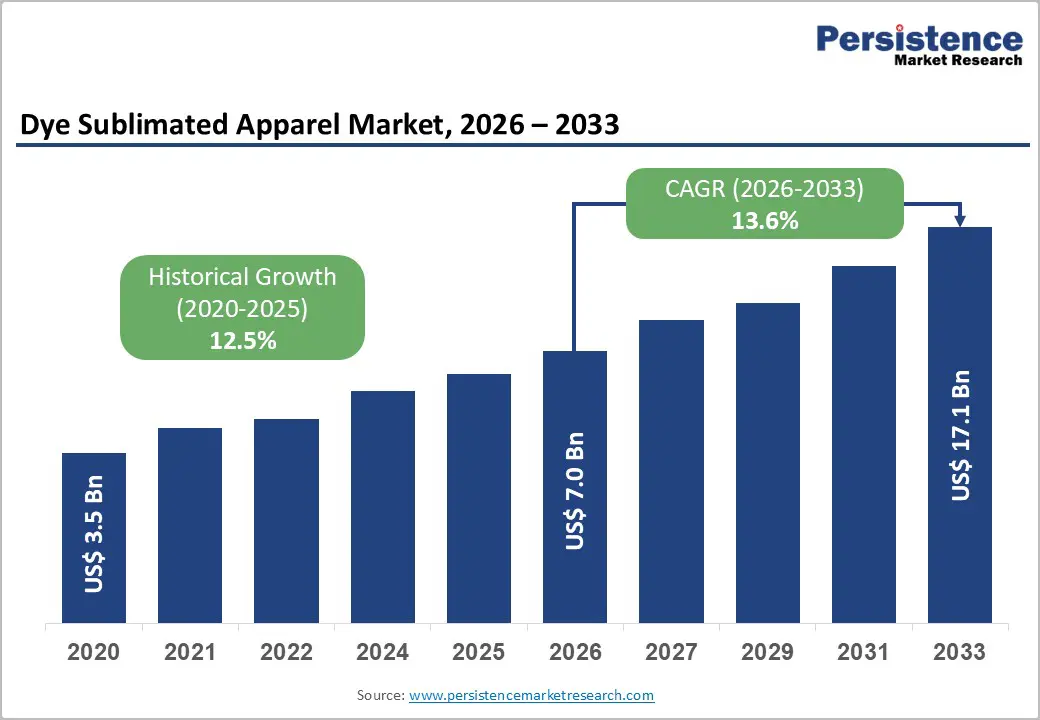
The global Dye Sublimated Apparel market is valued at US$ 7.0 Bn in 2026 and is projected to reach US$ 17.1 Bn by 2033, growing at a CAGR of 13.6% between 2026 and 2033.
The market is primarily propelled by surging consumer appetite for personalized, vibrant, and long-lasting printed garments across sportswear, corporate uniforms, and athleisure categories. Advancements in digital heat-press technologies including 3D Vacuum Heat Press and high-speed calendar systems, have significantly reduced production lead times and entry costs, enabling small and medium enterprises to participate competitively.
Key Industry Highlights:
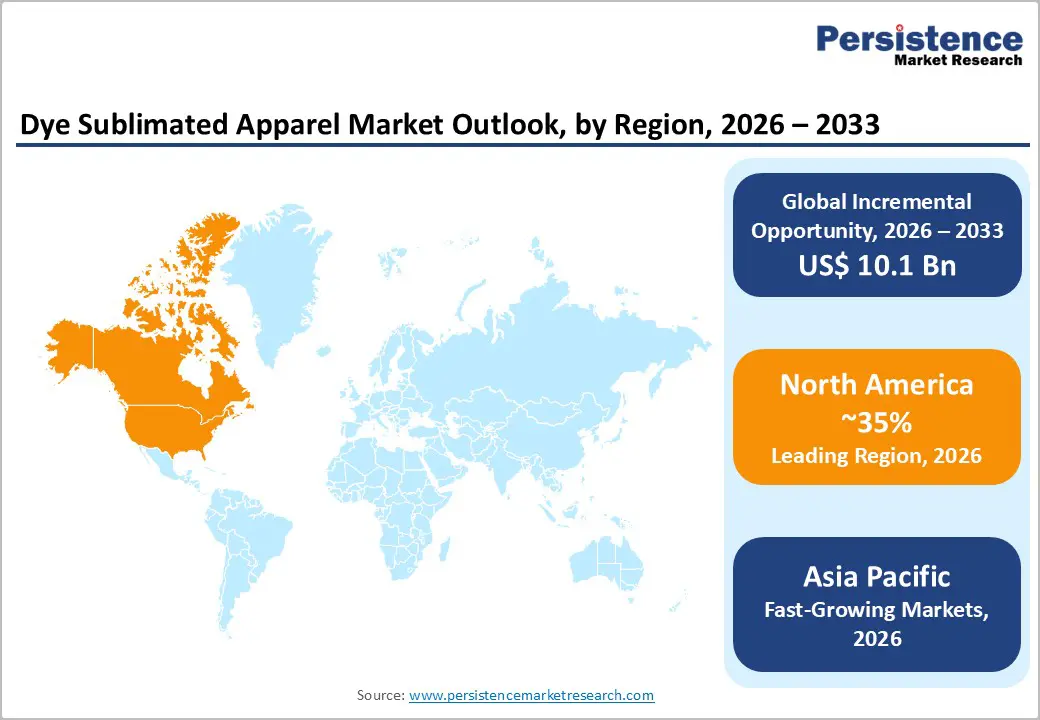
- Leading Region – North America leads the Dye Sublimated Apparel Market, driven by high per-capita spending on custom apparel, a robust e-commerce ecosystem, and strong demand from sportswear and corporate branding segments in the U.S.
- Fastest Growing Region – Asia Pacific is the fastest-growing region, with India projected at approximately 18.0% CAGR through 2034, supported by expanding middle-class incomes, digital textile adoption, and booming sportswear consumption.
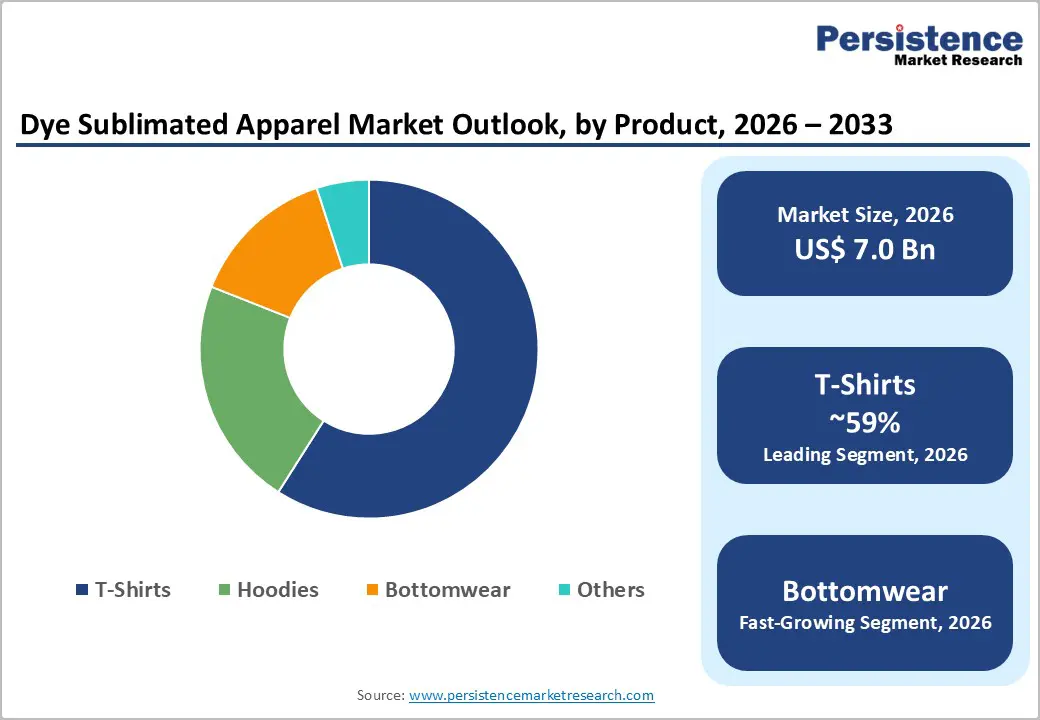
- Dominant Segment – T-Shirts dominate the product category with approximately 59% market share, owing to their universal applicability across promotional, casual, and sports contexts, combined with superior print receptivity of polyester-based fabrics.
- Fastest Growing Segment – The Online distribution channel is projected to register the highest CAGR during the forecast period, fueled by print-on-demand platforms, AI customization tools, and the Gen Z and Millennial consumer base's strong preference for personalized digital commerce.
- Key Market Opportunity – Growing regulatory pressure and consumer sustainability preferences present a significant opportunity for manufacturers investing in bio-based fabrics, recycled polyester, and waterless sublimation inks, particularly in European and North American markets.
| Key Insights | Details |
|---|---|
|
Dye Sublimated Apparel Market Size (2026E) |
US$ 7.0 Bn |
|
Market Value Forecast (2033F) |
US$ 17.1 Bn |
|
Projected Growth CAGR (2026–2033) |
13.6% |
|
Historical Market Growth (2020–2025) |
12.5% |
Market Dynamics
Drivers - Rising Demand for Personalized and Customizable Apparel
The global shift toward individuality and self-expression in fashion is a principal driver of the Dye Sublimated Apparel Market. Consumers increasingly seek garments that reflect personal identity, team affiliation, and brand messaging. According to the 2024 Sports, Fitness, and Leisure Activities Topline Participation Report, nearly 80% of Americans aged six and above participated in fitness or sports activities in 2023, an increase of 2.2% over 2022, adding approximately 5 million new participants. This expanding sportswear base directly fuels demand for customizable, high-performance sublimated garments. Corporate entities from start-ups to established enterprises are also adopting sublimated uniforms for branding, requiring cost-effective yet visually compelling apparel solutions that conventional printing cannot deliver at comparable quality or durability.
Technological Advancements in Digital Heat-Press Printing
Continuous innovation in dye sublimation hardware is broadening market accessibility and production efficiency. In April 2024, Seiko Epson Corporation unveiled its SureColor F11070 dye sublimation printer featuring four 4.7" Precision Core TFP printheads, offering roll-to-roll speeds of up to 2,700 sq. ft. per hour. Simultaneously, in August 2024, Prism Inks launched FUZION Ink Technology at Printing United, enabling seamless printing across polyester, cotton, and hard surfaces from a single printer. These innovations reduce setup costs, shorten production cycles, and improve colour consistency making sublimation printing more viable for small businesses and startups. The growing ecosystem of user-friendly heat-press machines and automated workflows continues to lower the barrier to entry.
Market Restraints - High Initial Capital Investment and Equipment Costs
One of the most significant barriers to market penetration is the high upfront investment required for advanced sublimation printing equipment. Industrial-grade dye sublimation printers and heat-press systems can cost tens of thousands of dollars, creating a steep entry barrier for small and micro-enterprises. While digital platforms and print-on-demand services have democratized some access, businesses seeking in-house full-scale production must commit substantial capital. This cost burden becomes particularly pronounced in price-sensitive emerging economies across South Asia and Sub-Saharan Africa, where access to financing is limited. The ancillary costs, maintenance, specialized inks, transfer paper, and skilled Labo compound the overall investment challenge.
Limited Fabric Compatibility and Sustainability Concerns
Dye sublimation printing is predominantly effective on polyester and polymer-coated substrates, restricting its application on natural fibres such as cotton and linen that constitute a significant share of consumer wardrobes. This fabric dependency limits the addressable market and creates a perception gap among eco-conscious consumers. Furthermore, the environmental impact of synthetic polyester production, including greenhouse gas emissions and microplastic shedding poses growing regulatory and reputational risks. The European Union's Sustainable Products Regulation and related textile circularity policies are increasingly scrutinizing synthetic fabric production, compelling manufacturers to adopt costlier bio-based alternatives or blended fabrics, which may diminish print quality.
Market Opportunities - Accelerating Growth of the Print-on-Demand and E-Commerce Ecosystem
The rapid proliferation of print-on-demand (POD) platforms and e-commerce marketplaces represents a transformative opportunity for the Dye Sublimated Apparel Market. According to the U.S. Census Bureau, retail e-commerce sales in the United States reached US$ 305.9 Bn in Q4 2024, marking a 2.7% increase from Q3 2024. Platforms such as Shopify, Etsy, and Amazon Handmade enable independent designers to offer personalized sublimated apparel without holding inventory. Companies such as Printful, Inc. are capitalizing on this by offering end-to-end fulfilment services, including custom labeling and sleeve printing. This model eliminates dead inventory risk and aligns well with the sustainability ethos of zero-waste, on-demand manufacturing creating new revenue streams especially for small brands targeting niche audiences.
Eco-Friendly Innovations and Bio-Based Substrate Development
As sustainability becomes a central purchasing criterion, market participants stand to gain significantly by investing in eco-friendly sublimation technologies. In January 2024, K&R Solutions Group introduced Bio Knit, a biodegradable fabric designed specifically for dye sublimation printing, positioning itself as a sustainable alternative to conventional polyester. Similarly, Adidas AG launched a sublimated sportswear line using recycled polyester and water-based inks in 2023 to meet eco-conscious demand. Innovations in waterless sublimation inks, energy-efficient heat presses, and RPET (recycled polyester) fabric blends are creating differentiated product propositions. Brands embracing these practices are likely to outperform peers in regulated markets such as the European Union and gain premium positioning with environmentally aware consumer segments globally.
Category-wise Insights
Printing Technique Analysis
Among the four printing techniques, the Small Format Heat Press segment commands the leading market share, accounting for approximately 51% of total revenues. Its dominance is attributable to cost efficiency, operational simplicity, and suitability for low-to-medium volume production runs favoured by small businesses, independent designers, and custom apparel brands. Unlike large industrial sublimation systems that require significant floor space and capital, small format heat presses enable on-demand printing with minimal setup costs, making them the preferred entry-level technology worldwide. Continuous technological refinements including automatic pressure adjustment and digital temperature control have further improved print consistency and minimized production errors.
Application Analysis
The Offline distribution channel holds the leading share in the application category, representing approximately 72% of global market revenues. Physical retail stores ranging from specialty sports outfitters to promotional merchandise shops maintain dominance due to consumers' preference for tactile product evaluation before purchase. Brick-and-mortar outlets offer extensive product variety across sizes, designs, themes, and custom options, providing an immersive shopping experience that online platforms currently cannot fully replicate. These stores also support walk-in customization services for corporate and sports team uniforms, catering to institutional buyers who require personalized consultation. However, the Online segment is projected to register the fastest CAGR during 2026–2033, driven by Generation Z and Millennial consumers who prefer digital design tools and direct-to-door delivery of customized apparel.
Product Analysis
Within the product category, T-Shirts represent the dominant segment with a market share of approximately 59%. Their universal appeal across casual wear, sportswear, corporate branding, and promotional events makes them the most versatile sublimation canvas. The ability of dye sublimation to produce fade-resistant, full-colour, photographic-quality prints on polyester T-shirt blanks has made the technique the preferred choice for bulk customization. Brands such as Royal Apparel manufacture dedicated polyester sublimation blanks specifically 100% polyester, 4.4 oz per square yard unisex T-shirts designed for optimal colour reproduction. The rising adoption of moisture-wicking polyester blends in athletic T-shirts and the expansion of print-on-demand platforms that feature T-shirts as flagship products further consolidate the segment's leadership.
Regional Insights
North America Dye Sublimated Apparel Market Trends
North America is the dominant regional market for dye sublimated apparel, led by the United States, which accounts for the largest revenue contribution in the region. The U.S. apparel market is characterized by high consumer spending on personalized fashion, deep penetration of e-commerce platforms, and robust demand from the sports and corporate sectors. According to the U.S. Census Bureau, retail e-commerce reached US$ 305.9 Bn in Q4 2024, underlining the digital channel's critical role in apparel distribution.
The U.S. regulatory framework increasingly incentivizes sustainable textile practices, with several states mandating reduced VOC emissions and restricting certain synthetic dyes, nudging manufacturers toward eco-compliant sublimation inks. Canada emerges as a high-potential sub-market within North America, projected to grow at a CAGR of approximately 10.5% through 2034, driven by outdoor culture, active lifestyle trends, and streetwear demand fueled by a vibrant music industry.
Europe Dye Sublimated Apparel Market Trends
Europe represents a mature yet actively evolving market for dye sublimated apparel, anchored by strong demand in Germany, the United Kingdom, France, and Spain. The region's performance is underpinned by a well-established sportswear culture, growing athleisure adoption, and stringent quality expectations that Favor dye sublimation over traditional screen printing. In March 2024, Hybrid Services Limited, the exclusive UK and Ireland distributor for Mimaki Engineering Co., Ltd. Unveiled the Tiger600-1800TS dye sublimation printer capable of print speeds up to 550 m²/hour, highlighting the region's readiness for high-volume sublimation production.
Regulatory harmonization under the EU's Sustainable Products Regulation and the European Green Deal framework is accelerating the transition to eco-friendly inks and recycled polyester substrates across European manufacturers. Countries such as Germany and France are also witnessing growth in corporate promotional apparel as businesses invest in branded merchandise for employee engagement and marketing campaigns.
Asia Pacific Dye Sublimated Apparel Market Trends
Asia Pacific is the fastest-growing regional market for dye sublimated apparel, currently commanding a share of over 30.2% of global revenues. The region's dominance is rooted in its large and cost-efficient textile manufacturing infrastructure across China, India, Vietnam, and Bangladesh. India stands out as the fastest-growing national market, expected to expand at a CAGR of approximately 18.0% through 2034, driven by rising disposable incomes, a growing middle class, and an influx of global fashion brands.
Within ASEAN, countries such as Indonesia, Thailand, and Vietnam are emerging as key production hubs, benefiting from lower labour costs and growing intra-regional sportswear consumption. Japan contributes technology leadership, with companies like Mimaki Engineering Co., Ltd. (headquartered in Nagano, Japan) pioneering advanced printhead technologies.
Competitive Landscape
The global Dye Sublimated Apparel Market is fragmented, comprising many niche players, regional specialists, and a few global operators. Market leaders differentiate through proprietary printing technologies, sustainable product lines, and digital customization platforms. Key strategies include geographic expansion into Asia Pacific and Latin America, investment in AI-driven design software, and forging print-on-demand fulfilment partnerships. Emerging business model trends include direct-to-consumer web-to-print platforms and white-label manufacturing services.
Key Market Developments
- In January 2024, K&R Solutions Group launched Bio Knit, a biodegradable fabric for dye sublimation printing, targeting airport advertising in the USA and Caribbean as an eco-friendly alternative to conventional polyester substrates.
- In January 2024, K1 Sportswear secured an exclusive multi-year uniform partnership with PLAY Hockey, supplying fully sublimated jersey replicas and team merchandise for all U.S.-based teams, highlighting institutional demand growth.
Companies Covered in Dye Sublimated Apparel Market
- Dad's Printing
- Inkwell Printing
- Royal Apparel
- TEXmarket
- ASPECT
- FUSH
- Printful, Inc.
- ALE CLOTHING
- Emirates Apparel
- Berunwear
Frequently Asked Questions
The global Dye Sublimated Apparel Market, valued at US$ 7.0 Bn in 2026, is projected to reach US$ 17.1 Bn by 2033, expanding at a CAGR of 13.6% during the forecast period (2026–2033). Historically, the market registered a CAGR of 12.5% between 2020 and 2025.
The key demand drivers include rising consumer preference for personalized, vibrant, and durable apparel, growth in sportswear and athleisure adoption with 80% of Americans participating in sports or fitness activities in 2023technological advances in digital heat-press printing, and rapid expansion of e-commerce and print-on-demand platforms globally.
The T-Shirts segment dominates the product category with approximately 59% market share, driven by their versatility across promotional, casual, and sports applications. The superior print receptivity of polyester-based T-shirt blanks and growing adoption by corporate events, sports teams, and e-commerce brands reinforce the segment's leading position.
North America leads the global market, anchored by the United States' advanced e-commerce infrastructure, high consumer spending on personalized fashion, and robust institutional demand from sports organizations and corporate buyers. The region is also supported by a strong innovation ecosystem comprising AI-powered design tools and direct-to-consumer fulfilment networks.
Key market players include Printful, Inc., Royal Apparel, ALE CLOTHING, Emirates Apparel, Berunwear, TEXmarket, Inkwell Printing, Dad's Printing, ASPECT, and FUSH. These companies compete based on printing quality, sustainable practices, digital customization capabilities, and geographic reach.


