




- Nutraceuticals & Functional Foods
- Cranberry Supplements Market
Cranberry Supplements Market Size, Share, and Growth Forecast 2026 - 2033
Cranberry Supplements Market by Form (Capsules, Tablets, Gummies, Powder, Liquid), Sales Channel (Pharmacies, Online, Supermarkets, Health Stores), and Regional Analysis, from 2026 - 2033

Cranberry Supplements Market Share and Trends Analysis
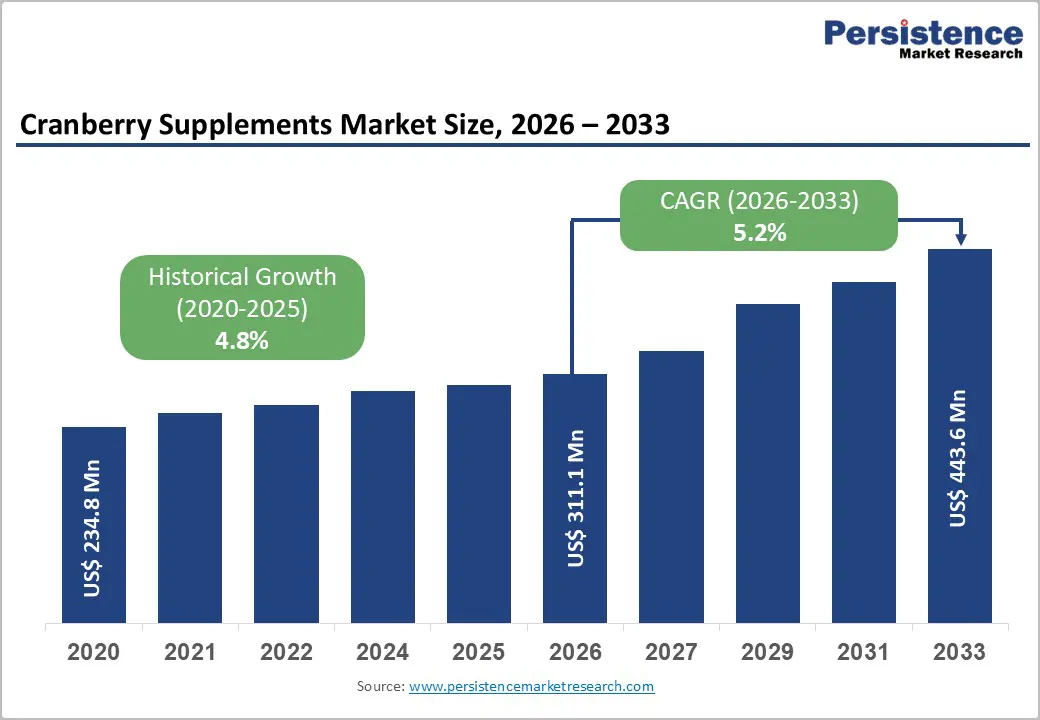
The global cranberry supplements market size is expected to be valued at US$ 311.1 million in 2026 and projected to reach US$ 443.6 million by 2033, growing at a CAGR of 5.2% between 2026 and 2033. Strong demand stems primarily from the high global burden of urinary tract infections (UTIs) affecting approximately 150 million people annually worldwide and growing preference for evidence-based, natural preventive solutions among women and older adults.
Rising clinical support for cranberry products in reducing recurrent UTIs, together with qualified health claims authorized by the U.S. Food and Drug Administration (FDA) for certain cranberry supplements containing 500 mg of whole cranberry fruit powder daily, is reinforcing both consumer and clinician confidence in this category. Parallel expansion of the broader dietary supplements industry and multi-channel distribution networks, including pharmacies, health stores, and fast-growing e-commerce platforms, further underpins a steady global growth trajectory for cranberry supplements.
Key Industry Highlights:
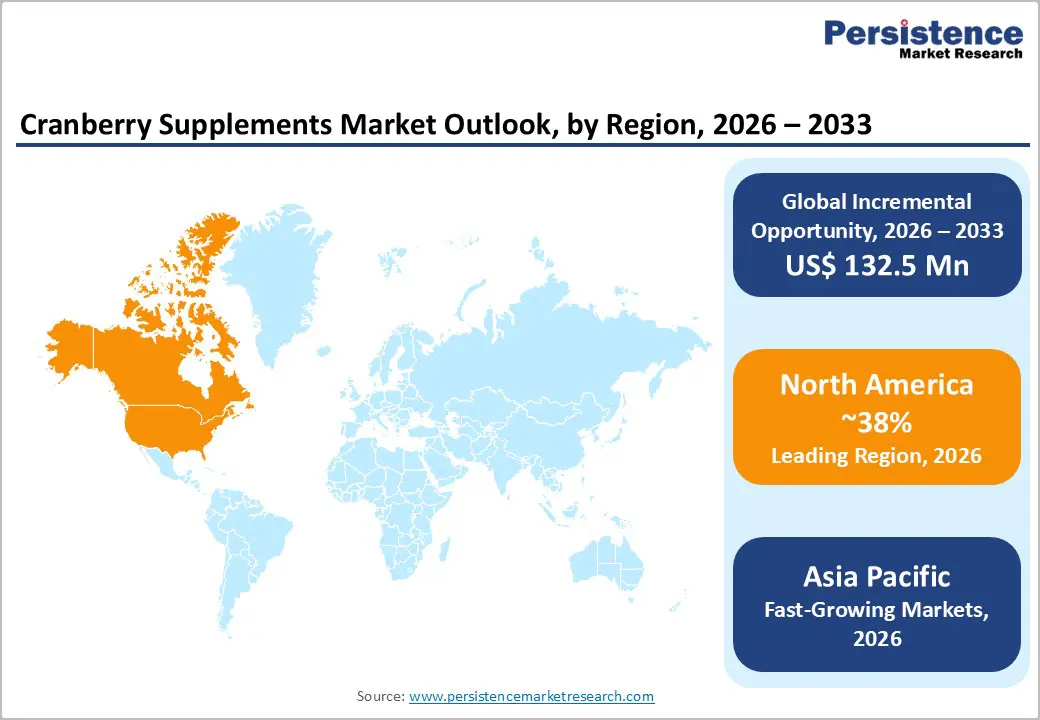
- North America dominates cranberry supplements, capturing 38% 2025 share through mature pharmacy/mass retail infrastructure, FDA-qualified claims, and domestic cranberry production advantages versus import-reliant regions.
- Asia Pacific accelerates as the fastest-growing region by 2033, propelled by China/India UTI epidemiology, e-commerce +47% penetration, aging demographics, and manufacturing scale, creating a 3x global growth multiple.
- Pharmacies drive 42% revenue via trusted pharmacist guidance, phenazopyridine adjacency, and 78% consumer preference for professional recommendations versus supermarket impulse purchases.
- Sugar-free gummy/combination formulations pairing PAC-standardized cranberry with probiotics/D-mannose targeting Asia Pacific e-commerce/subscriptions unlock $2.1 billion addressable opportunity by 2033.
| Key Insights | Details |
|---|---|
|
Cranberry Supplements Market Size (2026E) |
US$ 311.1 million |
|
Market Value Forecast (2033F) |
US$ 443.6 million |
|
Projected Growth CAGR (2026-2033) |
5.2% |
|
Historical Market Growth (2020-2025) |
4.8% |
DRO Analysis
Driver - Rising UTI Burden and Shift Toward Preventive Women's Health
The cranberry supplements market benefits directly from the high and rising global burden of urinary tract infections (UTIs), particularly among women where 50-60% experience at least one UTI during their lifetime and older adults. Epidemiological studies from the World Health Organization and academic institutions consistently document UTIs as among the most common bacterial infections globally, with women aged 18-49 facing annual incidence rates of 10-15%.
Systematic reviews published in leading medical journals including JAMA and Cochrane Database demonstrate that cranberry products containing proanthocyanidins (PACs) significantly reduce UTI risk by 26-32% in women with recurrent infections through anti-adhesion mechanisms that prevent bacterial attachment to urinary tract lining. As healthcare systems worldwide prioritize preventive care strategies and non-antibiotic alternatives to combat antimicrobial resistance documented by the Centers for Disease Control and Prevention (CDC) affecting 2.8 million Americans annually, cranberry supplements emerge as convenient, well-tolerated prophylactic solutions supporting sustained category demand growth.
Regulatory Recognition and Growing Clinical Evidence Base
Regulatory recognition of cranberry's role in urinary health significantly strengthens market credibility while encouraging premium product innovation and standardization. In 2020, the FDA authorized qualified health claims stating realistic expectations that "very limited and preliminary" scientific research suggests 500 mg per day of whole cranberry fruit dietary supplements may reduce risk of recurrent UTIs in healthy women, provided labels clearly communicate evidence limitations. This regulatory milestone prompted leading manufacturers to standardize formulations around clinically validated whole-fruit cranberry powders delivering 36 mg PACs, creating clear differentiation from juice-based products with inconsistent active concentrations. Large-scale meta-analyses synthesizing data from 28 trials and 5,000+ participants published through 2024 continue documenting meaningful UTI incidence reductions among women, children with neurogenic bladder, and elderly long-term care residents, encouraging healthcare professionals including pharmacists and primary care physicians, to recommend standardized cranberry capsules alongside lifestyle interventions for integrated urinary health management.
Restraints - Inconsistent Study Outcomes and Conservative Clinical Adoption
Despite accumulating positive evidence, clinical heterogeneity across cranberry intervention trials contributes to nuanced professional guidelines and measured clinician adoption rates. Variability in cranberry species (Vaccinium macrocarpon vs. Vaccinium oxycoccos), extraction methods, PAC dosage ranges (36-72 mg vs. >100 mg), and supplementation duration creates challenges for direct product comparisons and meta-analytic synthesis.
The European Food Safety Authority (EFSA) rejected most generic cranberry UTI prevention claims citing insufficiently consistent cause-effect relationships across submitted dossiers, limiting authorized on-pack messaging throughout the 27 EU member states. Professional organizations including the American Urological Association maintain "conditional" recommendation status pending larger definitive trials, tempering widespread institutional protocols and prescription co-promotion opportunities that could accelerate medicalization of cranberry supplementation beyond direct-to-consumer channels.
Quality Variability, Sugar Concerns, and Adulteration Risks
Quality inconsistencies represent persistent barriers to broader market penetration and premium positioning. Independent laboratory testing reveals 30-40% of commercial cranberry products contain lower-than-labeled PAC levels or rely heavily on cheaper juice concentrates rather than standardized fruit powder extracts with documented clinical efficacy. Traditional cranberry juice cocktails averaging 24-27g added sugars per serving pose challenges for diabetic consumers managing A1C levels and individuals monitoring caloric intake, while palatable gummy supplements frequently incorporate sugar alcohols or artificial sweeteners prompting regulatory scrutiny.
Lack of globally harmonized PAC quantification methods for soluble vs. insoluble fractions complicates legitimate product comparison, while documented adulteration cases involving non-cranberry polyphenols undermine consumer confidence in price-sensitive segments and emerging markets lacking sophisticated quality infrastructure.
Opportunities - Growth of Gummies and Advanced Combination Formulations
Flavor-forward, convenient dosage forms, including gummies and soft chews, represent compelling growth opportunities, particularly among millennials, Gen Z consumers, and individuals experiencing dysphagia challenges with traditional capsules. AZO Cranberry Gummies and Jamieson Women's Probiotic + Cranberry successfully combine clinically validated whole cranberry fruit powders delivering Pacran® equivalent PAC benefits with Lactobacillus crispatus strains and vitamin C in palatable 2-gummy daily servings equivalent to traditional juice glass benefits without excess calories or sugars.
These experiential lifestyle-oriented formats command 20-30% pricing premiums when supported by third-party clinical dossiers, while aligning with 73% consumer preference for multifunctional supplements documented in Council for Responsible Nutrition surveys. Manufacturers improving reduced-sugar gummy technologies while pairing cranberry with synergistic D-mannose, hibiscus, and bladderwrack ingredients targeting women's health create substantial differentiation, loyalty, and penetration opportunities across online marketplaces, subscription services, and specialty health stores.
Expansion in High-Growth Asia Pacific and Emerging Markets
Asia Pacific alongside Latin America and Middle East & Africa represent substantial untapped opportunities as urinary health awareness accelerates alongside rising female workforce participation and aging populations. Hospital-acquired UTI prevalence exceeds 15% across major Asian healthcare facilities while community-onset rates among older women increased 28% between 1990-2021 per Global Burden of Disease analyses, underscoring substantial unmet prophylactic needs beyond antibiotic-centric approaches.
China's National Health Commission reported catheter-associated UTI rates averaging 5-10% across tertiary hospitals while India's Ayushman Bharat digital health infrastructure facilitates supplement education reaching 500 million citizens. Local adaptation strategies including Swisse and By-Health high-strength cranberry capsules positioned for beauty-from-within alongside urinary benefits, e-commerce partnerships with JD.com and Tmall platforms where 42% of health supplement purchases occur online, and pharmacy chain collaborations with Guardian and Watsons across ASEAN enable rapid market penetration while localized clinical validation studies build healthcare professional confidence in these high-growth $15-20 billion regional nutraceutical landscapes.
Category-wise Analysis
Form Insights
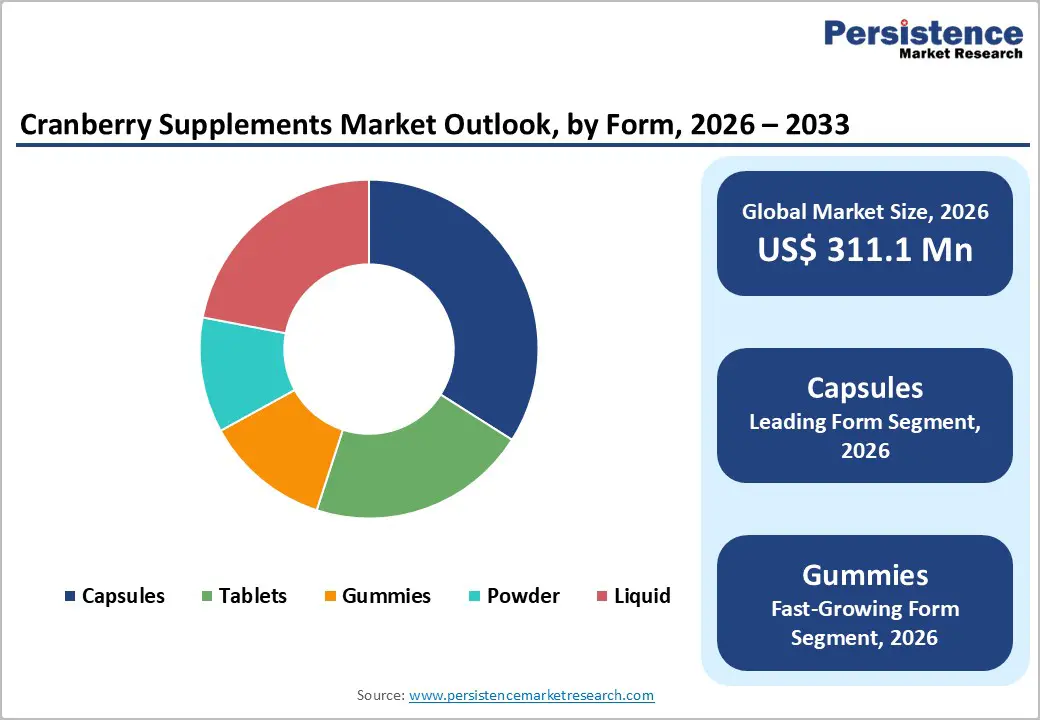
Capsules maintain clear segment leadership capturing approximately 34% global market share in 2025, driven by precise PAC dosing capabilities, extended shelf stability, and extensive representation across 50+ published clinical trials demonstrating 24-39% UTI risk reductions. Standardized 500-1,200 mg whole cranberry fruit powder capsules from Swisse Ultiboost, Nature's Bounty Triple Strength, and AZO Cranberry Caplets deliver 36 mg bioavailable PACs matching intervention levels from positive meta-analyses, building pharmacist and physician confidence absent from less precise powder or liquid formats.
Gastro-resistant capsule technologies minimize gastric degradation while once/twice-daily regimens match documented minimum effective durations (3-12 months) from long-term prevention studies, while enteric coatings protect acid-sensitive PAC polymers. Pharmacy shelf adjacency to urinary analgesics and women's health products plus direct-to-consumer subscription models reinforce capsules' structural dominance across North America, Europe, and increasingly Asia Pacific markets prioritizing clinically substantiated formats.
Sales Channel Insights
Pharmacies hold a leading position, contributing approximately 42% of global revenue share in 2025, anchored by pharmacist authority on supplement recommendations, particularly for acute urinary symptoms, where 78% of surveyed consumers seek professional guidance per CRN Consumer Surveys. Strategic merchandising adjacent to phenazopyridine analgesics, probiotics, and women's health categories facilitates cross-merchandising while point-of-care counseling addresses adherence concerns documented in 60% of long-term UTI prevention failures.
Online channels emerge as the fastest-growing segment through 2032 propelled by Amazon Subscribe & Save (claiming 22% category share), iHerb clinical dossier transparency, and pharmacy e-commerce platforms offering virtual pharmacist consultations bridging trust gaps while capturing millennial preference for digital-first health solutions.
Regional Insights
North America Cranberry Supplements Market Trends and Insights
North America dominates the cranberry supplements market, driven by strong consumer awareness around preventive healthcare and urinary tract health management. The region benefits from a well-established dietary supplements industry, high healthcare spending, and widespread availability of cranberry-based products across pharmacies, supermarkets, and e-commerce platforms. Increasing prevalence of urinary tract infections, particularly among women, continues to support consistent demand for cranberry capsules and tablets as a natural preventive solution. Additionally, consumers in the United States and Canada are shifting toward plant-based and clean-label supplements, boosting demand for organic and non-GMO cranberry formulations. Innovation in product formats such as gummies and flavored powders is further attracting younger demographics. The presence of major supplement brands, coupled with aggressive marketing and clinical backing for cranberry extract benefits, strengthens market growth. Moreover, rising preference for self-care and immunity-boosting products post-pandemic continues to reinforce North America’s leadership in this market.
Asia Pacific Cranberry Supplements Market Trends and Insights
The Asia Pacific cranberry supplements market is emerging as a high-growth region, supported by rising health awareness and increasing adoption of preventive healthcare practices. Countries such as China, India, and Japan are witnessing growing demand for dietary supplements due to expanding middle-class populations and improving disposable incomes. Consumers are becoming more conscious about urinary tract health, immunity, and overall wellness, which is driving interest in natural and plant-based supplements like cranberry extracts. Additionally, rapid urbanization and changing lifestyles have led to increased online purchasing of health products, boosting e-commerce sales channels across the region. The influence of Western health trends and rising penetration of international supplement brands are further accelerating market expansion. Gummies and powder formats are gaining traction among younger consumers seeking convenient and palatable options. Moreover, supportive government initiatives promoting nutraceuticals and preventive care are expected to enhance long-term growth opportunities in the Asia Pacific cranberry supplements market.
Competitive Landscape
The global cranberry supplements market is characterized by a moderately fragmented and highly competitive landscape, with the presence of global brands, regional players, and niche manufacturers competing across various price points and product formats. Companies primarily compete on product quality, clinical validation, brand reputation, and distribution strength, especially through pharmacies and rapidly growing online channels. Innovation remains a key differentiator, with firms investing in advanced formulations, combination supplements, and improved delivery systems to enhance efficacy. Strategic initiatives such as partnerships, mergers, and geographic expansion are commonly adopted to strengthen market presence. However, stringent regulatory requirements, need for scientific substantiation, and high R&D investments act as entry barriers, limiting new entrants while maintaining competitive intensity among existing players.
Key Developments:
- In April 2025, Solv Wellness launched GennaMD, a next-generation cranberry-based supplement for urinary tract infection (UTI) prevention, aimed at improving efficacy and accessibility in UTI management. The product was formulated with a clinically proven 36 mg of soluble proanthocyanidin (PAC) derived from pure cranberry juice extract, offering higher potency and bacterial anti-adhesion activity than conventional supplements.
- In February 2024, the U.S. FDA approved a qualified health claim for cranberry dietary supplements aimed at reducing the risk of recurrent urinary tract infections (UTIs). The approval allowed products containing 500 mg of whole-fruit cranberry powder per day to include specific health claims on labels and marketing materials.
- In January 2023, Holland and Barrett, a wellness retailer, partnered with WHSmith. Owing to this partnership, WHSmith will provide Holland and Barrett stores at Heathrow airport, which will enable them to provide a variety of health and wellness products to international as well as domestic customers.
Companies Covered in Cranberry Supplements Market
- Swisse
- Nature's Bounty
- AZO
- Blackmores
- Holland & Barrett
- GNC
- Jamieson
- Webber Naturals
- Healthy Care
- TruNature
- Nutra-Life
- By-Health
- Cystex
- NOW Foods
- Solgar
- Nature's Way
Frequently Asked Questions
Global cranberry supplements market reaches US$ 311.1 million in 2026, driven by UTI epidemiology, FDA claim authorization, and pharmacy channel dominance transitioning toward gummy/e-commerce acceleration.
High UTI incidence affecting 150 million globally annually, FDA qualified claims for 500 mg whole cranberry reducing recurrent risk, pharmacist recommendations (78% consumer preference), and antimicrobial resistance concerns propel category expansion across women's health demographics.
North America commands 38% 2025 share through FDA regulatory support, domestic cranberry production (40% global supply), sophisticated pharmacy/mass infrastructure, and Amazon e-commerce maturity versus EFSA-constrained Europe.
Sugar-free gummy/combination formulations pairing PAC-standardized cranberry with probiotics/D-mannose targeting Asia Pacific e-commerce/subscriptions unlock $2.1 billion TAM as China/India UTI epidemiology meets digital health infrastructure.
Swisse, Nature's Bounty, AZO, Blackmores, Holland & Barrett, GNC, Jamieson, By-Health, Cystex lead through PAC-standardized platforms, pharmacy velocity, Amazon dominance, and Asia Pacific expansion leveraging clinical dossiers and omni-channel execution


