




- Plastics, Polymers & Resins
- Chlorinated Polyvinyl Chloride Market
Chlorinated Polyvinyl Chloride Market Size, Share, and Growth Forecast, 2026 – 2033
Chlorinated Polyvinyl Chloride Market by Product Form (Resin & Compound, Pipes, Fittings & Valves, Sheets, Panels & Profiles), Application (Plumbing & Water Distribution, Fire Protection Systems, Others and Regional Analysis for 2026 – 2033

Chlorinated Polyvinyl Chloride Market Size and Trends Analysis
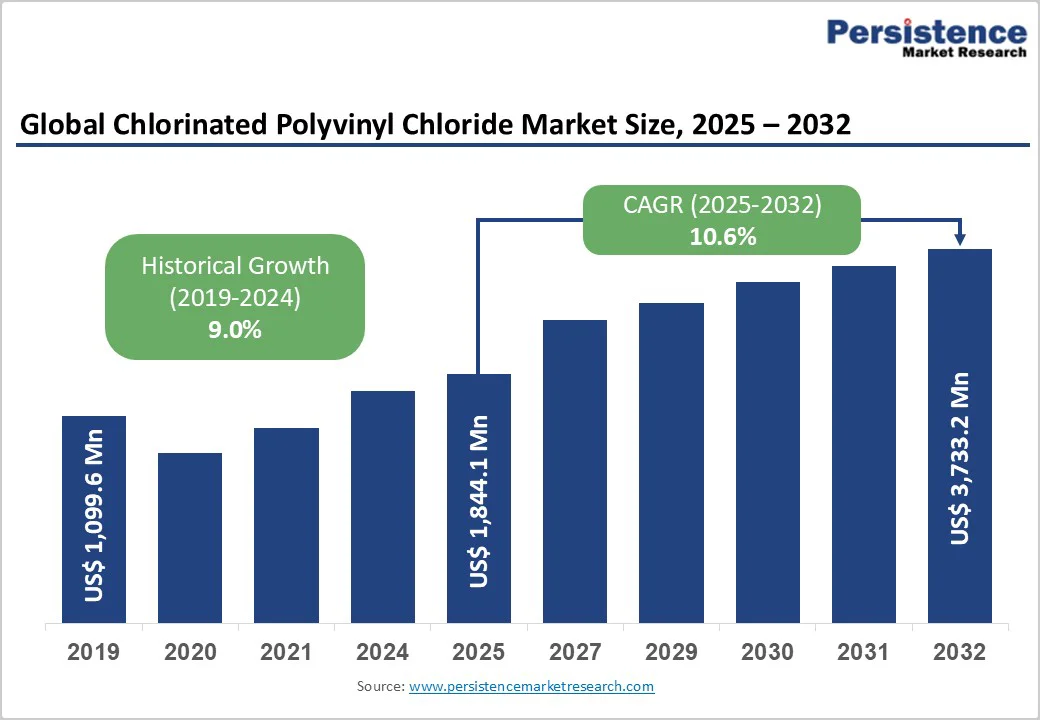
The global chlorinated polyvinyl chloride market size is likely to be valued at US$2.7 billion in 2026 and is expected to reach US$4.7 billion by 2033, growing at a CAGR of 8.4% during the forecast period from 2026 to 2033, driven by expanding water infrastructure, residential construction, fire protection, and industrial piping requirements, where CPVC is valued for its resistance to corrosion, chemicals, and elevated temperatures.
In 2026, the U.S. EPA reported that drinking-water systems require substantial investment over the next 20 years, including US$422.9 billion for distribution and transmission infrastructure, highlighting replacement opportunities for durable piping systems.
Key Industry Highlights:
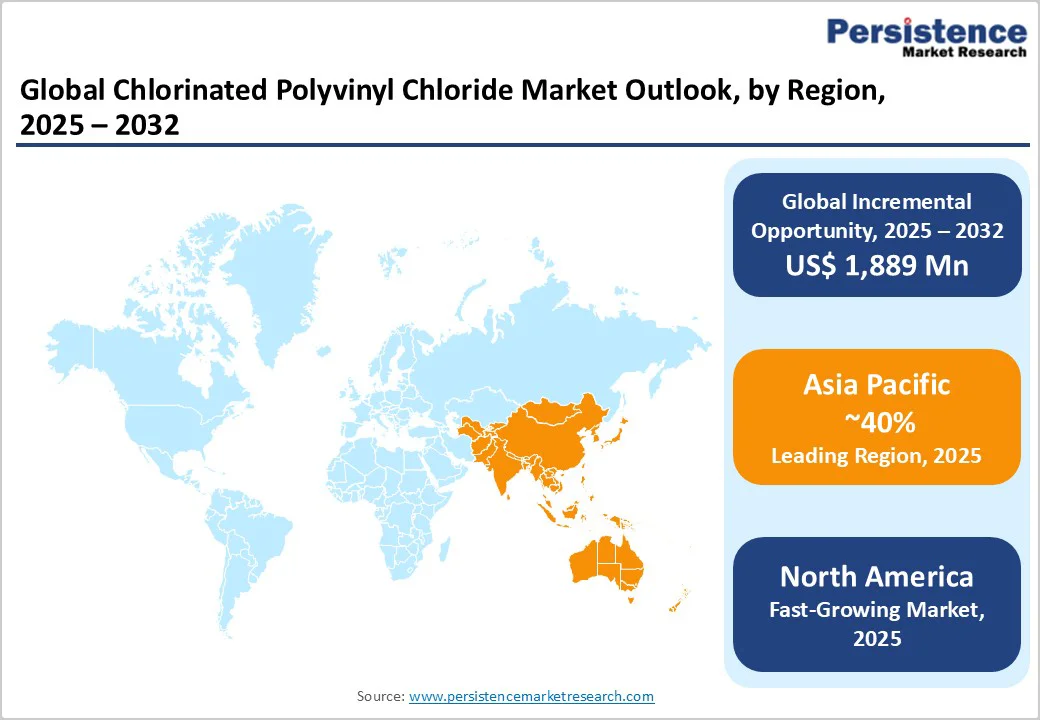
- Leading Region: Asia Pacific is anticipated to be the leading region, accounting for a market share of 46% in 2026, driven by rapid urbanization, construction activity, and expanding water infrastructure.
- Fastest-growing Region: Asia Pacific is likely to be the fastest-growing region, supported by rising adoption of CPVC piping in residential, commercial, fire-protection, and industrial applications.
- Leading Product Form: Pipes are projected to represent the leading product form in 2026, accounting for 55% of the revenue share, for strong demand across plumbing, fire protection, and industrial piping.
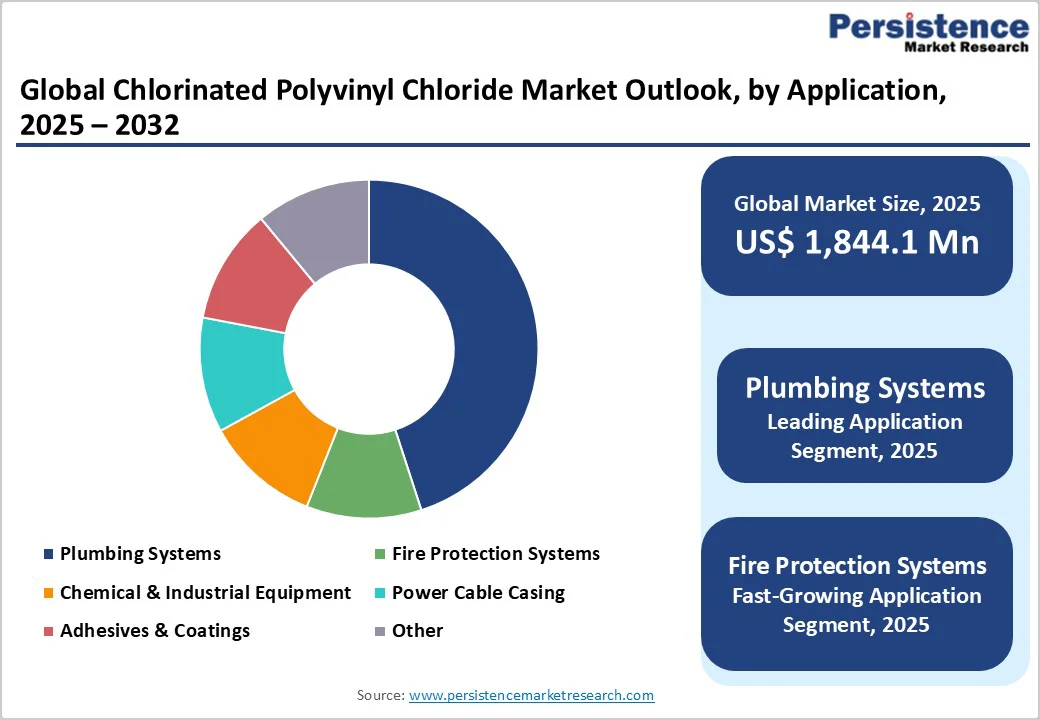
- Leading Application: The plumbing & water distribution segment is anticipated to be the leading application, accounting for over 50% of the revenue share in 2026, supported by residential construction, water infrastructure, and hot- and cold-water piping demand.
- Key Opportunity: Expanding water and infrastructure modernization, rapid urbanization, fire-protection adoption, and industrial process expansion create significant opportunities for CPVC across plumbing, water distribution, fire-safety, and corrosion-resistant industrial piping applications.
DRO Analysis
Driver - Infrastructure Modernization and Water-System Replacement
Infrastructure modernization is a major driver for the chlorinated polyvinyl chloride market as aging water networks increasingly require rehabilitation and replacement. The U.S. Environmental Protection Agency’s 2026 update to its Drinking Water Infrastructure Needs Survey identified substantial long-term requirements for replacing or rehabilitating deteriorating distribution and transmission pipelines.
This modernization creates opportunities for durable nonmetallic piping materials in potable-water and building-plumbing applications. CPVC offers corrosion resistance, smooth internal surfaces, and suitability for hot- and cold-water distribution, making it relevant to replacement projects where long service life and reduced maintenance are important considerations.
Replacement activity is also being strengthened by regulatory efforts addressing aging and potentially hazardous water infrastructure. In 2024, the EPA finalized requirements to accelerate replacement of lead service lines across the U.S., reinforcing the broader shift toward safer and more reliable distribution systems. Although CPVC is not a direct replacement for every existing pipe application, modernization programs can increase demand for qualified plastic piping systems in residential, commercial, and institutional construction.
Restraint - Certification and Installation-Skill Requirements
Certification and installation requirements can constrain CPVC adoption because products must meet application-specific standards before they can be used in critical plumbing and fire-protection systems. CPVC components intended for sprinkler applications, for example, must satisfy relevant specifications and listing requirements. The National Fire Protection Association’s requirements emphasize that listed CPVC fittings used in automatic sprinkler installations must be suitable for the intended service and installed according to applicable listing limitations and instructions.
Installation practices also influence system performance and can create challenges where trained personnel are unavailable. Correct cutting, joining, solvent cement application, support, spacing, and compatibility with surrounding materials are important for achieving reliable CPVC systems. National standards continue to specify technical requirements for CPVC fire-protection applications.
Opportunity - Expansion of Industrial Process Piping Applications
Industrial and chemical-process expansion presents an important opportunity because CPVC combines corrosion resistance with temperature capability suited to numerous process-piping environments. Chemical-processing facilities handle aggressive substances that can accelerate corrosion and deterioration in conventional metallic systems.
CPVC piping is resistant to many acids, bases, salts, and selected hydrocarbons, supporting its use in chemical handling, industrial water, wastewater, and process applications. As manufacturing facilities expand or modernize production infrastructure, operators increasingly evaluate piping materials based on durability, chemical compatibility, maintenance requirements, and lifecycle performance.
The opportunity extends beyond chemical manufacturing into broader industrial process-water applications, where corrosion can cause leaks, flow restrictions, maintenance requirements, and premature system failures. CPVC’s lightweight construction and resistance to internal and external corrosion can simplify installation and maintenance compared with certain metallic alternatives. These characteristics are particularly relevant to facilities seeking reliable piping while managing operational and maintenance costs.
Category-wise Analysis
Product Form Insights
Pipes are expected to lead, accounting for 55% of revenue in 2026, due to their widespread use in residential and commercial plumbing, potable-water distribution, fire-protection networks, and industrial process piping. Their corrosion resistance, lightweight construction, and suitability for hot- and cold-water applications make them a preferred alternative to conventional metallic piping in several projects. For example, IPEX’s Xirtec CPVC system is used for potable-water distribution in residential, commercial, and institutional applications.
The fittings and valves segment is likely to represent the fastest-growing segment, supported by rising demand for complete CPVC piping systems that require compatible components for connecting, controlling, and directing fluid flow. Growth is supported by expanding plumbing, fire-protection, and industrial applications where system reliability and corrosion resistance are important. IPEX’s BlazeMaster system combines CPVC pipes and fittings for approved fire-protection applications.
Application Insights
The plumbing and water distribution segment is projected to lead the market, capturing around 50% of the revenue share in 2026, supported by residential construction, commercial development, water-system modernization, and increasing demand for reliable hot- and cold-water distribution. CPVC’s resistance to corrosion and scaling, combined with relatively simple installation, supports its adoption across building plumbing systems and replacement projects.
Fire protection systems are likely to be the fastest-growing application due to stronger emphasis on building safety, expansion of sprinkler installations, retrofit projects, and adoption of listed CPVC systems. CPVC provides corrosion resistance, lightweight handling, and efficient installation, making it suitable for specified wet-pipe sprinkler applications. A notable example is Lubrizol’s BlazeMaster CPVC technology, which is widely used in approved fire-sprinkler system applications.
Regional Insights
North America Chlorinated Polyvinyl Chloride Market Trends
North America is likely to be a significant market for chlorinated polyvinyl chloride in 2026, supported by aging water infrastructure, residential construction, commercial development, and fire-protection applications. In the U.S., the EPA’s 2026 Drinking Water Infrastructure Needs Survey identified extensive requirements for distribution and transmission pipeline rehabilitation and replacement, supporting demand for durable piping solutions.
U.S. Chlorinated Polyvinyl Chloride Market Trends
The U.S. is expected to dominate the North American market, accounting for approximately 80% of the regional market share in 2026, supported by water-system replacement, building renovation, and infrastructure modernization. The EPA’s 2026 assessment highlights substantial requirements for water infrastructure rehabilitation, creating opportunities for corrosion-resistant piping solutions. Residential and commercial plumbing remains a key application, while fire-protection systems and industrial process piping provide additional demand. These factors are expected to sustain CPVC market activity in the U.S.
Canada Chlorinated Polyvinyl Chloride Market Trends
Canada is expected to remain a significant market for chlorinated polyvinyl chloride, accounting for approximately 20% of the North American market share in 2026, supported by investments in drinking-water, wastewater, and stormwater infrastructure. Federal infrastructure programs have supported the construction and rehabilitation of water infrastructure, while housing-enabling projects are creating additional demand for water and plumbing systems. Ontario’s expanded funding for water infrastructure to support new housing development is further strengthening demand. These investments are creating opportunities for durable plastic piping systems, including CPVC, across residential, municipal, and infrastructure applications.
Europe Chlorinated Polyvinyl Chloride Market Trends
Europe is likely to be a significant market for chlorinated polyvinyl chloride in 2026, due to construction recovery, infrastructure modernization, water-management investment, and demand for reliable plumbing and fire-protection systems. Germany is benefiting from renewed public infrastructure spending and improving residential construction activity. The U.K. is simultaneously increasing investment in water-supply resilience and housing-related infrastructure.
U.K. Chlorinated Polyvinyl Chloride Market Trends
The U.K. is likely to be a significant market for chlorinated polyvinyl chloride, with estimates for 15% of Europe's market share in 2026, supported by water-infrastructure modernization and housing development. In 2025, the government announced measures to accelerate water infrastructure investment. The East of England is receiving major investment to improve water resilience. New pipeline projects are being developed to strengthen regional supply. Water-efficient housing is another emerging demand factor. In 2025, the government proposed strengthened water-efficiency standards for new homes. These developments support demand for efficient plumbing systems.
Germany Chlorinated Polyvinyl Chloride Market Trends
Germany is anticipated to dominate the regional market, accounting for around 37% of the Europe market share in 2026. Germany is experiencing improving construction activity after a prolonged slowdown. Destatis reported that residential building permits increased in early 2026, indicating improving construction momentum. The government is also increasing infrastructure investment. Public spending is supporting modernization across infrastructure sectors. This creates opportunities for advanced piping systems. Residential plumbing remains an important application.
Asia Pacific Chlorinated Polyvinyl Chloride Market Trends
The Asia Pacific region is anticipated to be the leading region, accounting for a market share of 46% in 2026, driven by its rapid urbanization, housing construction, water infrastructure development, and industrial expansion. China benefits from extensive investment in water-conservancy and municipal infrastructure, while India is seeing strong demand from residential construction and organized plumbing systems.
China Chlorinated Polyvinyl Chloride Market Trends
China is projected to dominate the regional market, holding around a 30% share of the market in 2026, due to extensive water infrastructure development and urban construction. In 2025, China invested heavily in water-conservancy facilities. Large-scale municipal projects support piping demand. Industrial development provides additional opportunities. Residential and commercial construction also contributes to consumption. Water security remains an important government priority. Infrastructure upgrades encourage adoption of durable piping materials.
India Chlorinated Polyvinyl Chloride Market Trends
India is expected to emerge as a significant market, accounting for approximately a 22% share in 2026, due to urban housing, water infrastructure, sanitation projects, and replacement of conventional plumbing materials. Government-backed infrastructure development continues to expand water-supply networks. Residential construction remains a major consumption base. Industrial piping provides additional opportunities. In 2026, Lubrizol announced a major investment with Grasim Industries to establish integrated CPVC resin production in Gujarat.
Competitive Landscape
The global chlorinated polyvinyl chloride market exhibits a moderately fragmented structure, driven by the presence of specialized resin manufacturers, integrated chemical companies, and downstream pipe and fittings producers competing across plumbing, water distribution, fire protection, and industrial applications. Key leaders include Aliaxis Group S.A., Astral Limited, Georg Fischer Ltd., Kaneka Corporation, Lubrizol Corporation, IPEX Inc., Sekisui Chemical Co., Ltd., Prince Pipes and Fittings, and Supreme Industries Limited.
These players compete through capacity expansion, localized manufacturing, product development, strategic partnerships, and integrated pipe-and-fitting portfolios. A notable recent development is Lubrizol’s partnership with Grasim Industries, which inaugurated a CPVC resin manufacturing facility in Gujarat in June 2026, strengthening localized supply for plumbing, water management, fire-safety, and industrial piping applications.
Key Industry Developments:
- In June 2026, Lubrizol and Grasim Industries inaugurated a CPVC resin manufacturing facility in Vilayat, Gujarat, strengthening local CPVC resin and compound production for pipes and fittings used in residential, commercial, and industrial applications.
Companies Covered in Chlorinated Polyvinyl Chloride Market
- Aliaxis Group S.A.
- Astral Limited
- Charlotte Pipe and Foundry
- Georg Fischer Ltd.
- IPEX Inc.
- Kaneka Corporation
- Lubrizol Corporation
- Prince Pipes and Fittings
- Sekisui Chemical Co., Ltd.
- Supreme Industries Limited
Frequently Asked Questions
The global chlorinated polyvinyl chloride market is projected to reach US$2.7 billion in 2026.
Infrastructure modernization, rising construction activity, water-system replacement, and growing demand for corrosion- and heat-resistant piping in plumbing, fire protection, and industrial applications drive the market.
The chlorinated polyvinyl chloride market is expected to grow at a CAGR of 8.4% from 2026 to 2033.
Key opportunities lie in emerging-market urbanization, water-infrastructure development, industrial process piping, fire-protection systems, and technological improvements that expand CPVC applications.
Aliaxis Group S.A., Astral Limited, Charlotte Pipe and Foundry, Georg Fischer Ltd., and IPEX Inc are the leading players.


