




- Nutraceuticals & Functional Foods
- African Mango Seed Extract Market
African Mango Seed Extract Market Size, Share, Growth, and Regional Forecast, 2026 to 2033
African Mango Seed Extract Market by Form (Powder, Liquid, Capsules/Tablets), Nature (Organic, Conventional), End-user (Dietary Supplements, Functional Food & Beverages, Pharmaceuticals, Cosmetics & Personal Care, Others), and Regional Analysis from 2026 to 2033

African Mango Seed Extract Market Share and Trends Analysis
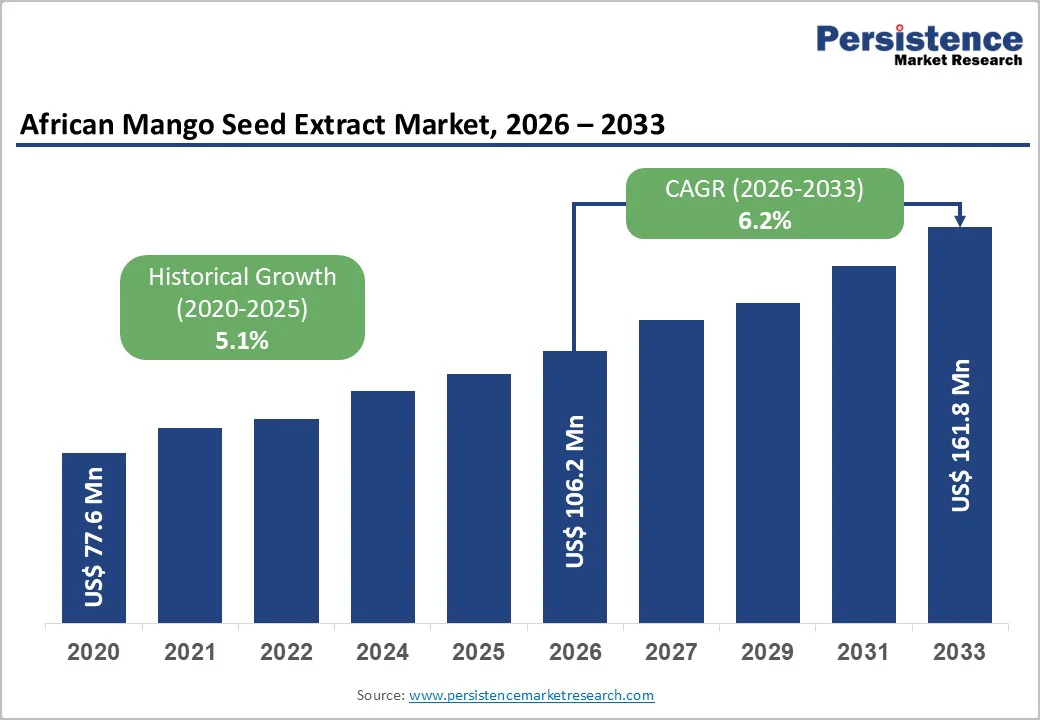
The global African mango seed extract market size is likely to be valued at US$ 106.2 million in 2026 and US$161.8 million by 2033, growing at a CAGR of 6.2% during the forecast period from 2026 to 2033.
The global market is witnessing a surge as consumers increasingly embrace natural metabolic-health and weight-management solutions. Rising demand for clean-label, plant-based botanicals is driving innovation in functional foods, beverages, and supplements worldwide.
Key Industry Highlights
- Leading Region: North America, holding 42% market share, driven by metabolic-health innovation, clean-label supplementation, and high consumer focus on natural weight-management solutions.
- Fastest-Growing Region: Asia Pacific, fueled by rising adoption of functional teas, metabolic-support beverages, ayurvedic-inspired blends, and e-commerce-driven discovery.
- Fastest-Growing Segment: Powdered African mango seed extract, preferred for ease of formulation, stability, and integration in nutraceuticals, sachets, drink mixes, and fortified snacks.
- Market Drivers: Growing global preference for plant-based dietary fibre sources, appetite-control ingredients, and natural metabolic-support solutions driving adoption across supplements and functional foods.
- Opportunities: Expansion of functional foods and metabolic-health beverages, offering standardized, traceable, and clean-label extracts for next-generation weight-management and wellness products.
- Key Developments: In August 2024, Xi’an Kintai Biotech Co., Ltd. achieved Halal certification, enhancing access to international markets for high-quality plant-extract products.
| Key Insights | Details |
|---|---|
| Global African Mango Seed Extract Market Size (2026E) | US$ 106.2 Mn |
| Market Value Forecast (2033F) | US$ 161.8 Mn |
| Projected Growth (CAGR 2026 to 2033) | 6.2% |
| Historical Market Growth (CAGR 2020 to 2025) | 5.1% |
Market Dynamics
Driver - Rising Global Demand for Plant-Based Dietary Fibre Sources
A compelling global push toward cleaner nutrition is elevating demand for plant-based dietary fibre sources, creating strong momentum for African mango seed extract. Consumers are shifting toward ingredients that support metabolic balance, appetite control, and digestive wellness without synthetic additives, positioning this fibre-rich extract as a preferred option in supplements and functional foods. Brands are integrating African mango seed extract into weight-management blends, gummies, beverages, and fortified powders to meet rising expectations for natural, minimally processed fibre. As fibre deficiency becomes a widespread health concern, manufacturers are looking for botanical ingredients that deliver satiety and sustained energy release. African mango seed extract fits this requirement with its favourable composition, making it a high-value driver of new product innovation.
Restraints - Supply-Chain Inconsistencies in Raw Seed Sourcing
An increasingly fragile sourcing landscape is creating measurable strain across the African mango seed extract industry, with raw seed availability becoming highly inconsistent from season to season. Wild-harvested Irvingia gabonensis relies heavily on unpredictable fruiting cycles, regional climate fluctuations, and fragmented collection networks, making a uniform supply difficult to guarantee. Smallholder-dependent procurement often faces delays due to transportation gaps, variable drying practices, and limited storage infrastructure, which affects seed quality and extraction yields. These inconsistencies push manufacturers to maintain higher buffer inventories, raise procurement costs, and manage greater batch-to-batch variability. For exporters serving nutraceutical and functional food clients, fluctuating seed integrity complicates standardization efforts and slows down scale-up plans in global markets.
Opportunity - Expansion of Functional Foods and Metabolic-Health Beverages
A powerful shift toward functional nutrition is opening a meaningful window of opportunity for African mango seed extract suppliers as brands intensify their focus on metabolic-health beverages and fortified food products. Companies developing glucose-support drinks, weight-management gummies, fibre-enhanced bars, and balanced-energy shots are actively seeking botanicals with credible satiety and lipid-modulation benefits, positioning African mango as a compelling ingredient for next-generation formulations. Startups can differentiate by offering standardized extracts with transparent sourcing, cleaner processing, and science-backed efficacy that appeal to formulators targeting blood-sugar balance and weight-wellness categories. Beverage innovators exploring low-calorie blends, gut-friendly profiles, and natural appetite-support solutions can integrate African mango to elevate functionality, strengthen label claims, and unlock deeper consumer engagement across global health-focused markets.
Category-wise Analysis
By Form Insights
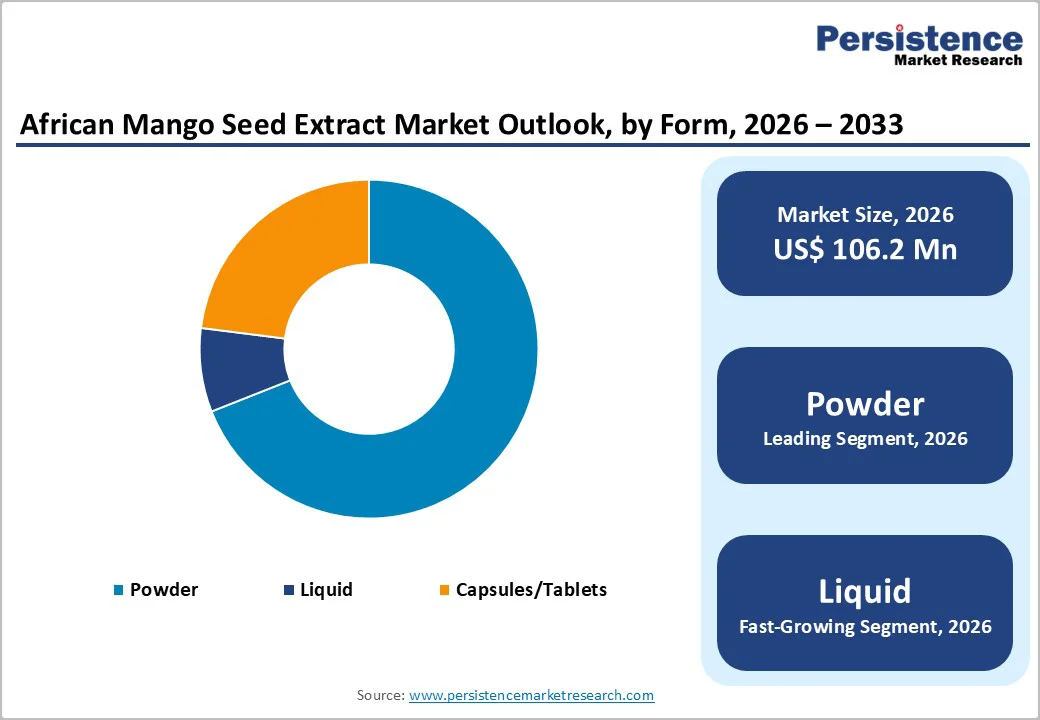
Powdered African mango seed extract holds approx. 69% market share as of 2024, reflecting its strong suitability for formulation, transport, and long-term stability across major nutraceutical and functional food applications. Brands prefer powder due to its ease of blending in gummies, sachets, drink mixes, and fortified snacks, along with its consistent solubility and standardized active content. Manufacturers rely on powder formats to streamline bulk procurement and ensure uniform dosing across global production facilities. Liquid African mango extract remains relevant for ready-to-drink beverages and fast-acting wellness shots, though its shorter shelf life limits large-scale adoption. Capsules and tablets continue to serve consumers seeking precise dosing and convenient supplementation, maintaining steady demand in weight-wellness and metabolism-support categories.
By Nature Insights
Organic African mango seed extract is projected to grow at a CAGR of 7.8% during the forecast period, driven by a rapid consumer shift toward cleaner, traceable, and sustainably harvested botanical ingredients. The organic segment is gaining traction as wellness brands emphasize chemical-free extraction, pesticide-free sourcing, and verifiable supply origins to appeal to premium buyers in weight-management and metabolic-health categories. Demand is strengthening in functional foods, nutraceutical blends, and plant-based supplements where organic certification enhances trust and marketability. Manufacturers are forming direct partnerships with certified farms in West and Central Africa to secure reliable organic raw material streams. As transparency, purity claims, and ethical sourcing rise in importance, organic African mango seed extract is emerging as the preferred choice for next-generation metabolic-health formulations.
Region-wise Insights
North America African Mango Seed Extract Market Trends
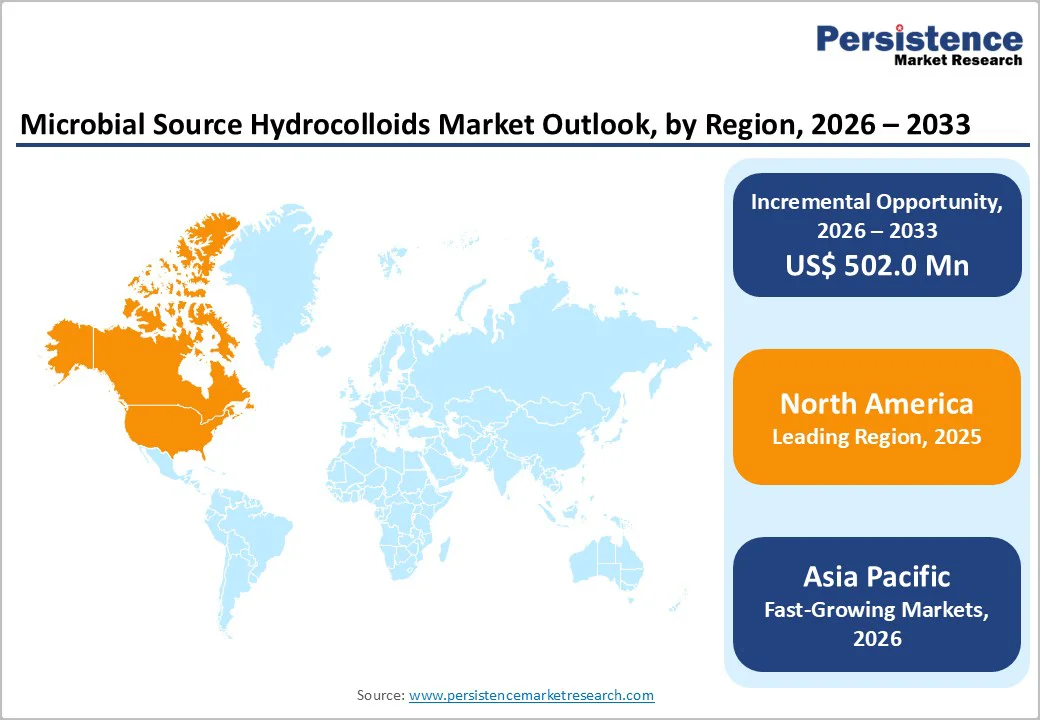
North America holds approximately 42% market share in the global African Mango Seed Extract Market, reflecting a region where metabolic-health innovation and clean-label supplementation continue to accelerate. In the US, brands are reformulating weight-management gummies, functional beverages, and lifestyle nutrition powders with higher-purity extracts to appeal to consumers seeking natural appetite-support and waistline-management solutions.
Canada is witnessing a rise in botanical-focused nutraceutical launches, with manufacturers emphasizing sustainability, traceability, and minimal-processing claims. Companies across the region are integrating African mango seed extract into multi-ingredient blends featuring fibers, adaptogens, and metabolic-support botanicals. The shift toward plant-based wellness, sugar-free delivery formats, and personalized nutrition platforms is strengthening adoption, positioning North America as a trend-shaping hub for advanced extract applications.
Asia Pacific African Mango Seed Extract Market Trends
Asia Pacific African Mango Seed Extract Market is expected to grow at a CAGR of 7.3% as consumers across the region gravitate toward natural metabolic-support ingredients and botanical weight-management solutions. China is seeing strong uptake in functional teas, sachets, and meal-replacement powders featuring African mango seed extract for urban consumers pursuing convenient wellness formats. India’s nutraceutical sector is integrating the extract into ayurvedic-inspired blends targeting digestion, energy balance, and healthy BMI support.
Japan continues to favor highly purified, science-positioned formulations used in capsules and metabolic-health beverages. South Korea is shaping trends through beauty-from-within concepts, where the extract appears in slimming drinks and lifestyle supplements. Growing e-commerce penetration, influencer-driven brand discovery, and rising clean-label adoption further amplify the region’s momentum.
Competitive Landscape
The global African Mango Seed Extract market operates as a fragmented yet rapidly professionalizing industry where suppliers compete on quality, purity, and scientific credibility. Leading companies are advancing product development by creating standardized extracts with consistent active compound levels while expanding B2B efforts into nutraceuticals, functional beverages, and weight-management products. Strategic partnerships with supplement manufacturers are speeding up the creation of customized blends and multi-ingredient formulas.
Several players are moving toward vertical integration by overseeing seed sourcing, processing, and extraction to ensure supply stability and lower variability. Consumer education campaigns are emerging to highlight benefits related to metabolism, appetite, and overall wellness, aiming to build trust and increase adoption. Import-export alliances are broadening market reach, while domestic production clusters in Africa are receiving more government funding to boost capacity and traceability.
Key Developments:
- In August 2024, Xi’an Kintai Biotech Co., Ltd. achieved a key global milestone by securing official Halal certification, strengthening its position in the international plant-extracts supply landscape.
Companies Covered in African Mango Seed Extract Market
- Champion Co., Ltd.
- Xi'an Kintai Biotech Inc.
- Naturalin Bio-Resources Co., Ltd.
- Hangzhou Muhua Bio-Tech Co., Ltd.
- Qingdao BNP BioScience Co., Ltd.
- Emerald Labs
- Hawaii Pharm LLC
- Apex Biotechnol
- Xi'an Haoze Biotechnology Co., Ltd.
- Others
Frequently Asked Questions
The global African Mango Seed Extract market is projected to be valued at US$ 106.2 Mn in 2026.
Rising global demand for plant-based dietary fibre sources is driving the global African Mango Seed Extract market.
The global African Mango Seed Extract market is poised to witness a CAGR of 6.2% between 2026 and 2033.
Expansion of functional foods and metabolic-health beverages is creating strong new avenues for scaling production and broadening market penetration.
Major players in the global African Mango Seed Extract market include Champion Co., Ltd., Xi'an Kintai Biotech Inc., Naturalin Bio-Resources Co., Ltd., Hangzhou Muhua Bio-Tech Co., Ltd., Qingdao MNP BioScience Co., Ltd., Emerald Labs, and others.


