




- Home Appliances
- Acrylic Medium Market
Acrylic Medium Market Size, Share, and Growth Forecast, 2026 – 2033
Acrylic Medium Market by Product Type (Gloss Medium, Matte Medium, Gel Medium, Glazing Medium, Modeling Paste), Application (Painting, Crafting, Mixed Media, Fluid Art, Finishing & Protection), End-user (Artists, Others), and Regional Analysis for 2026 – 2033

Acrylic Medium Market Size and Trends Analysis
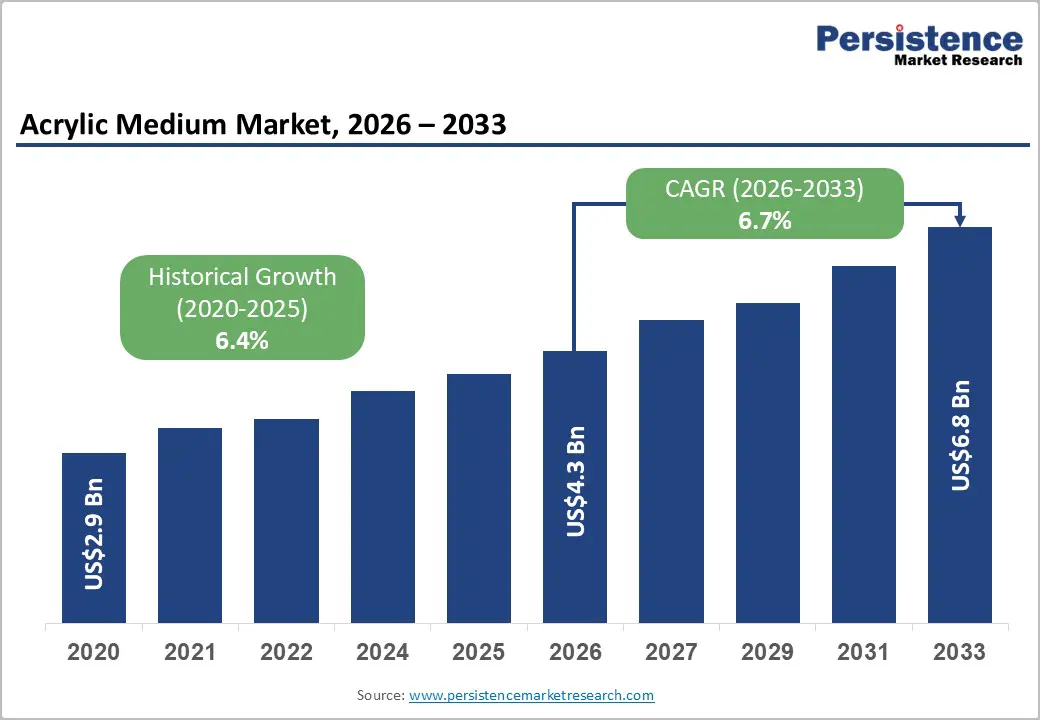
The global acrylic medium market size is likely to be valued at US$4.3 billion in 2026 and is expected to reach US$6.8 billion by 2033, growing at a CAGR of 6.7% during the forecast period from 2026 to 2033, driven by increasing engagement in visual arts, DIY crafts, and hobbyist activities, as well as expanding educational art programs worldwide.
Rising interest among amateur and professional artists fuels consistent demand for versatile acrylic mediums that allow greater flexibility in painting techniques, surface textures, and finishes. The market benefits from the adaptability of these products, which enhance working times, facilitate layering and glazing, and enable creative experimentation without compromising paint adhesion or durability. Growth is supported by the widespread availability of acrylic mediums through online retail channels, specialty art stores, and educational supply distributors, making them accessible to a broader audience. Trends such as mixed-media art, home décor projects, and eco-friendly, water-based formulations are shaping product innovation and expanding market applications.
Key Industry Highlights:
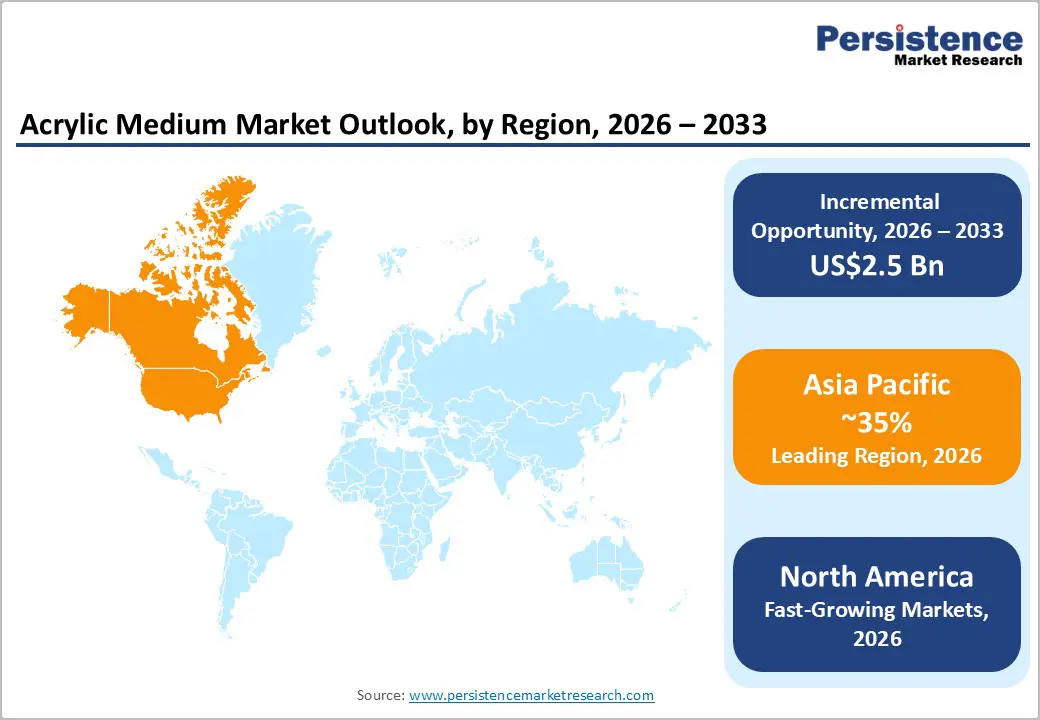
- Leading Region: Asia Pacific is anticipated to be the leading region, accounting for a market share of 35% in 2026, driven by rapid urbanization, growing e-commerce adoption, and strong manufacturing hubs.
- Fastest-growing Region: North America is likely to be the fastest-growing region, supported by a robust innovation ecosystem, strong art education programs, and growing e-commerce adoption.
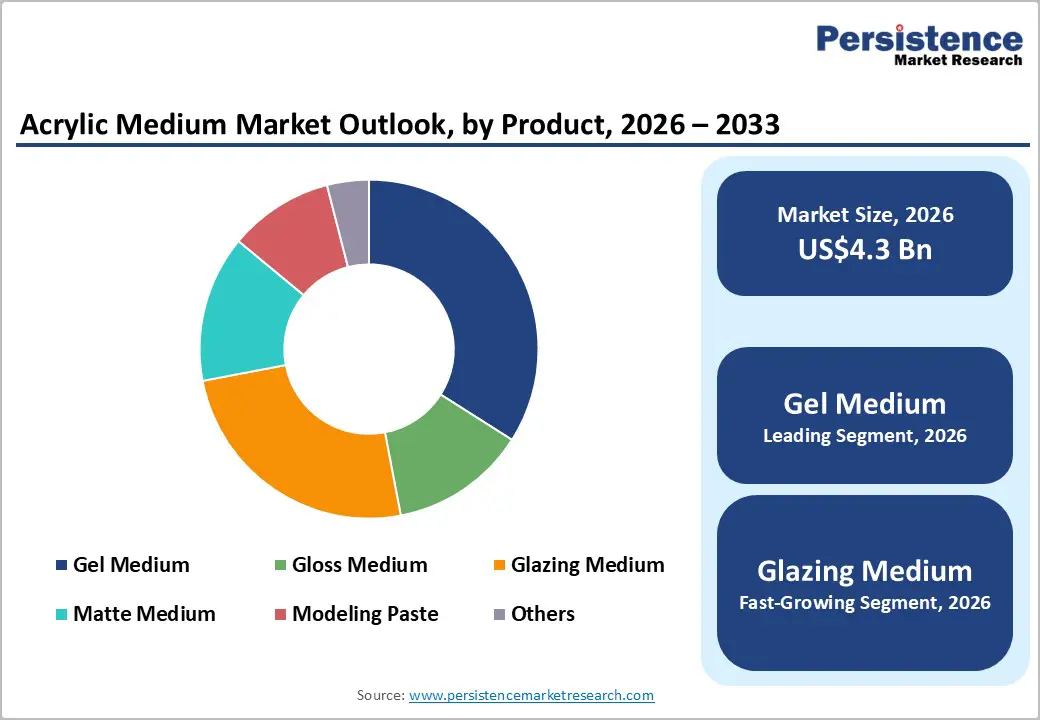
- Leading Product Type: Gel medium is projected to represent the leading product type in 2026, accounting for 40% of the revenue share, driven by its versatility in texture and impasto effects.
- Leading Application: Painting is anticipated to be the leading application, accounting for over 45% of the revenue share in 2026, supported by its widespread use in canvas and surface work.
| Key Insights | Details |
|---|---|
|
Acrylic Medium Market Size (2026E) |
US$4.3 Bn |
|
Market Value Forecast (2033F) |
US$6.8 Bn |
|
Projected Growth (CAGR 2026 to 2033) |
6.7% |
|
Historical Market Growth (CAGR 2020 to 2025) |
6.4% |
Market Factors – Growth, Barriers, and Opportunity Analysis
Growth Analysis - Rising Popularity of Acrylic Painting and Mixed Media Techniques
Acrylic painting has gained remarkable popularity among artists due to its versatility, vibrant colors, and quick-drying properties, making it suitable for a wide range of styles, from realism to abstract. Mixed media techniques that combine acrylics with other materials such as ink, collage, and pastes are increasingly adopted in galleries and studios, allowing artists to experiment with textures, layering, and visual effects. Social media platforms and online tutorials amplify awareness and skill-sharing, inspiring both professional and amateur creators.
The trend toward mixed media practices is particularly strong in contemporary art education and workshops, where students and hobbyists are encouraged to explore innovative techniques. Acrylic mediums facilitate experimentation by offering adaptability to different surfaces and compatibility with other materials without compromising adhesion or finish. The increasing number of art exhibitions and online showcases fuels engagement and visibility of these techniques, motivating the purchase of high-quality media. Professional artists leverage acrylics in commissions and studio work, establishing industry standards and influencing amateurs.
Growth in Educational and DIY Crafting Sectors
Educational institutions and creative workshops are expanding art programs that incorporate acrylic paints and mediums, exposing students to versatile techniques from an early age. DIY crafting communities are thriving, supported by online tutorials, maker spaces, and social media challenges, where acrylic mediums are integral for projects such as canvas painting, decorative crafts, and mixed-media experiments. The convenience, safety, and water-based formulation of these products make them ideal for schools and hobbyists. This expanding user base drives volume growth, encourages product innovation, and enhances accessibility.
The growth of hobbyist and DIY crafting culture is transforming consumer behavior, with enthusiasts seeking unique textures, finishes, and layering options in their projects. Workshops and craft kits often include acrylic mediums to enable creative learning and experimentation, increasing early adoption and brand loyalty. Online marketplaces and subscription art boxes support this trend, connecting manufacturers to end-users directly. The rise of adult coloring, decorative painting, and home décor personalization amplifies demand for user-friendly mediums.
Barrier Analysis - Raw Material Supply Chain Vulnerabilities
Acrylic mediums depend on polymer resins, pigments, and additives, which are subject to price volatility, import dependency, and occasional shortages. Supply chain disruptions due to geopolitical tensions, logistics challenges, or regulatory restrictions exacerbate risks, particularly for smaller or regional manufacturers. The reliance on specialized chemical suppliers also limits flexibility, affecting consistent product availability. These vulnerabilities can lead to delays in product launches, increased costs, and occasional stockouts, challenging manufacturers in maintaining a steady supply and fulfilling growing demand for acrylic mediums.
Extended lead times and fluctuating raw material quality pose operational challenges for premium and specialty medium producers. Manufacturers must ensure consistent viscosity, color stability, and performance across batches, which becomes difficult when material sources are unreliable. This unpredictability can affect both professional and educational users, who require reliable performance for workshops, classes, and studio work. Crises or import-export restrictions increase reliance on local substitutes, potentially impacting product quality.
Skill Barriers for Amateurs
While acrylic mediums offer versatility, mastering their use requires understanding layering, glazing, texturing, and drying behaviours. Novice artists and hobbyists often face challenges in achieving professional results, which can lead to inconsistent outcomes and reduced satisfaction. Certain products, such as modeling pastes and glazing mediums, demand specific techniques, tool usage, and patience. Without proper guidance or practice, beginners may struggle with colour blending, surface adhesion, and desired effects. These skill barriers can limit repeat purchases and hinder market expansion among casual users, highlighting the need for educational content, workshops, and tutorials to bridge the gap between product potential and user expertise.
The complexity of advanced acrylic techniques also affects adoption in DIY and educational settings, where instructors and learners must dedicate time to training. Hobbyists may prefer simpler mediums or pre-mixed kits due to ease of use, reducing demand for specialized products. Social media tutorials and online courses help mitigate this challenge by demonstrating techniques and building user confidence, but a learning curve remains a significant restraint. Manufacturers are increasingly offering instructional materials, video guides, and starter kits to encourage skill development.
Opportunity Analysis - Innovation in Eco-Friendly and Specialized Mediums
Rising environmental awareness has created strong demand for non-toxic, low-VOC, and water-based acrylic mediums, offering safer alternatives for classrooms, home use, and professional studios. Manufacturers are innovating with biodegradable additives, sustainable polymer resins, and natural pigments, appealing to eco-conscious consumers. Specialized formulations, such as slow-drying gels, high-gloss finishes, and texture-enhancing pastes, cater to professional artists seeking precision and creativity. The integration of environmentally responsible production methods strengthens brand image and expands access to sensitive markets, including educational institutions, healthcare art therapy programs, and family-focused craft segments.
Companies investing in research and development can introduce unique textures, finishes, and glazing capabilities that were previously unavailable in standard mediums. Marketing campaigns emphasizing sustainability and performance help attract new users while retaining existing consumers. Collaborations with artists and influencers promote innovative techniques and applications, encouraging adoption across multiple user segments. With regulatory focus on non-toxic formulations and growing consumer preference for responsible materials, eco-friendly and specialized acrylic mediums represent a high-potential opportunity for long-term market expansion.
Integration with Fluid Art and Mixed Media Trends
The rising popularity of fluid art and mixed media techniques presents significant market potential for acrylic mediums, especially pouring mediums, glazes, and gels that enable smooth flow, layering, and texture creation. Social media and online tutorials have popularized pour painting, resin art, and abstract mixed media, inspiring hobbyists and professional artists alike. This trend fuels demand for versatile media compatible with multiple surfaces and artistic materials. Fluid art integration also encourages experimentation in educational and DIY sectors, driving adoption among new users.
Mixed media trends encourage the blending of acrylics with inks, pastes, and found materials, expanding the applications of mediums beyond traditional painting. Artists increasingly seek products that maintain consistency, allow layering without cracking, and enhance dimensional effects. Workshops, social media challenges, and virtual exhibitions amplify awareness and engagement, accelerating market growth. Manufacturers introducing products explicitly designed for fluid art and multi-technique applications can differentiate their offerings, create premium product lines, and foster brand loyalty.
Category-wise Analysis
Product Type Insights
Gel medium is expected to lead the acrylic medium market, accounting for approximately 40% of revenue in 2026, driven by its versatility in creating texture, volume, and impasto effects. Widely adopted by professional artists and mixed media creators, gel mediums enable the building of three-dimensional structures on canvas, wood panels, and other surfaces. The preference for gel medium stems from its ability to maintain paint integrity while providing extended working time, enhanced layering, and superior adhesion. For example, Golden Artist Colors’ heavy gel medium has become a popular choice among professionals for its consistency and ability to produce thick textures without cracking.
The glazing medium segment is likely to represent the fastest-growing, supported by demand for transparent layering, luminosity, and color depth. Artists increasingly use glazing techniques to create subtle tonal variations, enhance shadows, and produce depth effects in fine art and fluid applications. The medium’s compatibility with modern acrylic formulations enables smooth blending and precise control over opacity without affecting adhesion or surface quality. For example, Winsor & Newton’s Artists’ acrylic glazing medium allows painters to achieve delicate washes and transparent overlays, making it popular in both professional and hobbyist circles.
Application Insights
Painting is projected to lead, capturing around 45% of the revenue share in 2026, supported by its versatility, quick drying, and compatibility with multiple surfaces, including canvas, wood, and paper. Traditional and modern painters rely on mediums such as gels and glosses to extend working time, adjust texture, and achieve desired visual effects. For example, Pebeo Studio acrylics are used in educational and professional painting programs to enhance color depth and surface finish. Social media platforms, including YouTube and Instagram, widely share painting tutorials demonstrating techniques with various acrylic mediums, helping hobbyists and students replicate professional results.
Fluid art is likely to be the fastest-growing application, driven by its popularity in pour painting, abstract designs, and interactive art styles. The segment is largely driven by social media trends, where artists showcase pour techniques, swirls, and abstract patterns using acrylic flow mediums to create visually striking effects. Fluid art is highly accessible for beginners, providing instant visual results and encouraging experimentation, which fuels adoption in both hobbyist and educational circles. For example, Golden Artist Colors Pouring Medium enables artists to manipulate viscosity and flow while maintaining color vibrancy, making it ideal for abstract and decorative projects.
Regional Insights
North America Acrylic Medium Market Trends
North America is likely to be the fastest-growing region, driven by professional artist communities, comprehensive art education programs, and increasing interest among hobbyists and DIY creatives. Contemporary art schools and universities emphasize acrylic techniques due to their versatility, clean handling, and compatibility with mixed media, supporting sustained demand for specialized mediums such as gels, glazes, and texture pastes. The expanding hobbyist base engages through social media tutorials, workshops, and community art spaces that introduce novel applications such as impasto and layered glazing.
The competitive landscape in North America reflects both established brands and new entrants innovating with product performance and sustainability features. For example, Liquitex has continually introduced advanced mediums such as its Professional Pouring Medium to support fluid art trends gaining traction across the region. This product caters to artists seeking controlled flow characteristics without compromising color brilliance or surface integrity, highlighting the convergence of technique innovation and market demand.
Europe Acrylic Medium Market Trends
Europe is likely to be a significant market for acrylic medium, due to mature demand anchored in traditional fine art practices and a strong culture of artistic education and craftsmanship. Countries such as Germany, France, and the U.K. have deep roots in painting and mixed media, where mediums that enhance texture, layering, and finish are widely used by both professionals and hobbyists. The emphasis on archival quality and long?lasting materials drives preference for artist?grade acrylic gels, glazing mediums, and texture pastes in ateliers, galleries, and art schools.
The competitive landscape in Europe features a mix of historic brands and contemporary innovators, each striving to balance tradition with modern artistic needs. For example, Schmincke, a renowned German fine art materials producer, has strengthened its acrylic mediums lineup with products designed for professional artists seeking high pigment load and excellent handling characteristics. Schmincke’s acrylic heavy gel and glazing medium exemplify offerings tailored to European artists who demand consistency and finesse in texture control and transparency effects.
Asia Pacific Acrylic Medium Market Trends
The Asia Pacific region is anticipated to be the leading region, accounting for a market share of 35% in 2026, driven by expanding art communities, rising disposable incomes, and increasing engagement in creative hobbies across countries such as China, India, and Southeast Asian nations. Rapid urbanization and widespread digital connectivity have made art supplies more accessible, while e?commerce platforms have significantly broadened distribution channels, enabling hobbyists and professional artists alike to explore a wide range of mediums. Traditional calligraphy and painting practices in the region are being complemented by contemporary acrylic techniques, encouraging experimentation with textures, glazing, and mixed media.
The competitive landscape in Asia Pacific reflects regional players innovating to meet varied needs. For example, Holbein Works, Ltd., a respected Japanese artist materials brand, has expanded its acrylic medium portfolio to include products optimized for local preferences, such as texture gels and high?clarity glazing mediums designed for both fine art and fluid techniques. Holbein’s focus on quality and surface performance resonates with artists seeking reliable mediums that support expressive detail and durability.
Competitive Landscape
The global acrylic medium market exhibits a moderately fragmented structure, driven by a mix of long?established multi?national art material manufacturers and emerging specialty brands competing for niche segments. Large, well?recognized players such as Liquitex and Golden Artist Colors hold strong positions thanks to extensive product portfolios, robust R&D, and high brand loyalty among both professional and hobbyist artists. These companies continually expand their offerings with innovations such as eco?friendly gels and specialty flow mediums to meet evolving artistic needs.
With key leaders including Liquitex, Golden Artist Colors, Winsor & Newton, Pebeo, Daler?Rowney, Royal Talens, Sennelier, and Holbein Works, the competitive environment emphasizes differentiation through product innovation, brand reputation, and strategic distribution networks. These players compete through continuous enhancements in medium performance, sustainable and low?VOC formulations, and broadening sales channels that incorporate both traditional specialty retailers and expanding e?commerce platforms.
Key Industry Developments:
- In February 2026, Konishi Co., Ltd. completed the acquisition of all issued shares of a newly established company spun off from Mitsubishi Chemical Corporation that holds Mitsubishi’s acrylic emulsion and synthetic resin emulsion businesses, making it a subsidiary of Konishi in a strategic move to strengthen its presence in the acrylic emulsion market.
- In November 2025, Pro Acryl launched its NEWSH Medium, a non-toxic acrylic alternative designed for miniature painting. The medium allows artists and hobbyists to achieve “dirty” textures, shading, and weathering effects traditionally created with toxic oil washes, but without the use of harmful solvents. It can be mixed with Pro Acryl paints and diluted with water for custom washes, making it safer and more user-friendly for both professionals and enthusiasts.
- In April 2025, Liquitex launched a new range of bio-based acrylic paints while continuing to expand its professional acrylic mediums portfolio. These products are designed to modify handling, texture, appearance, and volume, catering to the evolving needs of artists and hobbyists. The bio-based formulation emphasizes sustainability and environmental responsibility, aligning with the growing demand for eco-friendly art materials.
Companies Covered in Acrylic Medium Market
- Golden Artist Colors, Inc.
- Liquitex
- Winsor & Newton
- Pebeo
- Daler-Rowney Ltd.
- Royal Talens
- Sennelier
- Holbein Works, Ltd.
- M. Graham & Co.
- Schmincke
- Old Holland Classic Colours
- Grumbacher
- Maimeri
- Amsterdam Acrylics
- Chroma Inc.
Frequently Asked Questions
The global acrylic medium market is projected to reach US$4.3 billion in 2026.
The acrylic medium market is driven by the rising popularity of acrylic painting, mixed media techniques, and growing demand from artists, hobbyists, and educational sectors.
The acrylic medium market is expected to grow at a CAGR of 6.7% from 2026 to 2033.
Key market opportunities lie in the development of eco-friendly, non-toxic, and specialized acrylic mediums, as well as integration with fluid art and mixed media trends.
Golden Artist Colors, Inc., Liquitex, Winsor & Newton, Pebeo, Daler-Rowney Ltd., and Royal Talens are the leading players.


