




- Plastics, Polymers & Resins
- Acrylic Sheet Market
Acrylic Sheet Market Size, Share, and Growth Forecast, 2026 – 2033
Acrylic Sheet Market by Product Type (Extruded Acrylic Sheet, Continuous Cast Acrylic Sheet, Cell Cast Acrylic Sheet), Application (Visual Communication & Retail, Furniture & Design, Electronics & Energy, Others), and Regional Analysis for 2026 – 2033

Acrylic Sheet Market Size and Trends Analysis
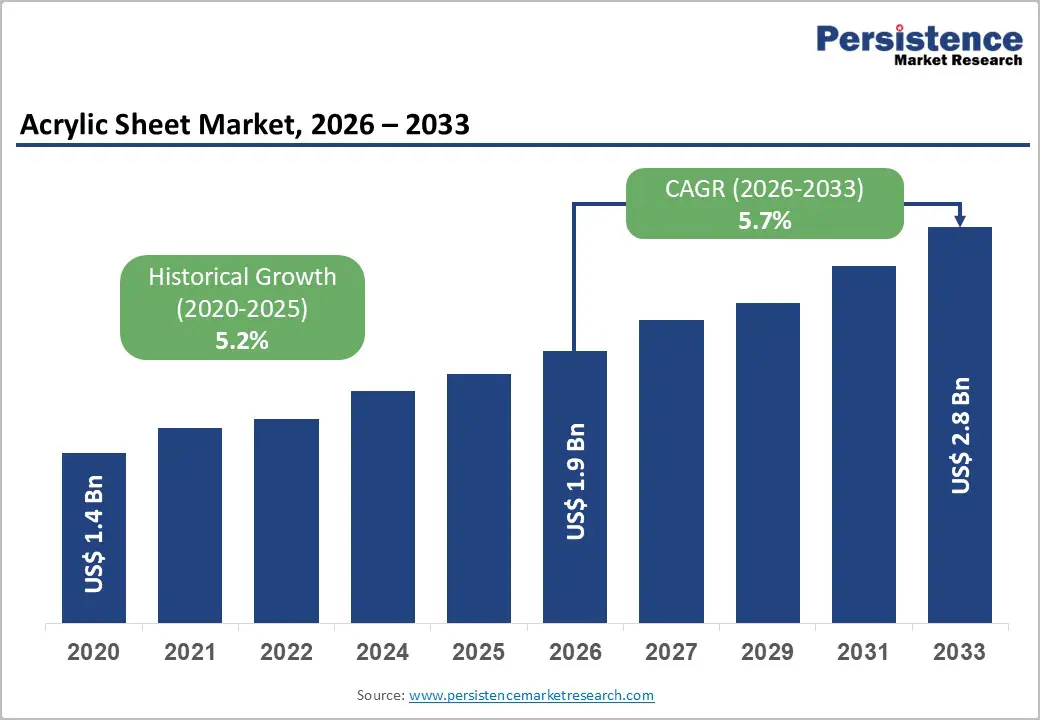
The global acrylic sheet market size is likely to be valued at US$1.9 billion in 2026 and is expected to reach US$2.8 billion by 2033, growing at a CAGR of 5.7% during the forecast period from 2026 to 2033, driven by increasing adoption in architecture and construction for lightweight, impact-resistant glazing, rising demand from visual communication and retail signage owing to excellent optical clarity and ease of fabrication, and expanding usage in automotive, electronics, and furniture applications for durable and aesthetically versatile components. The expanding visual communication and retail industry, fueled by growth in organized retail, advertising, and digital signage, continues to drive the consumption of acrylic sheets for display boards, illuminated signage, and point-of-sale materials. The automotive and transport sector is also contributing to market growth as manufacturers increasingly use acrylic sheets for lighting covers, interior components, and glazing solutions to reduce vehicle weight and improve fuel efficiency.
Key Industry Highlights:
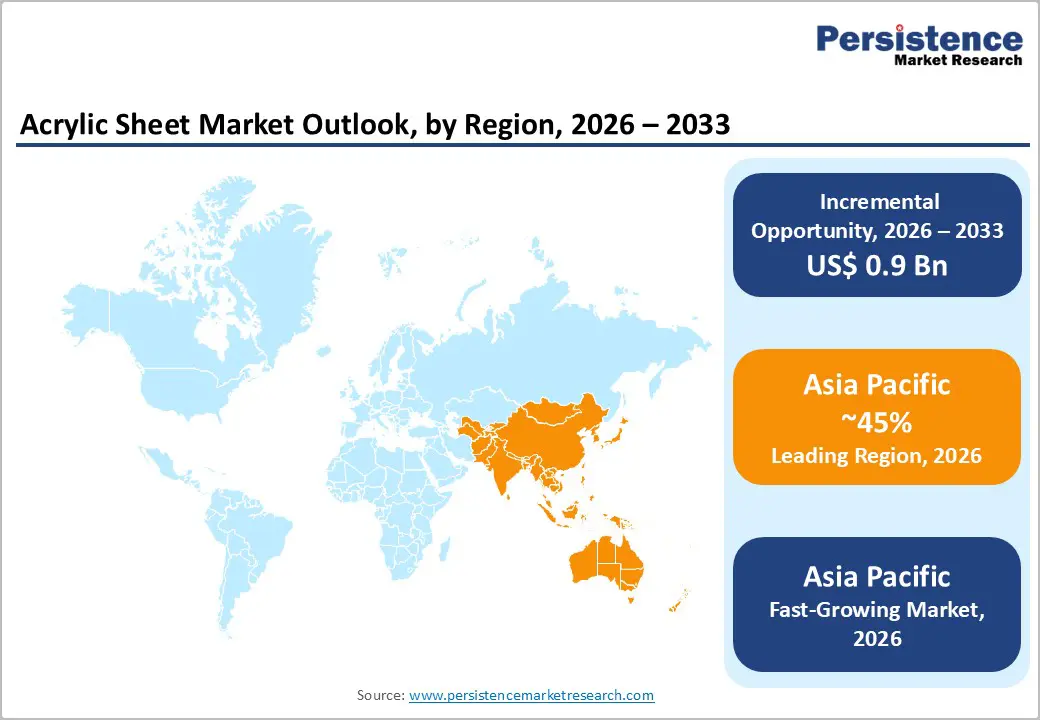
- Leading Region: Asia Pacific is anticipated to be the leading region, accounting for a market share of 45% in 2026, driven by rapid infrastructure development, strong manufacturing capabilities in China, rising construction and automotive demand in India, growing electronics applications in Japan, and accelerated urbanization across ASEAN economies.
- Fastest-growing Region: Asia Pacific is likely to be the fastest-growing region in the acrylic sheet in 2026, supported by rising investments in commercial and residential construction, expanding signage and retail sectors, increasing automotive production, and the region’s strong manufacturing and export advantages.
- Leading Product Type: Extruded acrylic sheets are projected to represent the leading product type in 2026, accounting for 50% of the revenue share, driven by their cost-effectiveness, uniform thickness, and suitability for high-volume applications such as signage and displays.
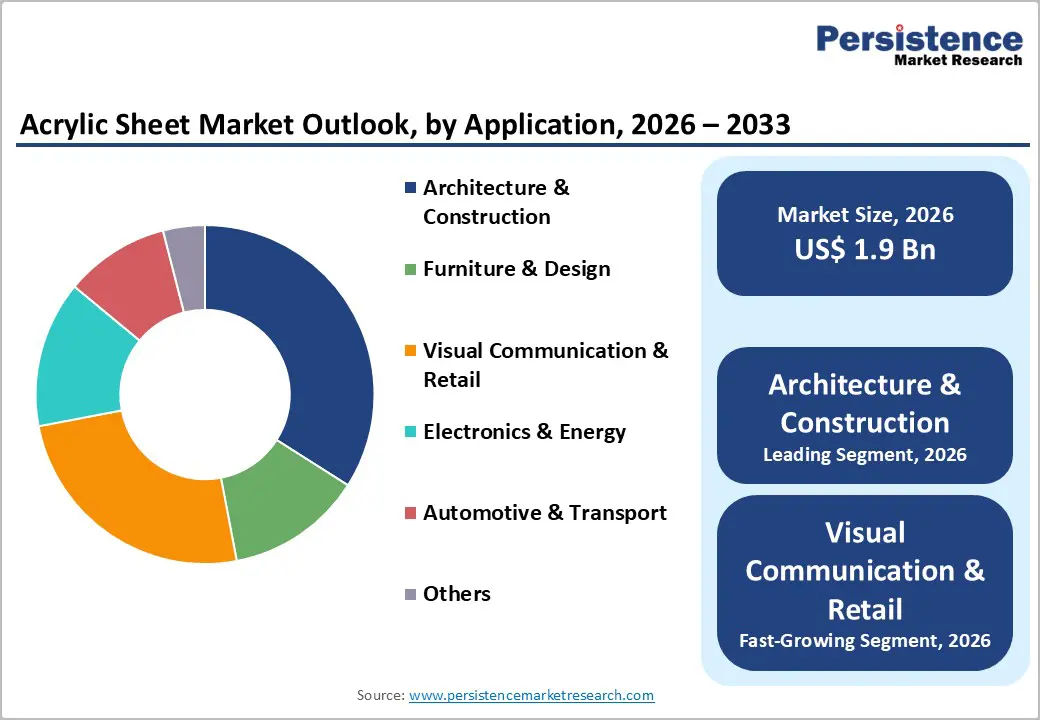
- Leading Application: Architecture & construction to be the leading application type, accounting for over 40% of the revenue share in 2026, supported by extensive use in glazing, façades, partitions, and interior applications worldwide.
|
Acrylic Sheet Market Size (2026E) |
US$1.9 Bn |
|
Market Value Forecast (2033F) |
US$2.8 Bn |
|
Projected Growth (CAGR 2026 to 2033) |
5.7% |
|
Historical Market Growth (CAGR 2020 to 2025) |
5.2% |
Market Factors – Growth, Barriers, and Opportunity Analysis
Growth Analysis - Rising Demand from Construction and Architecture Sectors
Increasing demand for lightweight, durable, and aesthetically appealing materials. Acrylic sheets are widely used in glazing, skylights, partitions, façades, and interior design applications because they offer high optical clarity, excellent weather resistance, and better impact strength compared to traditional glass. Rapid urbanization, smart city initiatives, and rising investments in commercial buildings, airports, malls, and residential complexes are significantly increasing acrylic sheet consumption, particularly in emerging economies where infrastructure development is accelerating.
Architects and builders increasingly prefer acrylic sheets for modern design flexibility and ease of fabrication. Acrylic sheets can be molded, cut, and shaped easily, allowing innovative architectural designs while reducing structural load. Their UV resistance and long service life lower maintenance costs, making them attractive for long-term construction projects. The growing trend toward sustainable and energy-efficient buildings supports acrylic adoption, as sheets enable better daylight transmission and insulation solutions.
Growth in Automotive and Transportation Applications
The acrylic sheet market is gaining momentum as manufacturers increasingly prioritize lightweight materials to enhance fuel efficiency and lower emissions. Acrylic sheets are widely used in automotive applications such as lighting systems, instrument panels, interior trims, wind deflectors, and glazing components, thanks to their high impact resistance, excellent optical clarity, and design versatility. The rapid expansion of electric vehicle production is further boosting demand, especially for lightweight, durable solutions in both interior and exterior vehicle components.
Increasing vehicle production in the Asia Pacific region and rising demand for premium and customized vehicle interiors are supporting the use of acrylic sheets. Acrylic's resistance to weather, chemicals, and UV radiation enhances component durability, making it suitable for long-term automotive applications. Public transportation projects such as metro trains, buses, and railways also use acrylic sheets for windows, partitions, and signage. Continuous innovation in automotive design and safety standards is accelerating the integration of acrylic sheets into transportation systems worldwide.
Barrier Analysis - Limited Production Capacity and High Waste Rates
Manufacturing acrylic sheets, particularly cast and cell cast variants, involves complex processes that generate material waste during cutting, trimming, and finishing. Inefficient recycling infrastructure in some regions amplifies material losses, increasing overall production costs. Smaller manufacturers often face difficulties scaling operations due to capital-intensive equipment and strict quality requirements, limiting supply growth despite rising demand.
High waste rates negatively impact profit margins and raise environmental concerns. Disposal of acrylic scrap remains challenging in regions lacking advanced recycling technologies, increasing compliance costs related to waste management regulations. Production inefficiencies can also lead to supply delays, affecting large-scale construction and signage projects. These capacity and waste-related challenges restrict rapid expansion, particularly in emerging markets where demand is growing faster than manufacturing infrastructure development.
MMA (Methyl Methacrylate) Monomer Supply Shortages
MMA (methyl methacrylate) is the primary raw material used in acrylic production. Volatility in MMA supply, caused by plant shutdowns, feedstock price fluctuations, and geopolitical disruptions, directly affects acrylic sheet availability and pricing. Dependence on limited MMA suppliers makes manufacturers vulnerable to supply chain disruptions, leading to increased production costs and inconsistent output levels. Sudden supply constraints can disrupt long-term contracts and limit the ability of producers to meet rising demand from the construction and automotive sectors.
Rising MMA prices increase operational expenses for acrylic sheet producers, forcing some manufacturers to pass costs onto end users. This can reduce demand in price-sensitive applications such as signage and interior décor. Regulatory pressures related to chemical production and environmental compliance also restrict MMA manufacturing capacity in certain regions. Smaller manufacturers are particularly affected as limited purchasing power reduces their ability to hedge against raw material volatility.
Opportunity Analysis - Technological Advancements and Sustainable Innovations
Innovations in extrusion and casting technologies have enhanced optical clarity, surface durability, and impact resistance while reducing energy consumption during production. Advanced coatings, scratch-resistant layers, and UV-protection technologies are expanding acrylic sheet applications across architecture, automotive, and electronics sectors, supporting premium product demand. These advancements support the growing demand for high-performance acrylic sheets in construction, automotive glazing, and electronic enclosures, while enabling manufacturers to offer longer-lasting and visually superior products for premium applications.
Digital manufacturing techniques and automation improve production efficiency and reduce waste, enabling manufacturers to scale operations cost-effectively. The development of specialty acrylic sheets with fire resistance, acoustic insulation, and smart-light diffusion properties broadens market potential. Continuous innovation allows manufacturers to differentiate products, meet evolving customer requirements, and capture higher value applications, positioning acrylic sheets as a preferred material across diverse industries.
Sustainable and Recycled Acrylic
Recycled acrylic sheets reduce dependency on virgin MMA while lowering carbon emissions and waste generation. Growing regulatory emphasis on circular economy practices and eco-friendly materials is encouraging manufacturers to invest in recycling technologies and bio-based acrylic alternatives, particularly in Europe and Asia Pacific. This shift supports supply security, reduces raw material cost volatility, and aligns acrylic sheet producers with evolving environmental standards in construction and industrial applications.
Demand for sustainable materials is rising across construction, retail, and automotive sectors, where brands seek environmentally responsible sourcing. Recycled acrylic maintains high optical clarity and durability, making it suitable for premium applications without compromising performance. Companies adopting sustainable acrylic solutions benefit from improved brand perception, stronger customer preference, and access to green building projects and sustainability-driven procurement programs.
Category-wise Analysis
Product Type Insights
Extruded acrylic sheets are expected to lead the acrylic sheet market, accounting for approximately 50% of revenue in 2026, driven by their cost-effectiveness, high production efficiency, and suitability for large volume applications. These sheets are produced using a continuous extrusion process, which delivers consistent thickness, a smooth surface finish, and reliable quality, key requirements for high-volume applications such as signage, point-of-sale displays, protective barriers, and advertising panels. For instance, large retail signage and indoor display boards often rely on extruded acrylic sheets because they offer uniform performance at a lower cost than cast acrylic alternatives.
Cell cast acrylic sheets are likely to represent the fastest-growing segment in 2026, supported by rising demand for premium-grade materials offering superior optical clarity, higher surface hardness, and excellent chemical resistance. These sheets are produced using batch casting processes, resulting in enhanced strength, better thickness tolerance, and improved resistance to weathering and solvents. For example, the use of cell cast acrylic sheets in large public aquariums and architectural skylights, where clarity, durability, and long service life are essential.
Application Insights
The architecture and construction segment is projected to lead the market, capturing around 40% of the revenue share in 2026, supported by extensive use across residential, commercial, and infrastructure projects. Acrylic sheets are widely adopted for windows, skylights, façades, partitions, noise barriers, and interior decorative elements due to their lightweight nature, high impact resistance, UV stability, and excellent light transmission. For example, the use of acrylic sheets in commercial building skylights and atrium roofing is essential where natural daylighting, durability, and weather resistance are essential.
The visual communication and retail segment is likely to be the fastest-growing, driven by expanding advertising activities, organized retail growth, and rising demand for high-clarity, durable display solutions. Acrylic sheets are widely utilized in illuminated signage, digital display panels, retail fixtures, and branding applications because of their high optical clarity, ease of processing, and excellent compatibility with LED lighting. For instance, their extensive use in LED backlit retail signboards and mall branding displays enhances visual appeal and durability, which play a key role in influencing consumer engagement.
Regional Insights
North America Acrylic Sheet Market Trends
North America is likely to be a significant market for acrylic sheets, driven by strong demand across construction, automotive, signage, and industrial applications. Premium acrylic sheets are widely used in glazing, skylights, façades, and interior partitions due to their superior optical clarity, impact resistance, and weather durability compared with traditional glass, making them ideal for urban commercial and residential projects across the U.S. and Canada. For example, Plaskolite LLC’s Optix® acrylic sheets are extensively adopted in retail signage, protective barriers, and architectural panels, supported by the company’s vertically integrated supply chain and advanced extrusion technologies that ensure consistent quality and supply reliability.
Innovation and application diversification are shaping market growth in North America as manufacturers focus on performance enhancements and new end-use opportunities. Demand is increasing for UV-resistant, anti-scratch, and impact-modified acrylic sheets in automotive interior and exterior components, LED lighting, and electronic displays, as the regional automotive and consumer electronics sectors evolve toward lightweight and durable materials. The trend toward sustainable solutions is encouraging the adoption of recyclable and bio-based acrylic variants, strengthening the market’s environmental profile.
Europe Acrylic Sheet Market Trends
Market growth in Europe is fueled by robust construction refurbishment projects, ongoing automotive manufacturing activities, and a wide range of industrial applications. Across Western Europe, modern architecture and building renovation initiatives are increasing demand for acrylic sheets in façades, skylights, interior partitions, and noise barrier systems due to their lightweight nature, high light transmission, and aesthetic appeal. For example, Evonik Industries AG’s PLEXIGLAS® products are widely specified in German commercial and residential projects for premium glazing and design applications, reflecting robust regional demand for high-performance acrylic solutions.
Europe is witnessing emerging growth across automotive, furniture & interior design, and sustainable materials segments, driven by stringent emission standards and evolving industry requirements. Automotive manufacturers are increasingly incorporating lightweight acrylic components in lighting covers and interior panels to meet EU regulations on vehicle efficiency and safety. The furniture and interior segment is growing as designers adopt acrylic sheets for modular kitchen panels, wardrobes, display systems, and decorative elements in both residential and commercial spaces.
Asia Pacific Acrylic Sheet Market Trends
The Asia Pacific region is anticipated to be the leading and fastest-growing region, accounting for a market share of 45% in 2026, driven by rapid industrialization, infrastructure expansion, and strong construction activity across China, India, Japan, and Southeast Asia. Demand in China is particularly significant due to large-scale urban infrastructure projects and robust manufacturing output, while India’s retail, construction, and automotive sectors continue to expand rapidly, increasing demand for weather-resistant glazing, signage, and interior applications. For example, Mitsubishi Chemical Corporation, with expanded regional manufacturing capacity, has strategically positioned new production facilities to meet rising demand for high clarity and UV-resistant acrylic sheets used in façades and automotive components.
Asia Pacific is experiencing heightened demand from the automotive and electronics sectors due to increasing vehicle production and the adoption of lightweight, impact-resistant materials to improve fuel efficiency and performance. Acrylic sheets are widely specified for automotive lighting covers, interior trims, protective panels, and LED displays in consumer electronics, supporting diversification of end-user applications. Signage and retail display demand also remains strong across the region, fueled by expanding organized retail and outdoor advertising growth, contributing to overall volume gains.
Competitive Landscape
The global acrylic sheet market exhibits a moderately fragmented structure, driven by the presence of multiple large integrated chemical manufacturers and a wide range of regional and niche players competing for share across applications such as construction, automotive, and signage. Leading companies invest heavily in production capacity, quality improvements, and innovation to meet diverse customer demands, while smaller regional firms focus on specialized applications or cost-competitive offerings to capture local demand.
With key leaders including Evonik Industries AG, Mitsubishi Chemical Corporation, Altuglas International (Arkema Group), and Plaskolite LLC, the market landscape is shaped by both giants and dynamic regional participants. These players compete through strategic investments in technological advancements, capacity expansions, enhanced distribution networks, and sustainability initiatives that differentiate their offerings and strengthen market positioning.
Key Industry Developments:
- In February 2026, SHINKOLITE launched its transparent premium-grade “Acrylic Aerosol Partition” to support the safe reopening of offices, retail stores, educational institutions, and public facilities. Designed to reduce the spread of viruses and droplets while maintaining visual openness, the partitions are made from high-clarity, easy-to-disinfect acrylic sheets and can be self-installed without drilling. The product addresses growing demand for hygienic, aesthetically pleasing protective solutions in public and commercial spaces.
- In April 2025, PLASKOLITE launched CELTEC® White, a new expanded PVC sheet designed specifically for the sign and graphics market, at the ISA International Sign Expo® 2025 in Las Vegas. Manufactured in the U.S., CELTEC® White offers an optimized white point for vibrant, true-to-color digital printing, along with consistent density, multiple sizes and thickness options, and eco-conscious production using up to 30% recycled content. The product targets applications such as signage, point-of-purchase displays, wayfinding systems, kiosks, and store fixtures, strengthening PLASKOLITE’s portfolio for visual communication solutions.
Companies Covered in Acrylic Sheet Market
- Arkema Group
- Evonik Industries AG
- Mitsubishi Chemical Corporation
- 3A Composites GmbH
- Plaskolite LLC
- SABIC (Saudi Basic Industries Corporation)
- Lucite International Ltd.
- Altuglas International (a subsidiary of Arkema Group)
- PolyOne Corporation
- Spartech Corporation
- Acrilex Inc.
- Asia Poly Industrial Sdn Bhd
- Madreperla S.p.A.
- PyraSied Xtreme Acrylic
- Gevacril S.r.l.
Frequently Asked Questions
The global acrylic sheet market is projected to reach US$1.9 billion in 2026.
The acrylic sheet market is driven by rising demand for lightweight, durable, and high-clarity materials across construction, signage, automotive, and electronics applications, supported by urbanization and infrastructure growth.
The acrylic sheet market is expected to grow at a CAGR of 5.7% from 2026 to 2033.
Key market opportunities lie in technological advancements, sustainable and recycled acrylic solutions, and expanding applications in premium construction, digital signage, and electric vehicle components.
Arkema Group, Evonik Industries AG, Mitsubishi Chemical Corporation, 3A Composites GmbH, Plaskolite LLC, and SABIC are the leading players.


