




- Automation & Robotics
- Explosive Trace Detectors Market
Explosive Trace Detectors Market Size, Share, and Growth Forecast, 2026 – 2033
Explosive Trace Detectors Market by Product Type (Handheld, Portable, Fixed Point/Standalone), Technology Type (Chemiluminescence, Thermo-redox, Amplifying Fluorescent Polymer, Mass Spectrometry, Others), and Regional Analysis for 2026 – 2033

Explosive Trace Detectors Market Size and Trends Analysis
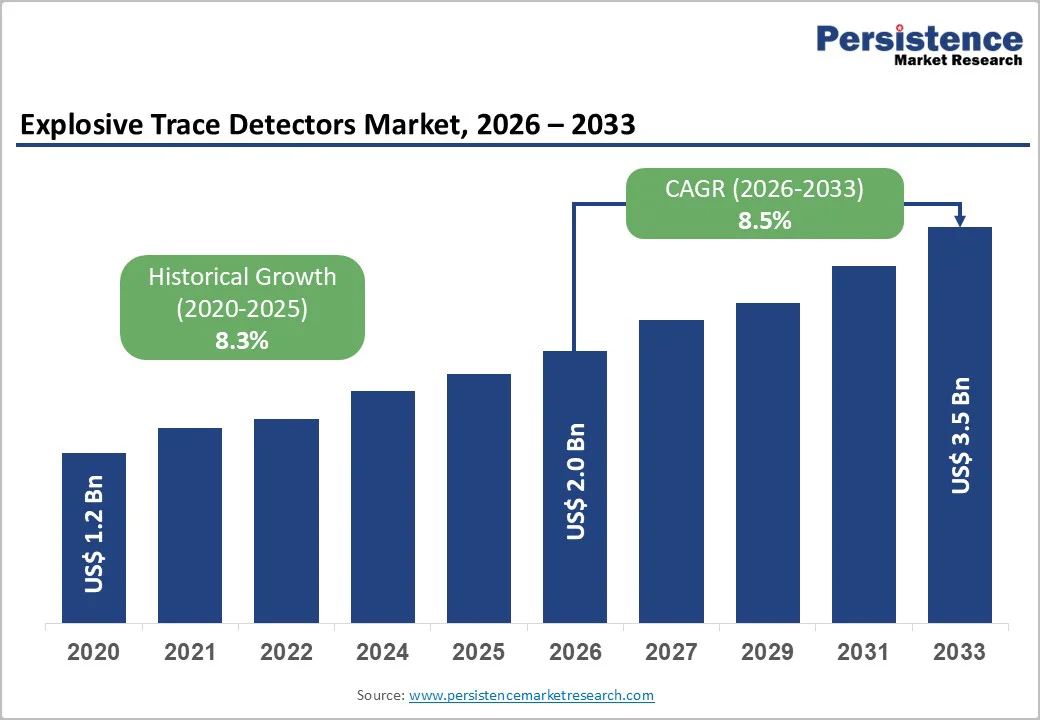
The global explosive trace detectors market size is likely to be valued at US$2.0 billion in 2026 and is expected to reach US$3.5 billion by 2033, growing at a CAGR of 8.5% during the forecast period from 2026 to 2033, driven by increasing terrorism threats, the implementation of stringent aviation and border security regulations by authorities such as the U.S. Transportation Security Administration (TSA) and the International Civil Aviation Organization (ICAO), and rising investments in the protection of critical infrastructure. Advancements in detection technologies, including improvements in sensitivity, specificity, and portability, have enhanced adoption across commercial and defense sectors. Aviation security continues to account for a significant portion of deployments.
Key Industry Highlights:
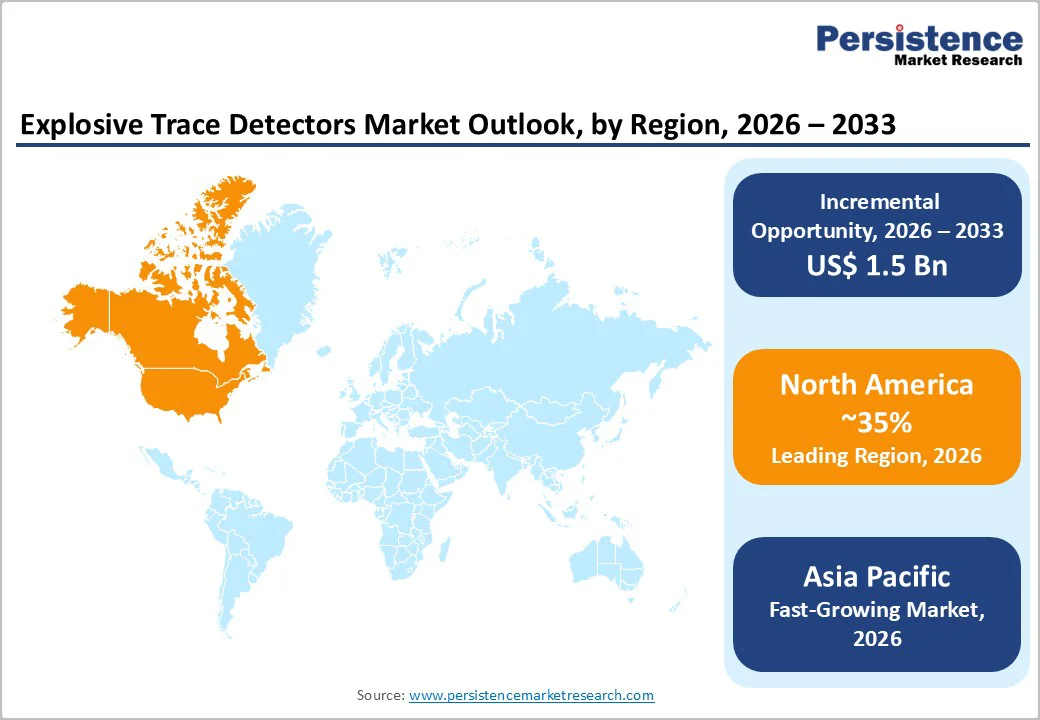
- Leading Region: North America is anticipated to be the leading region, accounting for a market share of 35% in 2026, driven by strong defense budgets, TSA-funded security programs, advanced technology adoption, and major players such as Leidos and Teledyne FLIR.
- Fastest-growing Region: Asia Pacific is likely to be the fastest-growing region, driven by rising terrorism, urbanization, increasing aviation traffic, infrastructure investments, and a mix of local and global players targeting border, airport, and logistics security.
- Leading Product Type: Handheld detectors are projected to represent the leading product type in 2026, accounting for 53% of the revenue share, driven by their mobility, compact design, and rapid deployment capabilities across airports, borders, and large public events.
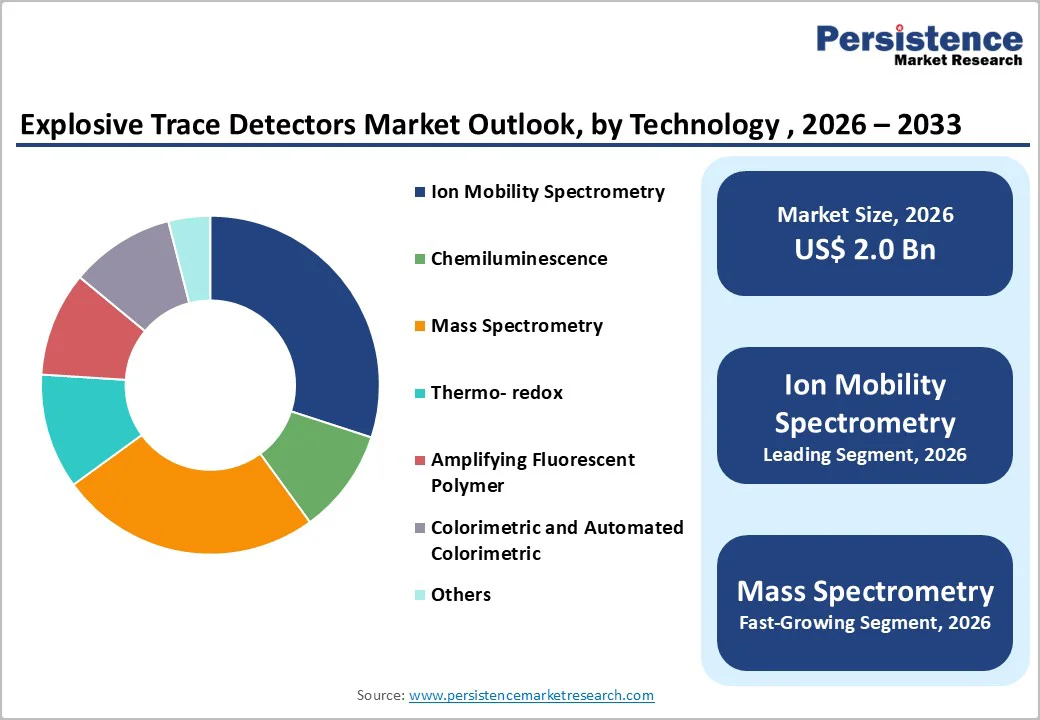
- Leading Technology: Ion Mobility Spectrometry (IMS) is anticipated to be the leading technology type, accounting for over 57.9% of the revenue share in 2026, supported by its high sensitivity, fast detection speed, and widespread adoption in commercial and security applications.
| Key Insights | Details |
|---|---|
| Explosive Trace Detectors Market Size (2026E) | US$2.0 Bn |
| Market Value Forecast (2033F) | US$3.5 Bn |
| Projected Growth (CAGR 2026 to 2033) | 8.5% |
| Historical Market Growth (CAGR 2020 to 2025) | 8.3% |
Market Factors – Growth, Barriers, and Opportunity Analysis
Rising Security Screening Volumes in Transportation and Critical Infrastructure
With increasing air travel, freight movement, and passenger traffic, airports, seaports, and rail stations are under heightened scrutiny to prevent explosive threats. Regulatory bodies such as the U.S. TSA, ICAO, and other national authorities have mandated stricter screening protocols, requiring the deployment of advanced explosive trace detectors (ETDs) at checkpoints. Handheld, portable, and fixed-point detection systems are increasingly used to ensure rapid, efficient, and accurate screening of passengers, luggage, and cargo. The growth in e-commerce and logistics also adds pressure on transportation hubs to implement high-throughput explosive detection, driving demand for systems with improved sensitivity, speed, and portability.
Critical infrastructure protection is another key area contributing to the explosive trace detectors (ETD) market growth. Energy facilities, government buildings, stadiums, and public venues face rising security challenges due to both targeted threats and general public safety concerns. Organizations are increasingly investing in detection solutions capable of continuous monitoring and rapid threat identification. Advanced technologies, such as Ion Mobility Spectrometry (IMS) and Mass Spectrometry, are deployed to detect trace explosives in complex environments, enhancing operational efficiency and reliability. The increasing volume of security screening across both transportation and critical infrastructure sectors significantly fuels the adoption and expansion of ETD systems.
False Alarm Rates and Maintenance Challenges
High incidences of false positives can disrupt airport operations, border control, and critical infrastructure screening, leading to delays, manual rechecks, and operational inefficiencies. In high-throughput environments such as airports, cargo terminals, and mass transit hubs, repeated false alarms not only slow down security processes but also place additional pressure on personnel to identify genuine threats accurately. Technological advancements, such as Ion Mobility Spectrometry (IMS) and Mass Spectrometry, have improved detection accuracy, but differentiating trace explosives from harmless substances remains challenging. Persistent false alarms can reduce confidence in detection systems and affect procurement decisions by security agencies.
Maintenance and operational challenges constrain market growth. ETD systems require regular calibration, cleaning, and component replacement to maintain sensitivity and reliability. Advanced systems, including handheld, portable, and fixed-point detectors, often need specialized technical expertise and support, increasing operational costs. Environmental factors such as dust, humidity, and extreme temperatures can degrade performance over time. These factors, combined with complex maintenance requirements, elevate the total cost of ownership, limiting adoption, particularly in budget-constrained regions, and slowing market expansion despite rising security demands.
Integration with Digital Security Ecosystems and Data Analytics
Modern security operations increasingly rely on connected systems to enhance situational awareness and threat response. By linking ETDs with centralized monitoring platforms, airports, border control agencies, and critical infrastructure operators can collect real-time data on detected substances, track patterns, and optimize the deployment of security personnel. Advanced analytics, including machine learning and AI algorithms, can reduce false positives, improve detection accuracy, and identify emerging threat trends. This digital integration also allows for predictive maintenance, operational efficiency, and improved decision-making, providing stakeholders with actionable insights beyond simple explosive detection.
The rise of smart infrastructure and IoT-enabled security networks amplifies the value of connected ETDs. Integration with video surveillance, access control, and emergency response systems creates a comprehensive security framework capable of rapid threat assessment and coordinated response. Analytics-driven dashboards and reporting tools help organizations comply with regulatory requirements while optimizing operational workflows. As security challenges evolve, the convergence of ETDs with digital ecosystems and data analytics is expected to drive higher adoption rates, enhance system intelligence, and open new markets in the commercial, aviation, and defense sectors.
Category-wise Analysis
Product Type Insights
The handheld detectors segment is expected to lead, accounting for approximately 53% of total revenue in 2026, driven by their mobility, compact design, and the ability to provide rapid and accurate detection across high-traffic areas such as airports, borders, and public events. Their portability allows security personnel to conduct on-the-spot screening of passengers, baggage, and parcels without the need for fixed infrastructure, making them ideal for dynamic and high-throughput environments. For example, Smiths Detection’s IONSCAN 600 is widely deployed in international airports for quick trace detection of explosives, combining high sensitivity with ease of use for operators.
Portable is likely to represent the fastest-growing segment, driven by advancements in battery life, ruggedness, and rapid-response capabilities. Unlike handheld detectors, portable units can be deployed in temporary checkpoints, cargo screening operations, and emergency scenarios, providing flexibility in areas where permanent infrastructure is unavailable. For example, Teledyne FLIR’s Fido X4 portable explosive detector offers rapid screening of vehicles and packages, combining high sensitivity with a lightweight design for field operations. Growth in this segment is supported by the expansion of e-commerce logistics, requiring screening of large volumes of cargo at distribution centers and border crossings.
Technology Type Insights
Ion mobility spectrometry is projected to lead the market, capturing around 57.9% of the total revenue share in 2026, driven by its high sensitivity, rapid detection speed, and widespread use across commercial, aviation, and defense applications. IMS systems can detect trace amounts of explosives without using radioactive sources in modern designs, making them safer and easier to deploy. For instance, the Bruker RAID-M 500 IMS-based detector is employed in airports and critical infrastructure to rapidly screen passengers, luggage, and cargo for explosive residues. The technology’s ability to produce fast results with minimal training required for operators makes it the preferred choice for high-throughput screening applications.
Mass spectrometry is likely to be the fastest-growing application in 2026, driven by its superior specificity, accuracy in complex environments, and ability to integrate with advanced sampling methods such as ambient ionization. Mass spectrometry allows for the precise identification of explosive compounds, reducing false alarms and improving operational reliability in high-security environments. For example, 908 Devices’ M908 portable mass spectrometer provides rapid trace detection for airport cargo, border control, and military applications, enabling detection of a wide range of explosives with high confidence. The segment growth is fueled by increasing adoption in sensitive infrastructure such as government facilities, seaports, and urban transit hubs, where the complexity of materials and mixed substances requires highly accurate detection technologies.
Regional Insights
North America Explosive Trace Detectors Market Trends
North America is anticipated to be the leading region, accounting for a market share of 35% in 2026, driven by heightened security requirements across airports, seaports, and critical infrastructure. Market trends include the modernization of screening systems, expansion of passenger and cargo security checks, and increasing adoption of integrated digital security platforms that combine real-time data analytics, predictive maintenance, and automated threat detection. Regulatory frameworks from the U.S. TSA, DHS, and Department of Defense further encourage the deployment of advanced ETD systems. The demand for portable, handheld, and fixed-point detectors is rising to meet the needs of high-throughput environments, emergency response, and temporary screening operations.
Technological innovation remains a key driver, focusing on enhancing sensitivity, reducing false alarms, and improving operational efficiency. For example, OSI Systems’ Rapiscan Systems ETD solutions are widely deployed in airports and government facilities, offering high-throughput trace detection capabilities for explosives and narcotics while meeting stringent U.S. security standards. The competitive landscape includes both established and emerging technology providers, with continued R&D, digital integration, and strategic partnerships enabling the market to maintain leadership and address evolving security threats effectively.
Europe Explosive Trace Detectors Market Trends
Europe is likely to be a significant market for explosive trace detectors in 2026, supported by strong regulatory frameworks and coordinated security initiatives across the European Union. Europe accounts for a significant share of the global market, driven by the modernization of airport security systems, expansion of rail and urban transit screening, and cross?border freight security programs. Harmonized standards through the European Civil Aviation Conference (ECAC) and EU aviation security directives ensure that member states deploy high sensitivity trace detection systems at major airports, seaports, and critical infrastructure sites.
Technological advancement and procurement activity characterize market trends in Europe, with both established and emerging solution providers contributing to the adoption of advanced detection systems. For example, Bruker Corporation’s DE tector flex trace detection systems are being deployed at major European airports such as Zurich, replacing older units with next-generation, non radioactive ionization based detectors capable of rapid trace analysis with reduced false positives. These advanced ETD solutions support enhanced security screening across passenger checkpoints and cargo facilities, aligning with Europe’s emphasis on efficient, high throughput operations.
Asia Pacific Explosive Trace Detectors Market Trends
The Asia Pacific region is likely to be the fastest-growing region in the explosive trace detectors market in 2026, driven by critical infrastructure and border control environments. Rapid urbanization, increasing air passenger traffic, and ongoing airport and port modernization projects are driving the deployment of advanced ETD systems. Rising security concerns stemming from terrorism threats, organized crime, and large scale public events have prompted investments in high sensitivity screening technologies across both public and private sectors.
Technological adoption and collaboration with solution providers are important trends shaping the Asia Pacific ETD landscape. For example, NUCTECH Company Limited, a major Chinese security equipment manufacturer, supplies explosives trace detection and integrated screening systems to airports and customs agencies across the region, enhancing detection capabilities at checkpoints and transit hubs. Partnerships between regional agencies and international technology vendors are also enabling the customization of ETD solutions to local security needs, while digital integration with analytics and smart infrastructure platforms improves threat response and operational efficiency.
Competitive Landscape
The global explosive trace detectors market exhibits a moderately fragmented structure, driven by the presence of several multinational corporations alongside regional specialists and innovative startups that together shape competitive dynamics. While a core group of established players holds a significant portion of market share through extensive product portfolios, distribution networks, and strong brand recognition, a growing number of smaller firms and new entrants are contributing to fragmentation by offering cost effective and highly specialized solutions tailored to specific end users and regional requirements.
With key leaders including Smiths Detection, Teledyne FLIR LLC, OSI Systems/Rapiscan Systems, Leidos Holdings, Bruker Corporation, Chemring Group, and Others, the market demonstrates a mix of legacy strength and forward looking innovation. These players compete through technological differentiation, strategic contracts with government and defense agencies, global service and support networks, and continuous product enhancements aimed at addressing evolving security threats and regulatory requirements. Innovation pipelines increasingly emphasize integration with digital ecosystems, predictive maintenance, and enhanced interoperability with broader security infrastructure, while pricing strategies and after sales services help retain customer loyalty.
Key Industry Developments:
- In November 2025, the Airports Authority of India (AAI) signed an INR 40 crore (US$4.82 million) contract with Vehant Technologies for the supply, installation, and maintenance of 232 indigenous Explosive Trace Detectors (ETDs) at more than 60 airports across India. The deployment will cover major hubs, including Chennai, Kolkata, Pune, Varanasi, Srinagar, Jammu, Amritsar, Port Blair, and Coimbatore, strengthening security screening at checkpoints, baggage handling areas, cargo, and transit zones.
- In August 2025, Bruker Corporation won several multi-year contracts exceeding US$27 million for its explosives and chemical trace detection solutions across the global aviation and defense sectors. The agreements include deployments of Bruker’s ETD systems at key international airports and air cargo hubs, as well as chemical reconnaissance solutions for defense and homeland security agencies. Notably, Brussels Airport Company NV awarded Bruker a seven-year framework agreement for 80 ETD units, including maintenance, training, and centralized management software.
Companies Covered in Explosive Trace Detectors Market
- Analogic Corporation
- Autoclear
- Bruker
- DetectaChem
- Teledyne FLIR LLC
- Smith’s Detection Group Ltd.
- American Innovations
- Westminster Group Plc
- Implant Sciences Group
- OSI Systems, Inc.
Frequently Asked Questions
The global explosive trace detectors market is projected to reach US$2.0 billion in 2026.
Rising security threats, increasing terrorism risks, and stringent aviation and border security regulations are anticipated to drive market growth.
The explosive trace detectors market is expected to grow at a CAGR of 8.5% from 2026 to 2033.
The key opportunities include the integration with digital security ecosystems, the adoption of advanced data analytics, and the development of portable and next-generation detection technologies.
Analogic Corporation, Autoclear, Bruker, DetectaChem, Teledyne FLIR LLC, and Smiths Detection Group Ltd. are the leading players.


