




- Home Appliances
- Mattress Market
Mattress Market Size, Share, and Growth Forecast 2026 - 2033
Mattress Market by Mattress Type (Spring Mattress, Foam Mattresses, Hybrid Mattresses), Mattress Size (Single, Double, Queen, King, Custom Sizes), Price (Premium, Economy), Sales Channel (Hypermarkets/Supermarkets, Direct Sales, Specialty Mattress Stores, Online Retailers), Regional Analysis, 2026 - 2033

Mattress Market Size and Trend Analysis
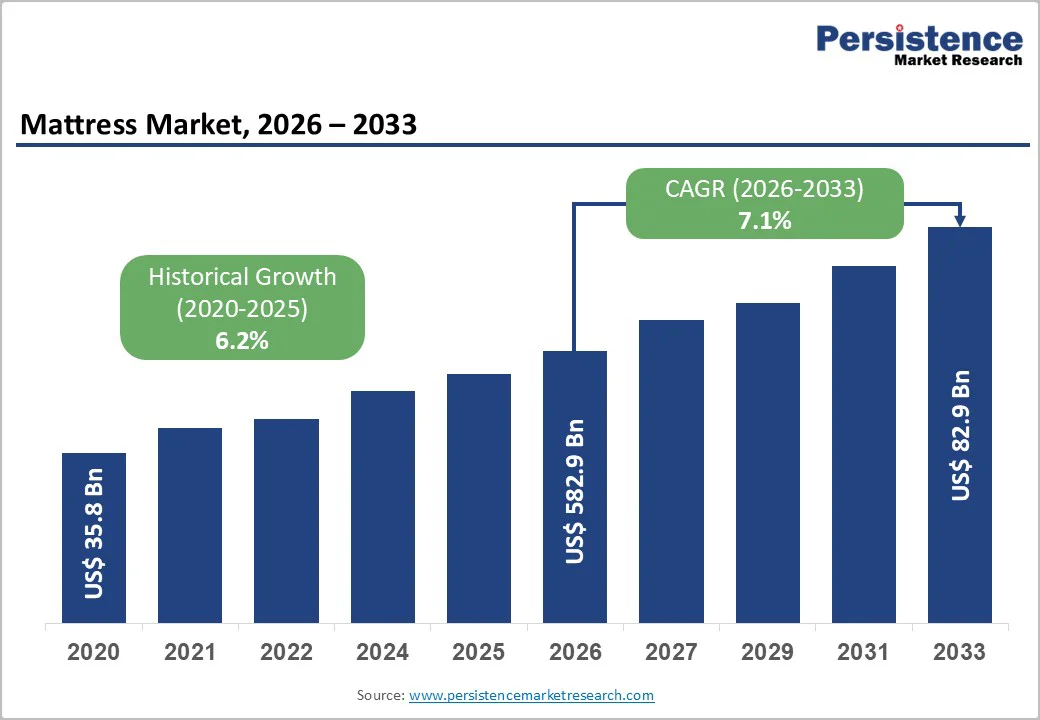
The global mattress market size is likely to be valued at US$ 51.3 billion in 2026 and is expected to reach US$ 82.9 billion by 2033, growing at a CAGR of 7.1% during the forecast period from 2026 to 2033. The market expansion is fundamentally driven by escalating consumer awareness regarding sleep health and wellness, with approximately 30% of the global population experiencing sleep disorders according to the World Health Organization (WHO).
Rising urbanization rates, particularly in emerging economies where over 40% of populations are projected to reside in urban areas by 2030, coupled with increasing disposable incomes across middle-class demographics, are substantially accelerating mattress procurement. The hospitality sector's robust recovery, with the United Nations World Tourism Organization (UNWTO) projecting international tourist arrivals to reach 1.8 billion by 2030, further amplifies commercial mattress demand across hotels, resorts, and healthcare establishments.
Key Market Highlights:
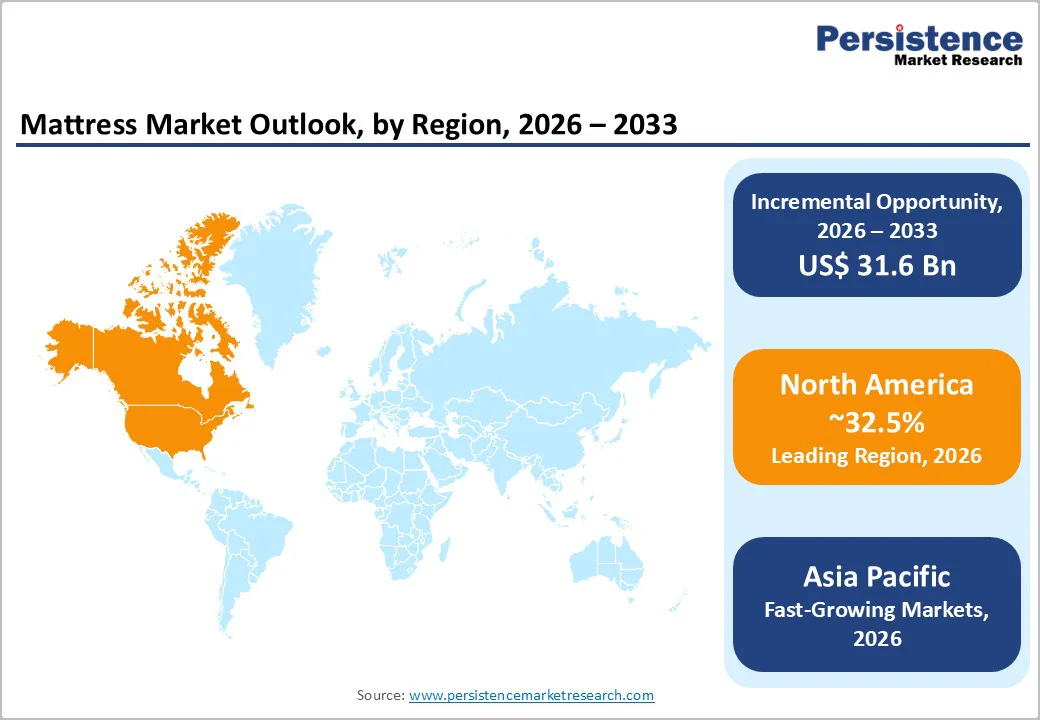
- Leading Region: North America leads the global mattress market, commanding approximately 32.5% of total revenue.
- Fastest Growing Region: Asia Pacific is the fastest-growing region, accounting for approximately 38% of global share, driven by urbanization and rising middle-class incomes.
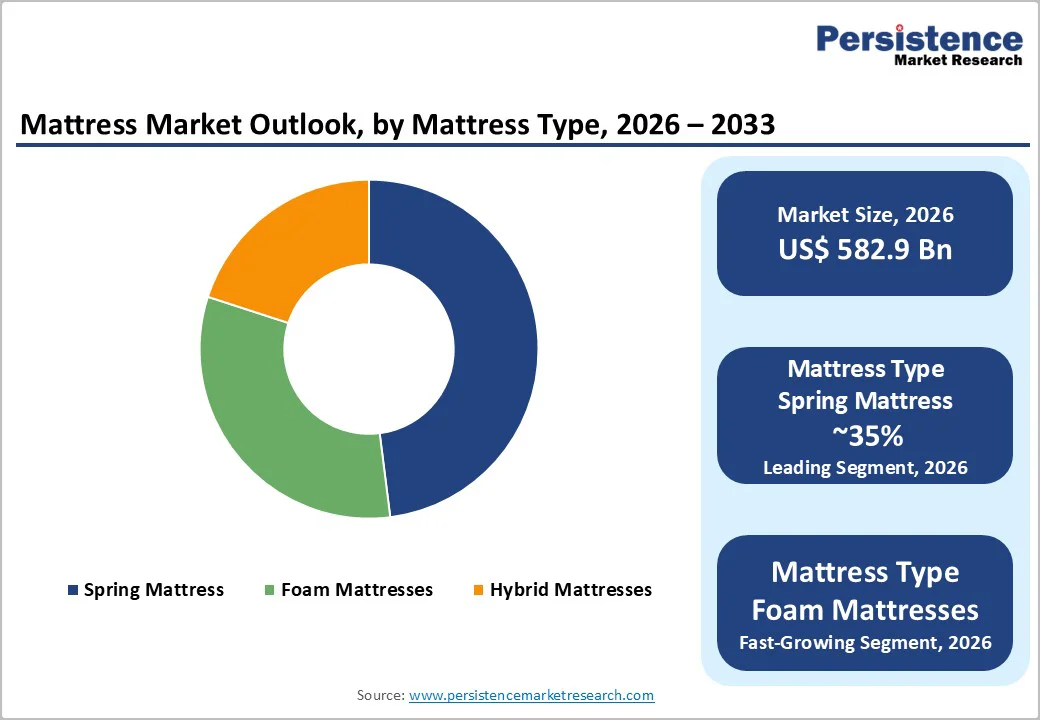
- Dominant Mattress Type: Spring mattresses hold market leadership with around 35% market share, supported by durability, affordability, and coil technology innovations.
- Fastest Growing Mattress Type: Hybrid mattresses are the fastest-growing segment, expanding at roughly 8% CAGR due to combined foam and innerspring support.
- Key Market Opportunity: Smart mattress technology adoption is projected to grow 25% annually, fueled by AI-powered sleep tracking, automated firmness adjustments, and IoT integration.
| Key Insights | Details |
|---|---|
|
Mattress Market Size (2026E) |
US$ 51.3 Billion |
|
Market Value Forecast (2033F) |
US$ 82.9 Billion |
|
Projected Growth CAGR (2026-2033) |
7.1% |
|
Historical Market Growth (2020-2025) |
6.2% |
Market Dynamics
Drivers - Rising Global Consciousness Toward Sleep Wellness & Premium Mattress Adoption
Growing global awareness of sleep as a core component of health is fundamentally reshaping mattress purchases. Today’s consumers are shifting from basic comfort-based buying to wellness-driven decision-making, prioritizing support, posture alignment, and back-pain relief. Clinical research has shown that medium-firm mattresses can improve sleep quality by 55% and reduce chronic low-back pain by 48%, reinforcing their value as a wellness product rather than conventional furniture.
The ResMed 2024 Global Sleep Survey, covering 36,000 respondents across 17 markets, highlighted that nearly 40% of people get no more than three good nights of sleep weekly — fueling demand for scientifically backed mattress solutions. With health now positioned alongside diet and fitness, consumers are willingly paying more for superior materials, orthopedic design, and premium comfort, accelerating market premiumization and driving long-term growth.
Hospitality Expansion & Large-Scale Real Estate Growth Fuel Mattress Procurement
The booming growth in hospitality and residential construction is creating large-volume demand for mattresses across global markets. Renovation, refurbishment, and build-out cycles in hotels have become major purchase drivers, with the U.S. alone expecting 300,000–400,000 rooms to undergo upgrade and conversion in 2025, directly boosting replacement-cycle mattress procurement. Parallel momentum in Latin America reflects similar strength, as 604 hotel projects (100,990 rooms) were recorded in Q1 2024, marking an 11% YoY rise.
In addition, large-scale pipeline expansion from global players like Hilton, targeting 300 new hotels across the Caribbean & Latin America, reinforces long-term institutional buying. Rapid urbanization in the Asia Pacific is also fueling steady residential demand as new homes require complete furnishing. This twin-sector growth ensures stable, recurring mattress consumption across premium hospitality, rental housing, and household segments.
Restraints - Fluctuating Raw Material Costs Impacting Production Profitability
The mattress manufacturing industry faces ongoing challenges due to fluctuations in key raw material costs, which can significantly affect production economics and profit margins. Foam, steel for springs, and other essential inputs have experienced periods of price volatility, while global supply chain disruptions have led to increased freight and logistics costs. These factors collectively raise manufacturing overheads and create pressure on pricing strategies.
Producers need to balance cost absorption and retail pricing, especially in price-sensitive markets, to maintain competitiveness and protect margins. Persistent volatility in raw materials and logistics can constrain market expansion in developing regions, where affordability remains a key purchasing driver.
Manufacturers are increasingly exploring strategies such as supplier diversification, material optimization, and improvements in production efficiency to mitigate the impact of cost swings. While premium and health-oriented segments may tolerate higher pricing, budget-conscious consumers could be discouraged from upgrading or replacing mattresses as frequently. These dynamic highlights the ongoing need for innovation in cost management and supply chain resilience across the global mattress market.
Unorganized Sector Competition & Counterfeit Products Undermining Market Stability
The mattress industry faces strong competition from unorganized manufacturers and the proliferation of counterfeit products, particularly in emerging economies across Asia Pacific and Latin America. Informal players often operate without adhering to quality standards or regulatory requirements, allowing them to offer lower-priced alternatives that erode brand value and disrupt pricing structures. This unregulated competition makes it challenging for legitimate manufacturers to maintain market share and justify investments in high-quality or sustainable production processes.
Sustainable manufacturing practices, such as low-emission foam handling and eco-friendly material use, impose additional costs on compliant producers, while unorganized competitors operate without such constraints. The uneven competitive landscape affects consumer perception, pricing integrity, and long-term brand loyalty. Counterfeit and substandard products can also lead to consumer dissatisfaction, slowing the adoption of premium and health-focused mattresses in value-driven markets.
Opportunity - Integration of Smart Sleep Technology and IoT Solutions
The integration of smart technology with mattresses is creating significant growth opportunities for manufacturers. AI-enabled and IoT-connected mattresses are transforming sleep experiences by offering features such as automated firmness adjustment, temperature regulation, anti-snoring support, and personalized sleep monitoring. Products like DeRucci’s T11 Pro Smart Mattress and Sleep Number’s Climate360 smart bed exemplify how technology can address specific consumer needs and enhance comfort. Rising consumer focus on health, wellness, and personalized experiences is driving the adoption of smart sleep solutions, enabling manufacturers to offer premium, high-value products and differentiate in a competitive market.
Smart mattresses also enable data-driven insights that allow brands to refine ergonomics and sleep support over time, strengthening customer loyalty. Manufacturers leveraging connected technology can create recurring engagement opportunities while positioning themselves as innovation leaders in the global mattress market.
Growing Demand for Sustainable and Eco-Friendly Sleep Solutions
Consumer preference for environmentally responsible products is opening new avenues for mattress manufacturers. Eco-friendly materials, such as natural latex and recycled components, along with recyclable or biodegradable mattress designs, are increasingly valued by health- and environmentally-conscious buyers. Leading brands are implementing sustainability-focused product lines and take-back programs to address end-of-life disposal, enhancing brand credibility and consumer trust.
Sustainability-driven mattresses allow manufacturers to differentiate their offerings, appeal to conscious consumers, and expand into premium segments. By aligning products with environmental stewardship, brands can strengthen long-term market positioning while tapping into a growing demand for responsible sleep solutions.
Category-wise Analysis
Mattress Type Insights
Spring mattresses continue to lead the global market, commanding approximately 35% market share due to their proven durability, affordability, and familiar comfort. More than 55% of households rely on innerspring mattresses as their primary sleep surface, reflecting widespread consumer trust in this segment. Innovations such as pocketed and micro-coils have enhanced motion isolation and targeted support, maintaining the segment’s relevance. Both residential and hospitality applications favor innerspring designs for their standardized quality, ease of maintenance, and reliability.
The segment’s sustained popularity is further reinforced by middle-income consumer preferences who prioritize functional comfort and longevity over advanced features. Continuous coil technology improvements allow manufacturers to differentiate products while retaining affordability, ensuring that spring mattresses remain a staple choice in global sleep solutions. This balance of value and comfort underpins their enduring market leadership.
Mattress Size Insights
Queen-size mattresses dominate the global market, accounting for approximately 35% market share, driven by their optimal balance of sleeping space and bedroom footprint compatibility. Urban households favor this size for couples seeking adequate personal space without excessive room requirements. The segment’s prevalence is supported by consumer preference trends across major markets, reflecting practicality and widespread availability.
King-size mattresses, however, are growing the fastest, with a projected CAGR of 7.8%, fueled by rising disposable incomes, larger dwelling spaces, and premium hospitality upgrades. This trend highlights an increasing willingness among affluent consumers and the hospitality sector to invest in expansive sleep surfaces, indicating opportunities for manufacturers to expand offerings in the luxury and high-end market segments.
Price Insights
The economy mattress segment leads the global market, capturing approximately 60% market share, primarily due to its affordability and accessibility in developing regions. Budget-conscious consumers often prioritize functionality and durability over advanced features, making economy mattresses a staple choice for households. Their widespread availability and reasonable pricing reinforce consistent demand, particularly in regions where cost-sensitive buyers dominate.
The premium segment is witnessing notable growth, driven by rising disposable incomes and increased awareness of the health benefits of quality sleep. Premium mattresses are increasingly perceived as wellness investments. The luxury segment reflects consumer preference for high-end products that combine comfort, long-term durability, and advanced features, positioning this segment as a high-value opportunity for manufacturers.
Sales Channel Insights
Specialty mattress stores remain the dominant distribution channel, commanding about 43% market share, supported by knowledgeable staff, hands-on product testing, and a dedicated focus on sleep solutions. Chains such as Mattress Firm, with over 2,300 U.S. locations, exemplify the strong consumer trust and convenience associated with specialty retail.
Online retail is rapidly gaining traction, with the bed-in-a-box model increasing accessibility and convenience. Platforms like Amazon capture a significant portion of U.S. online mattress sales. Traditional retailers are increasingly adopting omnichannel strategies, integrating physical showrooms with digital purchasing to enhance customer experience and capitalize on evolving buying behaviors.
Regional Insights
North America Mattress Market Trends
North America commands the leading regional position within the global mattress market, accounting for approximately 32.5% of total market revenue, with the United States contributing over 80% of regional sales. The region's dominance stems from elevated consumer awareness regarding sleep health, substantial purchasing power with average Americans spending approximately USD 1,000 annually on sleep-related products, and sophisticated retail infrastructure encompassing both specialty stores and e-commerce platforms. The Federal Trade Commission's (FTC) oversight of major industry transactions, including Tempur Sealy's USD 5 billion acquisition of Mattress Firm completed in February 2025, underscores regulatory attention to maintaining competitive market dynamics.
Innovation leadership characterizes the North American market, particularly in smart mattress technology integration and sustainable material adoption. Sleep Number's advanced smart beds featuring temperature regulation and sleep tracking capabilities demonstrate the region's technological advancement trajectory. The International Sleep Products Association (ISPA) reports that mattress replacement cycles among residential consumers have reduced to 6-8 years, accelerating demand replenishment. Metropolitan areas like Atlanta are experiencing rapid urbanization, adding approximately 69,200 residents annually, directly stimulating residential mattress demand.
Europe Mattress Market Trends
Europe represents a significant regional mattress market, with Germany commanding a leading national share due to strong consumer preference for quality, durability, and engineering excellence. Sustainability consciousness is prominent, especially in Nordic countries, driving demand for mattresses made with biodegradable or recycled materials. Regulatory frameworks such as the Carbon Border Adjustment Mechanism influence import patterns and encourage domestic production clusters.
The United Kingdom is the fastest-growing market in Europe, driven by robust e-commerce adoption and direct-to-consumer penetration. Companies like Emma Sleep GmbH and Pikolin Group are introducing intelligent and orthopedic mattresses with sleep tracking and therapeutic features, catering to aging populations and wellness-focused consumers. Hilding Anders’ sustainability-focused product lines further reflect industry commitment to eco-friendly practices and circular economy principles, positioning Europe as a market where innovation and environmental responsibility coexist.
Asia Pacific Mattress Market Trends
Asia Pacific is the fastest-growing regional mattress market, commanding approximately 38% of the global market share. Growth is fueled by rapid urbanization, rising middle-class populations, and increasing disposable incomes. China leads the region, while India shows remarkable expansion potential, supported by the transition from traditional cotton mattresses to modern foam, spring, and hybrid options. Retail expansion by companies like The Sleep Company, planning hundreds of new stores across Tier II cities, highlights the aggressive market penetration strategy.
The region benefits from strong manufacturing capabilities, with China serving as a hub for both domestic consumption and exports. Investments by companies such as DeRucci in Southeast Asian assets and Koala’s relocation of production to China exemplify consolidation and regional scaling. With annual demand of around 7 million units in India and untapped potential in smaller cities, the Asia Pacific offers immense opportunities for both volume-driven and premium mattress segments.
Competitive Landscape
The global mattress market is moderately fragmented, comprising established multinational corporations alongside numerous regional and local manufacturers. Market competition is driven by consolidation, with leading players pursuing vertical integration and horizontal expansion to strengthen their positioning. Key differentiators include technological innovation in sleep science, sustainable material sourcing, brand reputation, manufacturing efficiency, and extensive distribution networks.
Emerging business models are reshaping the competitive environment, with growing emphasis on direct-to-consumer digital platforms, subscription-based mattress replacement programs, and integrated sleep ecosystems that include accessories and smart home connectivity. These trends enable companies to enhance customer engagement and capture premium market segments.
Key Market Developments:
- In February 2025, Tempur Sealy International, Inc. completed its USD 5 billion acquisition of Mattress Firm, the nation's largest mattress specialty retailer, creating the world's largest bedding company with pro forma sales of approximately USD 8 billion and rebranding to Somnigroup International Inc.
- In July 2024, Serta Simmons Bedding, LLC introduced the Beautyrest Black Hybrid collection featuring proprietary InfiniSculpt™ HD Memory Foam and Triple-Stranded Pocketed Coil® Technology, expanding its premium hybrid mattress portfolio with 11 models spanning multiple firmness configurations.
- In December 2024, DeRucci Healthy Sleep announced a SGD 46 million investment to acquire Singapore's Moratel International and Indonesia's PTTC assets, enhancing overseas production capabilities and accelerating internationalization strategy across Southeast Asian markets.
Companies Covered in Mattress Market
- Tempur Sealy International, Inc.
- Serta Simmons Bedding, LLC
- Sleep Number Corporation
- Kingsdown, Inc.
- Spring Air International
- Silentnight Group Limited
- Pikolin, Hilding Anders
- Flex, Zinus, Inc.
- Kurlon Enterprise Ltd.
- Emma
- De Rucci
- Eurocomfort Group
- Sheela Foam Limited
- Casper Sleep Inc.
- Purple Innovation, LLC
- Leggett & Platt, Inc.
- Recticel NV/SA
- Magniflex
Frequently Asked Questions
The global mattress market is projected to reach US$ 82.9 billion by 2033, growing from US$ 51.3 billion in 2026 at a CAGR of 7.1% during the forecast period.
Key growth drivers include rising consumer awareness regarding sleep health and wellness, with approximately 30% of the global population experiencing sleep disorders, expanding hospitality and real estate infrastructure, increasing urbanization rates, and growing disposable incomes, particularly in emerging economies.
Spring mattresses maintain market leadership, commanding approximately 35% of global market share, driven by proven durability, widespread affordability, continuous innovation in pocketed coil technologies, and sustained consumer preference across residential and hospitality applications.
North America commands the leading regional position, accounting for approximately 32.5% of total market revenue, with the United States contributing over 80% of regional sales, driven by elevated consumer awareness, substantial purchasing power, and sophisticated retail infrastructure.


