




- Healthcare Services
- Cardiovascular Information Systems Market
Cardiovascular Information Systems Market Size, Trends, Share, Growth, and Regional Forecast, 2026 to 2033
Cardiovascular Information Systems Market by Component (Hardware, Software, Services), Deployment (Web-based, Cloud-based, On-premise), Application, End-user, and Regional Analysis from 2026 to 2033

Cardiovascular Information Systems Market Share and Trends Analysis
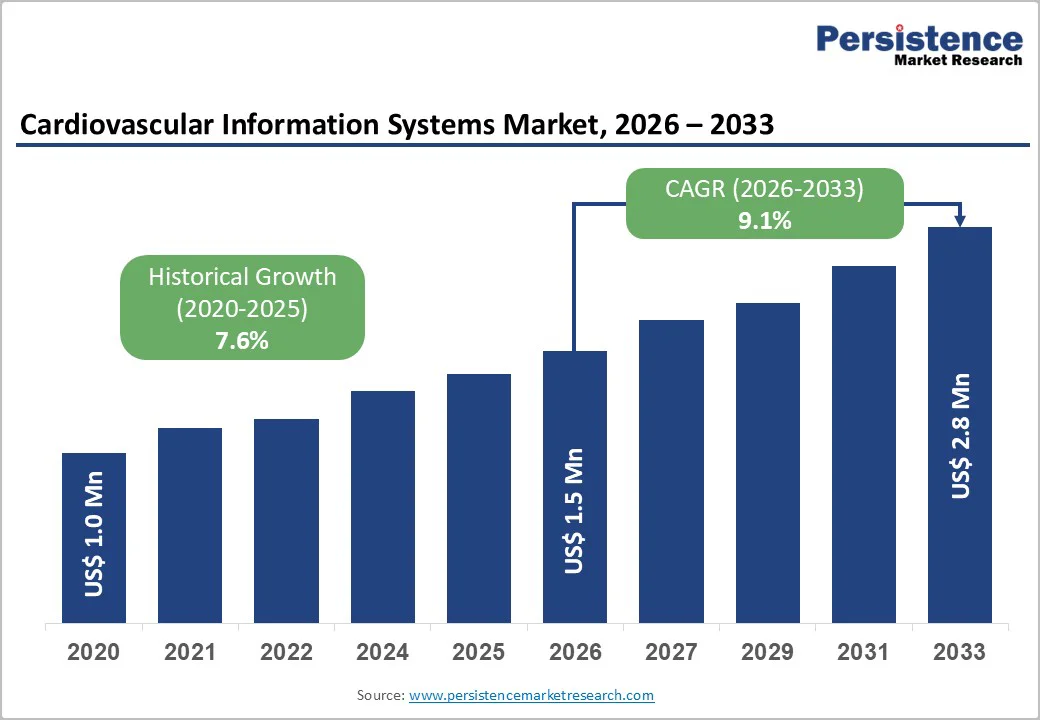
The global cardiovascular information systems market size is estimated to reach US$ 1.5 billion in 2026 and is projected to reach US$ 2.8 billion by 2033, growing at a CAGR of 9.1% between 2026 and 2033.
With the rapid rise in cardiovascular disease as a major global health burden, the need for cardiovascular information systems is felt acutely in the clinical industry. Growing emphasis on structured reporting, multimodality image management, and real-time clinical decision support is accelerating the adoption of CVIS across hospitals and specialty cardiac centers.
Government incentives for digital health integration, electronic health records (EHRs), and interoperable clinical workflows further strengthen market uptake. Compared with traditional cardiology IT tools, CVIS offers centralized data consolidation, enhanced workflow efficiency, and improved diagnostic accuracy across cardiovascular subspecialties.
Key Industry Highlights
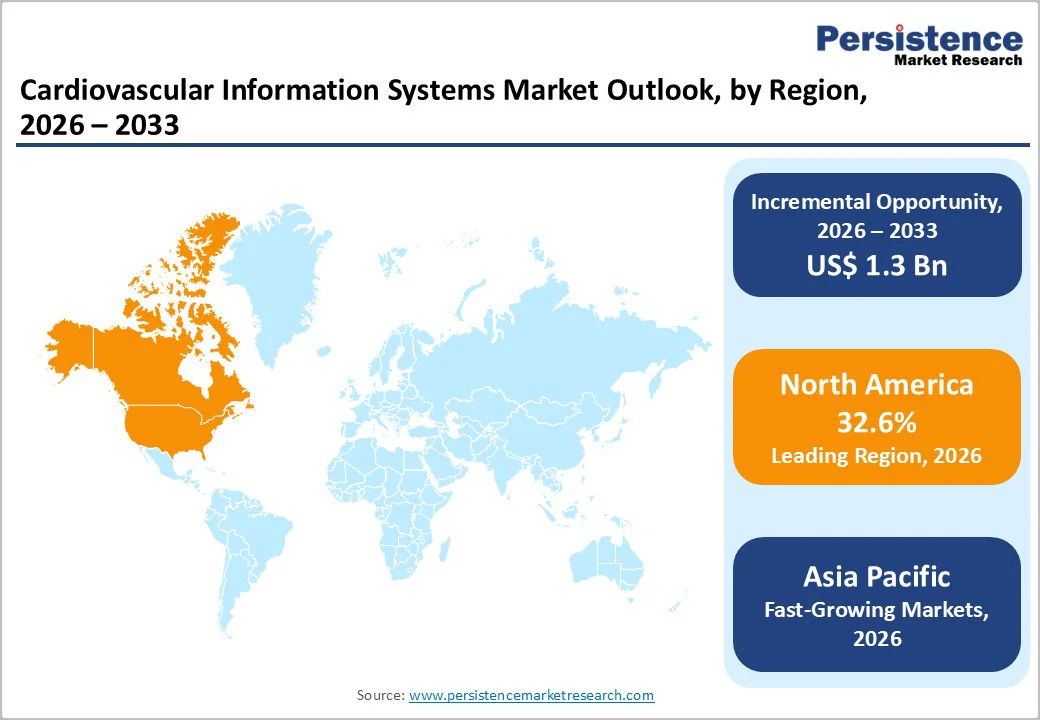
- Leading Region: North America dominates the global market, accounting for 32.6%, driven by advanced healthcare infrastructure, high adoption of AI-driven solutions, and strong hospital IT investments.
- Fastest-Growing Region: The Asia Pacific market is expected to grow rapidly with a CAGR of 15.3% in the forecast period, fueled by rising cardiovascular disease prevalence, AI-based risk prediction, and expanding digital healthcare infrastructure.
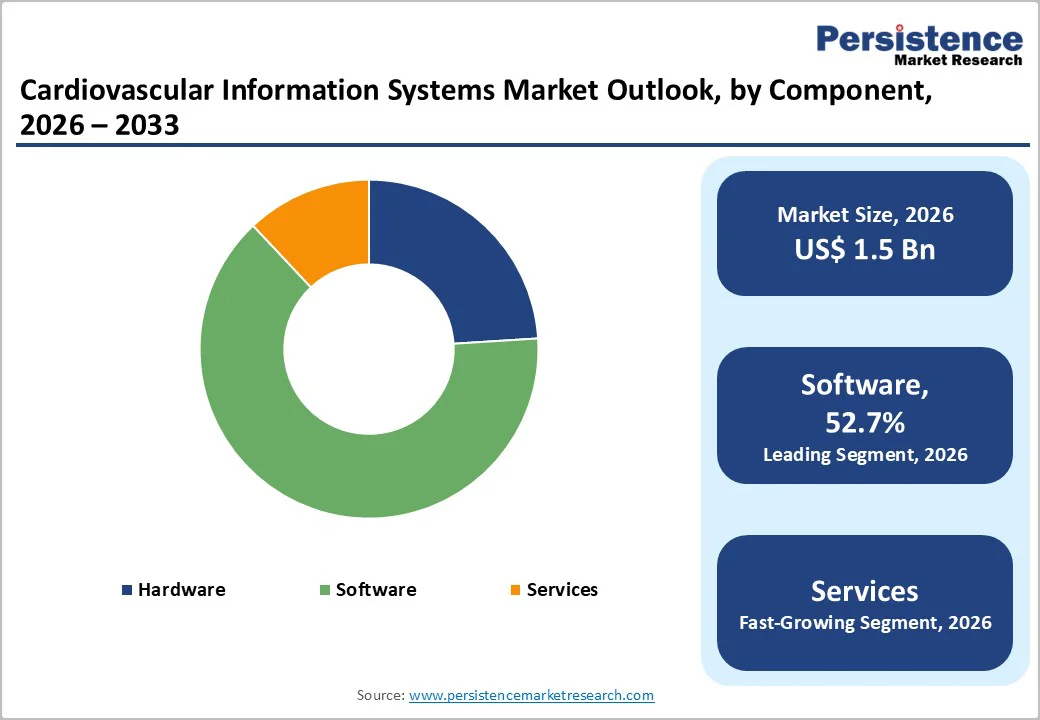
- Leading Component: Software lead with 52.7% share as it integrates multi-modality data, offers analytics, structured reporting, and supports interoperability with EHR and hospital information systems.
- Leading Deployment: Web-based lead with 71.1%, as it is preferred due to remote accessibility, scalability, ease of integration, telemedicine support, and reduced upfront investment for hospitals and clinics.
- Leading Application: Catheterization to remain dominant with 24.3%, because of increasing interventional cardiology procedures, the need for hemodynamic data management, and enhanced procedural efficiency.
- Leading End-user: Hospitals lead with a 42.8% share, driven by high patient volume, comprehensive cardiovascular services, adoption of integrated CVIS platforms, and a focus on workflow efficiency.
- Artificial intelligence adoption enhances predictive modeling, risk stratification, and clinical decision support, improving patient outcomes and workflow efficiency.
- Increasing cardiovascular disease cases globally drive demand for advanced imaging, monitoring, and integrated cardiovascular information systems.
- Mobile applications and cloud-based CVIS platforms allow clinicians to monitor patients outside hospitals, increasing accessibility and engagement.
| Key Insights | Details |
|---|---|
| Cardiovascular Information Systems Market Size (2026E) | US$ 1.5 Billion |
| Market Value Forecast (2033F) | US$ 2.8 Billion |
| Projected Growth (CAGR 2026 to 2033) | 9.1% |
| Historical Market Growth (CAGR 2020 to 2025) | 7.6% |
Market Dynamics
Driver - Rising Cardiovascular Disease Burden and Rapid Digital Transformation Accelerating Global Adoption of Cardiovascular Information Systems
According to the World Health Organization (WHO) 2025 report, the escalating global burden of cardiovascular diseases (CVDs)-which caused 19.8 million deaths in 2022, accounting for 32% of all global mortality, with 85% linked to heart attacks and strokes-is a major force accelerating demand for advanced digital cardiology platforms.
With most CVD-related deaths occurring in low- and middle-income countries and 38% of premature noncommunicable disease deaths in 2021 attributed to cardiovascular conditions, healthcare systems are prioritizing faster diagnosis, greater data transparency, and coordinated care delivery.
This rising clinical need is driving widespread adoption of Cardiovascular information systems (CVIS), which consolidate data from hemodynamic units, echocardiography devices, EKG/ECG systems, and third-party monitoring tools into a unified, structured, and easily retrievable digital environment.
Increasing regulatory focus on electronic health records (EHRs), picture archiving and communication systems (PACS), and interoperable digital infrastructure further strengthens this shift.
CVIS platforms also benefit from the rapid expansion of mobile technologies and telecardiology, enabling real-time access to imaging, reports, and longitudinal cardiac histories from any location. Post-pandemic demand for virtual care, remote monitoring, and digital collaboration continues to push hospitals toward integrated CVIS ecosystems that enhance clinical efficiency, patient engagement, and quality of cardiac care.
Restraints - Rising Data Security Pressures, Compliance Burdens, and Limited Advanced Integration Capabilities
Despite growing adoption, several structural and operational challenges continue to restrain the global cardiovascular information systems market. The most significant barrier is the rising threat of cybersecurity breaches as hospitals increasingly digitize cardiovascular workflows. Protecting high-value clinical data requires continuous investment in encryption, multi-factor authentication, audit mechanisms, and secure network architectures.
Compliance with stringent regulations, including the Health Insurance Portability and Accountability Act (HIPAA) in the U.S., adds to the financial and administrative burden, particularly for mid-sized hospitals and outpatient cardiology centers. Another limitation is the incomplete technological maturity of many CVIS platforms.
While current systems efficiently support multimodality imaging and standardized reporting, they often fall short in delivering advanced visualization, predictive analytics, and AI-enabled diagnostic decision support that modern cardiology demands.
These gaps hinder seamless integration across the full cardiology care continuum, from pediatric congenital heart disease to complex adult structural interventions, reducing the ability to maintain a unified, longitudinal patient record.
Interoperability challenges with legacy equipment, high upgrade costs, and workflow disruptions during system transitions further slow adoption in resource-constrained settings. Collectively, these factors limit the scalability, efficiency, and long-term value realization of CVIS deployments worldwide.
Opportunity - Expanding AI Integration, Advanced Analytics, and Strategic Partnerships, Creating High-Value Growth Opportunities
Rapid advancements in artificial intelligence (AI) and analytics are opening substantial growth opportunities for the global cardiovascular information systems market. AI-powered engines now enable deeper interpretation of multimodal cardiovascular data, supporting early risk detection, predictive modeling, and more precise clinical decision-making.
These capabilities have become particularly relevant as conditions such as Atrial Fibrillation (AFib) continue to rise, increasing the need for sophisticated platforms that can streamline fragmented diagnostic workflows, unify imaging and hemodynamic data, and enhance treatment planning.
Modern CVIS platforms increasingly support remote monitoring, enabling clinicians to track vital signs, rhythm irregularities, and therapy adherence from a distance, thereby improving continuity of care and patient engagement.
Strategic collaborations are also accelerating innovation. In November 2025, ASCEND Cardiovascular partnered with Konica Minolta Healthcare Americas, Inc. to develop an integrated enterprise imaging ecosystem tailored for cardiology departments. Such partnerships aim to break long-standing interoperability barriers by offering unified imaging, structured reporting, and multi-specialty support without sacrificing performance.
As hospitals worldwide shift toward interoperable, cloud-enabled, AI-driven cardiology workflows, CVIS vendors are well-positioned to expand their role in precision cardiology, remote care, and data-driven clinical management.
Category-wise Analysis
By Component Insights
Software is expected to capture a 52.7% share of the global cardiovascular information systems market by 2026. Their dominance is driven by the ability to integrate data from multiple cardiovascular modalities, streamline reporting, and provide advanced analytics and decision-support tools.
Software platforms enable structured storage, dynamic reporting, and interoperability with electronic health records (EHRs) and hospital information systems (HIS), improving diagnostic efficiency and clinical outcomes. Increasing adoption of AI-enabled analytics, predictive modeling, and cloud-based software deployment further strengthens their market share in both developed and emerging regions.
By Deployment Insights
Web-based CVIS solutions are projected to hold nearly 71.1% of the global market by 2026. These platforms allow clinicians to access cardiovascular data and imaging remotely from any location, facilitating real-time collaboration and telemedicine.
Web-based systems support interoperability with electronic health records (EHRs), picture archiving and communication systems (PACS), and multi-modality devices, enhancing workflow efficiency. Their scalability, lower upfront investment, and ease of integration make them highly attractive to hospitals and diagnostic centers, especially in regions emphasizing decentralized care and remote monitoring of cardiovascular patients.
By Application Insights
Catheterization are projected to account for nearly 24.3% of the global cardiovascular information systems market in 2026. The growth is driven by rising demand for interventional cardiology procedures, including percutaneous coronary interventions (PCI) and electrophysiology studies.
CVIS platforms for catheterization consolidate data from hemodynamic monitoring, imaging, and electrocardiography (ECG/EKG), allowing efficient workflow management and accurate reporting. Enhanced visualization, structured reporting, and integration with hospital information systems improve procedural efficiency and patient outcomes.
The increasing prevalence of cardiovascular diseases and rising investments in catheterization labs contribute to the strong market adoption of these specialized CVIS applications.
By End-user Insights
Hospitals are projected to account for nearly 42.8% of the global cardiovascular information systems market in 2026. High patient throughput, diverse cardiovascular service lines, and the need for integrated data management across multiple imaging modalities drive their dominance.
CVIS platforms help hospitals consolidate echocardiography, catheterization, electrocardiography (ECG/EKG), and hemodynamic data, supporting structured reporting, analytics, and interoperability with electronic health records (EHRs).
Growing adoption of AI-assisted diagnostics, telemonitoring, and remote access solutions further enhances hospitals’ ability to improve workflow efficiency, patient outcomes, and care coordination, reinforcing their leading position in the market.
Regional Insights
North America Cardiovascular Information Systems Market Trends
North America continues to lead the global cardiovascular information systems market, driven by strong adoption of advanced imaging technologies, AI-powered diagnostic tools, and well-established digital health infrastructure. By 2026, the region is expected to account for 32.6% of the global CVIS market, supported by a steady pipeline of innovation from healthcare IT and cardiology solution providers.
A key example is the showcase at the American College of Cardiology’s 73rd Annual Scientific Session & Expo (ACC.24) in April 2024, where ASCEND CV demonstrated next-generation workflow enhancements designed for cardiology departments. The company’s AI-enabled viewer, InView, attracted strong attention for its ability to streamline the interpretation of echo, vascular, and catheterization images.
Through integrated machine learning models and smart automation features, InView accelerates multimodality image review, improves prior-study comparison, and supports structured reporting. Its Categorical Hanging Image Protocol (CHIP)-which categorizes images by anatomy and pathology-helps clinicians review studies more efficiently while reducing variability in interpretation.
Importantly, CHIP can also classify earlier imaging records, providing cardiologists with faster access to historical data and more accurate longitudinal assessments. These advancements, combined with high healthcare digitalization, robust reimbursement structures, and early adoption of AI-based workflow tools, continue to position North America as the strongest growth engine for the CVIS market.
Europe Cardiovascular Information Systems Market Trends
Europe is projected to account for 29.4% of the global cardiovascular information systems market by 2026, fueled by the growing emphasis on connected, patient-centric cardiac care and advanced remote monitoring solutions.
In November 2025, GE HealthCare and AliveCor announced the world’s first clinical integration of GE HealthCare’s MUSE Cardiology Information System with AliveCor’s KardiaMobile 6L electrocardiogram (ECG) device at Hannover Medical School (MHH), Germany.
This collaboration enables patients to record medical-grade single-lead and six-lead ECGs remotely, improving early detection of arrhythmias such as atrial fibrillation, the most prevalent sustained cardiac arrhythmia in Europe, affecting over 11 million people and contributing to 8.4 million disability-adjusted life years (DALYs) globally.
By integrating remote ECG data directly into hospital CVIS platforms, clinicians can accelerate diagnostic workflows, reduce unnecessary hospital visits, and enhance care coordination. The solution supports decentralized care models, real-time patient monitoring, and interoperability with existing electronic health records (EHRs), ensuring continuity of care.
The combination of mobility, precision, and data integration positions Europe’s CVIS market for strong growth as healthcare providers adopt innovative technologies to optimize cardiovascular outcomes and patient engagement.
Asia Pacific Cardiovascular Information Systems Market Trends
Asia Pacific is witnessing rapid expansion, projected to grow at a compound annual growth rate (CAGR) of 15.3% during the forecast period, driven by rising cardiovascular disease prevalence and increasing adoption of AI-enabled healthcare solutions.
In March 2025, Apollo Hospitals, one of India’s largest hospital networks, announced a partnership with Solventum Health Information Systems, a 3M spinoff, to enhance its AI-powered Cardiovascular Disease Risk platform.
The collaboration integrates Solventum’s patient classification and quality-assessment tools with Apollo’s AI algorithms to improve cardiovascular care, optimize resource utilization, and evaluate outcomes, including mortality, hospital length of stay, complications, and readmissions.
By leveraging structured data, advanced analytics, and AI-driven risk stratification, the initiative aims to deliver high-quality, cost-effective cardiovascular care. Growing investments in digital health infrastructure and government initiatives to promote healthcare interoperability are further strengthening CVIS adoption across the region.
Competitive Landscape
The CVIS market is highly competitive, driven by firms racing to deliver AI-enabled, cloud-based and web-accessible platforms that integrate imaging, EHR, and analytics. Key competition hinges on offering interoperability, advanced data management, remote monitoring, and scalable deployment - forcing all players to continuously innovate and differentiate.
Key Industry Developments:
- In November 2025, Philips obtained U.S. Food and Drug Administration (FDA) 510(k) clearance for its latest Cardiovascular Workspace (IntelliSpace Cardiovascular, ISCV), now available via cloud-hosted and Software-as-a-Service (SaaS) deployment. The cloud-enabled platform integrates with the Philips HealthSuite ecosystem, enabling secure remote access to cardiovascular imaging and patient data, automating analysis, documentation, and reporting to boost efficiency and support scalable, AI-ready cardiac care workflows
Companies Covered in Cardiovascular Information Systems Market
- GE Healthcare
- Koninklijke Philips N.V.
- Siemens Healthineers AG
- FUJIFILM
- Lumedx (Intelerad)
- Agfa Healthcare
- Merative
- Esaote SPA
- Optum, Inc.
- Core Sound Imaging
- CorVista Health
- Novarad
- Konica Minolta Healthcare Americas, Inc.
Frequently Asked Questions
The global cardiovascular information systems market is projected to be valued at US$ 1.5 Billion in 2026.
Rising global burden of cardiovascular diseases and increasing adoption of AI-driven, interoperable digital health solutions drive market growth.
The global market is poised to witness a CAGR of 9.1% between 2026 and 2033.
Integration of AI, remote monitoring, and advanced analytics to enhance diagnosis, treatment, and patient-centric care present major growth opportunities.
Major players in the global are GE Healthcare, Koninklijke Philips N.V., Siemens Healthineers AG, FUJIFILM, Lumedx (Intelerad), and others.


