




- Specialty & Fine Chemicals
- Tetrapropyl Ammonium Hydroxide Market
Tetrapropyl Ammonium Hydroxide Market Size, Share, and Growth Forecast, 2025 - 2032
Tetrapropyl Ammonium Hydroxide Market By Product Type (Aqueous Solution, Propylene Glycol Solution, Others), Purity (Low Purity, Medium Purity, High Purity), End-use, and Regional Analysis for 2025 - 2032

Tetrapropyl Ammonium Hydroxide Market Size and Trends Analysis
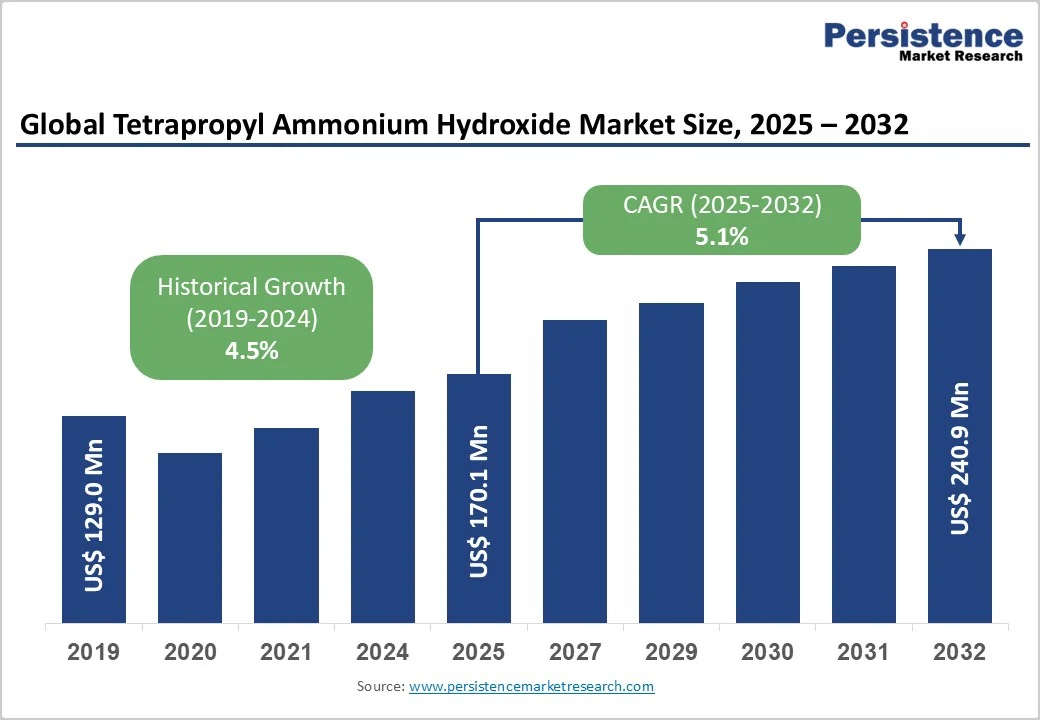
The global tetrapropyl ammonium hydroxide market size is likely to be valued US$170.1 Million in 2025, growing to US$240.9 Million by 2032 at a CAGR of 5.1% during the forecast period from 2025 to 2032, driven by the increasing prevalence of electronic manufacturing, rising demand for phase transfer catalysts, and advancements in chemical synthesis.
The need for high-purity surfactants and intermediates, particularly in semiconductors, has significantly boosted the adoption of tetrapropyl ammonium hydroxide across various industries. The market is further propelled by innovations in aqueous and solvent-based formulations, catering to preferences for efficient and eco-friendly options. The growing acceptance of tetrapropyl ammonium hydroxide as a versatile chemical agent, particularly in R&D, is a key growth factor.
Key Industry Highlights:
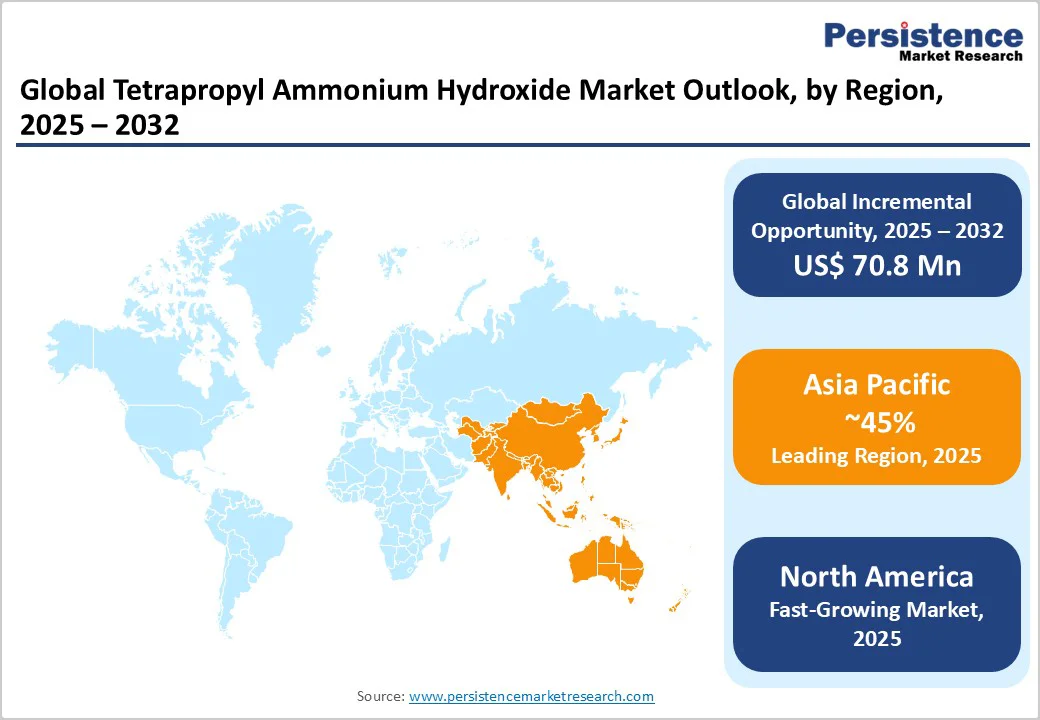
- Leading Region: Asia Pacific, commanding a 45% market share in 2025, driven by booming electronics sector, high prevalence of chemical manufacturing, and strong R&D activities in China.
- Fastest-growing Region: North America, fueled by increasing innovation in catalysts, rising awareness of high-purity chemicals, and growing investments in industrial research in the U.S.
- Dominant Product Type: Aqueous Solution, holding approximately 50% of the market share, due to its versatility in electronic applications.
- Leading Purity: High Purity, accounting for over 40% of market revenue, driven by demand in semiconductors.
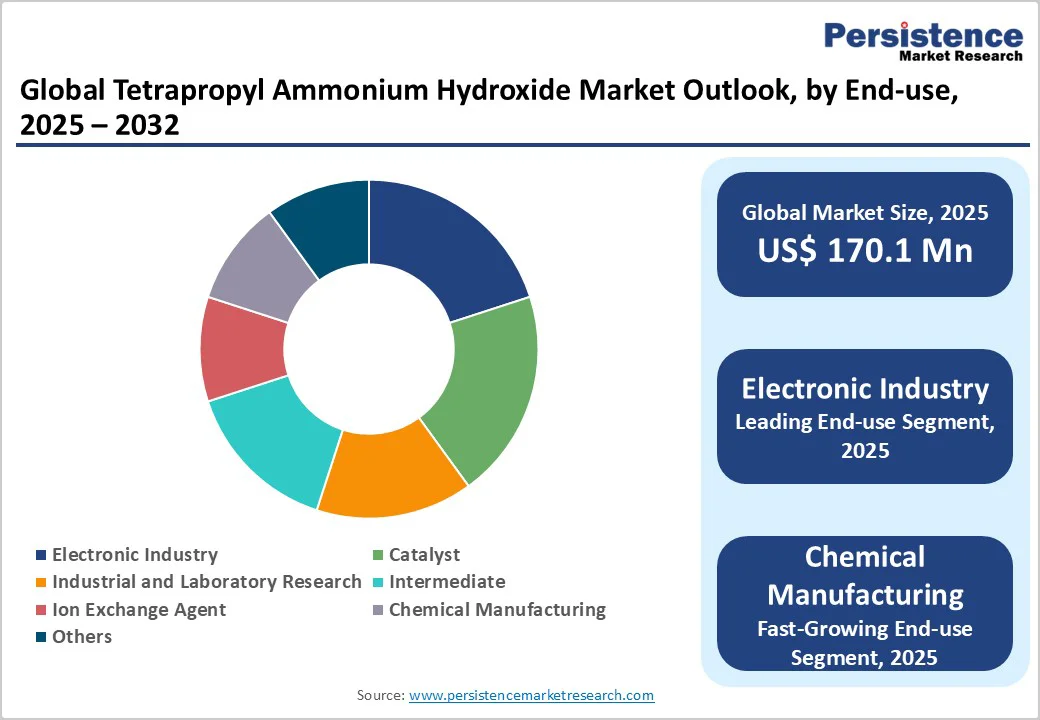
- Leading End-use: Electronic Industry, contributing nearly 35% of market revenue, due to its role in ion exchange and surfactants.
- Key Market Driver: TPAOH is widely used as an etchant and cleaning agent in semiconductor fabrication processes.
- Market Opportunity: Expanding usage in eco-friendly catalysts and zeolite production creates new growth avenues in sustainable chemical manufacturing.
| Key Insights | Details |
|---|---|
|
Tetrapropyl Ammonium Hydroxide Market Size (2025E) |
US$170.1 Mn |
|
Market Value Forecast (2032F) |
US$240.9 Mn |
|
Projected Growth (CAGR 2025 to 2032) |
5.1% |
|
Historical Market Growth (CAGR 2019 to 2024) |
4.5% |
Market Factors - Growth, Barriers, and Opportunity Analysis
Rising Prevalence of Electronic Manufacturing and Demand for High-Purity Chemicals
The increasing prevalence of electronic manufacturing globally is a primary driver of the Tetrapropyl Ammonium Hydroxide Market. Semiconductor production affects a significant portion of global GDP, with higher adoption in Asia. This widespread demand creates a substantial need for effective surfactants. Tetrapropyl ammonium hydroxide offers superior ion exchange, typically more efficient than alternatives, making it ideal for phase transfer catalysis. This is particularly critical for processes requiring purity.
The growing adoption of high-purity grades, such as those from Tokyo Chemical Industry Ltd., has gained traction due to proven efficacy in trials, with over 80% success in synthesis. Additionally, the rise in R&D and availability of tetrapropyl ammonium hydroxide in chemical supply chains have boosted access, further driving market expansion. The surge in demand for versatile agents, coupled with innovations in propylene glycol solutions, continues to propel the market forward, particularly in developed regions with advanced manufacturing.
High Development and Regulatory Costs
The high costs associated with development and regulatory approval of tetrapropyl ammonium hydroxide pose a significant restraint on market growth. Developing these chemicals requires advanced synthesis, rigorous purity testing, and specialized handling to ensure stability. These processes involve substantial financial investment, often exceeding millions of dollars, which can be a barrier for smaller companies.
Additionally, regulatory bodies impose stringent requirements for safety and environmental impact. Compliance with these standards, along with the need for certified facilities, increases overall costs and extends development timelines. For instance, approving methanol solutions can take years, with costs escalating due to multiple phases of toxicity trials. Smaller firms struggle against players such as SACHEM INC. Complexity of high-purity grades adds to production challenges, deterring innovation in cost-sensitive regions.
Advancements in Eco-Friendly Formulations and Expanded Applications
Advancements in eco-friendly formulations are creating notable growth opportunities for the tetrapropyl ammonium hydroxide (TPAOH) market. Manufacturers are increasingly focusing on developing sustainable and less hazardous variants that minimize environmental impact while maintaining performance efficiency. These green formulations are gaining traction across semiconductor, catalyst, and specialty chemical industries. The rising global emphasis on sustainability and green chemistry further supports the adoption of eco-friendly TPAOH, positioning it as a key material in environmentally responsible industrial processes.
Additionally, expanded uses in ion exchange and intermediates offer enhanced versatility by targeting emerging sectors, providing comprehensive solutions. For example, companies Anhui Super Chemical Technology Co., Ltd. and Tatva Chintan Pharma Chem Pvt. Ltd. invest in R&D for low-toxicity grades combining efficiency with safety. These reduce timelines via modular synthesis. Furthermore, smart purification enhances purity. As demand for versatile chemicals grows, these drive expansion in regions such as Asia Pacific and Europe.
Category-wise Analysis
Product Type Insights
Aqueous Solution dominates the market, expected to account for approximately 50% of the share in 2025. Its dominance is driven by solubility, cost-effectiveness, and versatility, making it preferred for electronic uses. Aqueous solutions, such as those from Quzhou Mingfeng Chemical Co., Ltd., provide stable conductivity, ensuring compatibility. Its ease and purity make it preferred for manufacturers.
Propylene Glycol Solution is the fastest-growing segment, driven by solvent stability and increasing adoption in catalysts. Propylene glycol solutions offer non-volatility, appealing for industrial. Focus on eco-formulations accelerates adoption in North America and Europe.
Purity Insights
High Purity leads the market, holding approximately 40% of the share in 2025. Its dominance is driven by rising demand from the semiconductor industry, where purity is critical for etching and cleaning processes. Its extensive use in ion exchange applications and research activities further strengthens its market position.
Medium Purity is the fastest-growing segment, propelled by its cost-effectiveness and increasing adoption in large-scale manufacturing. It offers an optimal balance between quality and affordability, making it suitable for diverse industrial applications. Its scalability and versatility in production processes further enhance its demand across emerging markets.
End-use Insights
Electronic Industry dominates the market, contributing nearly 35% of revenue in 2025. Its extensive use in semiconductor manufacturing, where high-purity chemicals are essential for precision etching and cleaning, fuels this leadership. Growing demand for advanced electronic components further reinforces its dominance in the global market.
Chemical Manufacturing is the fastest-growing segment, driven by its extensive use as a catalyst and chemical intermediate. The compound’s versatility supports various synthesis and formulation processes. Rapid industrial expansion and the rising need for efficient catalytic reactions further accelerate its adoption across chemical production sectors.
Regional Insights
Asia Pacific Tetrapropyl Ammonium Hydroxide Market Trends
Asia Pacific is the dominating market holding a market share of 45% for tetrapropyl ammonium hydroxide, fueled by rapid industrialization, expanding electronics manufacturing, and increasing chemical production in China and India. The region’s dominance in semiconductor fabrication and catalyst development drives strong demand for high-purity TPAOH formulations. China leads market growth with major companies such as Beijing Xinsaiwei Chemical Technology Co., Ltd. investing in large-scale, cost-effective production to meet the rising needs of electronics and chemical sectors.
In India, growing infrastructure development, coupled with a strong manufacturing base and supportive government initiatives, enhances demand for affordable and efficient chemical intermediates such as TPAOH. The growing presence of Original Equipment Manufacturers (OEMs) in electronics, automotive, and specialty chemical industries supports large-scale adoption. Continuous investments in R&D and the increasing focus on purity improvement and process innovation further strengthen the region’s competitive edge.
North America Tetrapropyl Ammonium Hydroxide Market Trends
North America is the fastest-growing market for the global tetrapropyl ammonium hydroxide market in 2025, driven by high-tech manufacturing and R&D in the U.S. The U.S. market features robust innovation, with companies such as SACHEM INC. leading high-purity developments. High electronic demand, coupled with regulatory support, fuels need for catalysts. Rise in aqueous solutions and supply chains further drive growth.
Intermediate uses, supported by investments, positions the U.S. as innovation leader. the growing preference for aqueous TPAOH formulations enhances operational efficiency while aligning with stringent environmental regulations in the U.S. and Canada. The region’s well-established supply chains, coupled with government support for sustainable manufacturing and innovation, further strengthen market expansion. Rising adoption of TPAOH in R&D laboratories and industrial-scale synthesis processes underscores its versatility and reliability.
Europe Tetrapropyl Ammonium Hydroxide Market Trends
Europe is driven by its well-established chemical industry, stringent regulatory framework, and collaborative innovation ecosystem. Key countries such as Germany, France, and Italy lead the region’s growth through significant investments in purity innovation, advanced formulations, and catalytic applications. The European Union’s REACH regulations promote the use of safer and more sustainable chemical products, encouraging manufacturers to develop eco-friendly and high-performance TPAOH variants.
Companies such as RSA Corporation are focusing on propylene glycol-based TPAOH solutions to meet evolving industrial requirements and environmental standards. The region’s strong emphasis on research and development, particularly in Western Europe, supports innovations in ion exchange materials, catalysts, and specialty chemicals. Growing awareness of green chemistry and cleaner production processes further enhances TPAOH adoption across the chemical and electronics sectors.
Competitive Landscape
The global tetrapropyl ammonium hydroxide market is highly competitive, mix of chemical leaders and specialists. Companies are actively focusing on product innovation, purity enhancement, and regional expansion to strengthen their market presence. In developed regions such as North America and Europe, key players such as SACHEM INC. and RSA Corporation maintain dominance through strong R&D capabilities, extensive distribution networks, and high-purity product lines catering to electronics and catalyst applications.
In the fast-growing Asia Pacific region, companies such as Tokyo Chemical Industry Ltd. leverage localized production and cost-efficient solutions to capture expanding demand from semiconductor and specialty chemical industries. Strategic initiatives, including partnerships, acquisitions, and technology collaborations, are intensifying market competition. Growing emphasis on sustainable manufacturing processes and eco-friendly chemical formulations is shaping the competitive dynamics, as companies strive to meet global regulatory standards and sustainability goals.
Key Industry Developments
- In March 2025, NAGASE & Co., Ltd. approved acquiring SACHEM’s Asian business (including five subsidiaries such as SACHEM Wuxi) to strengthen high-purity chemical offerings for semiconductor applications.
- In January 2024, Tatva Chintan Pharma Chem Pvt. Ltd. partnered with Asian firm for propylene glycol formulations.
Companies Covered in Tetrapropyl Ammonium Hydroxide Market
- Tokyo Chemical Industry Ltd.
- Anhui Super Chemical Technology Co., Ltd.
- SACHEM INC.
- Quzhou Mingfeng Chemical Co., Ltd.
- RSA Corporation, Tatva Chintan Pharma Chem Pvt. Ltd.
- Beijing Xinsaiwei Chemical Technology Co., Ltd.
- Acme Sujan Chemicals Pvt. Ltd.
- Shanghai Lingde Chemical Co., Ltd.
- Chem-Mundo
- George Uhe Co. Inc.
- Hawks Chemical Ltd.
- Sisco Research Laboratories Pvt. Ltd.
- Others
Frequently Asked Questions
The global tetrapropyl ammonium hydroxide market is projected to reach US$170.1 Million in 2025.
The rising prevalence of electronic manufacturing and demand for high-purity chemicals are key drivers.
The market is poised to witness a CAGR of 5.1% from 2025 to 2032.
Advancements in eco-friendly formulations and expanded applications are key opportunities.
Tokyo Chemical Industry Ltd., SACHEM INC., Tatva Chintan Pharma Chem Pvt. Ltd., and RSA Corporation are key players.


