




- Plastics, Polymers & Resins
- Styrene Butadiene Binders Market
Styrene Butadiene Binders Market Size, Share and Growth Forecast, 2026-2033
Styrene Butadiene Binders Market by Application (Lithium-Ion Batteries, Adhesives & Sealants, Others), Product Type (SBR Latex, Functionalized SB Binders, Others), End-use Industry (Battery Manufacturing, Others), and Regional Analysis for 2026-2033

Styrene Butadiene Binders Market Size and Trends Analysis
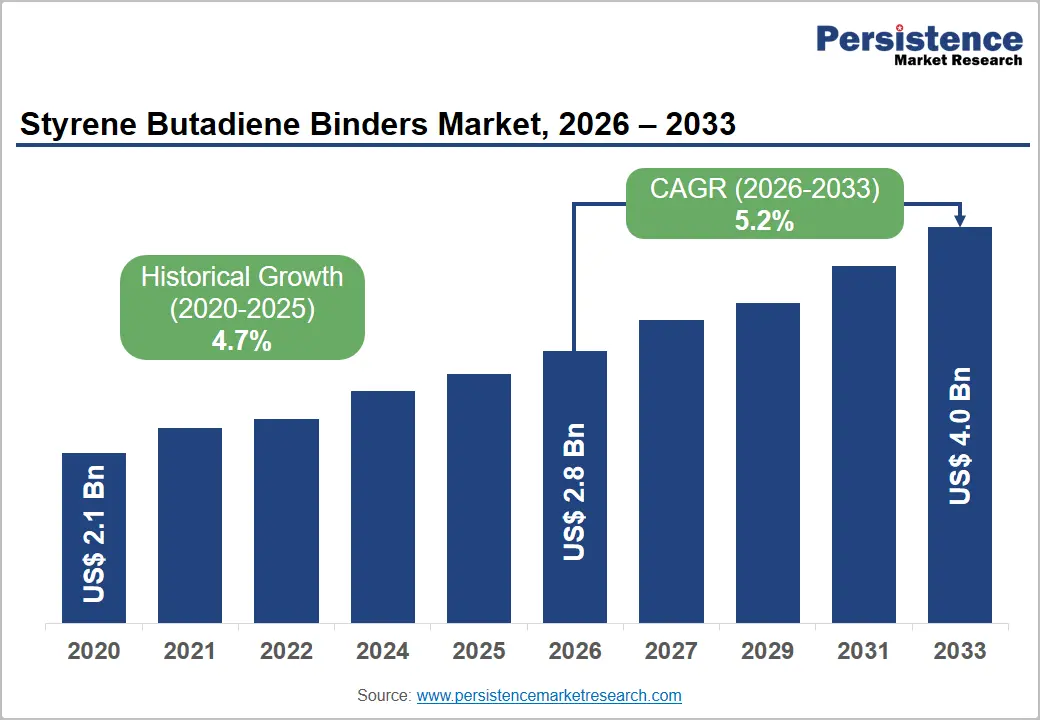
The global styrene butadiene binders market size is likely to be valued at US$2.8 billion in 2026 and is projected to reach US$4.0 billion by 2033, growing at a CAGR of 5.2% during the forecast period from 2026 to 2033, driven by expanding adoption of lithium-ion batteries, rising demand for high-performance coating materials, and increasing use of water-based binder technologies across paper, packaging, construction, and textile applications.
Growth is further supported by investments in electric vehicle manufacturing, battery gigafactories, and sustainable industrial materials. The transition toward low-VOC and environmentally compliant formulations is accelerating demand for advanced styrene butadiene latex binders, particularly in Asia Pacific and Europe.
Key Industry Highlights:
- Dominant Application: Lithium-ion batteries are expected to lead with an estimated 38% share in 2026, while adhesives & sealants are projected to be the fastest-growing application segment at approximately 6.8% CAGR during 2026–2033, supported by rising infrastructure and industrial activity.
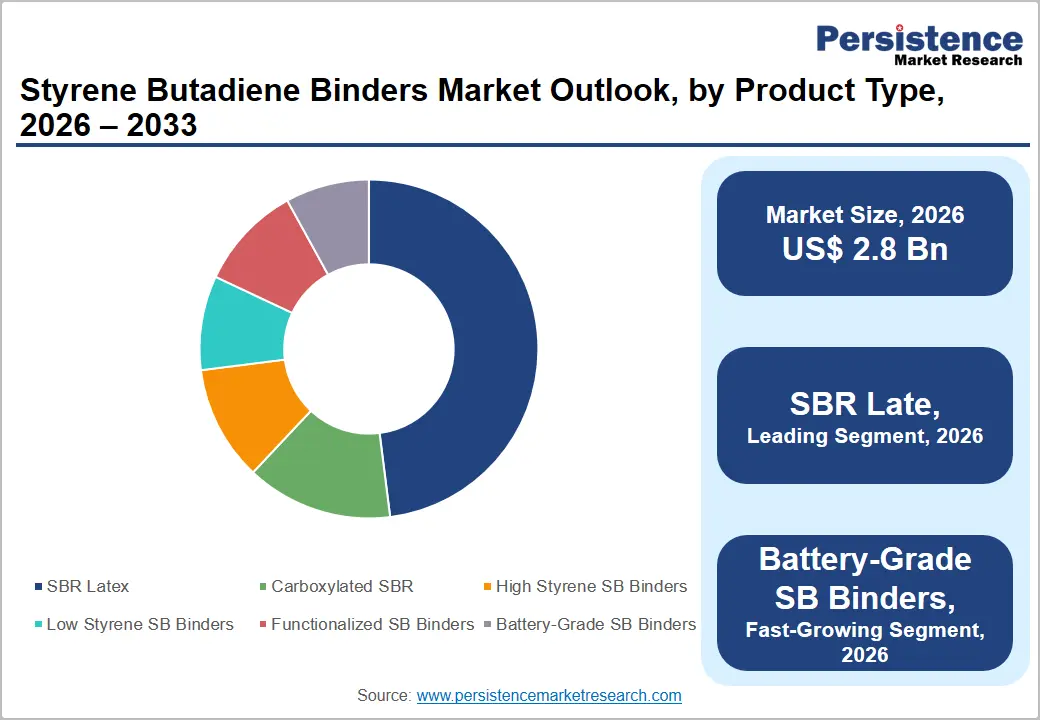
- Leading Product Type: SBR Latex is anticipated to account for nearly 48% of market revenue in 2026, while battery-grade SB binders are likely to record the fastest growth at around 8.7% CAGR through 2033, driven by expanding lithium-ion battery production.
- Dominant End-use Industries: Battery manufacturing is projected to lead with an estimated 33% share in 2026, while electronics is expected to emerge as the fastest-growing end-use segment at approximately 7.3% CAGR between 2026 and 2033.
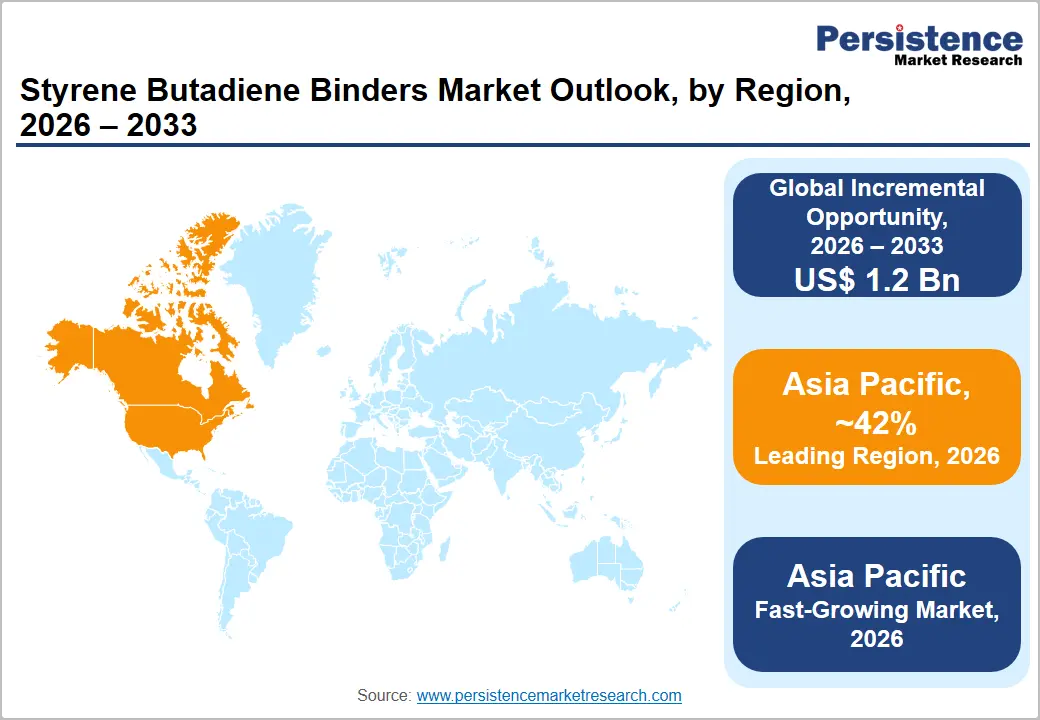
- Regional Leadership: Asia Pacific is estimated to dominate with approximately 42% of global revenue in 2026 and is expected to maintain the strongest growth momentum through 2033, supported by battery manufacturing expansion and EV adoption.
Driver - Rapid Expansion of Lithium-Ion Battery Manufacturing
The strongest growth catalyst for the styrene butadiene binders market is the accelerating global production of lithium-ion batteries. According to the International Energy Agency (IEA), global EV sales surpassed 17 million units in 2024, while announced battery manufacturing capacity continues to expand across China, Europe, and North America. Styrene butadiene binders are essential anode binder materials used in lithium-ion batteries due to their strong adhesion, mechanical flexibility, and cycle-life performance.
Battery manufacturers increasingly prefer battery-grade styrene butadiene binders because they improve electrode stability while enabling higher energy density. Government-backed battery localization initiatives in the U.S., China, India, and the European Union are driving new gigafactory investments. As battery production scales to support electric mobility and energy storage systems, demand for specialized binder formulations is expected to rise substantially, creating a sustained growth engine for the market throughout the forecast period.
Restraint – Volatility in Styrene and Butadiene Feedstock Prices
One of the key challenges facing the styrene butadiene binders market is the volatility of styrene monomer and butadiene prices, both of which are closely tied to crude oil and naphtha markets. According to the International Energy Agency (IEA), global oil markets have experienced significant price fluctuations in recent years due to geopolitical tensions, supply disruptions, and changing demand patterns. Since raw materials account for a major share of binder production costs, these fluctuations directly affect manufacturing profitability and pricing stability.
Supply constraints caused by refinery shutdowns, maintenance activities, and transportation bottlenecks have further increased feedstock price uncertainty. Industry sources indicate that butadiene prices can fluctuate by more than 20% annually during periods of market imbalance. These cost increases impact downstream sectors such as battery manufacturing, paper coating, and construction materials. As a result, manufacturers often face margin pressure, contract renegotiations, and delayed purchasing decisions, which can restrain overall market growth despite strong demand fundamentals.
Opportunity – Development of High-Performance Battery-Grade Binder Technologies
The rapid evolution of next-generation battery technologies is creating significant opportunities for the styrene butadiene binders market. Silicon-based anodes, high-energy-density lithium-ion batteries, and emerging solid-state batteries require advanced binder materials with superior adhesion and cycle stability. According to the International Energy Agency (IEA), global battery manufacturing capacity continues to expand rapidly to support growing electric vehicle and energy storage demand, driving the need for high-performance battery-grade styrene butadiene binders.
In 2025, Trinseo launched its fourth-generation VOLTABOND™ binder platform for lithium-ion batteries, while BASF expanded strategic partnerships with CATL and Gotion to advance battery material innovation. Supported by policies such as the U.S. Inflation Reduction Act and the European Battery Regulation, these investments are accelerating demand for specialized binder technologies, creating strong growth prospects for manufacturers focused on advanced battery applications.
Category-wise Analysis
Application Insights
Lithium-ion batteries are estimated to represent the largest application segment, accounting for approximately 38% of global market revenue in 2026. The segment's dominance is likely driven by the rapid expansion of electric vehicle production and stationary energy storage systems, both of which rely on styrene butadiene binders to enhance anode performance and cycle stability. Major battery capacity additions by companies such as CATL, BYD, and LG Energy Solution, alongside government-backed battery manufacturing programs in North America, Europe, and Asia, are expected to continue supporting demand for advanced binder materials.
The adhesives & sealants segment is projected to register the fastest growth through 2033, with an estimated CAGR of approximately 6.8%. Growth is expected to be supported by rising infrastructure investments and increasing demand for durable bonding solutions across construction and industrial manufacturing. Styrene butadiene binders are gaining wider adoption due to their flexibility, moisture resistance, and compatibility with environmentally compliant formulations, while ongoing construction activity in emerging economies is likely to further accelerate segment expansion.
Product Type Insights
SBR latex is estimated to remain the leading product type, capturing approximately 48% of market revenue due to its extensive use in paper coating, carpet backing, textiles, and construction applications. Its combination of cost efficiency, durability, and processing versatility has established it as the preferred binder solution across high-volume industrial sectors. Continued growth in packaging production and coated paper demand is expected to help sustain its strong market position throughout the forecast period.
Battery-grade SB binders are projected to witness the highest growth rate during the forecast period, with an estimated CAGR of approximately 8.7%, as battery manufacturers increasingly require specialized materials capable of improving electrode integrity and battery lifespan. The segment has gained momentum from innovations such as Trinseo's VOLTABOND™ platform and growing collaboration between chemical suppliers and battery producers. Rising investments in next-generation battery technologies are expected to create significant opportunities for premium binder formulations.
End-use Industry Insights
Battery manufacturing is estimated to account for the largest share of end-use demand, representing approximately 33% of the market in 2026. The segment's leadership is expected to be supported by accelerating electric vehicle adoption, large-scale energy storage deployments, and expanding regional battery supply chains. New gigafactory projects across China, the United States, Germany, and India are likely to continue driving substantial consumption of high-performance styrene butadiene binders.
The electronics segment is forecast to expand at the fastest rate through 2033, with an estimated CAGR of approximately 7.3%, fueled by increasing demand for smartphones, wearable devices, portable energy systems, and advanced electronic components. As manufacturers focus on higher energy density, longer battery life, and device miniaturization, the need for advanced binder technologies is expected to increase. Continued innovation in consumer electronics and semiconductor-related applications is likely to support sustained market growth.
Regional Insights
North America Styrene Butadiene Binders Market Trends
North America is estimated to capture approximately 24% of the global styrene butadiene binders market revenue in 2026. The region's growth trajectory is increasingly tied to the rapid expansion of battery manufacturing and the transition toward sustainable industrial materials. Demand for styrene butadiene binders is evolving beyond traditional applications such as paper coating and carpet backing, with battery-grade formulations gaining prominence as EV supply chains become more localized. Regulatory pressure to reduce VOC emissions is also accelerating the adoption of water-based binder technologies across coatings, adhesives, and construction materials.
U.S. Styrene Butadiene Binders Market Trends
The U.S. is estimated to account for nearly 82% of the regional market share, making it the region's primary demand center. The country's battery ecosystem has expanded significantly following the Inflation Reduction Act, with more than US$100 billion in announced EV and battery-related investments. Capacity additions by Tesla, Panasonic, LG Energy Solution, Samsung SDI, and SK On are expected to increase the consumption of advanced binder materials used in lithium-ion battery electrodes. Beyond batteries, the growing preference for sustainable coatings and industrial adhesives continues to create opportunities for specialty latex manufacturers.
Canada Styrene Butadiene Binders Market Trends
Canada, meanwhile, is anticipated to contribute 18% of regional demand and is steadily strengthening its position within the North American battery value chain. Investments in battery manufacturing and battery materials processing, including projects linked to Volkswagen, Stellantis-LG, and Umicore, are creating a favorable environment for advanced binder applications. The country's emphasis on critical mineral development and domestic battery supply-chain integration is expected to support long-term demand growth, particularly in high-performance battery-grade binder segments.
Europe Styrene Butadiene Binders Market Trends
Europe is estimated to represent approximately 27% of global market revenue, reflecting the region's strong emphasis on sustainability, advanced manufacturing, and battery supply-chain localization. Demand for styrene butadiene binders is increasingly influenced by environmental regulations that encourage low-emission and water-based materials. At the same time, large-scale investments in battery production are creating a new avenue of growth for specialized binder formulations, particularly those used in high-performance lithium-ion batteries.
Germany Styrene Butadiene Binders Market Trends
Germany is expected to remain the cornerstone of the European market, accounting for an estimated 30% of regional revenue. Its leadership stems from a powerful combination of automotive manufacturing, specialty chemicals expertise, and expanding battery production capacity. Facilities operated by companies such as CATL and PowerCo are strengthening domestic battery output, while the country's push toward electrification is increasing demand for advanced electrode materials. These developments are expected to reinforce Germany's position as Europe's largest consumer of battery-grade styrene butadiene binders.
France Styrene Butadiene Binders Market Trends
France is estimated to contribute close to 15% of the regional market and is emerging as a key beneficiary of Europe's battery independence strategy. The country's growing battery manufacturing footprint, highlighted by projects from ACC and Verkor, is creating fresh opportunities for binder suppliers serving electrode production. Alongside batteries, increasing adoption of sustainable packaging materials and environmentally compliant industrial products is supporting broader demand for water-based styrene butadiene binder technologies.
Asia Pacific Styrene Butadiene Binders Market Trends
With an estimated 42% share of global revenue, Asia Pacific is likely to continue its dominance in the styrene butadiene binders market and is expected to remain the industry's growth engine throughout the forecast period. The region benefits from an unmatched concentration of lithium-ion battery production, consumer electronics manufacturing, and synthetic latex capacity. Strong industrialization, extensive supply-chain integration, and favorable manufacturing economics have enabled widespread adoption of styrene butadiene binders across batteries, packaging, textiles, construction materials, and adhesives. The region's competitive advantage is further strengthened by continuous investments in energy storage and electric mobility.
China Styrene Butadiene Binders Market Trends
China alone is estimated to generate nearly 58% of Asia Pacific market demand, underscoring its central role in the global binder industry. As the world's largest producer of lithium-ion batteries and electric vehicles, the country has become a major consumer of battery-grade styrene butadiene binders. Capacity expansions by CATL, BYD, Gotion High-Tech, and EVE Energy continue to increase demand for advanced electrode materials. Beyond batteries, China's vast paper coating, construction, and adhesives industries provide a diversified consumption base that supports overall market stability.
India Styrene Butadiene Binders Market Trends
India currently accounts for an estimated 12% of the regional revenue, but its growth rate is expected to outpace many mature markets over the coming decade. Government-backed initiatives such as the Advanced Chemistry Cell Production Linked Incentive scheme have triggered substantial investments in domestic battery manufacturing. Projects announced by Reliance New Energy, Ola Electric, and Exide Energy are expected to create new demand streams for battery materials, including styrene butadiene binders. Simultaneously, rapid growth in packaging, infrastructure development, and electronics manufacturing is expanding the market's application footprint across the country.
Competitive Landscape
The global styrene butadiene binders market is moderately consolidated, with major manufacturers such as BASF, Trinseo, Synthomer, Dow, and Zeon Corporation collectively accounting for a significant share of global revenue. These companies benefit from established customer relationships across battery manufacturing, paper coating, construction, and adhesives industries, supported by extensive production networks and diversified product portfolios. Continuous investments in R&D are helping them strengthen their positions in advanced and battery-grade binder technologies.
Regional and niche producers, particularly in China, Japan, and South Korea, are expanding their presence through specialized formulations and competitive manufacturing capabilities. Technical qualification requirements and performance standards create moderate barriers to entry, especially in battery applications. The market is expected to witness gradual consolidation as leading companies pursue strategic partnerships, capacity expansions, and technology collaborations to capitalize on growing demand from electric vehicles and energy storage markets.
Key Industry Developments:
- In April 2026, CATL and HyperStrong signed a 60 GWh sodium-ion battery supply agreement, accelerating the commercialization of next-generation battery technologies and supporting future demand for advanced battery materials.
- In July 2025, BASF Battery Materials and CATL signed a global framework agreement for advanced battery materials supply, reinforcing battery supply chains and strengthening demand for specialty binder materials used in lithium-ion batteries.
Companies Covered in Styrene Butadiene Binders Market
- Trinseo
- BASF
- Synthomer
- Dow
- Arkema
- Zeon Corporation
- JSR Corporation
- LG Chem
- Asahi Kasei
- Shandong Yuyuan Group
- Wacker Chemie
- OMNOVA Solutions
- Kumho Petrochemical
- Nippon A&L
Frequently Asked Questions
The global styrene butadiene binders market is projected to reach US$ 2.8 billion in 2026.
Growing lithium-ion battery production, increasing demand for water-based binders, and expanding construction and packaging industries drive market growth.
The styrene butadiene binders market is expected to grow at a CAGR of 5.2% from 2026 to 2033.
Manufacturers can capitalize on the rising demand for battery-grade binders and next-generation energy storage technologies.
BASF, Trinseo, Synthomer, Dow, Zeon Corporation, and JSR Corporation are among the leading market participants.


