




- Non-food Packaging
- Squeeze Bottle Market
Squeeze Bottle Market Size, Share, and Growth Forecast, 2026 - 2033
Squeeze Bottle Market by Material (Polyethylene, Polypropylene, Others), Application (Personal Care & Beauty, Food & Beverages, Others), Capacity, and Regional Analysis for 2026 - 2033

Squeeze Bottle Market Size and Trends Analysis
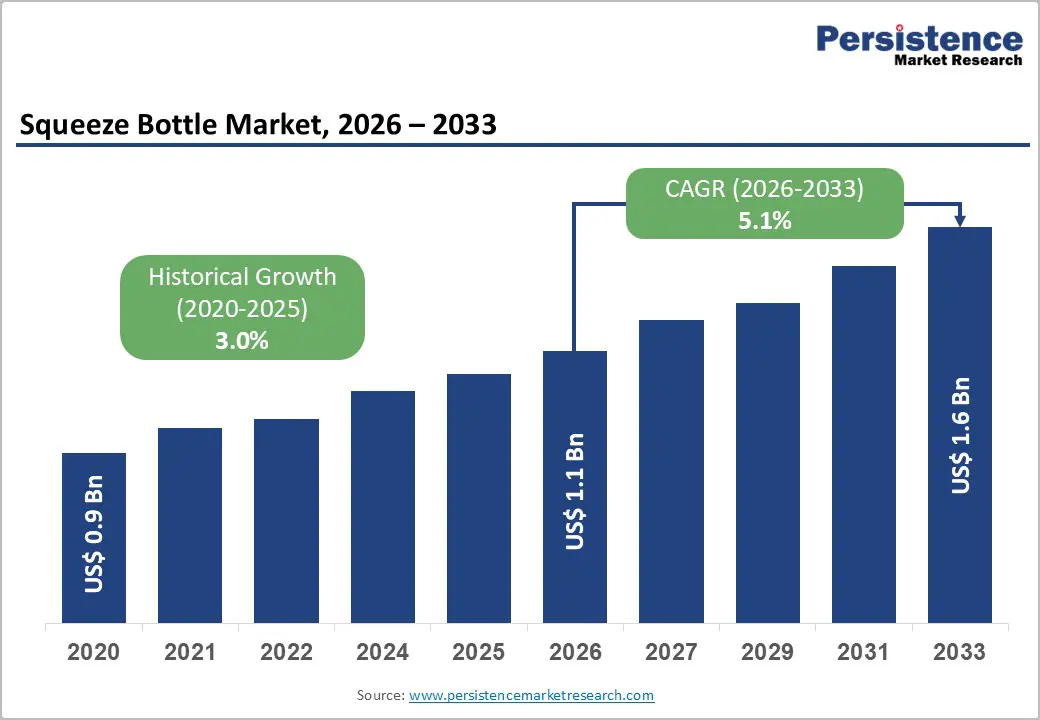
The global squeeze bottle market size is likely to be valued at US$1.1 billion in 2026 and is expected to reach US$1.6 billion by 2033, growing at a CAGR of 5.1% between 2026 and 2033, driven by rising demand for convenient, portable, and single-serve liquid packaging formats across personal care and food categories.
Structural shifts toward lightweight, recyclable polymer packaging, led by polyethylene and polypropylene, are reinforcing adoption. Regulatory pressure and brand sustainability commitments are accelerating the transition to recyclable and mono-material solutions, while product innovation in closures and dispensing systems continues to enhance functional performance. The expansion of on-the-go consumption patterns and steady demand growth in emerging markets further support long-term market growth.
Key Industry Highlights
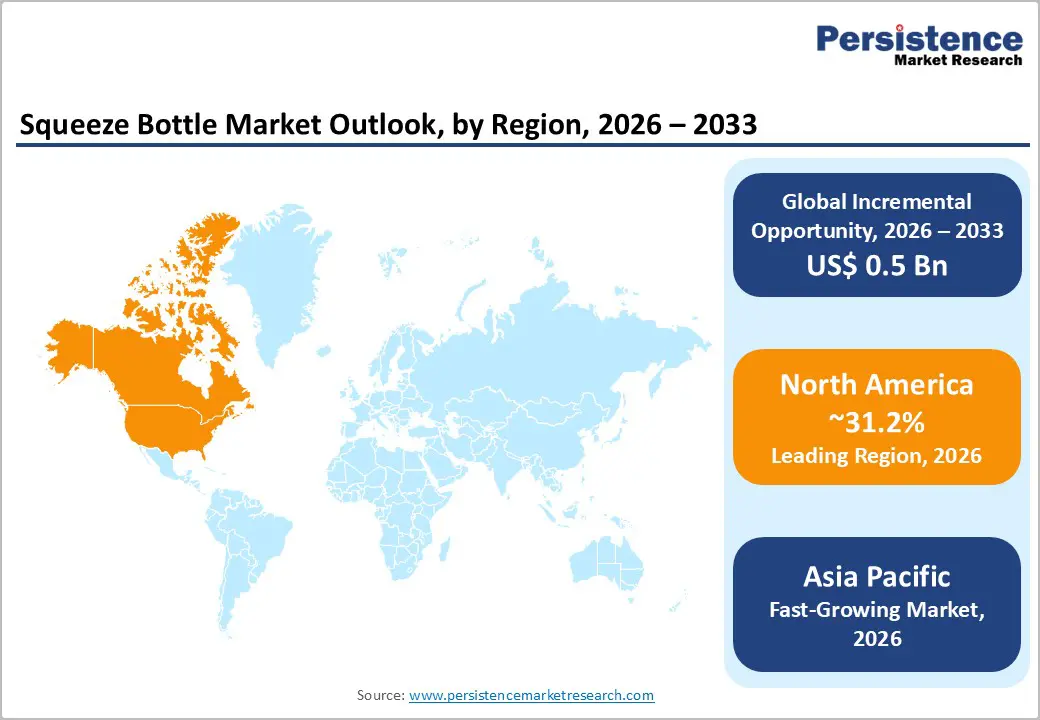
- Leading Region: North America is projected to account for approximately 31.2% of market share, supported by high consumption of personal care and packaged food products, strong brand presence, and early adoption of recyclable and mono-material packaging formats.
- Fastest-growing Region: Asia Pacific is the fastest-growing market, driven by rising urbanization, expanding modern retail, and increasing demand for convenient food and personal care packaging across China, India, and Southeast Asia, with growth outpacing mature regions throughout the forecast period.
- Investment Plans: Industry investments are concentrated on integrating recycled polymers, developing mono-material bottle and closure systems, and automating production, with leading converters expanding r-HDPE and r-PP processing capacity and upgrading high-speed blow-molding lines to meet sustainability and efficiency requirements.
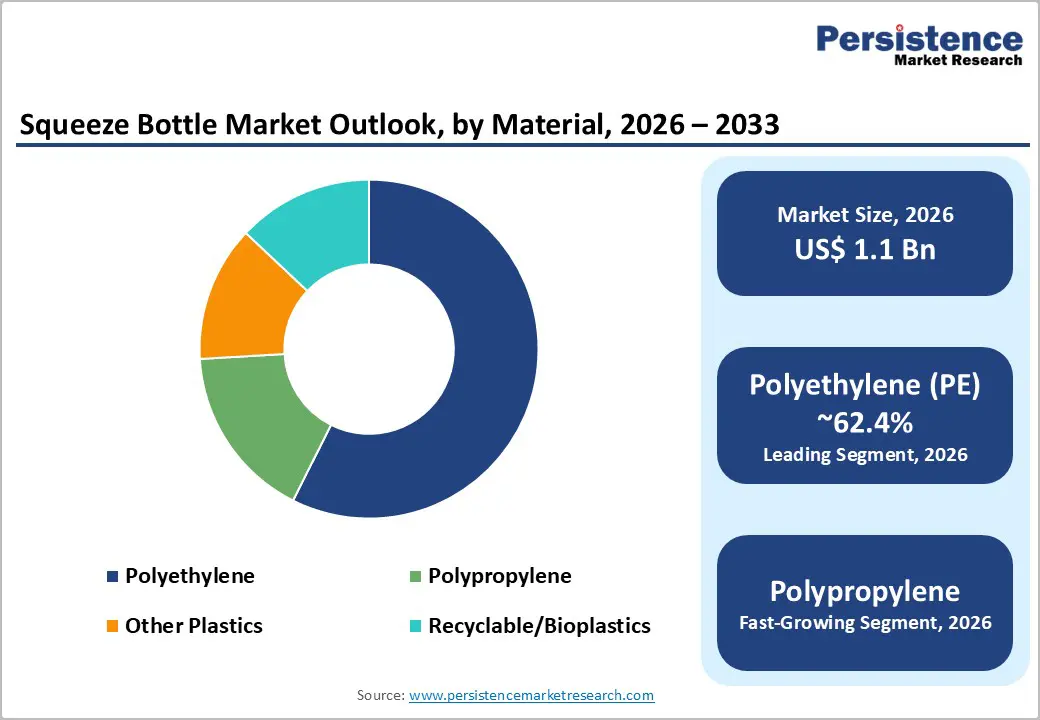
- Dominant Material: Polyethylene (PE) remains the dominant material, accounting for approximately 62.4% of the market due to its flexibility, cost efficiency, compatibility with high-volume manufacturing, and established recycling streams in food and personal care applications.
- Leading Application: Personal care and beauty applications represent approximately 44.3% of market share, driven by strong demand for controlled dispensing, ergonomic designs, premium finishes, and brand-led packaging differentiation.
| Key Insights | Details |
|---|---|
| Squeeze Bottle Market Size (2026E) | US$1.1 Bn |
| Market Value Forecast (2033F) | US$1.6 Bn |
| Projected Growth (CAGR 2026 to 2033) | 5.1% |
| Historical Market Growth (CAGR 2020 to 2025) | 3.0% |
Market Factors - Growth, Barriers, and Opportunity Analysis
Growth Analysis - Convenience and Single-Serve Consumption
Consumers increasingly prioritize convenience, portability, and ease of use, driving demand for squeeze bottles across food, personal care, and household applications. Single-serve and travel-friendly formats have gained traction as urban lifestyles and on-the-go consumption patterns expand. Growth in online grocery and direct-to-consumer channels has further increased demand for flexible, damage-resistant containers that reduce leakage and transit losses. Polyethylene remains the preferred material due to its flexibility, cost-efficiency, and compatibility with high-speed molding processes. Market impact: brand owners are expanding squeeze bottle usage for condiments, sauces, gels, lotions, and travel kits, supporting stable volume growth and higher average selling prices for specialized dispensing closures and functional enhancements.
Sustainability and Circularity Mandates
Regulatory initiatives and voluntary corporate sustainability targets are reshaping packaging design requirements. Governments and regulatory authorities are implementing stricter recyclability and waste reduction rules, compelling brands to shift toward recyclable and mono-material packaging formats. In response, manufacturers are investing in recyclable polymer grades, integrating recycled content, and implementing design-for-recyclability strategies. Market impact: innovation in materials and closures is accelerating, although the transition requires higher capital investment and technical validation. The market is evolving into two parallel tracks: cost-efficient conventional squeeze bottles for high-volume applications and premium sustainable formats with faster value growth driven by compliance and brand differentiation.
Personal Care Expansion and Premiumization
Personal care and beauty products offer a strong, structurally sound demand base for squeeze bottles, where controlled dispensing, tactile quality, and visual appeal are critical. Expanding skincare routines, increased grooming awareness, and premium product positioning are driving demand for soft-touch squeeze bottles in lotions, cleansers, and specialty treatments. Urban consumers, in particular, favor ergonomic, single-hand dispensing formats. Market impact: converters are developing advanced solutions, such as barrier layers, soft-touch finishes, and precision closures, which support higher margins than commodity food packaging. This segment continues to drive research, development, and collaborative innovation across the value chain.
Barrier Analysis - Raw Material Volatility and Margin Pressure
Volatility in petrochemical feedstock prices creates margin pressure for squeeze bottle manufacturers, particularly small and mid-sized converters. Sudden increases in crude oil or polymer prices limit the ability to pass costs through to price-sensitive customers. Risk quantification: historical swings in feedstock prices have altered packaging margins by several percentage points within a single fiscal year, increasing procurement risk. This environment encourages long-term supply contracts and accelerates consolidation as scale becomes essential for cost absorption.
Regulatory Complexity and Compliance Costs
Evolving packaging regulations, including recyclability standards and extended producer responsibility requirements, increase compliance costs and shorten redesign cycles. Manufacturers must invest in testing, certification, and tooling upgrades to maintain market access. Risk quantification: compliance-related redesigns can add approximately 2-5% to unit costs for legacy products and require capital expenditure for material qualification and process upgrades. Smaller players face disproportionate financial and operational strain.
Opportunity Analysis - Mono-Material Recyclable Solutions
Demand for mono-material squeeze bottles and compatible closure systems presents a significant growth opportunity. Brands seeking to improve recyclability are actively replacing multi-material designs. Market sizing estimate: Redesigning even 20% of non-recyclable squeeze bottle volumes into mono-material formats over the next five years represents a sizable incremental revenue opportunity. Actionable potential: converters with capabilities in recyclable material processing, recycled content integration, and closure compatibility can secure long-term supply agreements with major consumer brands.
Emerging Market Adoption and Localization
Emerging economies in the Asia-Pacific and parts of Latin America are seeing rising adoption of convenient packaging as modern retail and e-commerce penetration increase. Market sizing estimate: targeted premiumization in personal care and condiment packaging could drive double-digit unit growth in selected regional segments. Actionable potential: localized manufacturing, cost-efficient production, and alignment with regional recycling infrastructure position converters to capture national and regional brand growth.
Category-wise Analysis
Material Insights
Polyethylene is projected to account for approximately 62.4% of the market in 2026, driven by its extensive use in HDPE and LDPE formats across food, personal care, and household product applications. Its inherent flexibility, low production cost, and well-established recycling streams make it the preferred material for high-volume packaging. PE exhibits a wide range of chemical compatibility and temperature tolerance while remaining fully compatible with extrusion and injection blow molding, enabling scalable and cost-efficient manufacturing. Common applications include ketchup and sauce bottles that require consistent squeeze recovery, shampoo and lotion containers designed for daily use, and household cleaners in which durability and leak resistance are essential. This balance of performance, affordability, and processing efficiency continues to reinforce polyethylene’s leadership position.
Polypropylene is expected to be the fastest-growing material segment, supported by rising sustainability commitments and evolving regulatory expectations. Polypropylene is gaining traction due to its superior chemical resistance, higher heat tolerance, and suitability for applications requiring enhanced rigidity, such as flip-top cosmetic containers and pharmaceutical-grade packaging. Examples include personal care brands replacing multi-layer laminates with single-polymer squeeze bottles and food manufacturers adopting recyclable barrier coatings to maintain product integrity. These material categories are expected to exhibit higher growth rates than conventional PE, as environmental compliance and consumer preferences increasingly shape packaging decisions.
Application Insights
Personal care and beauty applications are projected to account for approximately 44.3% of the market, reflecting sustained demand for packaging that combines functionality, aesthetics, and user convenience. Products such as facial cleansers, moisturizers, shampoos, conditioners, and grooming formulations rely heavily on controlled dispensing, ergonomic grip, and consistent product flow. Brand investments in soft-touch finishes, airless dispensing systems, precision closures, and decorative surface treatments have significantly increased per-unit packaging value. Premium skincare and salon-grade haircare brands, in particular, use customized squeeze bottles to reinforce brand identity and enhance consumer experience. As a result, converters offering advanced design capabilities, material innovation, and customization continue to secure stronger pricing power and long-term supply relationships in this segment.
The food and beverages segment, particularly condiments and sauces, is emerging as the fastest-growing application area for squeeze bottles. Growth is driven by rising consumption of ready-to-use meals, home-cooking trends, and demand for convenient, mess-free dispensing formats. Squeeze bottles enable precise portion control and reduce product wastage, making them ideal for ketchup, mayonnaise, salad dressings, chocolate syrups, and regional sauces. Advances in barrier technologies, such as oxygen-resistant layers and improved closure sealing, support shelf stability for sensitive formulations. The expansion of online grocery platforms and the rapid growth of private-label food brands are further accelerating adoption, positioning this segment for above-average growth over the forecast period.
Regional Insights
North America Squeeze Bottle Market Trends - Premiumized Demand and Sustainability-Led Packaging Innovation
North America remains the leading regional market, accounting for approximately 31.2% of global squeeze bottle demand, supported by high per-capita consumption of personal care, home care, and packaged food products. The U.S. dominates regional demand due to its mature retail ecosystem, strong multinational brand presence, and early adoption of advanced packaging technologies. Major consumer goods companies such as Procter & Gamble, Unilever, and Colgate-Palmolive continue to rely heavily on squeeze-bottle formats for shampoos, lotions, oral care products, and condiments, thereby reinforcing stable baseline demand. While population growth remains modest, value growth is sustained through premiumization, functional closures, and design-led differentiation.
Sustainability-driven investment is a defining regional theme. Packaging manufacturers and resin suppliers are expanding capacity for recycled polymers and upgrading processing capabilities to meet brand commitments for post-consumer recycled content. For example, several North American packaging converters have increased the use of recycled HDPE and PP in squeeze bottle production following commitments by food and personal care brands to reduce virgin plastic usage. Automation and digital quality control systems are also being adopted to offset rising labor costs and ensure consistency in high-volume production. These investments improve operational efficiency while enabling compliance with evolving sustainability standards. The regulatory environment plays a significant role in shaping material selection and design strategies.
Oversight by agencies such as the U.S. Food and Drug Administration governs food-contact and pharmaceutical packaging safety, reinforcing demand for compliant, high-quality squeeze bottles. At the state level, extended producer responsibility programs and recycling mandates, such as those in California, are accelerating the shift toward monomaterial designs and improved recyclability. As a result, North America continues to lead in packaging innovation, with sustainability upgrades increasingly integrated into mainstream product lines rather than limited to niche offerings.
Europe Squeeze Bottle Market Trends - Regulation-Driven Redesign and Recyclability Compliance
Europe represents a mature but regulation-intensive squeeze bottle market, characterized by strong policy-driven momentum toward recyclability and waste reduction. Countries including Germany, the U.K., France, and Spain play a central role in shaping regional demand, supported by advanced recycling infrastructure and proactive regulatory frameworks. European personal care and cosmetics brands place a high importance on packaging sustainability and aesthetics, thereby driving the continued use of squeeze bottles in skincare, hair care, and dermatological products. Although overall volume growth remains moderate, value growth is sustained through innovation-led redesign and premium positioning.
Regulatory harmonization under European Union packaging and waste directives has accelerated the transition toward mono-material squeeze bottles and recyclable closures. Packaging producers supplying European markets have responded by redesigning multilayer structures and reducing material complexity to meet recycling targets. Several European packaging groups and global brands have publicly transitioned selected product lines to recyclable squeeze bottle formats in response to regulatory deadlines and retailer sustainability requirements.
These changes have shortened product redesign cycles and increased demand for technical expertise among packaging suppliers. Cost pressures related to labor, energy, and regulatory compliance limit large-scale capacity expansion in the region. These constraints have encouraged efficiency improvements and higher-value innovation. Investments increasingly focus on lightweighting, precision dispensing, and material optimization rather than pure volume growth. As a result, Europe continues to influence global squeeze bottle standards, with regulatory-driven innovation shaping material choices and design practices that are later adopted in other regions.
Asia Pacific Squeeze Bottle Market Trends - High-Volume Growth Fueled by Mass-Market Consumption and Localized Manufacturing
Asia Pacific is expected to be the fastest-growing region, driven by population scale, rising disposable incomes, urbanization, and rapid expansion of modern retail channels. China and India account for a significant share of incremental volume growth, supported by increasing consumption of packaged food, personal care, and household products. Local and multinational brands are expanding their product portfolios to serve mass-market and mid-tier consumers, where squeeze bottles offer cost-effective, convenient, and familiar packaging solutions. In parallel, Japan remains a key market for premium cosmetic and personal care squeeze packaging, emphasizing design precision and material quality.
The region’s manufacturing advantages play a central role in its growth trajectory. Lower production costs, proximity to resin suppliers, and large-scale conversion capacity have positioned Asia Pacific as both a consumption and production hub. Global packaging companies continue to expand localized manufacturing and sourcing strategies across Southeast Asia, China, and India to improve supply chain resilience and responsiveness. This localization supports faster product launches and enables customization for regional preferences, particularly in food sauces, skincare, and haircare categories.
Regulatory frameworks across the Asia Pacific remain fragmented, ranging from advanced recycling policies in markets such as Japan to evolving standards in India and parts of ASEAN. This variability creates both complexity and opportunity. Companies that proactively align with emerging recycling and waste management regulations are gaining early-mover advantages, particularly as governments increase focus on plastic waste reduction. As sustainability awareness grows among consumers and regulators, the region is expected to see accelerated adoption of recyclable and simplified squeeze-bottle designs, thereby reinforcing its position as the primary growth engine for the global market.
Competitive Landscape
The global squeeze bottle market is moderately concentrated, with a group of global packaging suppliers accounting for a substantial share of total value, alongside numerous regional and local converters. Competitive positioning varies by application, with higher consolidation in personal care and greater fragmentation in food and condiments. Success is driven by material innovation, closure expertise, sustainability capabilities, and global supply reliability.
Market leaders emphasize innovation in dispensing systems, mono-material sustainability, geographic expansion, and partnerships across the recycling value chain. Differentiation is achieved through regulatory compliance, scalable manufacturing, and rapid customization capabilities.
Key Industry Developments:
- In February 2025, Berry Global and Mars announced the transition of pantry jars for major confectionery brands to packaging made with 100% recycled plastic, significantly reducing virgin plastic use and advancing circular packaging commitments.
Companies Covered in Squeeze Bottle Market
- Amcor Plc
- Berry Global, Inc.
- Plastipak Holdings, Inc.
- ALPLA Group
- Silgan Plastics
- AptarGroup, Inc.
- Alpha Packaging
- Pretium Packaging
- Comar, LLC
- Gerresheimer AG
- Berlin Packaging
- MJS Packaging
- O.Berk Company
- PAU Packaging
- Graham Packaging Company
- Cospack America
- Weener Plastics Group
- RPC Group
Frequently Asked Questions
The global squeeze bottle market size is likely to be valued at US$1.1 billion in 2026.
By 2033, the squeeze bottle market is expected to reach US$1.6 billion.
Key trends include rising demand for convenience and single-serve formats, a shift toward recyclable and mono-material polyethylene and polypropylene designs, increased use of recycled polymers, and premiumization in personal care packaging through advanced closures, soft-touch finishes, and improved dispensing accuracy.
By material, polyethylene is the leading segment, accounting for approximately 62.4% revenue share, while by application, personal care and beauty dominate with around 44.3% of total market revenue.
The squeeze bottle market is projected to grow at a CAGR of 5.1% between 2026 and 2033.
Major players include Amcor Plc, Berry Global, Inc., Plastipak Holdings, Inc., ALPLA Group, and Silgan Plastics.


