




- Sporting Goods & Equipment
- Running Belt with Water Bottle Market
Running Belt with Water Bottle Market Size, Share, and Growth Forecast, 2026 - 2033
Running Belt with Water Bottle Market by Product Type (Adjustable Running Belts, Others), Material Type (Nylon, Polyester, Neoprene, Others), Capacity (Single Water Bottle Capacity (500ml), Others), User-Demographics, and Regional Analysis for 2026 – 2033

Running Belt with Water Bottle Market Size and Trends Analysis
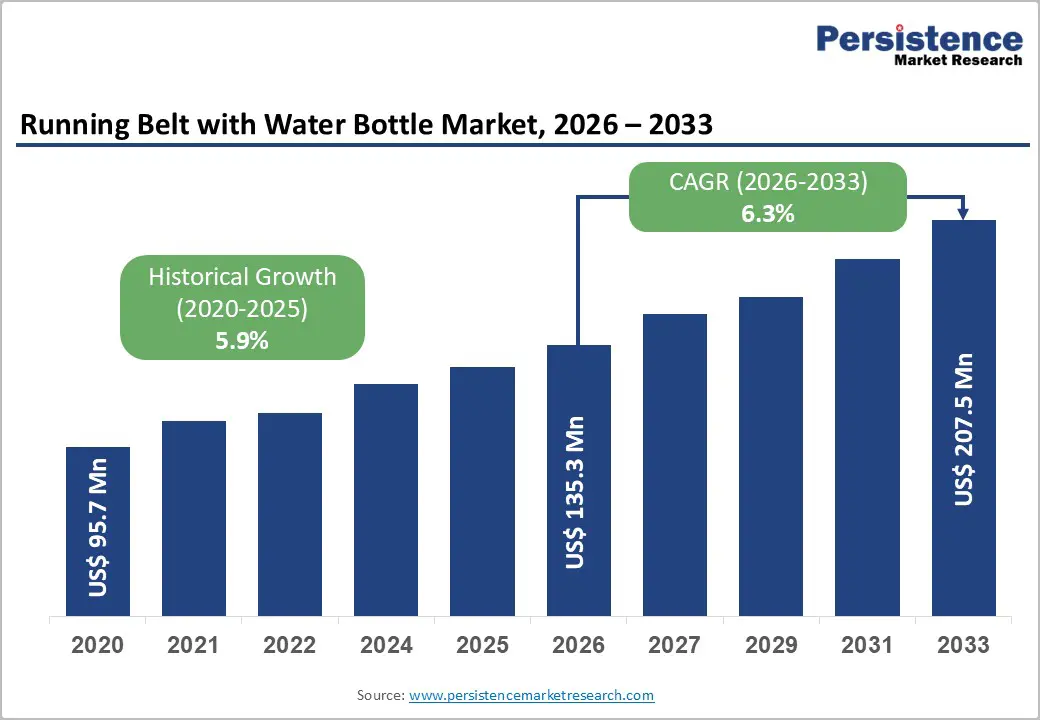
The global running belt with water bottle market size is likely to be valued at US$135.3 million in 2026, and is expected to reach US$207.5 million by 2033, growing at a CAGR of 6.3% during the forecast period from 2026 to 2033, driven by the increasing prevalence of outdoor running and trail activities, rising demand for hands-free hydration solutions, and advancements in lightweight, bounce-free running belt designs.
The growing demand for comfortable, sweat-resistant running belts with a water bottle, especially adjustable and eco-friendly variants, is accelerating the adoption across user groups. Advancements in hydration vests and expandable-capacity designs are accelerating adoption by providing flexible solutions for long-distance use. The growing awareness of running belts with water bottles as essential gear for marathon preparation and trail safety, particularly in emerging fitness markets, remains a key driver of market growth.
Key Industry Highlights:
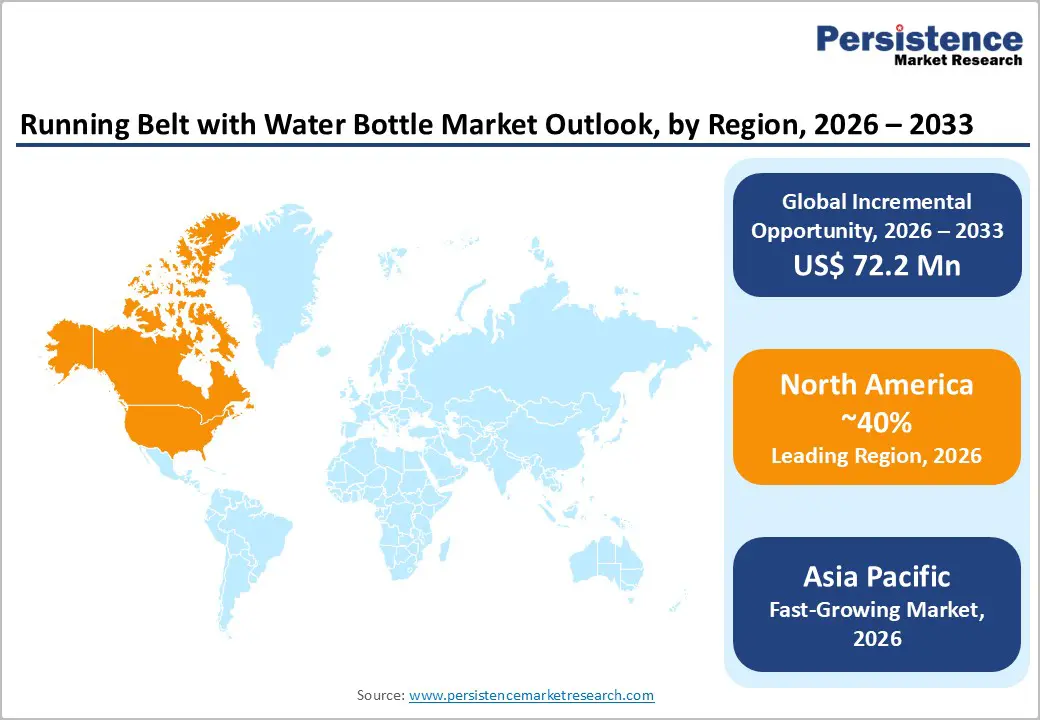
- Leading Region: North America, to account for a 40% market share in 2026, driven by high running participation, strong trail culture, and premium demand in the U.S.
- Fastest-growing Region: Asia Pacific, to be fueled by rising fitness awareness, expanding marathon events, and growing investments in sports accessories in China and India.
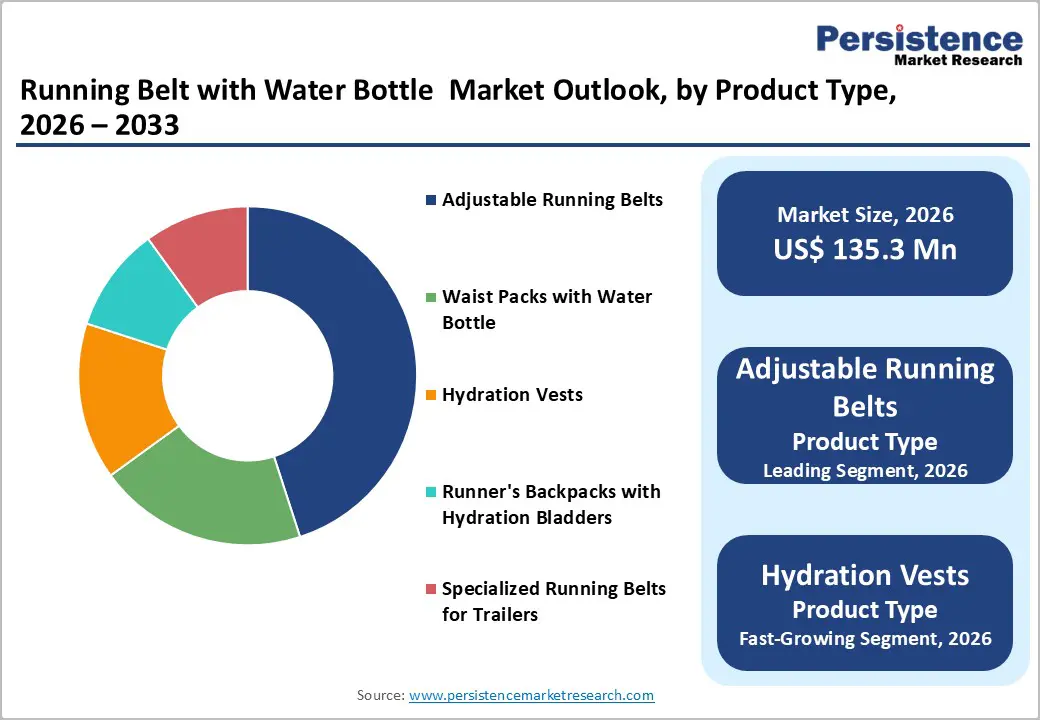
- Dominant Product Type: Adjustable running belts, to hold approximately 45% of the market share, as they offer universal fit and convenience.
- Leading Material Type: Nylon is expected to dominate, accounting for 35% of revenue, driven by its lightweight, durable, and flexible properties, which are ideal for frequent outdoor use.
- Leading Capacity: The 500ml water bottle segment is projected to account for more than 50% of market revenue, driven by the preference for lightweight bottles for daily runs.
- Leading User-Demographics: Intermediate runners, who contribute nearly 35% of the market revenue, due to balanced training needs.
| Key Insights | Details |
|---|---|
| Running Belt with Water Bottle Market Size (2026E) | US$135.3 Mn |
| Market Value Forecast (2033F) | US$207.5 Mn |
| Projected Growth (CAGR 2026 to 2033) | 6.3% |
| Historical Market Growth (CAGR 2020 to 2025) | 5.9% |
Market Factors – Growth, Barriers, and Opportunity Analysis
Rising Demand for Outdoor Running Activities and Hands-Free Hydration
The growing popularity of outdoor running and hands-free hydration reflects a broader shift toward active, flexible, and wellness-oriented lifestyles. Urban professionals and fitness enthusiasts are increasingly choosing running as it requires minimal gear, can be done outdoors, and fits conveniently into busy daily routines. In parallel, public investment in parks, jogging paths, and open fitness areas is further boosting participation in outdoor running across both urban and suburban regions.
As runners place greater emphasis on comfort and efficiency, the adoption of hands-free hydration solutions has accelerated. Carrying traditional water bottles can disrupt the running flow and contribute to fatigue, particularly during long-distance or endurance runs. In contrast, hands-free options such as running belts with built-in bottles or soft flasks enable runners to hydrate without stopping, enhancing convenience and performance. Heightened awareness of dehydration-related health risks during physical activity has also shaped consumer preferences, with runners increasingly prioritizing regular fluid intake, even on shorter runs, thereby driving demand for wearable hydration accessories.
Seasonal and Weather Dependency
Seasonality and weather dependence are significant restraints on the running belt with water bottle market, as product demand is closely tied to outdoor running activity levels. Running participation tends to increase during favorable weather conditions such as mild temperatures and dry seasons, while extreme heat, heavy rainfall, cold waves, or high humidity discourage outdoor exercise. During such periods, runners often shift to indoor workouts or reduce training frequency, which directly affects the purchase and use of running accessories.
In regions with long monsoon seasons, harsh winters, or prolonged summers, outdoor running becomes inconsistent, leading to uneven sales patterns across the year. This seasonality creates demand fluctuations for manufacturers and retailers, making inventory planning and revenue forecasting more challenging. Retailers may experience strong sales during peak fitness seasons but face slower turnover during adverse weather periods. Weather conditions also influence user comfort and product performance. High temperatures can increase discomfort caused by belt tightness or water bottle weight, while cold climates may limit the need for frequent hydration, reducing perceived product value.
Developments in Bounce-Free and Eco-Friendly Delivery Platforms
Developments in bounce-free and eco-friendly running belts with water bottle delivery platforms are transforming the global fitness accessory landscape by addressing two major challenges: motion discomfort and environmental impact. Bounce-free platforms are engineered to achieve zero-shift stability, reducing reliance on tight straps and enabling smoother long-distance running. Innovations such as dual-layer elastic gel padding, magnetic bottle holders, and reflective trims significantly improve comfort and visibility, reducing injury risk for runners and in training campaigns.
Progress in eco-friendly platforms, including recycled polyester, biodegradable neoprene, plant-based canvas, and reusable hydration bladders, supports more sustainable gear by minimizing plastic waste, the product’s first line of defense against scrutiny. These formats eliminate landfill waste, enhance durability, and enable versatile use without performance trade-offs, making them highly suitable for mass trail-running programs.
Category-wise Analysis
Product Type Insights
Adjustable running belts are expected to dominate the market, capturing around 45% of the market share by 2026. Their popularity stems from their universal fit, lightweight design, and affordability, making them a top choice for daily runners. These belts offer a secure hold for water bottles, ensure comfort, and enhance accessibility, making them ideal for large-scale fitness initiatives. Nathan Sports, a key player in this segment, produces adjustable hydration belts, such as the TrailMix Plus, which are widely used by marathon runners for their ability to fit various body sizes and securely hold water bottles over long distances. The adjustable design makes them especially favored in organized marathon training groups and community fitness programs leading up to major events such as the New York City Marathon, where runners of all levels train together.
Hydration vests are likely to be the fastest-growing segment, driven by their large capacity and increasing popularity in ultra-marathons. With a multi-bottle design, these vests are perfect for long-distance events, minimizing the need for frequent refills. Ongoing innovations in ventilation are enhancing its appeal, driving rapid adoption in North America and Europe, where demand for trail gear is growing. Models such as the Salomon Adv Skin 5 Set Running Backpack, along with larger variants like the 12L models, are favored by ultra-marathon and long-distance trail runners for their high capacity and multi-bottle hydration system. These vests allow athletes to carry more water and gear without frequent stops. Designed to distribute weight evenly, they feature multiple fluid compartments, including front soft flask pockets and space for a back reservoir, making them ideal for endurance races, where hydration and energy must be carried over long distances without interruption.
Material Type Insights
Nylon is projected to lead the market, capturing a 35% share by 2026, owing to its lightweight, durable, and flexible qualities, which make it perfect for frequent outdoor use. The material’s high tensile strength and abrasion resistance ensure that the belt can endure the demands of long runs, trail conditions, and daily training without losing its shape. Nylon offers moisture resistance and is easy to clean, maintaining hygiene through repeated use. An example is the Nathan TrailMix Plus 3.0 Hydration Belt, which is made from a 60% nylon and 40% polyester blend. This combination offers the lightweight durability of nylon along with its abrasion resistance and stretch resistance, helping the belt retain its shape during long outdoor runs and trail workouts. The nylon-rich design also makes it moisture-resistant and easy to clean, features that are highly valued by runners for maintaining hygiene after intense training sessions.
The eco-friendly segment is expected to be the fastest-growing, driven by rising consumer awareness of environmental sustainability. Manufacturers are now using recycled plastics, fabric scraps, and biodegradable textiles in belts and vests, achieving a balance between eco-consciousness and performance. These materials minimize environmental impact while preserving the lightweight, flexible, and moisture-resistant qualities that runners need. A great example is the Eco SPIbelt from SPIbelt, which is made from approximately 87% recycled materials, including reclaimed plastics, fabric scraps, and elastic that would otherwise be discarded. This shows how sustainable design is gaining traction in the hydration gear market, without sacrificing comfort or performance. The Eco SPIbelt maintains the brand's signature bounce-free, lightweight design and practical storage, all while reducing environmental impact by transforming waste materials into durable, high-performance running gear.
Capacity Insights
The single water bottle capacity (500ml) segment is expected to lead the market, holding approximately 50% of the share in 2026, driven by lightweight preference, large daily run programs, and strong global demand for minimal gear. Their dominance continues as short-distance runners expand. The rising adoption of double-bottle and expanded-capacity campaigns highlights the growing focus on endurance alternatives. The HydraPak Softflask Speed 500 mL by HydraPak is a widely cited example of a single 500 ml water bottle dominating everyday running hydration gear. This 500 ml soft flask is intentionally sized to be lightweight and compact, making it ideal for short to medium daily runs and routine training sessions where runners prefer minimal gear that does not weigh them down. Its design fits easily into handheld grips, waist belts, or running vests, reflecting why the ~500 ml capacity continues to hold a significant share of the running water bottle market, balancing fluid volume with convenience and comfort for most runners’ needs.
The large-capacity belts segment (1.5L and above) is likely to experience the fastest growth, driven by increasing participation in ultra-distance running and greater inclusion of such gear in trail racing events. A growing preference for longer-distance formats, combined with improved endurance levels among runners, is accelerating adoption. Market growth is further supported by advances in bladder integration and the ongoing development of expandable designs that are now entering consumer testing. Products such as the Ultraspire Speedgoat 3.0 High-Capacity Hydration Belt, the Ripper 1.5L Lumbar Pack, and similar high-capacity hydration waist packs highlight the growing adoption of larger-capacity hydration belts among endurance athletes. The Ultraspire Speedgoat 3.0, for example, provides over 1 liter of water capacity along with additional space for nutrition and essential gear, making it well-suited for long trail runs or ultramarathon segments where access to aid stations is limited..
User-Demographics Insights
Intermediate runners are projected to lead the market, accounting for nearly 35% of total revenue in 2026. This dominance is driven by their role as the core user group for structured training routines, progressive performance programs, and a wide range of run types that require dependable hydration solutions. Their established training habits, higher activity frequency, and ability to handle longer distances or specialized workouts drive greater product usage and repeat purchases. This segment is also at the forefront of adopting adjustable designs and participating in early trials of emerging hydration vest technologies. Brands such as Salomon exemplify this focus by offering hydration solutions ranging from belts to advanced vests, including models such as the Salomon Adv Skin 12 and Active Skin 8. These products are tailored to the needs of regularly training runners preparing for races, trail runs, and progression programs. Designed for comfort, stability, and practical hydration capacity, they effectively bridge the gap between entry-level accessories and highly specialized ultra-endurance equipment.
Trail runners are likely to be the fastest-growing segment, driven by their strong off-road presence and expanding role in adventure racing. They offer convenient, quick, and accessible capacity, attracting participants who prefer rugged, low-bounce settings. Increased outreach programs, ultra-focus, and wider availability of routine and premium belts further accelerate uptake, driving rapid adoption across both urban and remote areas. Salomon ADV Skin 12L Hydration Vest Set from Salomon among serious off-road athletes. This hydration vest is widely used by trail and ultra distance runners because it combines ample storage capacity (up to 12 L) with a secure, low?bounce fit that performs well on rugged terrain. Its design includes multiple pockets for soft flasks and gear, breathable materials, and ergonomic straps, helping runners carry water, nutrition, and essentials over long, technical distances without frequent stops.
Regional Insights
North America Running Belt with Water Bottle Market Trends
North America is projected to lead the market, capturing nearly 40% of global revenue for running belts with water bottles in 2026. This dominance is supported by high participation in running, a well-established trail-running culture, and strong consumer interest in performance-oriented gear. Well-developed distribution networks across the U.S. and Canada further enhance market penetration, ensuring broad availability of running belts with water bottles among intermediate runners, marathon participants, and trail athletes. Rising preference for adjustable, lightweight, and easy-to-carry designs is also accelerating adoption, as these solutions offer greater comfort and eliminate the drawbacks of handheld bottles.
Ongoing innovation in running-belt hydration technology, including bounce-free stabilization, environmentally friendly materials, and more efficient hydration delivery, is attracting substantial investment from both public and private stakeholders. In addition, government-led health initiatives and fitness awareness campaigns continue to encourage proper hydration and the use of comfortable, safe running gear, helping sustain long-term demand. The increasing emphasis on higher-capacity options and specialized applications, particularly for ultra-running and endurance-focused activities, is further broadening the use cases for running belts with water bottles.
Europe Running Belt with Water Bottle Market Trends
Europe’s growth is being driven by rising awareness of performance benefits, strong running communities, and government-backed health initiatives. Countries such as Germany, France, and the U.K. have well-developed fitness ecosystems that encourage regular use of gear and support the adoption of innovative belt designs, including running belts with water bottles. These functional solutions are especially attractive to intermediate runners, regulation-conscious users, and trail runners, as they enhance endurance, comfort, and overall usability.
Advancements in running belt–with–water bottle technology, such as improved stability, activity-specific designs, and higher eco-friendly standards, are further strengthening the market potential. European authorities are progressively backing research initiatives and pilot projects for both routine and specialized belt applications, thereby strengthening confidence in the market. At the same time, growing demand for convenient and lightweight options aligns with the region’s emphasis on preventive fitness and injury reduction. Public awareness campaigns are expanding adoption across urban and rural areas, while manufacturers continue to invest in advanced fabrics and innovative variants to improve performance and appeal.
Asia Pacific Running Belt with Water Bottle Market Trends
Asia-Pacific is likely to be the fastest-growing region, driven by rising fitness awareness, increased government initiatives, and expanding application programs across the region. Countries such as India, China, Japan, and Southeast Asian nations are actively promoting belt campaigns to address rapid growth and emerging marathon needs. A running belt with a water bottle is particularly attractive in these regions due to its cost-effective administration, ease of use, and suitability for large-scale training programs in both urban and rural populations.
Technological advancements are enabling the development of a stable, effective, and easy-to-wear running belt with a water bottle that can withstand challenging climates and minimize discomfort. These innovations are critical for reaching remote runners and improving overall hydration coverage. Growing demand for intermediate, marathon, and trail applications is contributing to market expansion. Public-private partnerships, increased sports expenditure, and rising investment in accessory research and manufacturing capacity are further accelerating growth. The convenience of belt delivery, combined with improved stability and reduced risk of dehydration, positions the running belt with water bottle as a preferred choice.
Competitive Landscape
The global running belt with water bottle market features competition between established sports accessory leaders and emerging performance brands. In North America and Europe, Amphipod and Nathan Sports lead through strong R&D, distribution networks, and retail ties, bolstered by innovative adjustable and vest programs. In Asia Pacific, local brands advance with cost-competitive solutions, enhancing accessibility. Bounce-free delivery boosts comfort, cuts motion risks, and enables mass integrations across regions. Strategic partnerships, collaborations, and acquisitions merge expertise, expand portfolios, and speed commercialization. Eco-friendly formulations solve sustainability issues, aiding penetration in green-focused areas.
Key Industry Developments
- In February 2025, Nathan Sports launched its revolutionary HydroDash Pro series featuring integrated hydration monitoring technology that tracks fluid intake and provides real-time recommendations through smartphone connectivity. The belt incorporates antimicrobial materials and a new bounce-reduction design that has shown 78% less vertical movement during testing with elite runners. Initial user feedback indicates 92% satisfaction rates with comfort and functionality improvements.
- In January 2025, Ultimate Direction introduced its sustainability-focused FlowState collection made from 85% recycled ocean plastics, featuring modular bottle systems that allow users to customize capacity from 12-32 ounces based on activity requirements. The innovative quick-release mechanism enables bottle access without breaking stride, while the belt structure provides 40% better weight distribution compared to previous models. The collection targets environmentally conscious athletes seeking high-performance gear.
Companies Covered in Running Belt with Water Bottle Market
- Amphipod
- FuelBelt
- Nathan Sports
- Ultimate Direction
- CamelBak Products
- Decathlon
- Fitletic
- Salomon and The North Face
- Jupiter Gear
- Osprey Packs Inc.
Frequently Asked Questions
The global running belt with water bottle market is projected to reach US$135.3 million in 2026.
The rising prevalence of outdoor running and trail activities and demand for hands-free hydration are the key drivers.
The running belt with water bottle market is poised to witness a CAGR of 6.3% from 2026 to 2033.
Advancements in bounce-free and eco-friendly delivery platforms are the key opportunities.
Amphipod, Nathan Sports, Ultimate Direction, CamelBak Products, and Salomon are the key players.


