




- Metalworking & Fabrication
- Resistance Welding Equipment Market
Resistance Welding Equipment Market Size, Share, and Growth Forecast 2026 - 2033
Resistance Welding Equipment Market by Product Type (Spot Welding Equipment, Seam Welding Equipment), Automation Level (Manual, Semi-Automatic, Fully Automatic), End-Use Industry (Automotive, Electronics and Electrical), and Regional Analysis, 2026 - 2033

Resistance Welding Equipment Market Size and Trends Analysis
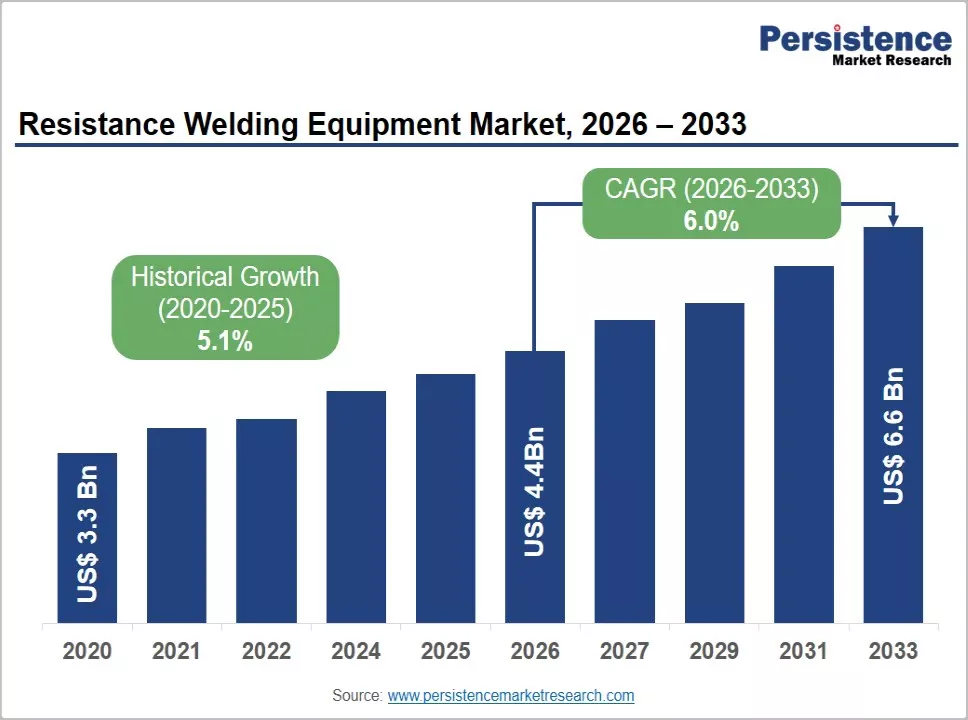
The global resistance welding equipment market size is likely to be valued at US$4.4 billion in 2026 and is estimated to reach US$6.6 billion by 2033, growing at a CAGR of 6.0% during the forecast period from 2026 to 2033, driven by rising automotive production and electric vehicle manufacturing, increasing adoption of automated and robotic welding systems, demand for high-speed and consistent joining of sheet metal and lightweight materials, and expanding applications in electronics, battery assembly, and industrial fabrication.
Key Industry Highlights
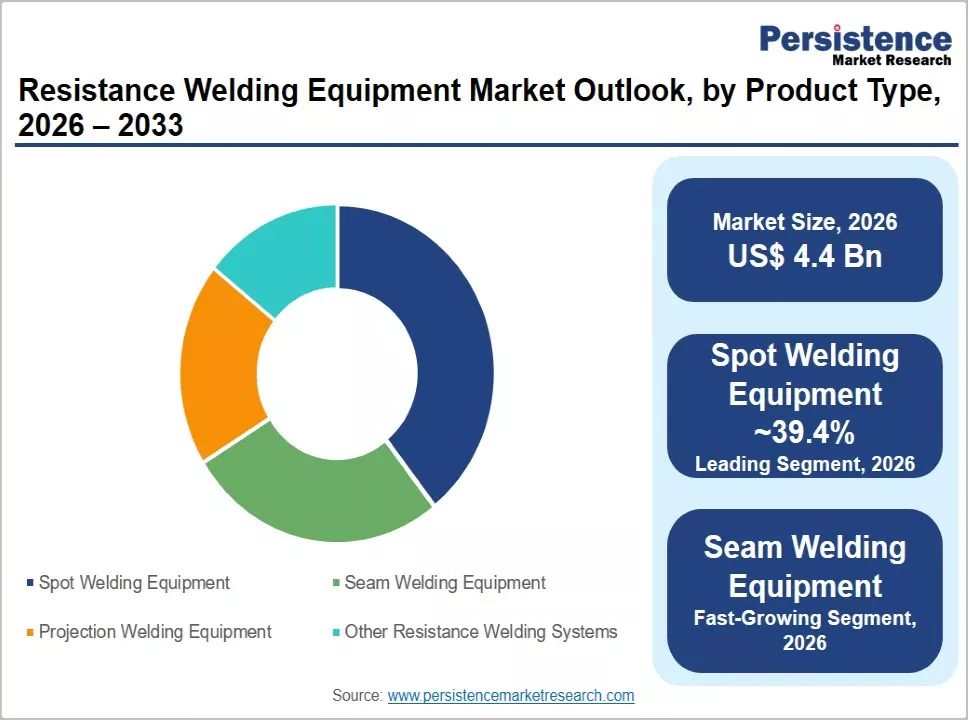
- Leading Product Type: Spot welding equipment, about 39.4% share in 2026, as it remains the primary method for high-volume sheet metal assembly in automotive body construction and related component manufacturing.
- Dominant End-use Industry: Automotive, around 43.2% share in 2026, as vehicle body shops, structural components, and battery pack assembly continue to generate the largest demand for resistance welding systems.
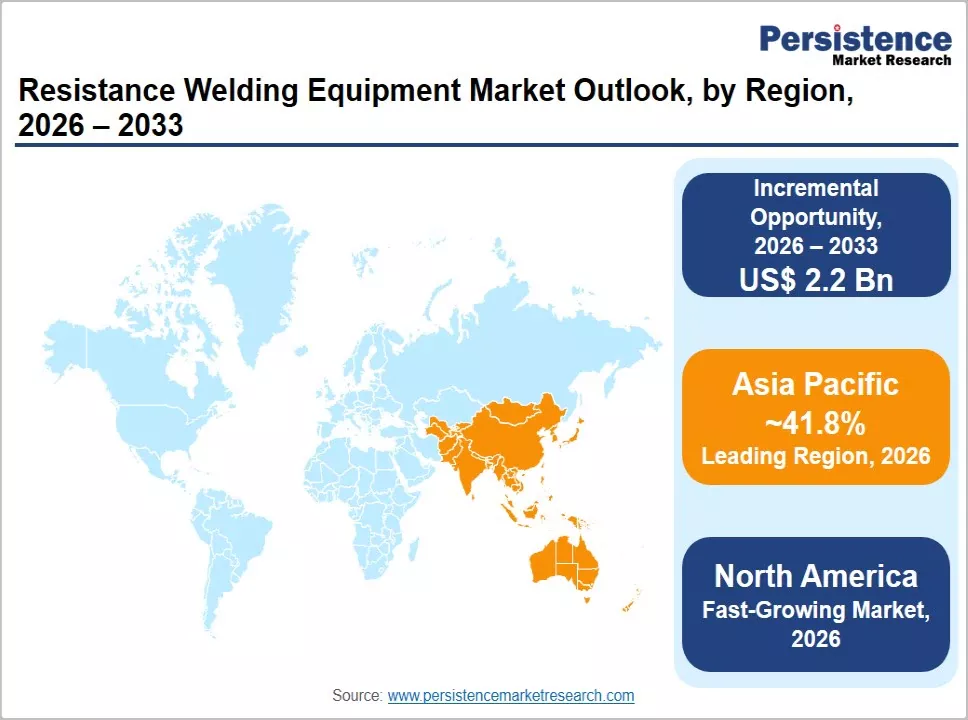
- Leading Region: Asia Pacific, with about 41.8% share in 2026, owing to large-scale automotive and electronics manufacturing bases in China, Japan, South Korea, and India, combined with ongoing capacity expansion and automation investments.
- Fast-growing Region: North America, supported by rapid industrialization, rising electric vehicle production, and increasing adoption of automated welding solutions.
- New Study: In 2026, the American Welding Society published AWS D8.2M:2026, a new specification covering automotive resistance spot welding of aluminum. The standard establishes quality characteristics and metrics for individual resistance spot welds in automotive aluminum structures, providing manufacturers and welding-equipment users with defined criteria for evaluating weld quality.
DRO Analysis
Driver- Automotive Production and Electric Vehicle Expansion to Increase Equipment Demand
The continued growth of global automotive production, particularly the rapid expansion of electric vehicle manufacturing, is a major driver for resistance welding equipment. Spot and seam welding remain essential for body-in-white assembly, structural components, and battery enclosure fabrication. Electric vehicles often require additional precision welding for battery modules, busbars, and lightweight aluminum structures, increasing the number of welds per vehicle and supporting higher equipment utilization.
As automakers and battery manufacturers scale production capacity, they invest in both new welding lines and upgrades of existing systems to handle higher volumes, tighter tolerances, and new material combinations. This sustained capital spending across traditional and electric vehicle platforms underpins steady demand for resistance welding equipment worldwide.
Rising Automation and Industry 4.0 Adoption to Raise System Requirements
Manufacturers across automotive, electronics, and industrial sectors are accelerating the adoption of automated and robotic resistance welding systems to improve consistency, reduce labor dependency, and increase throughput. Fully automatic and servo-driven equipment delivers more precise control of current, force, and timing, resulting in higher weld quality and lower scrap rates. Integration with production line controls and real-time monitoring further enhances process reliability.
The shift toward smart manufacturing encourages investment in equipment that can communicate with plant networks, support predictive maintenance, and provide detailed process data. These capabilities are becoming standard expectations in high-volume production environments and are expanding the market for advanced resistance welding systems.
Restraint- High Initial Investment and Technical Complexity May Limit Adoption by Smaller Fabricators
Advanced automatic and robotic resistance welding systems require significant capital investment, specialized installation, and skilled operators or programming support. Smaller job shops and fabricators may continue to rely on manual or semi-automatic equipment when production volumes do not justify the higher cost of fully automated solutions. Integration with existing production lines and the need for consistent electrode maintenance can also raise operational complexity.
In cost-sensitive markets, the payback period for high-end systems may appear lengthy, slowing replacement of older equipment. Training requirements and the need for reliable technical support further influence purchasing decisions, particularly among smaller manufacturers with limited in-house engineering resources.
Opportunity- Lightweight Materials and Battery Assembly to Drive Specialized Equipment Demand
The increasing use of aluminum, high-strength steels, and multi-material structures in automotive and aerospace applications is creating demand for resistance welding equipment optimized for these materials. Specialized systems with precise force and current control, adaptive process parameters, and advanced electrode designs help manufacturers achieve reliable joints while managing challenges such as electrode wear and material conductivity differences.
Electric vehicle battery pack and module assembly represents a particularly strong growth area. Precision spot and seam welding are widely used for cell interconnects, tab joining, and enclosure sealing. Equipment suppliers that develop solutions tailored to battery manufacturing requirements can capture incremental demand as global battery production capacity expands.
Servo Technology and Process Monitoring to Support Higher-Value Systems
The adoption of servo-controlled actuators and advanced process monitoring is enabling higher-performance resistance welding equipment. These systems offer improved energy efficiency, better weld consistency, and reduced variation compared with traditional pneumatic designs.
Real-time monitoring of current, voltage, force, and displacement allows operators to detect process deviations early and maintain quality standards. Manufacturers seeking greater process control and data-driven manufacturing are increasingly specifying these advanced features, supporting a shift toward higher-value equipment segments.
Category-wise Analysis
Product Type Insights
Spot welding equipment is predicted to lead with a share of about 39.4% in 2026, as it is the most widely used resistance welding method for sheet metal assembly in automotive body construction and related high-volume applications. Continuous improvements in gun design, power supplies, and process control sustain its dominant position.
Seam welding equipment is expected to grow steadily, supported by applications in fuel tanks, exhaust systems, and battery enclosures. Projection welding and other specialized resistance welding systems serve niche requirements in electronics, fasteners, and precision components, contributing to overall market diversity.
End-use Industry Insights
The automotive segment is anticipated to dominate with a share of around 43.2% in 2026, driven by high-volume body-in-white assembly, structural component fabrication, and the expanding requirements of electric vehicle and battery pack production. Resistance welding remains a core process for joining sheet metal and lightweight materials at the scale and speed demanded by vehicle manufacturers.
Electronics and electrical applications generate steady demand for precision resistance welding in component assembly and interconnections. Aerospace and broader industrial manufacturing also contribute, particularly where high joint reliability and process consistency are required. As production volumes and material complexity increase across these sectors, demand continues to support both standard and advanced resistance welding equipment.
Regional Insights
Asia Pacific Resistance Welding Equipment Market Trends
Asia Pacific is predicted to lead in 2026 globally with a share of approximately 41.8%, as the region hosts the world’s largest automotive, electronics, and industrial manufacturing bases. China, Japan, South Korea, and India continue to expand production capacity for vehicles, components, and consumer electronics driving installations of both standard and automated resistance welding systems. Rising electric vehicle and battery manufacturing activity further strengthens equipment demand. Local suppliers and international manufacturers both participate actively in the regional market.
China Resistance Welding Equipment Market Trends
China will likely hold the largest share within Asia Pacific in 2026, accounting for about 47.5%, supported by its dominant position in automotive production, electronics manufacturing, and rapidly growing electric vehicle and battery industries. High-volume body assembly and component fabrication generate continuous demand for spot and seam welding equipment. Ongoing automation investments and capacity expansion in new energy vehicle plants further support market growth. Domestic equipment suppliers compete alongside global brands, offering a wide range of solutions across price and performance segments.
India Resistance Welding Equipment Market Trends
In 2026, India is projected to account for a share of roughly 14.8% in Asia Pacific, as expanding automotive production, growing electronics manufacturing, and industrial development increase the need for resistance welding equipment. Rising adoption of automated systems in organized manufacturing facilities supports higher-value equipment demand, while price-sensitive segments continue to utilize manual and semi-automatic solutions. Government initiatives promoting manufacturing and electric mobility also contribute to longer-term market expansion.
North America Resistance Welding Equipment Market Trends
North America is expected to hold a substantial share of approximately 28.6% in 2026, driven by a mature automotive sector, significant electric vehicle investments, and ongoing industrial automation activity. Automotive body shops and battery manufacturing facilities continue to upgrade welding lines for higher efficiency and material compatibility. Aerospace and general industrial applications also contribute to steady equipment demand. Emphasis on process quality, data monitoring, and energy efficiency influences purchasing decisions across the region.
U.S. Resistance Welding Equipment Market Trends
A share of nearly 79.3% is expected to be held by the U.S. in 2026 in North America. The country benefits from large-scale automotive manufacturing, expanding electric vehicle and battery production capacity, and a strong industrial base. Continuous modernization of welding lines, adoption of servo and inverter technologies, and focus on lightweight material joining sustain demand for advanced resistance welding equipment. Both original equipment installations and replacement of aging systems support market activity.
Europe Resistance Welding Equipment Market Trends
Europe will likely account for about 22.4% of the global market in 2026, supported by advanced automotive manufacturing, aerospace activity, and strict quality and environmental standards. Manufacturers continue to invest in automated and energy-efficient resistance welding systems that improve consistency and reduce operating costs. Electric vehicle production growth and lightweight material adoption further encourage equipment upgrades across the region.
Germany Resistance Welding Equipment Market Trends
Germany is predicted to register a substantial share of approximately 32.6% in 2026 in Europe. The country’s strong automotive industry, precision engineering capabilities, and emphasis on high-quality manufacturing support consistent demand for advanced resistance welding equipment. German suppliers and users place particular value on process reliability, automation integration, and compatibility with modern vehicle materials and production methods.
U.K. Resistance Welding Equipment Market Trends
A regional share of nearly 13.9% is predicted to be held by the U.K. in 2026. Demand is supported by automotive, aerospace, and industrial manufacturing activity, along with ongoing modernization of production facilities. Focus on process efficiency, quality control, and adaptation to new materials continues to influence equipment selection across both high-volume and specialized welding applications.
Competitive Landscape
The global resistance welding equipment market is moderately fragmented, with competition among global manufacturers and specialized regional suppliers. Companies compete through process performance, automation capabilities, energy efficiency, material compatibility, electrode life, and after-sales support. Close relationships with automotive and industrial customers remain important, while continuous development of servo, inverter, and monitoring technologies shapes competitive differentiation.
Key Industry Developments
- In February 2026, AMADA WELD TECH debuted the UB-1500B Linear DC Resistance Weld Control at MD&M West. The new system is part of the company’s UB Series resistance-welding power supplies and adds enhanced data and monitoring capabilities, a modern interface, and Flex Pulse Mode for flexible pulse shaping. The company positioned the system for precision welding of medical-device components.
- In December 2025, researchers reported a conductive heat ultrasonically assisted resistance spot welding process for multilayer copper foils used in battery-cell internal assemblies. The process combined electrical resistance heating with ultrasonic vibration and achieved high-quality welds in stacks containing 96 copper-foil layers. The researchers also found that ultrasonic assistance could refine the microstructure and reduce heat-affected-zone softening.
- In 2025, AMADA WELD TECH’s European subsidiary acquired MacGregor Welding Systems, a U.K.-based manufacturer of precision micro-joining equipment. MacGregor’s portfolio includes DC micro-resistance welding equipment, automated and semi-automated resistance welding systems, and integrated production lines. AMADA WELD TECH said the acquisition would expand its product and service range and support the development of new resistance-welding technologies.
Companies Covered in Resistance Welding Equipment Market
- Lincoln Electric
- Illinois Tool Works
- Fronius International
- Daihen Corporation
- ARO Technologies
- TECNA
- NIMAK
- Panasonic Welding Systems
- AMADA WELD TECH
- CenterLine
- Others
Frequently Asked Questions
The global resistance welding equipment market is projected to be valued at US$4.4 billion in 2026.
The resistance welding equipment market is expected to reach US$6.6 billion by 2033.
Key market trends include greater automation and servo control, inverter-based power supplies, advanced process monitoring, improved compatibility with lightweight materials, and specialized solutions for electric vehicle battery and structural assembly.
Spot welding equipment is expected to be the leading product type with a share of around 39.4% in 2026, boosted by its extensive use in automotive body assembly and high-volume sheet metal joining.
The resistance welding equipment market is expected to grow at a CAGR of 6.0% from 2026 to 2033.
Lincoln Electric, Illinois Tool Works, and Fronius International are a few key market players.


