




- Healthcare Services
- Prostate Cancer Screening Market
Prostate Cancer Screening Market Size, Share, and Growth Forecast 2026 - 2033
Prostate Cancer Screening Market by Test Type (PSA Tests, Biomarker and Genomic Tests), End User (Diagnostic Laboratories, Hospitals), Application (Opportunistic Screening, Organized Population Screening), and Regional Analysis, 2026 - 2033

Prostate Cancer Screening Market Size and Trends Analysis
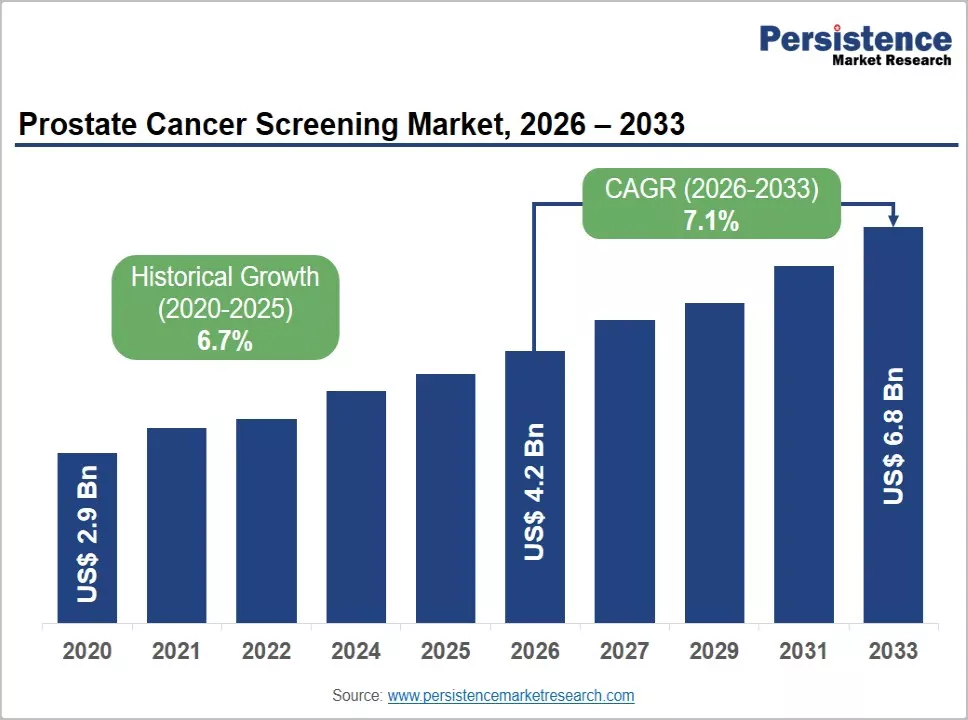
The global prostate cancer screening market size is likely to be valued at US$ 4.2 billion in 2026 and is estimated to reach US$ 6.8 billion by 2033, growing at a CAGR of 7.1% during the forecast period 2026 to 2033, driven by rising disease burden and surging use of blood biomarkers and Magnetic Resonance Imaging (MRI).
Prostate cancer is the second most common cancer in men worldwide. Updated clinical guidelines are also moving screening toward risk-based, more accurate pathways.
Key Industry Highlights
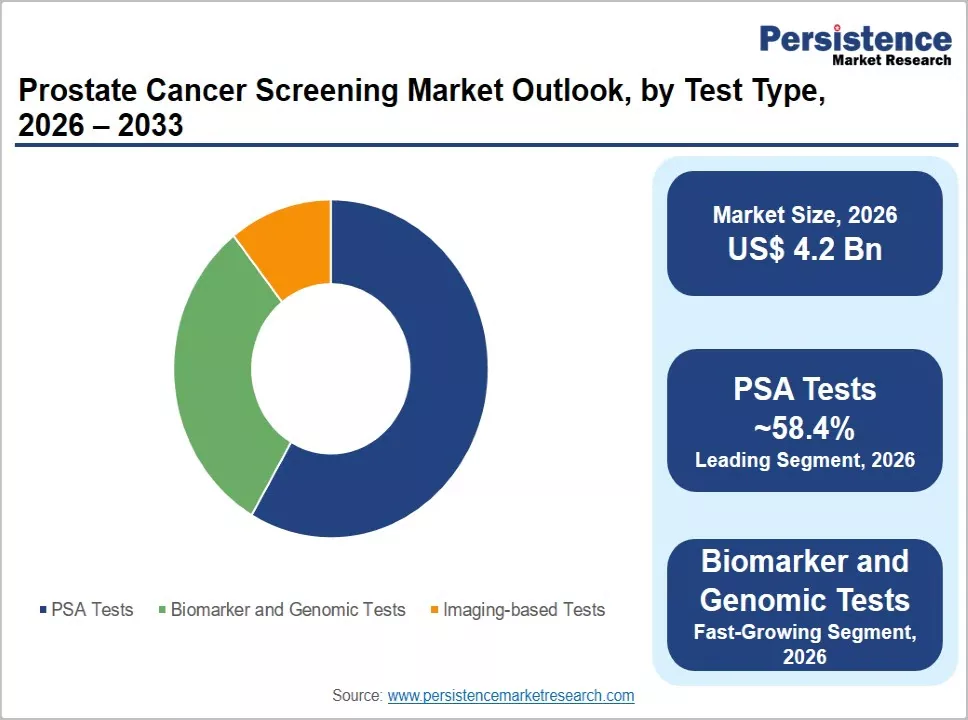
- Leading Test Type: Prostate-specific antigen (PSA) tests, about 58.4% share in 2026, because they are low-cost, widely available, and the first-line test in most guidelines.
- Dominant Application: Opportunistic screening, around 54.1% share in 2026, as most men are tested after a doctor discussion rather than through organized national programs.
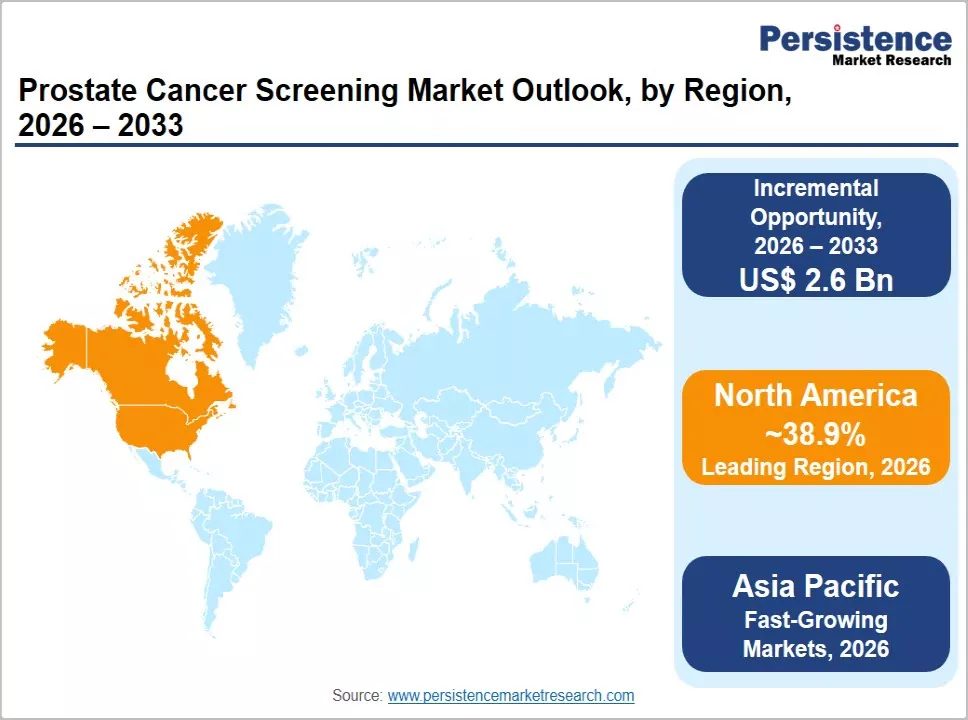
- Leading Region: North America, with about 38.9% share in 2026, as the U.S. has high awareness, strong reimbursement, and early adoption of advanced diagnostics.
- Fast-growing Region: Asia Pacific, due to rising incidence, expanding laboratory networks, and growing awareness of early detection.
- Latest Partnership: In February 2026, Broad Clinical Labs partnered with researchers from the U.S. Department of Veterans Affairs to advance the Prostate Cancer, Genetic Risk, and Equitable Screening (ProGRESS) study. The nationwide clinical trial is designed to enroll 5,000 veterans and evaluate a genetic testing approach that identifies hundreds of prostate cancer-associated genetic variations. The test builds on the Prostate CAncer integrated Risk Evaluation (P-CARE) model, developed using genetic, family history, and medical data from nearly 600,000 men. The collaboration aims to identify men at elevated genetic risk who may benefit from earlier or more intensive screening while helping lower-risk individuals avoid unnecessary follow-up procedures.
DRO Analysis
Driver- Rising Disease Burden Globally to Strengthen Screening Demand
Prostate cancer cases continue to rise. The World Cancer Research Fund reports 1,467,854 new cases worldwide in 2022. It ranks the disease as the second most common cancer in men. The American Cancer Society projects 333,830 new U.S. cases and 36,320 deaths in 2026. In the U.S., 2022 data show 230,125 new cases and 33,746 deaths.
U.S. incidence rose about 3% per year from 2014 to 2022. The society links the increase largely to more men being screened. It also warns that too many men are still not screened early enough. These findings keep early detection high on the clinical agenda. They also support steady test volumes.
Updated Guidelines and Better Tests to Bolster Adoption
Guidelines are shifting toward more precise screening. In February 2026, the American Urological Association (AUA) and the Society of Urologic Oncology amended their early detection guideline. The update adds information on MRI before initial biopsy, biomarkers for risk stratification, and personalized re-screening intervals. The guideline contains 35 recommendations.
Better tests are also reaching the market. In the Stockholm3 study, the test showed 90% sensitivity for aggressive cancer, compared with 74% for PSA at 3 ng/ml. Higher accuracy can reduce unnecessary biopsies. Laboratories and urology clinics therefore have a strong reason to add biomarker and imaging steps to their workflows.
Restraint- Overdiagnosis Risk and Debate over Population Screening May Limit Growth
PSA testing has a known false-positive problem. Cancer Research UK notes that around 8 in 10 men with a raised PSA result do not have prostate cancer. These results can lead to anxiety, extra tests, and biopsies. Such harms make many health systems cautious about broad screening. Fewer false alarms remain a key goal for test makers.
Policy bodies are also restrictive. In May 2026, the U.K. National Screening Committee (U.K. NSC) recommended screening only for a targeted group. It rejected screening for all men and for Black men, citing unclear benefit versus harm. Narrow recommendations can limit publicly funded volumes. Payers may also question the cost of advanced tests. The final advice also dropped men with BRCA1 gene changes, as newer evidence did not consistently show higher risk of fast-growing cancer.
Opportunity- Blood Biomarkers and Genomic Tests to Create High-value Testing
Biomarker tests offer a path to more accurate triage. In 2021, the U.S. Food and Drug Administration (FDA) approved OPKO Health's 4Kscore test for men aged 45 and older. The blood test estimates the chance of aggressive cancer, defined as a Gleason score of 7 or higher. Stockholm3 now adds strong population-level data. A score below 5.0 is linked to a lower likelihood of aggressive disease. A biopsy is still needed to confirm cancer.
Genomic tools are also advancing. MDxHealth said in January 2026 that it is adding its Genomic Prostate Score test to the UK ProtecT trial, which follows more than 1,500 men on active surveillance. Such evidence can support wider reimbursement. Laboratories that offer these tests can earn higher revenue per patient. In August 2022, MDxHealth acquired the Oncotype DX Genomic Prostate Score business from Exact Sciences for up to US$100 million.
Organized and Risk-based Programs to Widen the Patient Pool
Public programs are taking shape in Europe. The PRAISE-U initiative is running pilots in Ireland, two regions of Spain, Poland, and Lithuania. A full evaluation will go to the European Commission by the end of 2026. The EU Council is also considering adding prostate cancer to its screening guidance. The European Association of Urology says limited resources and weak follow-up systems remain barriers.
Risk-based programs are starting in the U.K. England's government accepted the UK NSC advice. It covers men aged 45 to 61 with a BRCA2 gene change and a family history of cancer. They would get a PSA test every two years, with rollout expected from 2027. This creates a new, defined screening population.
Category-wise Analysis
Test Type Insights
PSA tests are predicted to lead with a share of about 58.4% in 2026, because they are inexpensive, easy to run, and recommended as the first step in most guidelines. Hospitals and laboratories already have automated immunoassay platforms. Primary care doctors also order them routinely. These factors keep test volumes high, even as newer options enter the market. Test makers are also launching automated platforms to improve throughput.
Biomarker and genomic tests are estimated to be the fastest-growing segment in the forecast period, as clinicians look for ways to avoid unnecessary biopsies. Products such as 4Kscore and Stockholm3 refine risk after an abnormal PSA result. Imaging-based tests, especially MRI, are also gaining ground. The AUA now covers MRI before an initial biopsy. Better triage can lower the burden on pathology and biopsy services.
End User Insights
Diagnostic laboratories are anticipated to dominate with a share of around 44.7% in 2026, because they process most PSA and biomarker samples. Large networks offer scale, automation, and broad test menus. Specialty labs also run proprietary genomic assays. Physicians rely on them for fast and consistent results. This makes laboratories the main channel for screening tests. Their scale also helps them negotiate with payers.
Hospitals are expected to remain in the second position in 2026, as they combine testing with MRI, urology consultation, and biopsy. They manage men with abnormal results from start to finish. Specialty clinics are also growing. Urology practices increasingly offer same-day PSA and imaging referral. This supports faster decisions and better follow-up.
Regional Insights
North America Prostate Cancer Screening Market Trends
North America is predicted to dominate in 2026 globally with a share of approximately 38.9%, due to high disease awareness, strong insurance coverage, and early use of advanced diagnostics. The World Cancer Research Fund reports 230,125 new U.S. cases in 2022. Companies such as OPKO Health, MDxHealth, and Exact Sciences are active in the region. Guideline updates also support wider use of MRI.
U.S. Prostate Cancer Screening Market Trends
A share of nearly 82.6% is expected to be held by the U.S. in 2026 in North America, as it has a large screening population and a mature laboratory sector. The American Cancer Society projects 333,830 new cases in 2026. The February 2026 AUA update promotes biomarkers and MRI. FDA-approved tests such as 4Kscore also support adoption. Insurance coverage for PSA testing supports high volumes.
Asia Pacific Prostate Cancer Screening Market Trends
Asia Pacific is anticipated to be the fastest-growing region globally in 2026 with a share of around 22.1%, because incidence is rising and awareness of early detection is improving. Countries are also expanding laboratory networks and urology services. Aging populations add to risk. Private hospitals are introducing MRI-based and biomarker pathways in urban centers.
China Prostate Cancer Screening Market Trends
China will likely lead in Asia Pacific in 2026 with a share of about 31.8%, supported by a large aging population and growing health checkup programs. The World Cancer Research Fund reports 134,156 new cases in 2022. Domestic diagnostics suppliers are also expanding. Rising demand for imaging further supports growth. China recorded 47,522 prostate cancer deaths in 2022, which highlights the need for earlier detection.
India Prostate Cancer Screening Market Trends
In 2026, India is projected to account for a share of about 16.5% in Asia Pacific, because awareness is increasing and private diagnostic chains are expanding. The World Cancer Research Fund reports 37,948 new cases in 2022. The country recorded 18,386 deaths the same year, a high share of cases. Wider PSA access and better primary care referral can support steady growth.
Europe Prostate Cancer Screening Market Trends
Europe is predicted to hold the second position in 2026 globally with a share of roughly 18.4%, as organized screening models are being tested. The PRAISE-U pilots cover several countries. Sweden, Czechia, and Estonia already run national programs. Public programs may expand testing if evaluations are positive.
Germany Prostate Cancer Screening Market Trends
Germany is predicted to register a substantial share of approximately 22.9% in Europe in 2026, as it has a large aging population and a well-developed laboratory sector. The World Cancer Research Fund reports 65,269 new cases in 2022. Evidence from European pilots may shape future policy. Germany recorded 18,015 deaths in 2022.
U.K. Prostate Cancer Screening Market Trends
A share of nearly 18.7% is predicted to be held by the U.K. in 2026 in Europe, due to its high incidence and active policy debate. The World Cancer Research Fund reports 55,485 new cases in 2022. In May 2026, the UK NSC recommended targeted PSA screening for men with a BRCA2 gene change. England plans rollout from 2027. The U.K. recorded 13,237 deaths in 2022.
Competitive Landscape
The global prostate cancer screening market is moderately fragmented and highly competitive, with diagnostics majors, molecular testing specialists, and clinical laboratories competing through test accuracy, clinical evidence, platform reach, and reimbursement. OPKO Health, MDxHealth, Exact Sciences, Roche Diagnostics, Abbott Laboratories, Siemens Healthineers, and A3P Biomedical have established positions, while biomarker innovation is increasing competition. Companies also partner with hospitals and research groups to generate clinical evidence.
Key Industry Developments
- In June 2026, University College London (UCL) announced the launch of the international PARADIGM clinical trial to evaluate artificial intelligence in prostate MRI interpretation. The study plans to recruit 500 men and compare AI-generated MRI assessments with interpretations from specialist radiologists to determine whether AI can reliably identify clinically significant prostate cancer. The research aims to improve consistency in MRI-based cancer detection, address shortages of specialist radiologists, and support the potential expansion of MRI-based screening pathways.
- In June 2026, researchers published a two-year follow-up analysis of the Stockholm3-MRI population-based prostate cancer screening study in Annals of Internal Medicine. The study evaluated 12,670 men aged 50–74 years and compared the Stockholm3 risk-assessment test with conventional PSA screening. Results showed that Stockholm3 achieved higher sensitivity for detecting clinically significant prostate cancer, at 90% compared with 74% for PSA testing, while maintaining similar specificity. The findings highlighted the potential of combining blood-based biomarkers, genetic risk factors, and clinical information to improve screening accuracy and reduce missed cancer cases.
- In February 2026, four Dutch healthcare institutions, including Radboud University Medical Center, Erasmus MC, the Netherlands Cancer Institute, and Andros Clinics, announced a joint pilot study on risk-based prostate cancer screening. Supported by a €3.2 million grant from the Dutch Cancer Society, the initiative plans to invite 25,000 men aged 50–70 years for PSA testing. Men with elevated PSA levels will undergo further assessment involving prostate-volume measurements, MRI scans, and targeted biopsies where necessary. The study aims to evaluate the effectiveness, feasibility, and cost-effectiveness of introducing a structured national prostate cancer screening program in the Netherlands.
Companies Covered in Prostate Cancer Screening Market
- OPKO Health, Inc.
- MDxHealth SA
- Exact Sciences Corporation
- Veracyte, Inc.
- A3P Biomedical AB
- Roche Diagnostics
- Abbott Laboratories
- Siemens Healthineers AG
- Beckman Coulter, Inc.
- Quest Diagnostics Incorporated
- Laboratory Corporation of America Holdings
- Fujirebio
- Koninklijke Philips N.V.
- GE HealthCare Technologies Inc.
- Myriad Genetics, Inc.
- Others
Frequently Asked Questions
The global prostate cancer screening market is projected to be valued at US$ 4.2 billion in 2026.
The market is expected to reach US$ 6.8 billion by 2033.
Key market trends include risk-based screening, blood biomarker and genomic tests, MRI before biopsy, and organized screening pilots in Europe.
PSA tests are expected to be the leading test type segment with a share of around 58.4% in 2026, as they are low-cost, widely available, and the first-line test in most guidelines.
The market is expected to grow at a CAGR of 7.1% from 2026 to 2033.
OPKO Health, MDxHealth, and Exact Sciences are a few key market players.


