




- Technology
- Global Prison Management Systems Market
Global Prison Management Systems Market Size, Share, and Growth Forecast 2026–2033
Global Prison Management Systems Market by Component (Hardware, Software, Services), by Deployment (On-Premises, Cloud-Based, Hybrid), by End User (Government Correctional Facilities, Private Correctional Facilities), by Regional Analysis, 2026–2033

Global Prison Management Systems Market Size and Trend Analysis
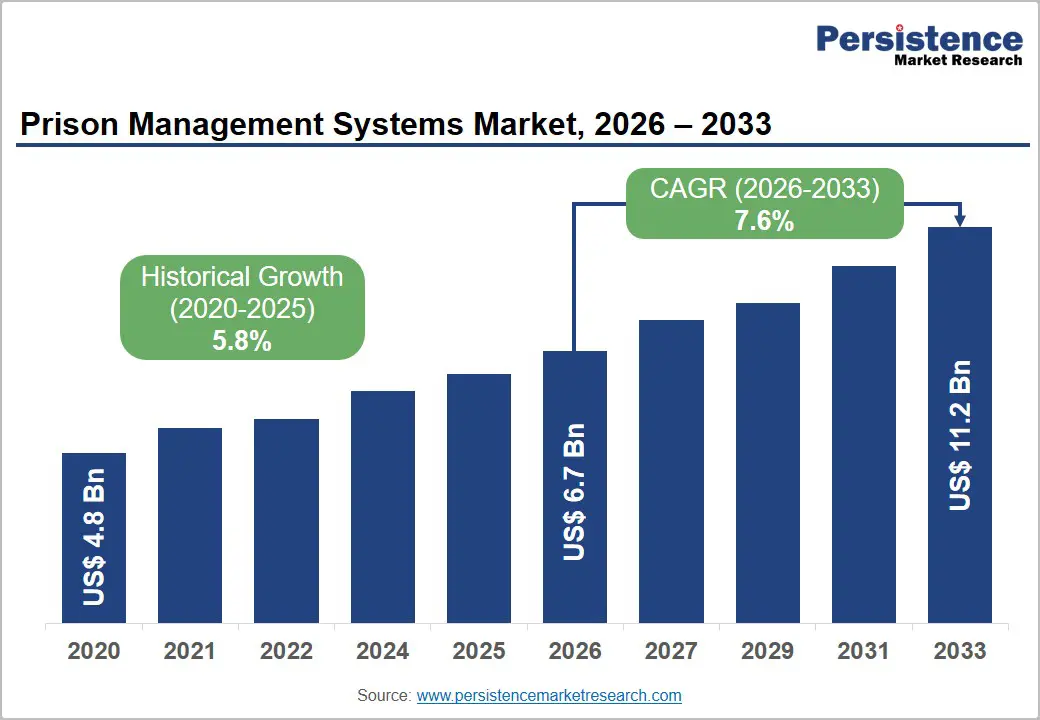
The global prison management systems market is expected to be valued at US$ 6.7 Billion in 2026 and is projected to reach US$ 11.2 Billion by 2033, growing at a CAGR of 7.6% between 2026 and 2033, driven by the increasing digitalization of correctional facilities, rising inmate populations, growing regulatory and judicial reporting requirements, and persistent staffing shortages across prison systems worldwide.
Government-led modernization initiatives across North America, Europe, Asia Pacific, and the Middle East are further accelerating technology adoption within correctional institutions. As public safety agencies prioritize data-driven prison administration and secure information management, demand for advanced prison management systems is expected to remain strong.
Key Industry Highlights:
- Leading Component: Hardware dominates the market with nearly 45% market share in 2026, valued at approximately US$ 3.0 Billion, driven by mandatory deployment of surveillance cameras, biometric access control systems, perimeter security infrastructure, communication devices, and monitoring equipment across correctional facilities.
- Fastest Growing Component: Software is the fastest-growing segment, supported by increasing adoption of integrated inmate management, digital workflows, analytics-driven administration, and automated compliance reporting platforms.
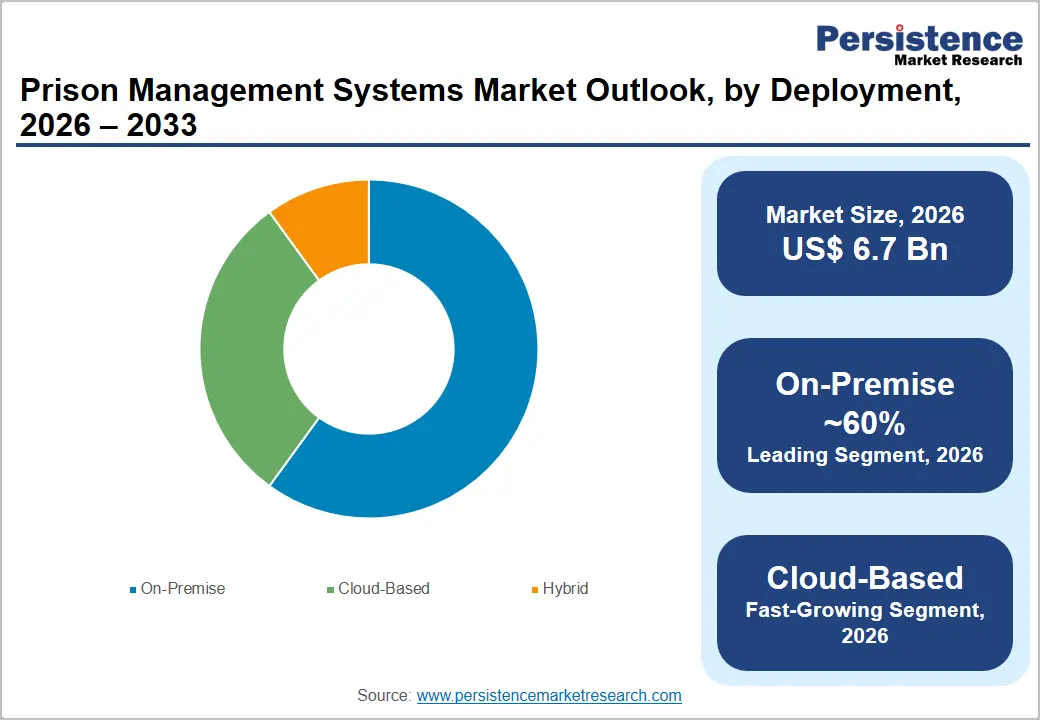
- Leading Deployment: On-Premises leads the market with over 60% share in 2026, exceeding US$ 4.0 Billion, owing to stringent security requirements, data sovereignty regulations, and the need for direct institutional control over inmate and operational data.
- Leading End User: Government Correctional Facilities account for nearly 85% of market share in 2026, reaching around US$ 5.7 Billion, supported by large-scale public prison networks, continuous modernization programs, regulatory compliance requirements, and recurring technology investments.
- Fastest Growing End User: Private Correctional Facilities are the fastest-growing segment, fueled by increasing focus on operational efficiency, contract compliance, transparency, and technology-enabled facility management.
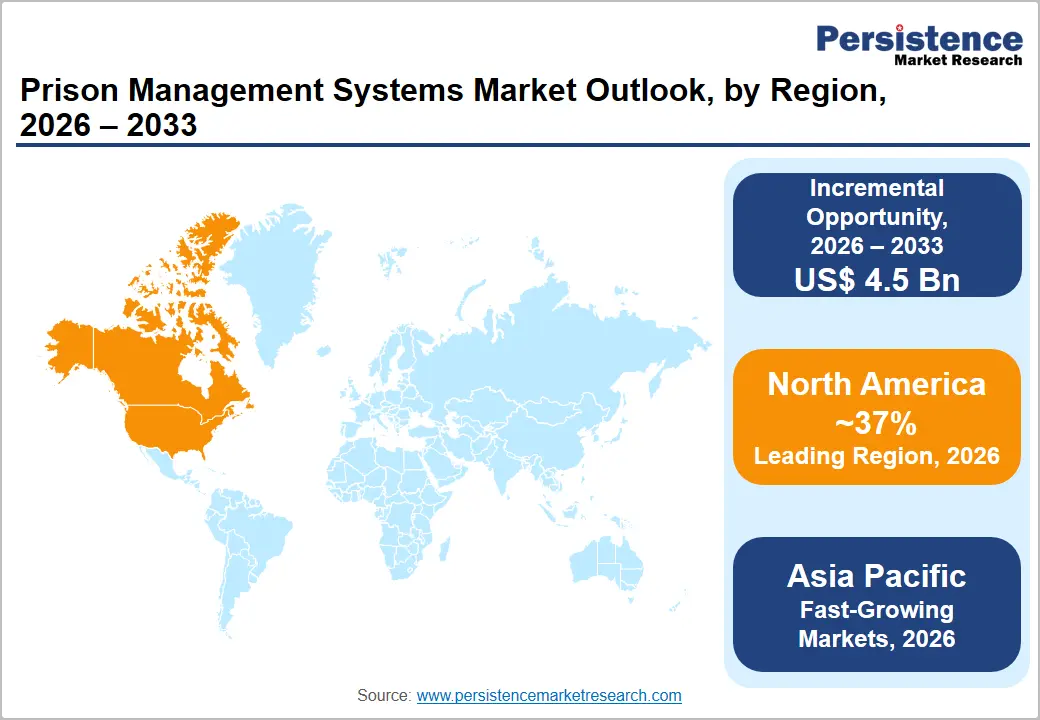
- Leading Region: North America holds over 37% of the global market in 2026, valued at approximately US$ 2.48 Billion, driven by extensive correctional infrastructure, strong government funding, mature procurement ecosystems, and modernization of legacy prison management platforms.
- Fastest Growing Region: Asia Pacific is the fastest-growing region, projected to expand at a CAGR of 11.3% through 2033, supported by prison digitization initiatives, smart governance programs, correctional facility expansion projects, and rising investments in public safety technologies across China, India, and Southeast Asia.
Market Dynamics
Market Growth Drivers
Escalating Correctional Population Density Forcing Operational Automation
Correctional systems globally are experiencing sustained population pressure, requiring automation to manage rising inmate-to-staff ratios. United Nations Office on Drugs and Crime (UNODC), global prison populations have increased by roughly 20–25% over the past two decades, placing significant strain on facility operations. This structural imbalance is accelerating adoption of integrated surveillance, biometric access control, and centralized inmate management platforms. Correctional agencies are increasingly shifting toward unified digital ecosystems that integrate inmate tracking, classification, and case management workflows. Vendors such as established correctional software providers have expanded platforms to support real-time monitoring and data-driven inmate movement analytics.
Mandatory Compliance and Accountability Legislation Creating Non-Discretionary Procurement
Regulatory frameworks are a major structural driver of prison management system adoption, as compliance requirements make procurement mandatory rather than discretionary. In the U.S., the Prison Rape Elimination Act (PREA) standards require correctional facilities to maintain auditable reporting systems for incidents, investigations, and inmate safety monitoring. Accountability-driven regulations are emerging in Europe under evolving Council of Europe prison rule updates, reinforcing standardized documentation requirements across jurisdictions. The National Institute of Standards and Technology (NIST) Cybersecurity Framework 2.0 (2024) has further strengthened federal compliance expectations, while frameworks such as FedRAMP typically require 12–18 months of authorization time and multi-million-dollar compliance investments often ~US$1–3 million, depending on system scope. These requirements collectively create high entry barriers and favor established vendors with pre-certified infrastructure.
Market Restraints
High Upfront Capital Expenditure and Lengthy Procurement Cycles Suppressing Adoption Velocity
Correctional technology procurement is constrained by multi-year government budgeting cycles and high infrastructure costs, including surveillance systems, biometric devices, and integrated software platforms. Large-scale deployments often exceed annual budget thresholds, forcing phased implementation over multiple fiscal years. Government Accountability Office (GAO) assessments indicate that correctional IT procurement cycles frequently extend around 18 to 36 months from solicitation to full deployment, significantly delaying vendor revenue realization. New entrants face additional barriers due to the need for pre-approved vendor status, compliance validation, and reference deployments. Market access is highly concentrated among established providers with long-standing public sector relationships and certified procurement listings.
Data Sovereignty and Cybersecurity Compliance Requirements Fragmenting the Vendor Landscape
Correctional institutions manage highly sensitive data, including biometric identifiers, criminal histories, and behavioral records, making them subject to strict national data protection and cybersecurity regulations. These requirements often restrict cross-border data hosting and impose limitations on cloud deployment architectures. Vendors must design jurisdiction-specific infrastructure, increasing operational complexity and compliance costs. Frameworks such as NIST CSF 2.0 and FedRAMP significantly elevate compliance expectations for cloud-based correctional systems. FedRAMP authorization alone typically requires 12–18 months of preparation and substantial investment. This creates a structural disadvantage for smaller vendors, leading to market consolidation among large providers.
Market Opportunities
AI-Driven Predictive Risk Assessment Platforms Represent a High-Value Upgrade Cycle
Artificial intelligence enabled risk assessment tools are emerging as a key upgrade opportunity within prison management systems, particularly for facilities modernizing legacy case management infrastructure. Evidence-based correctional frameworks promoted by institutions such as the U.S. National Institute of Corrections (NIC) have increased acceptance of validated actuarial and AI-assisted risk evaluation models. This shift is enabling gradual institutional adoption of predictive analytics for inmate classification and recidivism risk scoring. Vendors that integrate explainable and bias-audited AI models with existing court and correctional databases are well positioned to capture modernization budgets. The key requirement is interoperability with legacy systems and adherence to transparency standards in algorithmic decision-making.
Rehabilitation Technology Integration Opening New Revenue Streams Within Existing Facilities
Correctional systems are increasingly prioritizing rehabilitation and recidivism reduction, creating demand for digital education, vocational training, and reentry support platforms. These systems are being integrated into broader prison management ecosystems to support outcome-based correctional strategies. Government-backed initiatives such as the U.S. Bureau of Justice Assistance’s Justice Reinvestment programs are encouraging data-driven rehabilitation investments. Technology providers are expanding into secure learning platforms, digital content delivery, and reentry tracking tools that operate within secure correctional environments. The partnerships between technology vendors and correctional authorities have demonstrated the viability of secure tablet-based education and training infrastructure.
Category-wise Insights
Component Analysis
Hardware accounts for nearly 45.0% of the global prison management systems market in 2026, reaching US$ 3.0 Billion, owing to the critical requirement for maintaining secure and controlled correctional environments. Correctional facilities rely on surveillance cameras, biometric access systems, perimeter intrusion detection equipment, communication devices, and monitoring infrastructure to ensure inmate supervision and staff safety. These assets form the operational backbone of prison security and require periodic upgrades and replacements to comply with evolving security standards.
Software is the fastest growing component due to the increasing emphasis on operational efficiency, centralized inmate information management, and real-time decision-making. Correctional authorities are adopting integrated platforms that streamline inmate records, classification, movement tracking, scheduling, and reporting functions. Growing demand for analytics-driven prison administration, digital workflows, and automated compliance management is accelerating software deployment.
Deployment Analysis
On-Premises deployment accounts for over 60.0% of the global prison management systems market share in 2026, exceeding US$ 4.0 Billion, due to stringent security, data protection, and regulatory compliance requirements. Correctional agencies manage highly sensitive inmate, legal, and operational information that must remain under direct institutional control. Many facilities operate within isolated or highly restricted networks, making locally hosted systems the preferred deployment model. It also provides greater customization capabilities and supports integration with existing security hardware, reinforcing its dominant position across large correctional institutions.
Cloud-based deployment is emerging as the fastest growing segment as correctional operators seek greater flexibility, scalability, and lower infrastructure management burdens. Smaller detention centers and regional correctional facilities increasingly favor cloud solutions because they reduce capital expenditure and simplify software maintenance. The model enables faster implementation, remote access to operational data, and continuous feature updates without extensive internal IT resources. Advancements in cybersecurity frameworks and secure cloud architectures are further improving confidence in cloud adoption across the corrections sector.
End User Analysis
Government Correctional Facilities account for nearly 85.0% of market share in 2026, reaching US$ 5.7 Billion, as public institutions represent the majority of incarceration capacity worldwide. National, state, and municipal correctional agencies continuously invest in technologies that enhance security, inmate management, regulatory compliance, and operational transparency. Large-scale procurement programs covering multiple facilities generate substantial and recurring technology expenditures. Government-led prison modernization initiatives and digital transformation programs continue to strengthen demand for advanced prison management systems.
Private Correctional Facilities represent the fastest growing segment, supported by increasing investments in technology-driven operational management and contract compliance. Private operators are adopting advanced management platforms to improve inmate monitoring, reporting accuracy, resource utilization, and performance accountability. Technology deployment is becoming an important requirement for meeting service-level obligations established by government authorities. Rising emphasis on transparency, audit readiness, and efficient facility administration is encouraging greater implementation of modern prison management solutions within privately operated correctional facilities.
Regional Insights
North America Prison Management Systems Market Trends and Insights
North America holds over 37.0% of the global prison management systems market in 2026, reaching US$ 2.48 Billion, supported by the region's extensive correctional infrastructure, advanced government IT procurement ecosystem, and ongoing investments in correctional modernization. The region benefits from sustained federal and state funding programs, including provisions under the Second Chance Act and related correctional reform initiatives that encourage the deployment of digital inmate management, rehabilitation tracking, and case management platforms. Growing emphasis on operational efficiency, data transparency, and inter-agency information sharing continues to accelerate technology adoption across correctional facilities.
The U.S. prison management systems market accounts for over 80.0% of the North American market in 2026, exceeding US$ 1.98 Billion, driven by the country's extensive federal and state correctional network comprising more than 1,800 correctional facilities. A key growth catalyst is the replacement of aging offender management and facility administration platforms, many of which were originally implemented more than two decades ago and no longer meet current operational requirements. Correctional agencies are increasingly investing in integrated platforms that support inmate records management, workforce scheduling, security monitoring, healthcare administration, and rehabilitation program tracking. These investments are aimed at improving operational efficiency, regulatory compliance, and overall facility security.
Europe Prison Management Systems Market Trends and Insights
Europe holds nearly 25.0% of the global prison management systems market in 2026, reaching US$ 1.68 Billion, driven by increasingly stringent requirements for inmate recordkeeping, prisoner rights documentation, operational transparency, and secure information management across correctional institutions. Justice ministries throughout Europe are investing in modern prison management platforms to support electronic inmate records, health management, disciplinary tracking, facility operations, and interoperability with broader justice-sector databases.
Germany represents nearly 20.0% of the Europe prison management systems market in 2026, surpassing US$ 0.34 Billion, driven by Germany's decentralized correctional administration structure, where individual state justice ministries continue to modernize prison information systems and strengthen integration with digital court and case-management platforms. The U.K. holds over 17.0% of the regional market, reaching US$ 0.28 Billion, supported by ongoing digital transformation initiatives across His Majesty's Prison and Probation Service (HMPPS). Investments in data interoperability, inmate tracking, rehabilitation management, and integration between prison, probation, and court systems are expected to sustain demand.
France prison management systems market is expected to reach nearly US$ 0.25 Billion, supported by correctional infrastructure modernization efforts, expansion of detention capacity, and increasing deployment of digital tools to improve inmate management and address overcrowding challenges. The Rest of Europe collectively holds over 22.0% of the regional market, surpassing US$ 0.37 Billion, led by modernization initiatives across the Netherlands, Belgium, Poland, and the Nordic countries. Growing adoption of e-government frameworks, electronic monitoring solutions, multilingual inmate management platforms, and integrated justice information systems continues to create substantial opportunities for prison management system providers across these markets.
Asia Pacific Prison Management Systems Market Trends and Insights
Asia Pacific holds over 23.0% of the global prison management systems market in 2026, reaching US$ 1.54 Billion, and projected to grow at a CAGR of 11.3% through 2033. The growth is being driven by increasing government investments in digital public safety infrastructure, smart governance initiatives, and correctional facility modernisation. Ongoing prison capacity expansion projects across India and Indonesia are further strengthening technology adoption by embedding digital management capabilities into newly constructed facilities from the planning stage.
China holds over 41.0% of the Asia Pacific prison management systems market in 2026, surpassing US$ 0.63 Billion, supported by the country's extensive correctional infrastructure and continued investments in public security technologies. Government-led digital transformation initiatives are encouraging the deployment of AI-enabled surveillance, perimeter security monitoring, and integrated inmate management platforms across correctional facilities. Japan reaching US$ 0.26 Billion, where correctional authorities are increasingly adopting biometric monitoring, automated surveillance, and workforce-efficiency solutions to address persistent staffing shortages and an ageing correctional workforce. South Korea exceeding US$ 0.09 Billion, supported by smart correctional facility programmes incorporating IoT-based monitoring, automated access control, and digital inmate welfare management systems.
India prison management systems market is expected to reach US$ 0.18 Billion by 2026, supported by nationwide prison digitisation initiatives and rising demand for efficient inmate administration amid persistent prison overcrowding. The government's e-Prison programme continues to accelerate software deployment across state prison departments, creating a sizeable addressable market for integrated prison management platforms. Southeast Asia surpassing US$ 0.22 Billion, led by Indonesia, the Philippines, Thailand, and Vietnam, where overcrowding concerns and criminal justice reforms are driving correctional technology investments.
Competitive Landscape
Market Structure Analysis
The global prison management systems market is moderately concentrated at the enterprise level, with a few large vendors holding substantial installed bases across government correctional agencies. Competition is driven more by regulatory compliance capabilities, interoperability with court and law enforcement systems, cybersecurity standards, and long-term operational efficiency than by pricing alone. Market leaders are increasingly pursuing platform consolidation strategies, integrating adjacent security, records, and inmate services capabilities to offer unified correctional management ecosystems. Smaller specialised providers are gaining traction in mid-sized and local detention facilities by offering more flexible deployment models and lower implementation complexity.
Key Market Developments
- In April 2026, The Supreme Court of India directed the nationwide implementation of the E-Prisons Early Release Processing Module, a digital platform designed to streamline remission and premature-release procedures for inmates. The initiative aims to improve transparency, reduce administrative delays, and strengthen the digital transformation of prison management across the country.
- In November 2025, ASTPP launched a Secure & Monitored Prison Communication System designed for correctional facilities, enabling controlled voice and video communication between inmates and approved contacts. The platform offers real-time call monitoring, recording, whitelist/blacklist controls, and integration with existing prison management systems to enhance security, regulatory compliance, and operational transparency while reducing communication costs.
Companies Covered in Global Prison Management Systems Market
- Tyler Technologies
- Montgomery Technology
- NEC Corporation
- Thales Group
- Axis Communications
- Bosch Security and Safety Systems
- Cisco Systems
- Huawei Technologies
- IBM Corporation
- Fujitsu
- CentralSquare Technologies
- Civica
- SYSCON Justice Systems
- Omnigo Software
- Others
Frequently Asked Questions
The global prison management systems market is valued at US$ 6.7 Billion in 2026 and is projected to reach US$ 11.2 Billion by 2033, expanding at a CAGR of 7.6%, supported by correctional facility digitalization initiatives and increasing adoption of compliant inmate management platforms worldwide.
The market expansion is fueled by regulatory requirements for secure inmate tracking and incident reporting, along with rising prison populations that increase operational complexity. Correctional agencies are investing in automation to improve efficiency, transparency, and security across facilities.
Hardware segment leads with nearly 45.0% market share, driven by continuous deployment of surveillance systems, biometric access controls, and security infrastructure across correctional facilities. Regular upgrades and replacement cycles support sustained demand for hardware solutions.
North America holds the largest share more than 37.0%, supported by its extensive correctional network, established technology procurement frameworks, and strong investment in prison modernization. Ongoing upgrades of legacy systems continue to reinforce the region’s leadership.
Key opportunities are emerging in AI-powered risk assessment, rehabilitation management, and predictive analytics platforms. Vendors that integrate advanced decision-support tools with accountability and compliance features are well positioned to capture future growth.
The leading companies include Tyler Technologies, Montgomery Technology, NEC Corporation, Thales Group, Axis Communications, Bosch Security and Safety Systems, Cisco Systems, Huawei Technologies among others.


